
Air Purifier Commercial Use: 2026 Buying Guide
A facilities manager usually hears about an air-quality problem before seeing it in a dashboard. Staff complain about stale air, a restaurant notices persistent odors, or a clinic discovers that a portable unit has been running in a corner with little effect. The purchase may have been made by floor area, yet the room still lacks the clean-air delivery required for its occupancy and contaminant load.
That's the central problem with air purifier commercial use. A unit can have an impressive coverage claim and still underperform when operated at a quiet speed, placed in a dead zone, or fitted with a filter that the HVAC fan can't handle. Commercial purification works when buyers connect technology, airflow, placement, maintenance, and verification.
Table of Contents
- Why Air Purifier Commercial Use Is Different From Home Units
- Sizing Commercial Air Purifiers by Clean Air Delivery Rate
- Comparing Purification Technologies for Commercial Environments
- Filtration Upgrades for Commercial HVAC Systems
- Placement Strategy and Maintenance Routines
- Commercial Use Cases and Technology Recommendations
- Verifying Performance After Installation
- Building a Long-Term Commercial Air Purification Plan
Why Air Purifier Commercial Use Is Different From Home Units
A portable unit can look adequate on paper and still miss the problem in practice. In a quiet office, a restaurant with bursts of cooking smoke, or a clinic with steady foot traffic, contaminants are generated all day. Commercial spaces do not stay still, and neither does the air. Settings get changed, doors open, filters load, furniture disrupts circulation, and a unit that seemed large enough at purchase can end up doing very little where people sit and work.
That changes how commercial buyers should evaluate equipment. The useful questions are operational ones: does the unit keep pulling enough air after weeks of dust loading, can staff tolerate the sound at the speed that matters, how hard is filter replacement, and will the purifier work with the ventilation already in the building? Those trade-offs matter more than a tidy coverage claim on the carton.
Verified particle capture, sustained airflow, filter maintenance, and compatibility with ventilation systems are the actual buying criteria. HEPA filtration is not a lifestyle feature. It is established technology with a long commercial record. HEPA systems were developed in the early 1940s for the Manhattan Project and later moved into applications such as hospitals, pharmaceutical manufacturing, electronics, aerospace, and nuclear-related operations, as outlined in Britannica's history of high-efficiency particulate air systems.
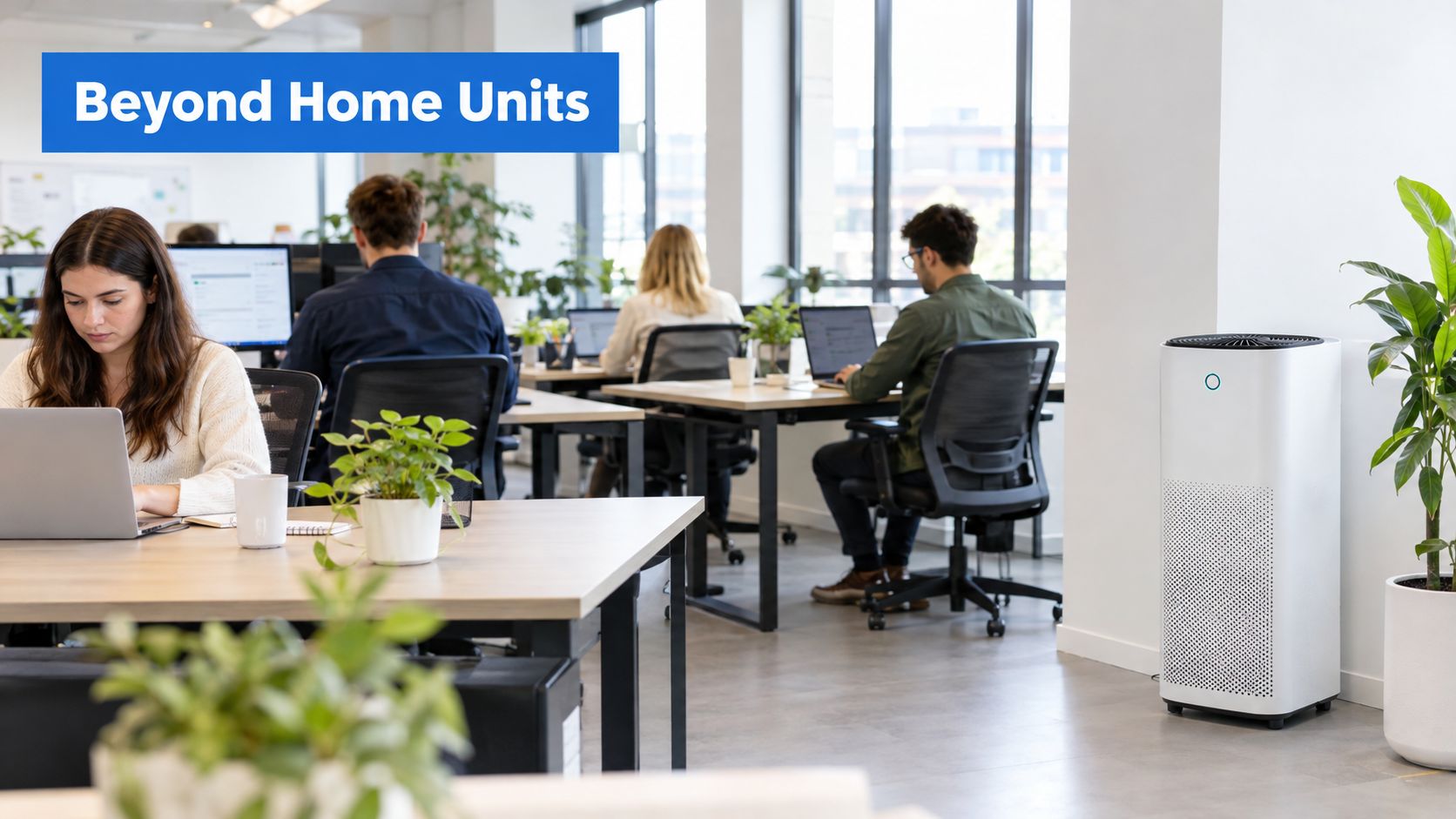
Indoor conditions also vary sharply by building type. The EPA guide to indoor air quality notes that mean office PM10 concentrations were 73% lower than school levels, and office PM2.5 concentrations were 43% lower than school levels. That does not mean offices are automatically clean or that schools all need the same response. It means occupancy patterns, outdoor-air intake, building condition, and ventilation performance shape the problem before a purifier is even switched on.
The mistake I see most often is simple. A buyer chooses one unit for a large open area based on stated floor coverage, then runs it on low because the top speed is too loud. The air near the discharge improves first. The occupied zone across the room may barely change.
The question that matters is How much clean air reaches the occupied zone at the speed staff will tolerate?
Practical rule: Treat the manufacturer's floor-area figure as a starting clue, not proof of delivered clean air.
Sizing Commercial Air Purifiers by Clean Air Delivery Rate
Commercial portable units should be sized by clean air delivery rate, or CADR, rather than floor area alone. CADR combines airflow and particle-removal efficiency:
CADR ≈ Q × η
Here, Q represents airflow and η represents removal efficiency. To translate CADR into room performance, use:
ACH = CADR × 60 ÷ room volume
The result is clean-air changes per hour, or ACH. Room volume must be calculated from length, width, and ceiling height, and CADR should be expressed in cubic feet per minute when using this formula.
A practical calculation
Take a 10,000 ft³ office and a cleaner rated at 1,000 CFM. If that rating represents the selected operating speed, the cleaner provides approximately 6 ACH, calculated as 1,000 × 60 ÷ 10,000. The example is useful because it exposes the difference between a product's headline capacity and its real operating setting.
ASHRAE recommends using AHAM CADR ratings for sizing air-cleaning units and favors HEPA or other high-efficiency particle filters for particle control. If a unit reaches its advertised CADR only at a loud maximum setting, size the room using the CADR available at the intended continuous setting instead.
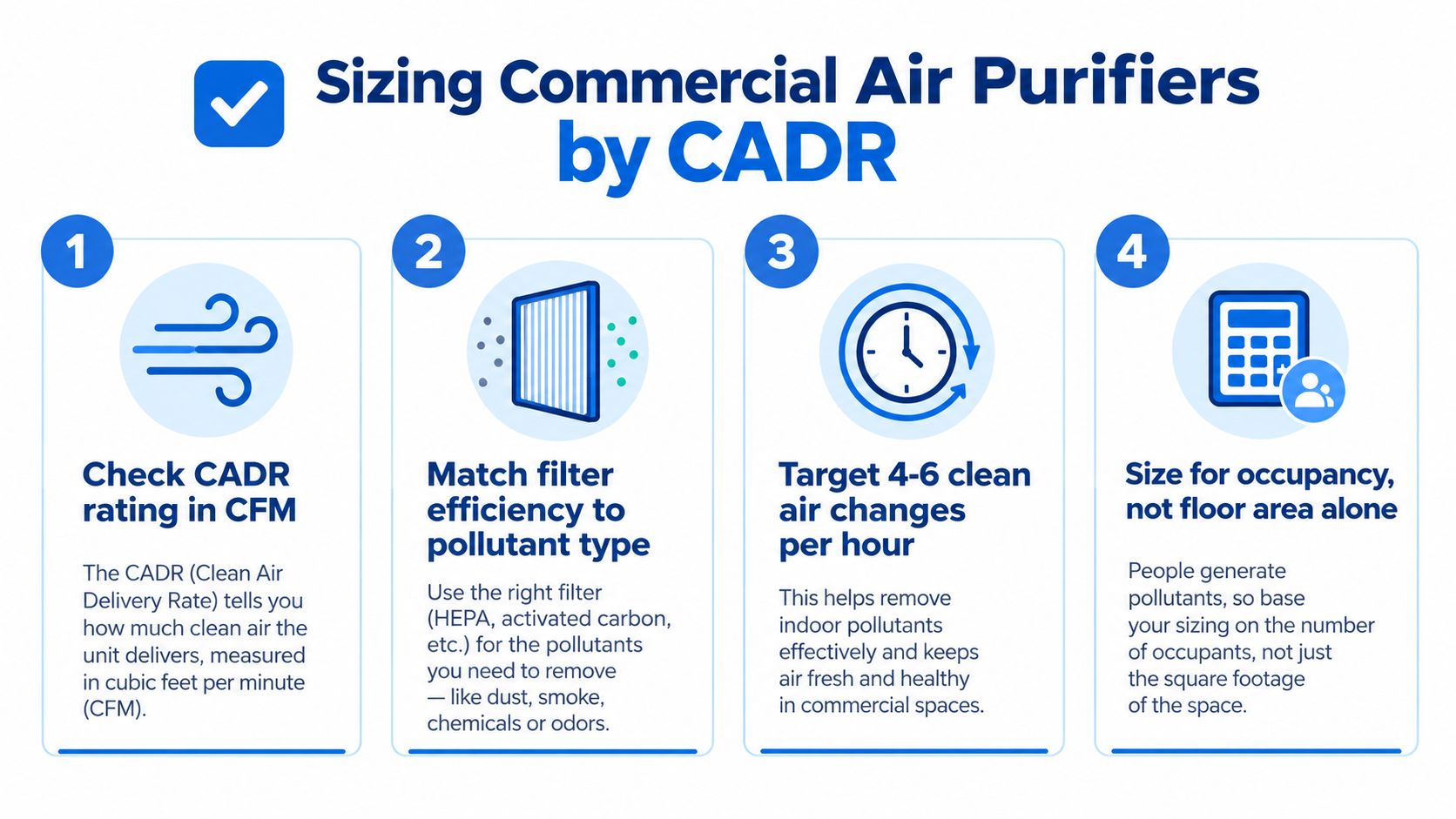
Apply the calculation before buying
- Measure volume: Record length, width, and ceiling height for each occupied zone, not just the total floor area.
- Set an operating speed: Use the CADR at the speed people can accept continuously, rather than the maximum setting used for a short test.
- Distribute airflow: Use multiple units when walls, furniture, partitions, or distance create uneven mixing.
- Check the pollutant: CADR is most useful for particles. Odors, VOCs, and microbial-control claims require separate technology and safety checks.
- Keep ventilation in place: Portable cleaners supplement outdoor-air ventilation, source control, and balanced HVAC. They don't replace them.
A small, enclosed vehicle is a different sizing problem from a commercial room. For that application, the EcoTravel Voyager Portable Car Air Purifier is described as purifying air inside a car from exhaust gases, unpleasant odors, and other contaminants entering from the roadway, while also providing protection against viruses and bacteria from the air-conditioning system. It shouldn't be used as a substitute for calculating CADR in an office, classroom, or treatment room.
Comparing Purification Technologies for Commercial Environments
No purification technology handles every indoor-air problem. A facility may need particle removal in one area, odor control in another, and carefully verified infection-control support in a third. The wrong technology can create a maintenance burden or introduce a secondary pollutant while appearing to solve the visible symptom.
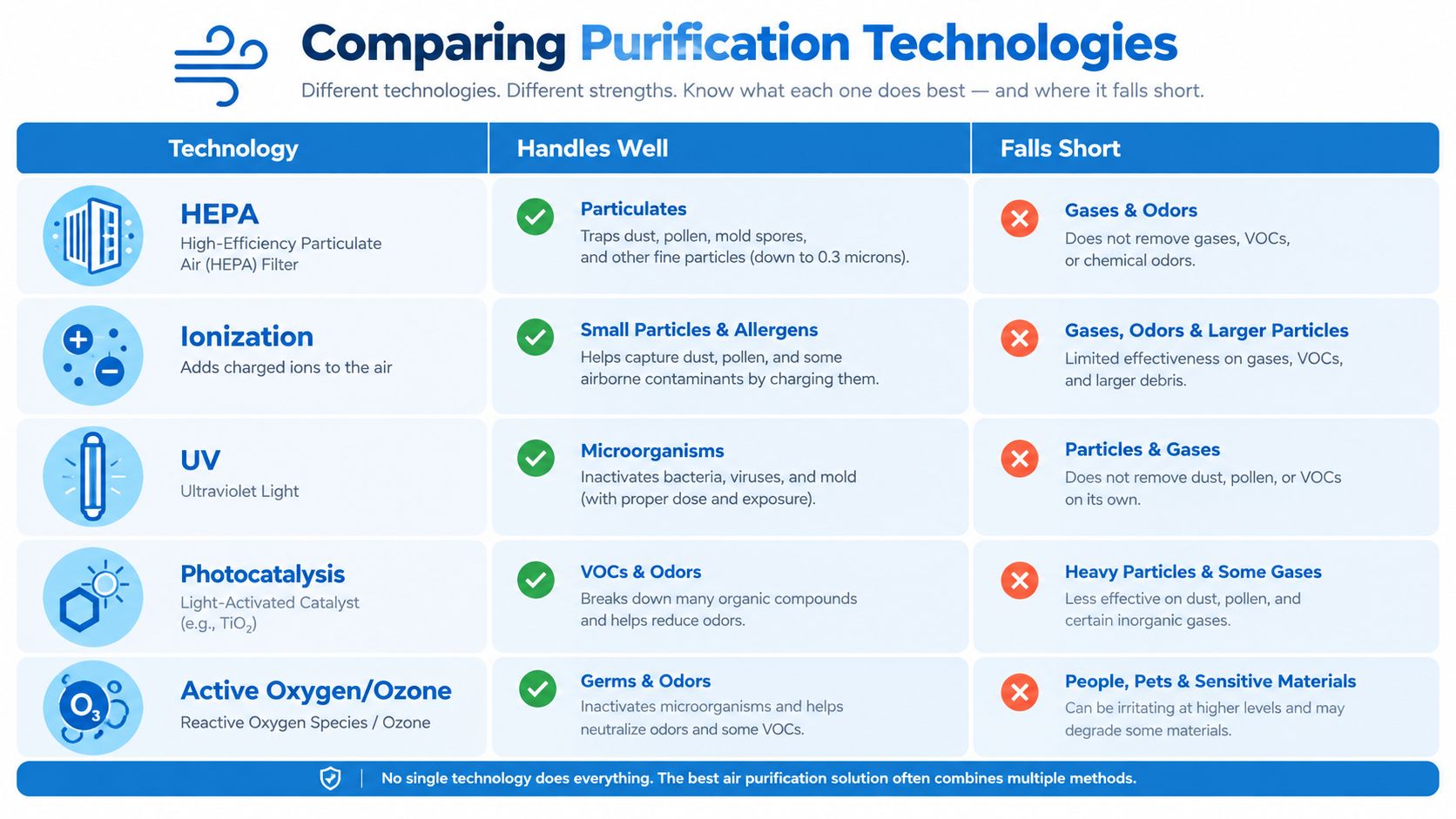
Match the method to the outcome
| Technology | Handles well | Falls short |
|---|---|---|
| HEPA | Airborne particles, including fine particulate matter | Requires filter replacement and doesn't address gases by itself |
| Ionization | Particle charging and collection in suitable systems | May generate ozone or reactive oxygen species, so verification matters |
| UV | Air treatment where sufficient exposure and design are provided | Effectiveness depends on dose, airflow, lamp condition, and maintenance |
| Photocatalysis | Certain odors and chemical contaminants in designed systems | Performance depends on catalyst condition, airflow, and by-product control |
| Active oxygen or ozone | Odor and oxidation applications under controlled conditions | Can create secondary pollutants and may be unsuitable for occupied spaces |
HEPA is usually the straightforward choice when the primary requirement is particle control. It has a defined filter-performance framework, but the filter still loads, airflow can decline, and the fan must keep moving air through the media. Carbon or other gas-phase media may be added when odors or VOCs matter, but that creates another replacement and monitoring obligation.
Ionization and oxidation technologies require more caution than a simple removal claim suggests. A 2025 peer-reviewed assessment found that two commercial ionizers reduced an airborne SARS-CoV-2 surrogate by about 82%, while also noting ozone risks. Separate 2025 research found that ozone can react with pollutants accumulated on mechanical-ventilation filters and generate odorous VOCs. The findings are summarized in the peer-reviewed assessment of ionizers, ozone, and secondary emissions.
What works in occupied buildings
UV can be useful as an additional layer when the equipment provides adequate exposure and technicians can inspect lamps and surfaces. Photocatalysis may help with selected chemical or odor concerns, but buyers should ask for application-specific test conditions and by-product data. Ozone-generating equipment should never be selected just because it makes a room smell different. Odor reduction isn't proof that the air is safer.
For offices, restaurants, gyms, and healthcare spaces, require ozone verification, ventilation review, maintenance access, and outcome-based testing before approving an ionizing or oxidation system. A technology that looks effective in a controlled demonstration may behave differently once filters accumulate pollutants, occupancy changes, or staff reduce fan speed because of noise.
Filtration Upgrades for Commercial HVAC Systems
A standalone purifier and an HVAC filtration upgrade solve different airflow problems. A portable unit recirculates air locally. An HVAC filter treats air moving through the air handler, but only if the fan can maintain the required flow after the filter creates additional resistance.
CDC guidance recommends MERV-13 filters, or the highest efficiency the system can accommodate without adversely affecting performance. The same guidance identifies a target of at least 5 clean-air changes per hour where feasible, combining outdoor ventilation, HVAC filtration, and portable HEPA cleaners rather than relying on one layer. See the CDC ventilation guidance for filtration and clean-air strategies.
Check the fan before changing the filter
A denser filter can capture more particles, but it also produces pressure drop. If the fan lacks reserve capacity, airflow may fall, ventilation may weaken, energy use may rise, or the equipment may operate outside its approved conditions.
Before retrofitting, ask the HVAC contractor to verify:
- Rack dimensions: Confirm that the replacement filter fits without bypass gaps.
- Fan reserve: Establish whether the fan can overcome the added resistance.
- Approved pressure drop: Check the manufacturer's operating range.
- Actual airflow: Measure performance after installation instead of assuming the design value remains unchanged.
- Service access: Make sure staff can inspect and replace filters safely.
Moisture and building-envelope problems also need source control. A facilities team reviewing how to stop mold in your home can apply the same basic principle commercially, although larger buildings require professional investigation, moisture management, and HVAC assessment.
An integrated product category such as HVAC air purification equipment should be evaluated as part of the air handler's design, not as an isolated accessory. In medical offices and other higher-risk areas, portable or built-in HEPA systems can add a local cleaning layer, particularly where HVAC changes alone don't provide adequate distribution.
Placement Strategy and Maintenance Routines
Placement determines whether a purifier treats the occupied zone or only circulates air around itself. Put portable units where they can draw from the room and discharge into the mixed breathing zone, while keeping inlets and outlets clear. Avoid corners behind furniture, enclosed cabinets, and locations where the outlet immediately feeds back into the inlet.
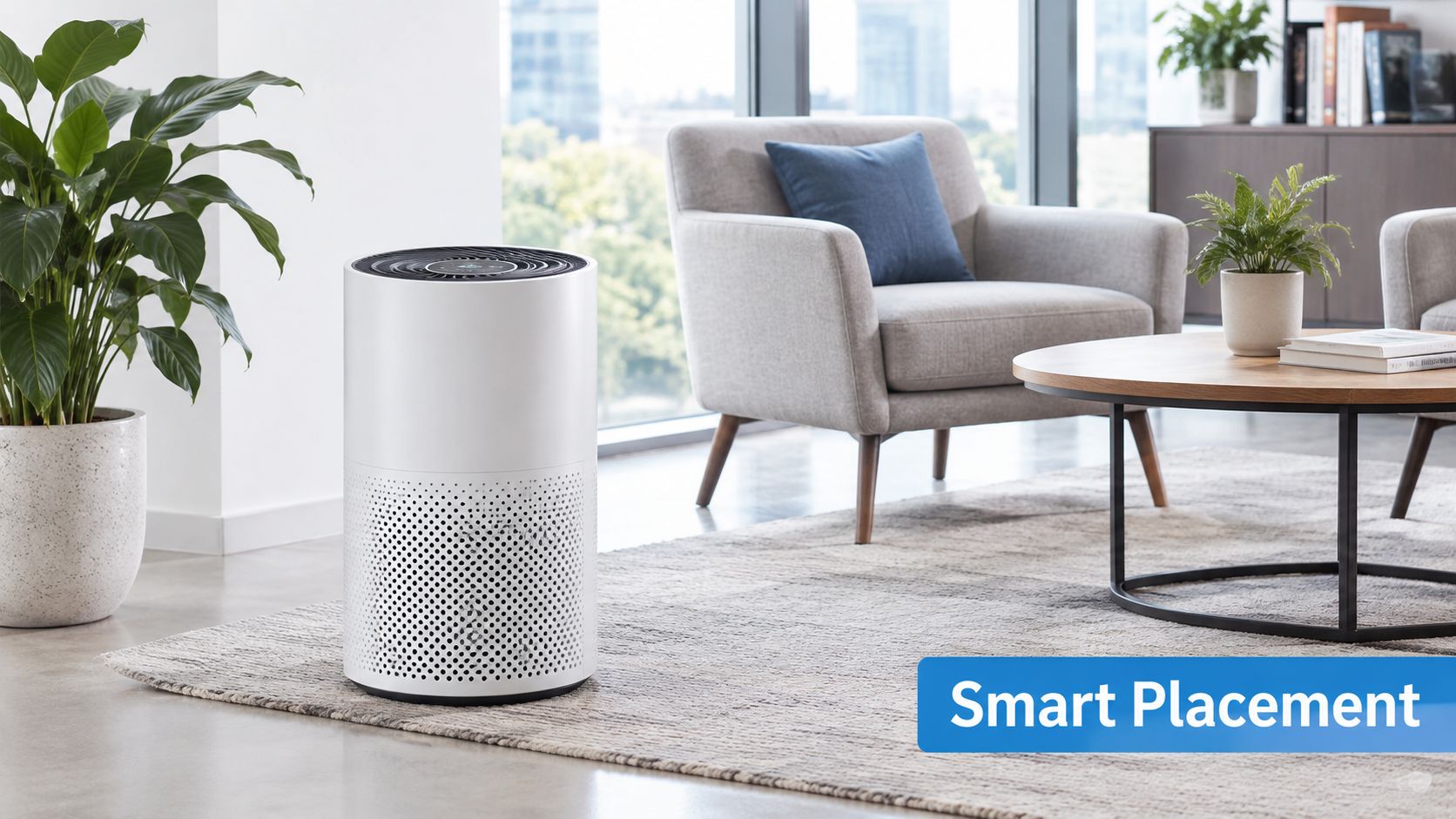
In an open office, one powerful unit may leave remote desks underserved. Multiple smaller units can create better distribution, even when their combined headline capacity looks similar. Keep noise in mind, but don't solve noise complaints by permanently selecting a setting that fails the room's clean-air requirement.
Build a routine staff can actually follow
A maintenance log should record the unit identifier, location, operating hours, filter condition, replacement date, and any alarm or sensor issue. Pre-filters need inspection and cleaning according to the equipment instructions. HEPA and carbon filters require replacement based on loading and manufacturer guidance, while UV systems need lamp and surface checks.
For systems using sensors, verify that readings remain plausible and that the sensor inlet is clean. Regulated spaces should retain service records, filter receipts, technician notes, and post-maintenance checks so an auditor can trace what happened.
ENERGY STAR estimates that a continuously operating standard room air cleaner uses approximately 394 kWh annually, but commercial systems may involve multiple units, higher fan settings, HVAC integration, and additional maintenance loads, as explained by ENERGY STAR's air-cleaner guidance.
A short visual demonstration can help staff understand why placement and unobstructed airflow matter, but training still needs to be supported by written procedures and logs.
Commercial Use Cases and Technology Recommendations
Source profile decides the technology stack. A quiet office with intermittent dust, a salon with chemicals and aerosols, and a veterinary exam room with tighter infection-control expectations should not be buying the same machine just because the floor area looks similar. In practice, room size is only the first screen. The harder question is whether the unit can deliver enough clean air at the fan speed people will tolerate, and whether the maintenance routine will still be followed six months later.
HEPA remains a strong primary option where airborne particles are the main problem. The familiar 99.97% of particles measuring 0.3 micrometers figure describes filter efficiency at a defined test size under standard conditions. It does not tell you how much clean air the room will receive once cabinet resistance, fan speed, placement, and filter loading start affecting performance. That gap is why commercial selection cannot stop at the filter label.
| Environment | Primary concern | Recommended technology | Notes |
|---|---|---|---|
| Offices | Fine particles, resuspended dust, stale air | HEPA or high-efficiency particle filtration, with ventilation review | Use CADR at an acceptable continuous speed and account for open-plan zones |
| Schools and daycares | High occupancy and particulate exposure | Portable HEPA plus HVAC filtration where feasible | Protect distribution and keep maintenance simple for staff |
| Healthcare and veterinary clinics | Fine particles and higher infection-control sensitivity | HEPA, supported by suitable HVAC filtration and carefully specified supplemental systems | Avoid unverified ozone-producing equipment in occupied treatment areas |
| Restaurants and salons | Odors, particles, aerosols, and chemical emissions | Particle filtration plus appropriate gas-phase media or source control | Capture the source at the hood, workstation, or process before relying on room cleaning |
| Gyms | Resuspended dust, odors, and high occupant activity | High-CADR particle filtration with low-noise continuous operation | Place units to avoid short-circuiting airflow around equipment |
| Smoking lounges and basements | Smoke, odors, moisture-related concerns | Source control, ventilation, particle filtration, and carefully selected gas-phase treatment | Oxidation technologies require secondary-emission review |
Offices are a good example. A polished fit-out does not fix weak air distribution, and premium space often has more layout complexity than a simple rectangular room. The Tandem Space class A report is useful here because it highlights how occupancy zones, circulation, and room use affect planning. The same discipline applies in back-of-house rooms, reception areas, treatment spaces, and classrooms.
For buyers comparing packaged options, EcoQuest Purifiers lists commercial air purification products across several technology categories used in professional settings. Treat any catalog as a starting point, not proof of fit. Confirm delivered airflow at the intended operating speed, expected filter or cell service intervals, sound levels people can live with, and whether the technology is suitable for occupied use in that specific environment.
Verifying Performance After Installation
Purchase price tells you almost nothing about whether the installation is working six months later. Commission the equipment as you would any other building system, with a baseline, an installation record, and follow-up measurements.
Use a commissioning record
Record the following before and after installation:
- Room volume and occupancy: Document dimensions, schedules, density, and activities that generate particles or odors.
- Baseline conditions: Measure PM2.5 and other relevant indicators before operation under representative conditions.
- Installed capacity: Record the unit model, filter type, rated CADR, selected operating speed, and placement.
- Post-installation readings: Repeat PM2.5 measurements after the room reaches normal occupancy and operating conditions.
- Operating cost: Track electricity use where practical, along with fan settings and runtime.
- Maintenance history: Log filter changes, pre-filter cleaning, alarms, sensor checks, and technician visits.
A commercial air-quality monitor such as an indoor air quality monitor can support trend tracking, but sensor data has limits. A lower particle reading doesn't prove pathogen elimination, and a single reading can't establish consistent performance across every occupied zone.
Review results after seasonal changes, altered occupancy, construction, or HVAC work. Report trends rather than isolated numbers, and compare them with the operating conditions that produced them. If staff keep lowering the fan speed because of noise, the record should show that, because the installed system is then delivering less clean air than its maximum specification.
Building a Long-Term Commercial Air Purification Plan
The best commercial program looks less like a one-time equipment purchase and more like a managed building process. Start with room volume and occupancy, select technology for the actual pollutant, confirm airflow at the intended setting, place units for distribution, and document maintenance. Then verify whether the measured result justifies continued operation.
Total cost includes electricity, filter or cell replacement, labor, sensor checks, repairs, and downtime. A cheaper unit can become expensive if staff avoid using it, filters are difficult to source, or no one can prove when service is due. A more capable system can also fail if its noise, pressure drop, or maintenance demands exceed what the facility can support.
Audit existing equipment using three questions:
- Does the unit deliver enough clean air at its normal setting?
- Are filters, cells, lamps, and sensors being maintained on schedule?
- Can the facility show a measurable result in the occupied space?
If any answer is unclear, measure before replacing equipment. The goal of air purifier commercial use is not to fill a room with devices. It's to maintain verified clean-air delivery as occupancy, seasons, building systems, and maintenance conditions change.
EcoQuest Purifiers offers commercial, HVAC-integrated, portable, HEPA, UV, ionization, photocatalytic, ozone, and replacement-part options for different indoor-air applications. Review the EcoQuest Purifiers catalog, then contact the team with your room volumes, operating conditions, and maintenance requirements so you can compare solutions against measurable clean-air delivery rather than purchase price alone.