
Air Purifier for HVAC: Types, Fit, and Trade-offs
Buying the highest-rated filter isn't automatically the best way to clean your home's air. A filter or in-duct device can only help when your HVAC system delivers air to it, and the equipment must remain compatible with that added filtration. Before choosing an air purifier for HVAC, look at the air's route through your home, not just the product label.
Table of Contents
- Why Your Furnace Filter Is Only Part of the Answer
- How RCI, UV, and Bipolar Ionization Work in Ducts
- Separating Odor Claims From Ozone Risks
- Checking Compatibility With Your Existing HVAC System
- Installation Requirements and Pros and Cons
- Maintenance Schedules and Replacement Parts
- Choosing Between In-Duct Options and Next Steps
Why Your Furnace Filter Is Only Part of the Answer
Your furnace filter has a different job today than homeowners might assume. Conventional furnace filters were designed primarily to protect mechanical equipment. Modern air-cleaning guidance places more emphasis on reducing people's exposure to fine particles, according to the EPA's residential filtration technical bulletin, which also notes that central systems may recirculate air for only about 20% of annual hours in some homes.
That runtime finding isn't a prediction for your house. It's a reminder that a filter's efficiency and its opportunity to clean air are different things. Air sitting in a bedroom while the central fan is off isn't passing through the filter.
Follow the Air Before Choosing Equipment
Think of your ductwork as a river channel and the filter as a screened dam. The screen can catch material carried toward it, but it can't collect anything from a disconnected pond. In the same way, a purifier's location inside the HVAC system doesn't guarantee that every occupied room receives useful air cleaning.
Consider a hypothetical home where heating and cooling run infrequently during mild weather. The homeowner upgrades the filter but leaves the fan schedule unchanged. The filter may capture particles effectively when air passes through, yet the upgrade hasn't addressed the long periods without circulation.
Practical rule: Evaluate the filter, the airflow path, and the fan schedule as a connected system.
Start with these questions:
- What are you trying to reduce? Fine airborne particles, a persistent smell, and a continuing pollution source require different decisions.
- Where does the problem matter most? Identify occupied bedrooms, a home office, or another priority space rather than assuming every room needs the same approach.
- When does air reach the equipment? Check the thermostat's fan settings and discuss actual circulation with an HVAC professional.
You can compare replacement filters and screens after confirming the required dimensions and equipment limits. The useful starting point isn't a shopping category, however. It's a plan that combines appropriate filtration, adequate circulation, and control of the pollutant source.
How RCI, UV, and Bipolar Ionization Work in Ducts
A powerful-sounding technology can still do little in a home if air rarely reaches it. The fan schedule, duct layout, and device placement all affect how much air receives treatment. Start by learning what each option acts on, then ask whether the proposed setup can treat the air moving through your system.
The diagram shows three common in-duct approaches.
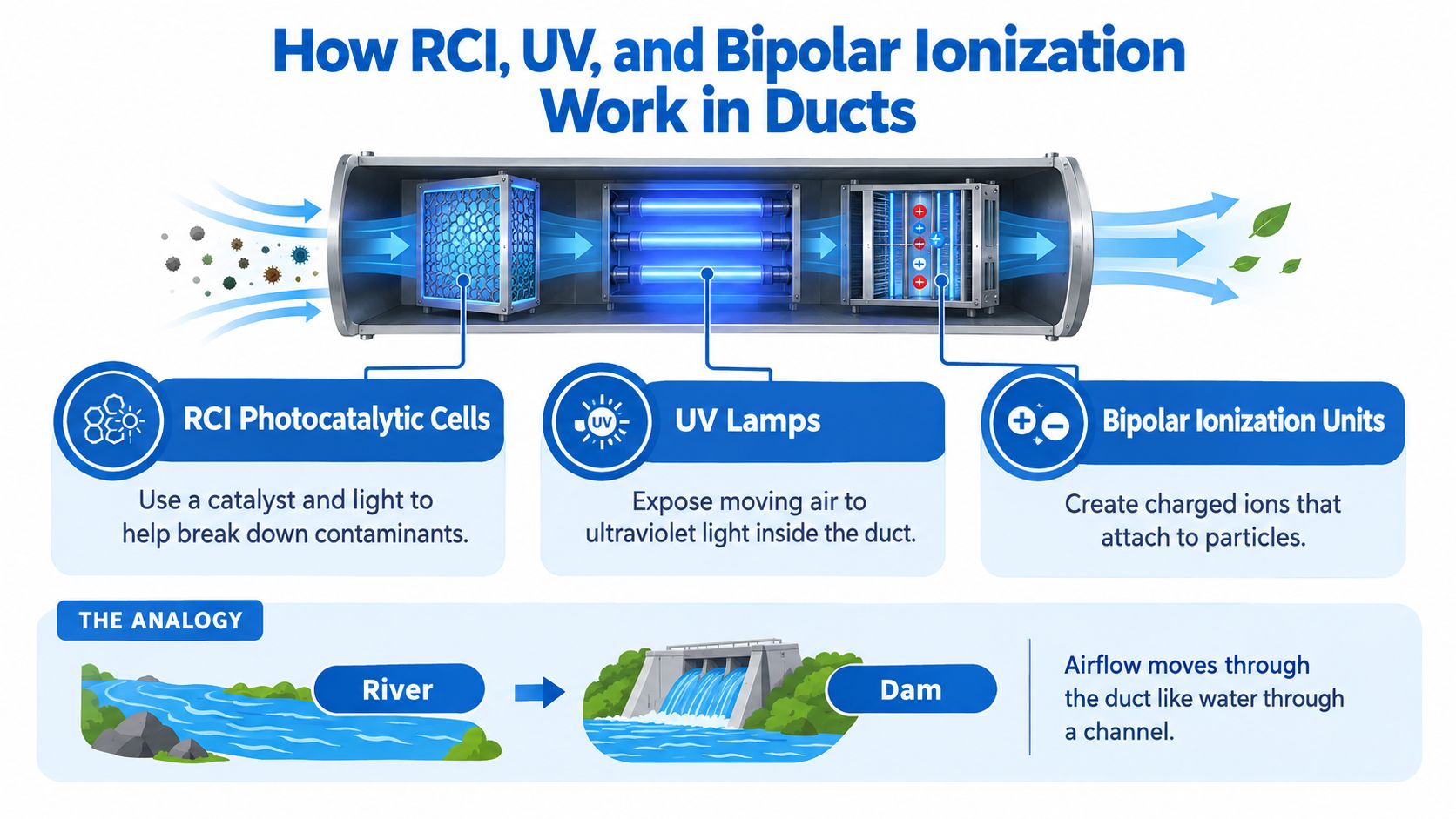
Different Ways to Interact With the Stream
A filter traps particles that physically hit its media. Other devices use light, a catalyst, or charged ions, so their intended targets and performance questions differ. The mechanism helps explain what to investigate, but it does not establish how well a particular model works.
RCI photocatalytic cells combine light and a catalyst to support a reaction intended to treat contaminants. Ask which contaminants have been tested and whether testing considers reaction by-products. An odor-treatment claim, for example, doesn't show that the device removes airborne particles.
UV lamps expose a lamp-lit surface or area to ultraviolet light, with microbial activity as the intended target. Ask whether the design treats a surface inside the equipment or air moving through the duct. Air treatment depends on the installation and airflow conditions, so request evidence relevant to the proposed setup.
Bipolar ionization units produce charged ions that interact with airborne particles. The charged particles still need somewhere to go, such as a surface where they can settle. Ask how the manufacturer measures particle removal from occupied air and what happens to particles after they become charged.
Placement and Documentation Matter
A unit mounted in a supply duct and one installed inside an air handler may encounter different airflow conditions. Ask the installer to identify where treatment occurs, what airflow the device requires, and how it will work alongside the existing filter. If the fan runs only during heating or cooling, the device may treat less air than you expect.
A useful proposal should clarify four points:
- The mechanism: What the lamp, cell, or ionizer is designed to do.
- The measured result: Which pollutant was tested and under what conditions.
- The installation conditions: Whether testing resembles the setup planned for your home.
- The service requirements: Which components need cleaning, inspection, or replacement.
The accompanying video can help you visualize the equipment. Treat it as a demonstration, not model-specific performance documentation.
Include replacement cells and lamps in your system plan. Before approving installation, request service instructions and confirm who will handle the work. A device that is hard to reach or poorly documented may be inconvenient to maintain, even if its technology suits your needs.
Separating Odor Claims From Ozone Risks
A fresher smell isn't proof that airborne particles have been removed. Likewise, a particle-removal claim doesn't establish that a device treats gases. Keep particles, gases, odors, and treatment by-products separate when reviewing an air-cleaner proposal.
The EPA's guidance on ionizers and ozone-generating air cleaners states that ion generators may remove some small particles but don't remove gases or odors effectively. It also warns that certain electronic cleaners can generate potentially harmful ozone, advises against ozone-generating cleaners in occupied spaces, and recommends UL 2998 certification for bipolar-ionization products to validate zero ozone emissions.
Ask What Leaves the Device
The important question isn't whether a treatment reacts with a pollutant. Ask what remains in the air after treatment and whether independent emissions documentation covers the exact model you're considering.
Use this distinction when reading product descriptions:
- Particle removal: Look for evidence that airborne particles are captured or otherwise removed, not merely charged.
- Gas or odor treatment: Request results for the specific substance of concern rather than accepting a broad freshness claim.
- Emissions: Ask what the equipment releases during normal operation and whether those emissions have been independently assessed.
A listing in an air purifier and ozone-generator catalog isn't, by itself, evidence that every device or operating mode is suitable for an occupied home. Evaluate the individual technology and its documentation.
Don't use your sense of smell as an emissions test or as proof that a room is safe to occupy.
Resolve the Source Before Masking the Symptom
For a persistent odor, my recommendation is to identify the source before buying treatment equipment. Ask whether cleaning, removal of affected material, appropriate ventilation, or a pollutant-specific filtration approach would address the problem more directly. Ozone shouldn't be treated as a shortcut around that investigation.
For a local restoration perspective, Eagle Restoration's odor treatment guidance for Marion County homeowners is a resource to discuss with a qualified contractor. Keep the occupied-space safety guidance above as your baseline rather than interpreting an odor-treatment service description as approval for everyday exposure.
Finally, request emissions and performance information that addresses normal maintenance conditions. Ask whether neglected collectors, cells, or lamps could alter the result, and what service is required to keep the installation operating as documented.
Checking Compatibility With Your Existing HVAC System
A 16x25 filter can fit its cabinet while still restricting the blower at the airflow your heating or cooling equipment needs. MERV, or Minimum Efficiency Reporting Value, helps compare particle capture, but the rating alone cannot show whether a filter suits your HVAC system.
The EPA's filtration fact sheet describes a MERV scale from 1 to 20 for particles between 0.3 and 10 micrometers. It lists the minimum removal requirements below and identifies MERV 13 or higher as a practical option for fine-particle concerns when the fan and filter track can handle the added resistance.
Minimum MERV Removal Requirements by Particle Size
| MERV Rating | 0.3 to 1.0 Micrometers | 1.0 to 3.0 Micrometers | 3.0 to 10 Micrometers |
|---|---|---|---|
| MERV 8 | No minimum stated in this comparison | At least 20% | At least 70% |
| MERV 11 | At least 20% | At least 65% | At least 85% |
| MERV 13 | At least 50% | At least 85% | At least 90% |
Read across the table to compare how each rating performs for different particle sizes. The blank entry for the smallest particles in the MERV 8 row means the comparison sets no minimum for that range, not that the filter captures none.
These are filter-removal requirements measured for the filter, not a forecast of the reduction throughout your home. Whole-house results also depend on how long the fan runs, how air moves through the ducts, and whether rooms circulate air back to the return.
Check Resistance, Fit, and Delivery
A filter is like a screen in a river: a finer screen can catch smaller material, while also slowing the flow. Your blower has to move enough air through the filter to operate within the equipment's limits. Ask the contractor to assess the proposed filter and system together.
- Blower capability: Have the contractor check the filter's resistance against the equipment's operating limits.
- Filter cabinet fit: Confirm the dimensions and that the filter sits securely in the cabinet.
- Ductwork condition: Ask whether the existing ducts can deliver air as the proposed cleaning approach requires.
- Operating behavior: Discuss fan settings, noise, and any signs that the change could interfere with normal heating or cooling.
A snug fit confirms dimensions, not performance. A high-rated filter can underperform as part of the home's cleaning strategy if the fan runs too little or duct and room airflow leave air untreated.
If the preferred rating exceeds what the existing setup can support, ask about a cabinet change, another compatible filter, or room-level cleaning. Choose the arrangement the blower can support at its rated airflow.
Installation Requirements and Pros and Cons
An in-duct purifier belongs inside a mechanical system that still has to heat and cool your home properly. Installation planning should therefore address access, compatibility, controls, and future service before anyone treats the equipment as a simple add-on.
The graphic summarizes the practical trade-offs, with one important qualification: whole-home coverage is an installation goal, not a guarantee of equal treatment in every room.
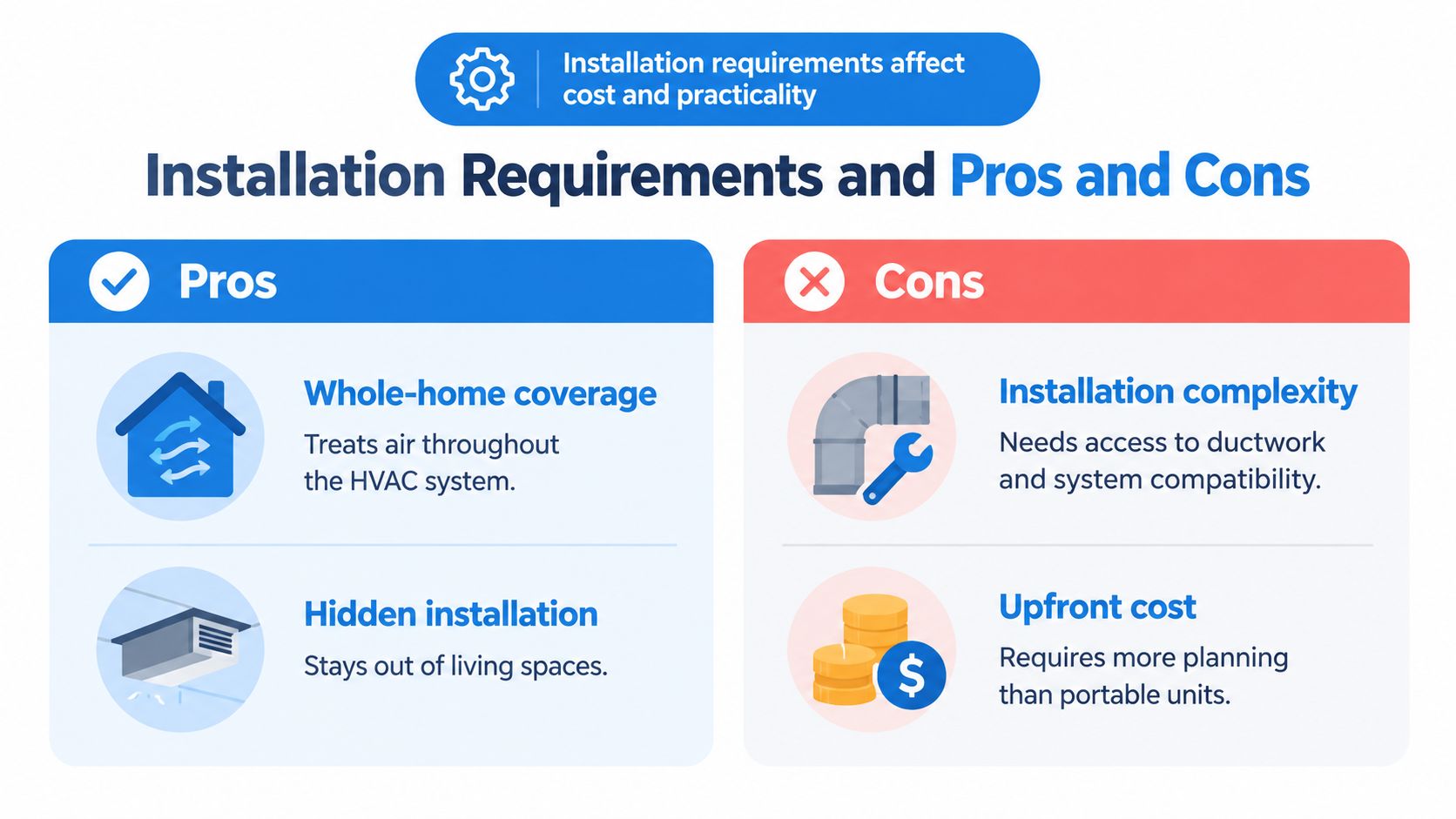
Compare the Installed Strategy
Ask a qualified installer to inspect the proposed mounting location and explain how the unit will be powered, controlled, and serviced. Request a written scope that distinguishes necessary HVAC work from the air-cleaning device itself. That makes it easier to compare proposals without confusing a low equipment price with a complete installation.
The EPA's guidance on central and portable filtration says compatible high-efficiency HVAC filtration can reduce airborne smoke, while two or more strategically placed portable or DIY cleaners may be equally effective and potentially cheaper than continuously running central HVAC with a high-efficiency filter.
That comparison is about a filtration strategy, not an endorsement of every electronic device sold for duct installation. Don't use evidence about filter performance to validate an unrelated photocatalytic or ionization claim.
| Decision factor | HVAC-integrated approach | Room-level approach |
|---|---|---|
| Installation | Requires assessment of the existing mechanical system | Lets you plan around selected occupied spaces |
| Appearance | Can keep treatment equipment out of living areas | Requires space for equipment in the room |
| Coverage planning | Depends on the home's air-distribution arrangement | Prioritizes specific rooms |
| Operating decision | Must account for central fan operation | Can be considered separately from heating and cooling demand |
| Service planning | Requires access to the installation location | Requires attention to each individual unit |
Match the Approach to Occupancy
Consider a household where people spend most evenings in a living room and sleep in bedrooms with limited circulation. Compare the cost and practicality of serving those spaces directly against changing the central system's operating pattern. Floor area alone won't settle that decision.
The main advantage of integration is using an existing distribution system without placing another appliance in each living space. The main limitation is dependence on that system's suitability and operation.
A mixed approach may deserve consideration too. Ask for separate proposals for central filtration, targeted room cleaning, and a combination, with installation work, electricity considerations, replacement parts, and service clearly identified. You'll get a more useful comparison than a simple list of device prices.
Maintenance Schedules and Replacement Parts
Maintenance should be planned before installation, while the model number, service instructions, and installer are readily available. Don't wait for an odor, a warning light, or visible dust to decide what needs attention.
There isn't a universal replacement calendar for every air purifier for HVAC. Follow the exact equipment instructions and ask the installer to explain which intervals are fixed, which depend on inspection, and which reflect your operating conditions.
Build a Component-Based Routine
Keep a written record organized by component rather than a vague reminder to service the purifier.
- Filters: Record the correct dimensions, approved replacement specification, installation date, and required inspection or replacement timing. Check the fit during service instead of assuming a replacement seals correctly.
- RCI cells: Follow the model's cleaning and replacement instructions. Ask what inspection can establish and when replacement is required.
- UV lamps: Use the specified service interval and replacement part. Don't substitute a generic lamp just because it appears to fit.
- Collectors and electronic components: Follow the manufacturer's cleaning procedure and ask which tasks require a technician.
When comparing replacement RCI cells and UV lamps, match the part to the exact model and manual. A similar name or appearance isn't enough to establish compatibility.
Ownership check: Before buying the purifier, make sure you can identify its replacement parts and understand who will service it.
Make Recurring Costs Visible
Ask the seller for a maintenance list alongside the installation proposal. It should identify consumables, cleaning responsibilities, access requirements, and any professional service. Treat those obligations as part of ownership rather than an unexpected expense later.
Use the service log to record observations as well as dates. Note a newly noticeable airflow sound, a loose filter fit, a warning indicator, or a change after maintenance. Those notes give a technician something concrete to investigate without requiring you to diagnose the equipment.
Finally, arrange the installation so routine service is practical. If reaching a cell or lamp requires an awkward dismantling process, ask whether another approved location or different approach would be easier to maintain. A homeowner needs a serviceable system, not just a successful installation day.
Choosing Between In-Duct Options and Next Steps
A purifier can have a strong rating and still clean too little air if the HVAC fan rarely runs, ducts restrict flow, or air does not circulate through the rooms that matter. Treat the decision as a system question: how much air moves, when it moves, and which pollutants the chosen technology is intended to address.
Turn the Assessment Into a Purchase Decision
Start with a short list of what the system must work with and what you want it to do:
- Record the equipment: Note the HVAC model, filter dimensions, cabinet details, and current fan schedule. A contractor can check whether the proposed device fits without creating excessive resistance.
- Choose priority rooms: Decide whether you need whole-home treatment through HVAC circulation, focused room cleaning, or both. Air follows paths of least resistance, much like a river; a room with little return-air movement may receive less treatment.
- Name the treatment goal: Identify the pollutant concern and ask what evidence supports the technology for that purpose. Also check emissions information and what the device will not address.
For a general comparison of recirculating and exhausting airflow, see Labs USA's ductless and ducted hood selection guide. It covers specialized extraction equipment, so use it to understand airflow paths, not to size or install a residential purifier.
Make the Next Step Concrete
Use the proposal guidance from the installation section rather than repeating that comparison here. Your distinct next step is to send a concise request that connects the equipment to the household's priorities:
“I'm considering an HVAC-integrated air purifier for [priority rooms] because of [pollutant concern]. My system is [HVAC model], with a [filter size] filter. Please explain how the device affects airflow and fan-runtime needs, what it is designed to address, and what service it requires.”
Before buying, put the HVAC model, filter size, priority rooms, and service contact on one page. Add the chosen device and its maintenance requirements once confirmed. Keep that sheet with the system records so future service starts with the details that matter.
EcoQuest Purifiers offers indoor-air-quality equipment, replacement filters, RCI cells, UV lamps, and repair support, along with refurbished units and a trade-in program. You can share your HVAC specifications and room priorities with EcoQuest Purifiers and ask its support team about compatible options and their maintenance requirements.