
Best Activated Charcoal Odor Eliminator: How to Pick One
Most buying guides treat the best activated charcoal odor eliminator as the biggest pouch, the bag you can "recharge" on a sunny windowsill, or any filter that prints the word charcoal on the carton. That advice fails in real rooms. Charcoal doesn't hold every gas the same way, and a format that clears a shoe closet can do almost nothing beside a bathroom drain.
The useful comparison is narrower. Match the product format and the carbon mass to the odor chemistry, the humidity, the airflow, and the hour the media saturates. A passive bag, a cabin filter, a carbon plate, a sealed canister, and a charcoal stage inside a fan-driven purifier are different machines, not different logos.
Read those choices the way a building-science review would. Test conditions come first, then the gas you're really trying to hold, then a replacement log you can keep. Start with the format, because airflow and carbon mass decide whether the chemistry ever gets a chance to work.
Table of Contents
- Quick Picks by Charcoal Product Format
- How Activated Charcoal Traps Odor Molecules
- Metrics That Separate Credible Products
- Humidity, Airflow and Contact Time That Change Results
- Matching Charcoal to Your Odor Source
- How to Track Saturation and Replace Charcoal
- Confirm the Right Charcoal Setup Before You Buy
Quick Picks by Charcoal Product Format
| Format | Carbon Load | Airflow Handling | Best Target | Replace When |
|---|---|---|---|---|
| Sachet or pouch | Low, often tens of grams | Passive only | Closets, shoes, small sealed spaces | Odor returns in the same spot |
| Vehicle cabin filter | Moderate, sized to the HVAC housing | Fan-driven through the cabin system | Smoke, traffic and food odors in cars | Stale or musty air from the vents |
| Carbon plate or panel | Set by thickness | Passive or fan-assisted | Kitchens, bathrooms, pet areas | Odor reappears after the surface saturates |
| Canister or box filter | Higher, in a sealed bed | Fan or duct-driven | Basements, garages, sewer-gas areas | Breakthrough confirmed by smell test or log |
| Charcoal stage in a powered purifier | Listed in grams on the filter card | Fan-forced across the media | Whole-room smoke and cooking odors | When the filter indicator calls for it |
Charcoal odor eliminator formats at a glance. Format determines airflow and carbon mass; the brand name tells you neither. Carbon load shows how much adsorbent is present, while airflow handling indicates how odor molecules reach it. Use these columns to match the product to the room and the way air moves through it.
Where most rooms should start
For one problem room, a carbon plate or canister is usually a more suitable starting point than several pouches. A plate fits a kitchen, bathroom, or pet corner and can be fan-assisted. A canister holds more carbon in a sealed bed, making its format a better fit for a basement, garage, or area with drain odors. For a whole floor, choose a powered purifier whose filter card states the charcoal-stage mass in grams.
Sachets suit closets, shoes, and other small, enclosed spaces. Bamboo charcoal bags represent the low-mass, passive option in the table. Since they do not move air, their reach is limited in an open living room. Vehicle cabin filters sit inside the HVAC housing and work when the fan runs. Plates and panels occupy a middle ground: thickness sets their depth, so a decorative sheet and a deeper panel offer different amounts of carbon.
Format determines airflow and carbon mass; the brand name tells you neither.
Check the product sheet for a named carbon stage before assuming a machine contains charcoal. Filterless units such as the EcoQuest Living Air Classic XL-15 rely on ionization and activated oxygen, rather than a charcoal stage. Without a listed carbon stage, the machine uses a different odor-control technology. For any format, compare the listed carbon mass, airflow path, target space, and replacement cue against the odor problem you need to address.
How Activated Charcoal Traps Odor Molecules
Adsorption holds odor molecules on the internal surfaces of a highly porous carbon granule. Scent masking works by adding a stronger fragrance, which can make an odor less noticeable while the original molecules remain in the air.
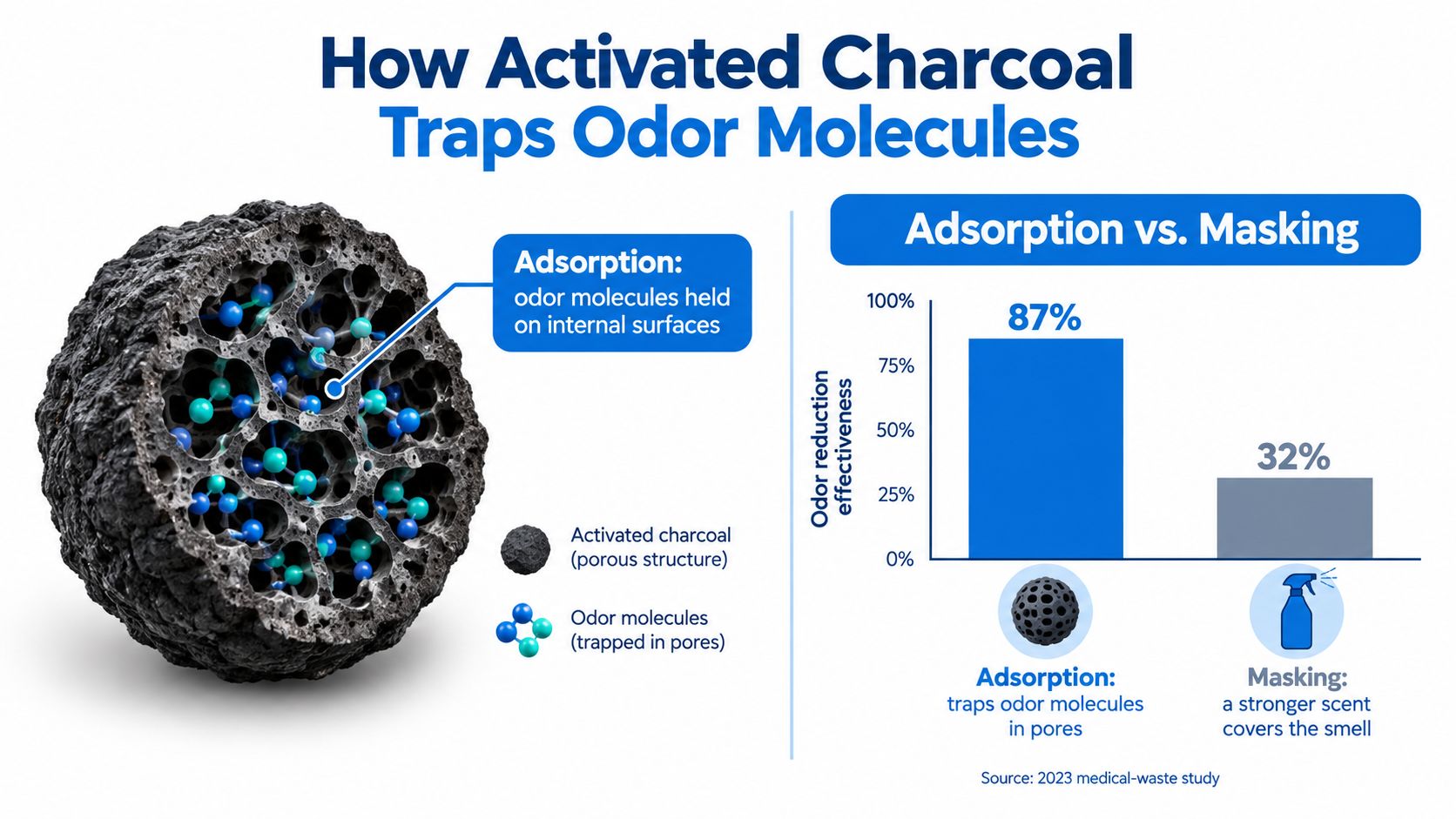
A 2023 Molecules paper on medical-waste odorants measured effective adsorption capacity for five gases at concentrations below 1 part per million. Hydrogen sulfide reached 0.2 milligrams per gram, while trimethylamine reached 35.7 mg/g, a nearly 180-fold difference. These figures describe results under the paper's low-concentration test conditions, not the performance of a product in a kitchen or other room.
Capacities from the 2023 Molecules study, tested below 1 part per million:
| Odor Compound | Capacity (mg/g) | Typical Smell Source |
|---|---|---|
| Hydrogen sulfide | 0.2 | Sewer gas, rotten eggs |
| Ammonia | 4.2 | Urine, pet areas, some cleaners |
| Acetaldehyde | 6.3 | Overripe fruit, some solvents, smoke byproducts |
| Methyl mercaptan | 6.6 | Gas odorant, decaying matter |
| Trimethylamine | 35.7 | Fish, decaying protein |
What the spread means at home
Hydrogen sulfide produces the rotten-egg smell associated with sewer gas and some drains. Its low capacity in this test makes it a difficult target for carbon. A pouch beside a floor drain may therefore have limited impact, especially if the pipe continues to supply the gas. In a small closet with a milder odor load, the same pouch has a different task.
Ammonia registered 4.2 mg/g and is associated here with urine, litter areas, and some cleaners. Acetaldehyde measured 6.3 mg/g; its listed sources include overripe fruit, some solvents, and smoke byproducts. Methyl mercaptan, at 6.6 mg/g, is linked to gas odorant and decaying matter. At the high end, trimethylamine measured 35.7 mg/g and is associated with the smell of decaying protein.
A carbon bed's apparent loading for one gas does not establish how much of another it can hold. The relevant capacity depends on the odor compound, so carbon suited to amines may perform differently against sulfur gases.
A pouch is not a drain repair
The same sachet faces different conditions in a shoe closet and beside a drain. In still air, it may collect a modest organic load in a small space. Near a drain, it faces a sulfur gas that the study's carbon held weakly, with continued supply possible from the pipe. Match the product's carbon and format to the target odor, such as smoke, cooking compounds, sulfur, or amines, rather than assuming one formulation handles them equally.
Metrics That Separate Credible Products
The word charcoal on a label tells you almost nothing about performance. A credible product publishes the numbers gas-phase standards already use. A literature review behind a Lawrence Berkeley National Laboratory technical report treats removal efficiency, pollutant capacity, pressure drop, and retention or breakthrough as core indexes in ISO 10121.1 and ASHRAE 145.1.
That same laboratory record shows why quantity matters. Activated carbon reached about 95–97% initial removal of a test VOC stream, yet equilibrium loading changed with inlet concentration, 0.18 g of heptane per gram of carbon at one concentration and 0.075 g/g at a lower one. Carbon mass plus a verified capacity and a replacement interval is the comparison. The word on the box isn't.
Questions to put to the seller
Ask in this order, and write the answers down before you pay.
- Carbon mass. How many grams of carbon sit in each filter, and in the whole unit? If the seller can't state grams, you can't compare two boxes.
- Surface area and iodine number. What is the internal area in square metres per gram, and what is the iodine number? A high iodine number generally points to greater adsorption of small organic molecules. Ask how both were measured.
- Test airflow. At what airflow, in cubic metres per hour or CFM, was capacity measured? CADR rates particle removal. It doesn't measure gas capacity.
- Pressure drop. What are the clean and loaded values in pascals? That's the resistance the fan has to overcome, and it changes as the media loads.
- Removal efficiency. Which test gas, and which inlet concentration, produced the percentage on the sheet?
- Replacement interval. What humidity and how many hours per day sit behind that interval?
Office managers comparing whole-room units can cross-check those questions against an air purifier buying guide for office managers from Top Cleaners, then confirm the carbon stage on a unit such as a VOC air purifier. Sulfur compounds, ammonia, aldehydes, or high humidity may need impregnated or blended media and a test that matches the application. A plain high iodine number doesn't settle that.
Specification test: A carbon filter with no published test conditions is a claim, not a specification.
Humidity, Airflow and Contact Time That Change Results
A charcoal pouch can underperform in a steamy bathroom even when its carbon is suitable for the odor. Water competes for adsorption sites, while airflow determines how long odor molecules stay near the media. Product format and carbon mass only make sense against those room conditions.
Relative humidity and empty-bed contact time affect odor and VOC removal in carbon systems, as described in the EPA record on carbon adsorption factors. Moisture reduces activated carbon's capacity for many VOCs by occupying pores that odor molecules would otherwise use. Formaldehyde adsorption performance can also change around 65–75% relative humidity. Bathrooms, basements, and humid climates may reach that range, so a dry-room rating may not predict performance there.
Flow can starve the bed
In low-concentration ammonia tests, adsorption capacity declined as airflow rose from low to medium and then high. At high flow, capacity was about two-fifths lower than at low flow, according to the EPA record on carbon adsorption factors. Passive pouches rely on diffusion through still air, while a fan pushing air through a thin carbon layer can reduce contact time. Higher airflow alone does not guarantee greater odor capture.
The right format depends on how much air reaches the carbon, how long it remains in contact, and how humid the air is. A larger carbon mass cannot compensate for poor contact or persistently damp conditions.
Conditions worth writing down
- Bathrooms and basements. Humidity can reduce available adsorption capacity. Dry the room before judging a pouch's performance.
- Kitchens. Steam and grease can shorten useful life. Use the range hood to capture cooking plumes, then assess how much odor remains in the room.
- Vehicles. Cabin filters face heat and moisture cycles that a closet pouch may not. Choose the format for the cabin's airflow and conditions.
- Sealed cabinets. Air moves slowly, so diffusion limits contact. A small amount of carbon may still suit a tiny space if the odor source has been removed.
Before adding another pouch to a damp basement, reduce excess moisture at home. Ventilation and correcting the moisture source address the conditions that limit adsorption; charcoal can then help capture residual odor.
Matching Charcoal to Your Odor Source
The best charcoal setup depends on what is producing the odor, where the air moves, and how much carbon can stay in contact with it. Smoke, cooking fumes, pet odors, and solvents do not place the same demands on a filter. The table matches each source to a practical format or companion measure, while showing where carbon alone has limited value.
| Odor Source | Charcoal Fit | Pair With | Realistic Limit |
|---|---|---|---|
| Cigarette and tobacco smoke | Strong for vapor-phase compounds; particles need filtration | HEPA stage plus charcoal | Smoke-soaked fabrics keep releasing odor |
| Cooking grease and frying fumes | Moderate; grease coats pores | Range hood plus charcoal filter | Grease fouling shortens service life |
| Pet urine and litter | Moderate for ammonia-type odors; limited capacity | Enzyme cleaner and frequent litter change | Remove the source; charcoal treats airborne odor |
| Car cabin odors | Good for traffic and food odors in a sealed space | Cabin filter on a set schedule | Heat and humidity shorten service life |
| Sewer gas and bathroom drains | Weak for hydrogen sulfide at low concentration | Drain repair and ventilation | A pouch is unlikely to suffice |
| Mold-associated mustiness | Limited when moisture remains | Dehumidification and cleaning | The odor source persists until the area is dry |
| Solvents, paint and chemicals | Good for many VOCs when dry | Ventilation | Check the label for the specific compound |
Fit, pairing, and the limit
Grease and frying fumes are a moderate fit because grease coats pores and shortens service life. Use the range hood to capture the plume, with charcoal filtering what remains. For pet urine and litter, pair carbon with an enzyme cleaner and regular litter changes. The table's limits matter: a small carbon mass has finite capacity, so leaving the odor source in place keeps adding to its load.
A cabin filter suits car odors when air is pushed through the media, but heat and humidity can shorten its service life. Clean affected surfaces as well, and set a filter replacement schedule rather than waiting for odors to return through the vents. Drivers can find solutions for unpleasant cabin odors before choosing a charcoal setup.
Sewer gas is a poor match for a pouch. Low-concentration hydrogen sulfide is difficult for charcoal to capture, so address the drain or leak and ventilate. For mold-associated mustiness, dehumidification and cleaning are the relevant measures; charcoal offers limited odor control while moisture remains. Solvents, paint, and other VOCs may suit dry carbon, but performance depends on the specific compound. Check product labeling for that compound and use ventilation to dilute what remains.
A sealed refrigerator has a small air volume and a distinct odor load, so a modest carbon format may fit once spills are cleaned and the interior is dry. Choose charcoal made for a refrigerator for that setting. Whole-room smoke and cooking fumes call for a format with enough carbon and airflow to handle the room's load. The Fresh Air Double Plus combines charcoal with HEPA, germicidal UV, ozone generation, and ionization. For any powered unit, including portable car purifiers, check the specifications for the carbon stage and match its capacity to the odor source and expected replacement timing.
How to Track Saturation and Replace Charcoal
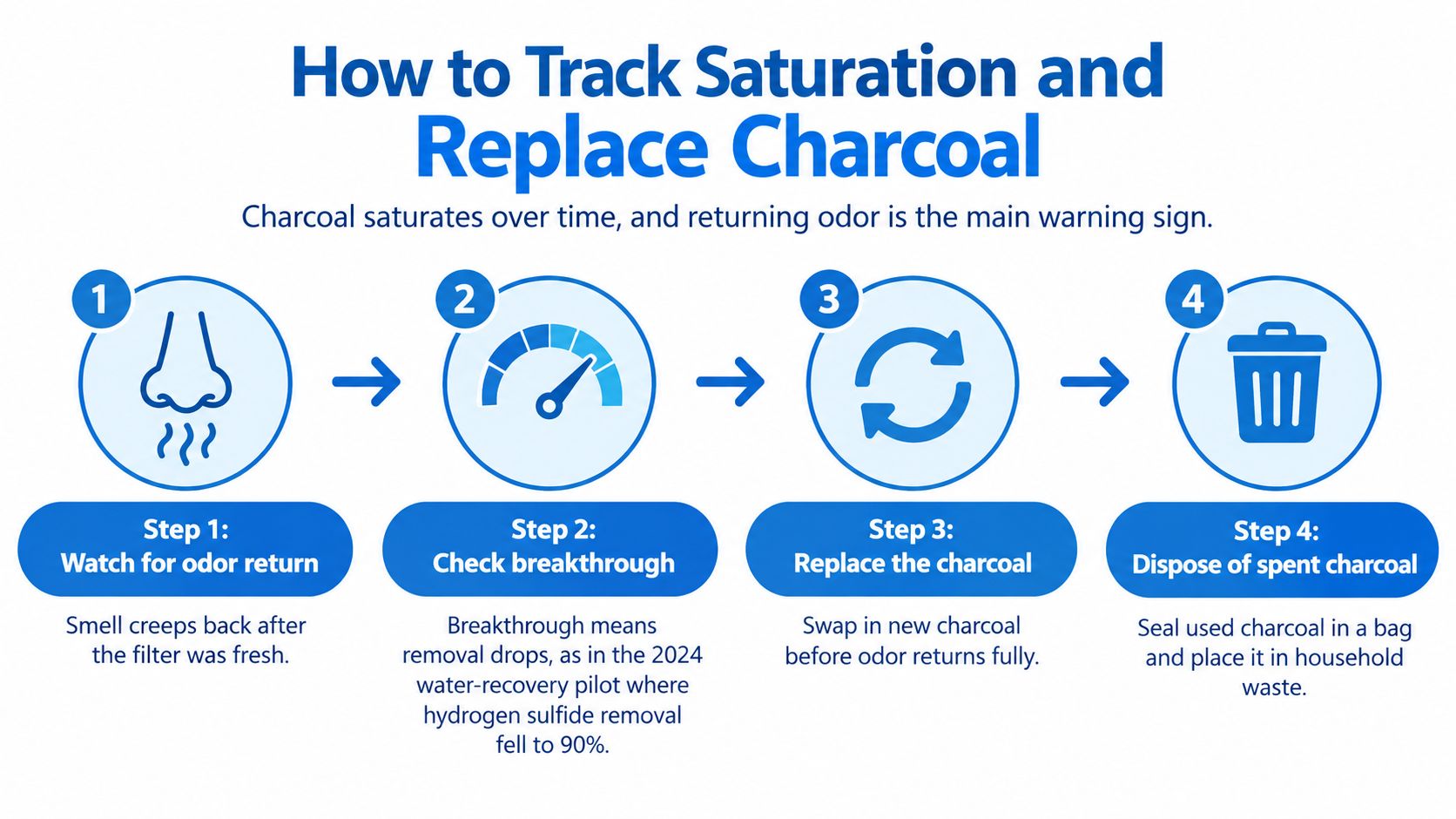
Charcoal has a finite capacity. The clearest warning is odor returning while the media still looks dry and intact. That is breakthrough: the carbon's internal surfaces have taken up enough compounds that removal is declining.
A 2024 Water Environment Research pilot tested three granular activated-carbon filters on foul air at a Southern California water-resource-recovery facility. Average contact time was 3.8 seconds. The researchers defined breakthrough as hydrogen-sulfide removal falling to 90% and continuing to drop. Coconut carbon mixed with permanganate reached that point after 57 days; ordinary coconut carbon did so after 107 days, and coal-based granular carbon after 129 days. The permanganate blend gave the strongest overall odor treatment in the test, while coal carbon lasted longest under those conditions. The paper also cites a U.S. Environmental Protection Agency technical review that reported granular activated-carbon beds for biologically generated odor compounds effective for about 3 to 5 years in some applications. It notes that saturation can differ between total organic contaminants and odor compounds.
These results describe industrial beds handling forced foul air at a stated contact time. A household pouch or thin purifier sheet has a different carbon mass, airflow, humidity, and odor load, so those timelines do not transfer directly. Use the product's stated interval as a starting point, then track odor and airflow in the space where the media operates.
A log you can keep
- Record the install. Write the installation date, odor type, and room on tape attached to the housing.
- Set the first check. Follow the interval on the product specification sheet. Check monthly in a humid or smoky space, even if the stated interval is longer.
- Compare the air. Once a week, smell the air before and after it passes through the media. A returning odor on the outlet side signals reduced removal.
- Log changes. Note odor return and any decline in airflow. If odor returns sooner over successive checks, the bed may be undersized for the load.
- Replace on evidence. Change the media when odor returns while it still looks dry and intact, or when airflow remains low after cleaning the prefilter.
- Skip sun-drying. Sunlight or household heat does not restore spent carbon. Published regeneration uses controlled high humidity or raised temperature; a windowsill is not that process, and heat can release odors back into the air.
| Sign | Likely Cause | Action |
|---|---|---|
| Odor returns within days of install | Undersized bed or high odor load | Add carbon mass or shorten the check interval |
| Odor returns after months; media looks dry | Saturation | Replace the media |
| Musty smell after humid weeks | Moisture occupying the pores | Dry the space and check the seal; replace if it persists |
| Odor worse after sun exposure or heating | Attempted regeneration or heat-driven release | Don't reuse; replace |
| Airflow noticeably reduced | Loaded media or dust raising pressure drop | Clean the prefilter; replace the media if flow stays low |
Replacement rule: If odor returns while the media still looks dry and intact, replace it. Sunlight will not restore spent carbon.
Seal spent charcoal in a bag and put it in household waste. Avoid shaking it indoors, where captured material can be released.
Confirm the Right Charcoal Setup Before You Buy
Choose a format and carbon mass that fit the odor source, room conditions, airflow, and replacement timing. A product label alone cannot establish that match. For a powered unit, first decide how much room air needs treatment and whether the fan can move it through the carbon stage; then compare that setup with the room's ventilation and odor load.
Before you order
- Match the product format to the installation. Check whether the unit can sit where air really passes through it, and whether its dimensions leave room for the required airflow.
- Estimate the needed airflow from the room's air-change rate. Use the rate specified for the intended use, then choose a filter and fan combination that can supply it without excessive resistance. A room-area rating by itself does not show how much air passes through the carbon.
- Set a replacement plan before purchase. Use the seller's stated interval only if it describes conditions similar to your space. Humidity and odor load can shorten service life, so confirm that replacement media is available.
- Check service and fit. Verify that the replacement filter matches the model and that manuals or support are available for setup and maintenance.
Use the Metrics section's questions to assess the seller's claims, then make the airflow-and-fit decision for your room. If specifications or replacement details are missing, choose a product with clearer documentation. For supported models, replacement filters, manuals, and support are available from EcoQuest Purifiers.
EcoQuest Purifiers sells indoor-air equipment for homes, vehicles, and commercial spaces, including charcoal and HEPA options, replacement filters, and manuals for supported models. Compare the product specifications with the room and odor you need to address before ordering.