
Best Car Air Purifier with HEPA Filter Guide
The popular advice is simple: choose a car purifier with a HEPA badge and cleaner air will follow. That advice skips the specification that determines whether the filter can matter while you're driving, airflow. A dense filter attached to a weak fan may capture particles in principle, yet move too little cabin air to change your exposure meaningfully.
The better question is not “Does this car air purifier have HEPA?” It's “Can this system deliver enough clean air for my cabin, at a tolerable noise level, while the vehicle HVAC system is operating?” Research supports both sides of the buying decision. A cabin filter improved real-world exposure, while a separate vehicle-cabin study found that a low-flow portable purifier offered no particle-based improvement over the stock filter alone. (Randomized cross-over cabin-filter study, vehicle-cabin airflow study)
This guide evaluates the best car air purifier with HEPA filter through that lens. The comparison below emphasizes CADR, added airflow, noise, filtration type, and the role of the factory cabin filter. The goal is a situational recommendation, not a list of attractive devices that all carry the same marketing label.
| Performance question | What the evidence indicates | Buying implication |
|---|---|---|
| Does filtration change cabin exposure? | A cabin filter reduced UFP exposure by 28%, PM2.5 by 30%, and black carbon by 32% in tested driving conditions. (Study) | A good cabin filtration strategy can materially reduce particulate exposure. |
| How does true HEPA compare with standard OEM filters? | A high-efficiency cabin filter reduced UFP concentration by 93% on average, compared with 41% to 65% for in-use OEM filters. (CDC-indexed study) | Filter quality matters, but it must be paired with adequate airflow. |
| Can a small portable unit fail? | A 2025 vehicle test found no particle-based improvement from a portable purifier at about 270 lpm, while a much higher-flow unit improved CAQI at tested fan settings. (Vehicle-cabin study) | Don't buy on HEPA terminology alone. Check added airflow and CADR. |
| What does a tested portable HEPA unit deliver? | A vehicle-cabin test measured 5–10 cfm by PM10 mass measurement. (Independent cabin test) | Small units may suit targeted or supplemental cleaning, not every cabin. |
| What is the noise tradeoff? | Independent testing reported 15.2 CFM particle CADR and 53.8 dB(A) maximum noise. (CADR and noise testing) | High output can be audible, especially in a quiet cabin. |
Table of Contents
- Introduction Why HEPA Alone Does Not Guarantee Cleaner Cabin Air
- How HEPA Car Purifiers Work and What Specs Actually Matter
- HEPA Versus Other Car Purification Technologies Compared
- Performance and Safety Trade Offs That Decide Real World Results
- Choosing by Use Case From Daily Commutes to Family and Rideshare Driving
- Installation Placement Power and Maintenance for Best Results
- Final Recommendation How to Pick the Best HEPA Car Purifier for Your Vehicle
Introduction Why HEPA Alone Does Not Guarantee Cleaner Cabin Air
A HEPA filter is a particle-capture component, not proof that a car purifier will clean the cabin effectively. Its performance depends on how much contaminated air the fan draws through the media and how well the cleaned air reaches the breathing zone. A unit with excellent filter material but weak circulation can underperform on the road.
Cabin air changes constantly. Traffic, road position, exhaust, ventilation mode, and outside particle levels all affect exposure. Real-driving research found that an upgraded cabin filter produced meaningful reductions in particulate exposure under tested conditions, rather than only in a laboratory setting. The practical conclusion is more useful than repeating the individual measurements: filtration can help, but only when airflow is sufficient to process cabin air faster than pollution enters.
The practical test is simple: a purifier must move enough filtered air to compete with pollutant entry and the vehicle's own air exchange.
Evidence also shows why a high-efficiency filter can outperform ordinary factory equipment. A CDC-indexed cabin study found substantially greater ultrafine-particle reduction with HEPA filtration than with in-use OEM filters. The same research measured cabin carbon dioxide under conditions showing that improved particle filtration does not automatically require severely restricted ventilation. Filter media therefore matters, but it works within a larger air-management system.
The buying mistake to avoid
Many buyers compare HEPA labels while overlooking CADR, fan capacity, cabin volume, HVAC settings, and the noise produced at the speed needed for useful cleaning. That reverses the engineering priority. First determine whether the system can move enough air. Then assess HEPA construction, carbon capacity, power demand, placement, and maintenance.
A portable unit may still serve as a supplemental cleaner, especially when positioned near an occupant. The EcoTravel Voyager Portable Car Air Purifier is described as treating air inside a vehicle from exhaust gases, odors, and other contaminants entering from the roadway, along with contaminants associated with the air-conditioning system. Those are product-positioning claims, not independent proof of cabin performance. Without comparable CADR, airflow, and real-cabin measurements, the HEPA label alone cannot show whether the device will materially change exposure.
For some vehicles, upgrading the HVAC cabin filter is the more rational first move. It uses the car's existing blower to process a larger share of cabin air, while a small portable purifier may add limited circulation unless its output is matched to the cabin and used consistently.
How HEPA Car Purifiers Work and What Specs Actually Matter
A HEPA badge does not tell you whether a purifier can clean a cabin at a useful rate. The practical question is how much filtered air reaches occupants, at what noise level, and under which HVAC settings. A small filter paired with weak airflow may capture particles in its media while producing little change across the cabin.
Five specifications that deserve attention
1. Filter construction. Look for a clearly identified HEPA or high-efficiency particulate filter, rather than a vague phrase such as “purifying technology.” HEPA media targets airborne particles, including fine traffic-related material, pollen, and dust. It does not, by itself, remove every gas or odor.
2. CADR. Clean air delivery rate combines airflow with particle-removal performance, making it more informative than a broad coverage claim. For a cabin around 3 m³, convert the published rate before judging it. One cubic metre per minute equals about 35.3 CFM, so a claim in lpm must be divided by 1000 to obtain cubic metres per minute, then converted if needed. Compare CADR values only when the test method and particle basis are similar.
3. Added airflow. Fan flow and CADR describe related but different outputs. Vehicle research may report airflow in lpm, while purifier specifications use CFM or cubic metres per hour. A high airflow claim does not prove equivalent particle CADR, but very low airflow sets a clear limit on how quickly the cabin can be processed. The cabin study cited here found a meaningful difference between weak and high-flow operation, a point examined in the performance section.
4. Noise. A purifier can clean effectively at a speed occupants will not tolerate. Check operating and maximum noise in dB(A), rather than relying on “quiet” wording. A unit that is switched off during calls or conversation contributes no useful cleaning during those periods.
5. Power and serviceability. USB, 12V, and battery operation impose different operating limits. Vehicle power supports longer operation, while battery models add portability but require charging. Confirm that replacement filters are identifiable, available, and practical to change.
The vehicle HVAC system remains the main airflow path. If its cabin filter is overdue, poorly sealed, or highly restrictive, replacing it may produce more useful coverage than adding a small portable unit. A portable purifier makes more sense as a supplement when its intake and outlet are unobstructed, its CADR suits the cabin volume, and it runs consistently near occupants.
HEPA Versus Other Car Purification Technologies Compared
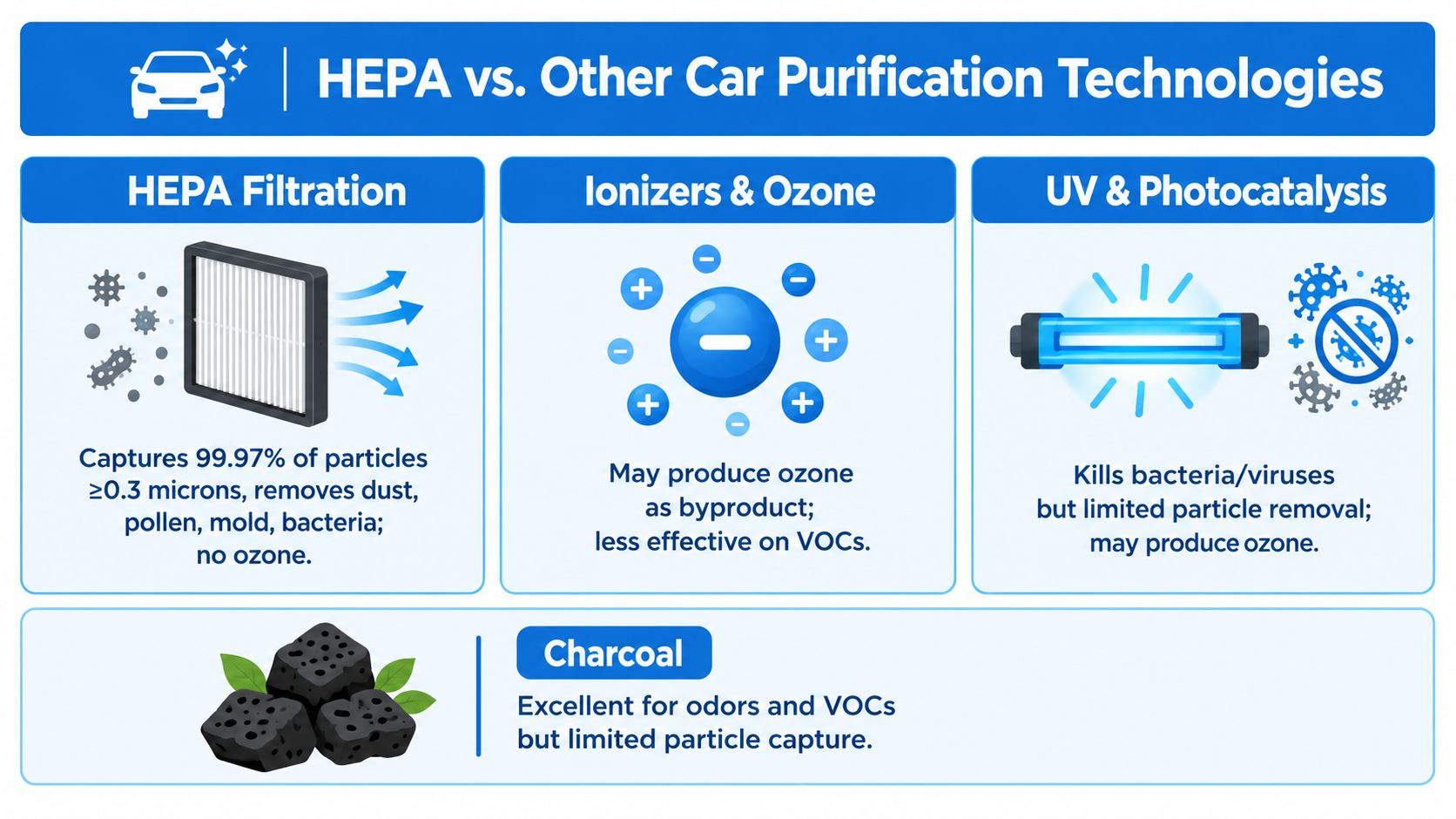
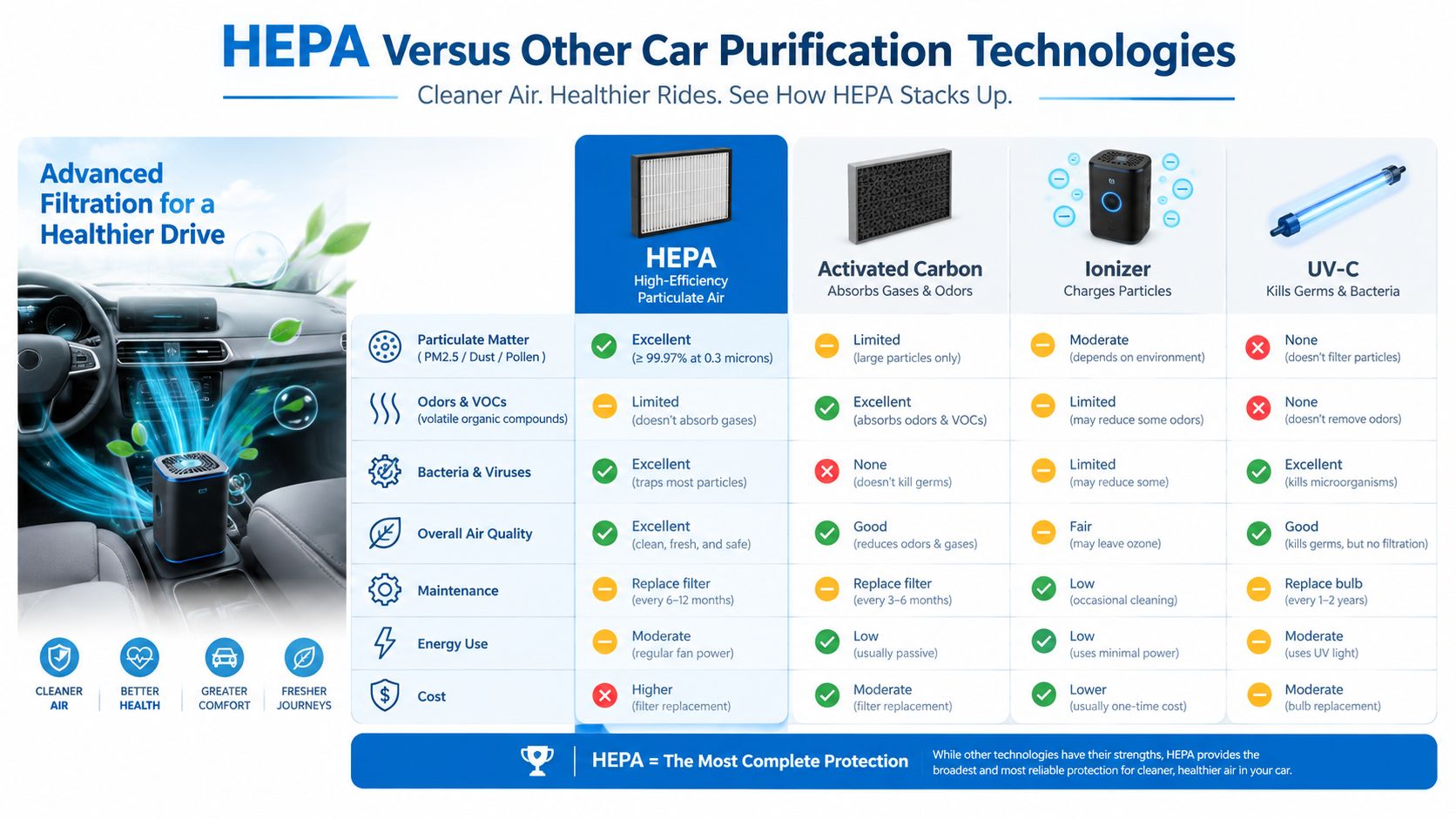
A HEPA badge identifies filter media, not the amount of cleaned air delivered. In a small cabin, airflow and CADR determine whether that media processes enough air to matter. The technologies below address different contaminants, so “air cleaning” should not be treated as one interchangeable feature.
HEPA for airborne particles
Mechanical HEPA filtration captures particles as air passes through the media. It suits road dust, fine particles, pollen, and smoke particles, provided the fan moves sufficient air through the filter. A portable HEPA unit tested in an actual vehicle cabin delivered a CADR of 5 to 10 cfm by PM10 mass measurement. The test found particle-cleaning performance comparable to ionizer units, without deliberately adding ions or ozone. (Portable HEPA cabin test)
That finding puts the HEPA label in context. A small filter with weak airflow may have high capture efficiency but still clean the cabin slowly. The vehicle's HVAC system can process substantially more cabin air, so an effective, well-sealed cabin filter upgrade may outperform a portable unit when the factory filter is overdue or poorly suited to particle removal.
For continuous occupancy, passive particle capture is easier to defend than a technology that intentionally changes the cabin's chemistry.
Ionizers and ozone-producing systems
Ionizers charge airborne particles, allowing them to deposit on surfaces or be collected, depending on the design. Ozone-generating systems use oxidation as part of their treatment approach. Such systems may have a role in controlled, unoccupied treatment, but they require caution inside an occupied vehicle because the cabin is enclosed and ozone irritates the respiratory system.
“Ion” does not describe identical products. Buyers should request credible ozone testing and clear operating instructions. An ozone generator for car and home belongs to a different category from a HEPA purifier designed to run while people breathe the cabin air.
Carbon, UV, and photocatalysis
Activated carbon targets odors and gaseous compounds, not particles. Results depend on carbon quantity and design, contact time, and the contaminant. A thin carbon layer may reduce light odors, but its presence alone does not establish useful control of exhaust or embedded smoke.
UV and photocatalytic systems may address biological contaminants or gases under suitable conditions, yet they do not replace particle filtration. In a moving car, exposure time, airflow, light intensity, catalyst condition, and containment determine performance. The practical combination is mechanical filtration for particles, an adequately sized gas-phase stage for odors, and specialized technologies only when their operating conditions and safety evidence are clear.
Performance and Safety Trade Offs That Decide Real World Results
A HEPA badge does not predict cabin performance by itself. The meaningful question is how much filtered air the system delivers through the occupied space. Research comparing high-efficiency cabin filtration with ordinary OEM filters found a substantial difference in ultrafine-particle removal, but the result came from the complete filter and air-moving system, not from the filter media alone. (CDC cabin-filter study)
| Metric | True HEPA System | Standard OEM Cabin Filter |
|---|---|---|
| Reported UFP reduction | Higher-efficiency particle removal when sufficient air passes through the filter | Lower and more variable particle reduction |
| Main strength | Captures particles efficiently when the system supplies enough airflow | Provides routine factory filtration with variable performance |
| Key limitation | Fan capacity, noise, power use, and pressure drop determine useful delivery | May provide less particle reduction than a high-efficiency replacement |
| Ventilation context | Results depend on HVAC mode, cabin leakage, and fresh-air exchange | Recirculation can raise carbon dioxide and alter exposure conditions |
The table's practical lesson is simple: filtration efficiency and air delivery must be assessed together. A restrictive filter paired with a weak fan may perform well in a laboratory test while changing little in a moving cabin.
Why CADR is the decision metric
Independent testing of a HEPA-equipped in-car purifier measured particle CADR at 25.9 m³/h, or 15.2 CFM, with maximum noise of 53.8 dB(A). Those measurements highlight the trade-off. Higher fan speed can deliver more cleaned air, but the resulting noise may affect whether drivers keep the unit running. (Independent CADR and noise test)
A vehicle-cabin airflow study reached a more important conclusion. A portable purifier with relatively low added airflow did not improve particle-based cabin air quality compared with the stock cabin filter alone, while a much higher-flow unit produced measurable improvement at lower and medium fan settings. The implication is clear: a small purifier can clean air close to its outlet without mixing enough air to influence the cabin overall. (Vehicle-cabin airflow study)
Ask manufacturers for measured CADR or airflow, the test conditions, and noise at the setting used for that output. Marketing terms such as “true HEPA” provide little guidance if the device cannot circulate enough cabin air. In some vehicles, upgrading the factory cabin filter and using the HVAC system correctly will produce more useful coverage than adding a low-flow portable unit.
Safety belongs in the specification sheet
For occupied driving, choose mechanical particle capture without deliberate ozone production. The purifier must leave factory vents and controls unobstructed, stay secure during braking, and operate without compromising practical ventilation. Power cables should not interfere with pedals, visibility, or airbag deployment zones.
A cabin air-quality monitor can help assess whether filtration and HVAC changes are improving actual cabin conditions. Use measured particle and ventilation results, rather than relying only on a purifier's indicator light.
Choosing by Use Case From Daily Commutes to Family and Rideshare Driving
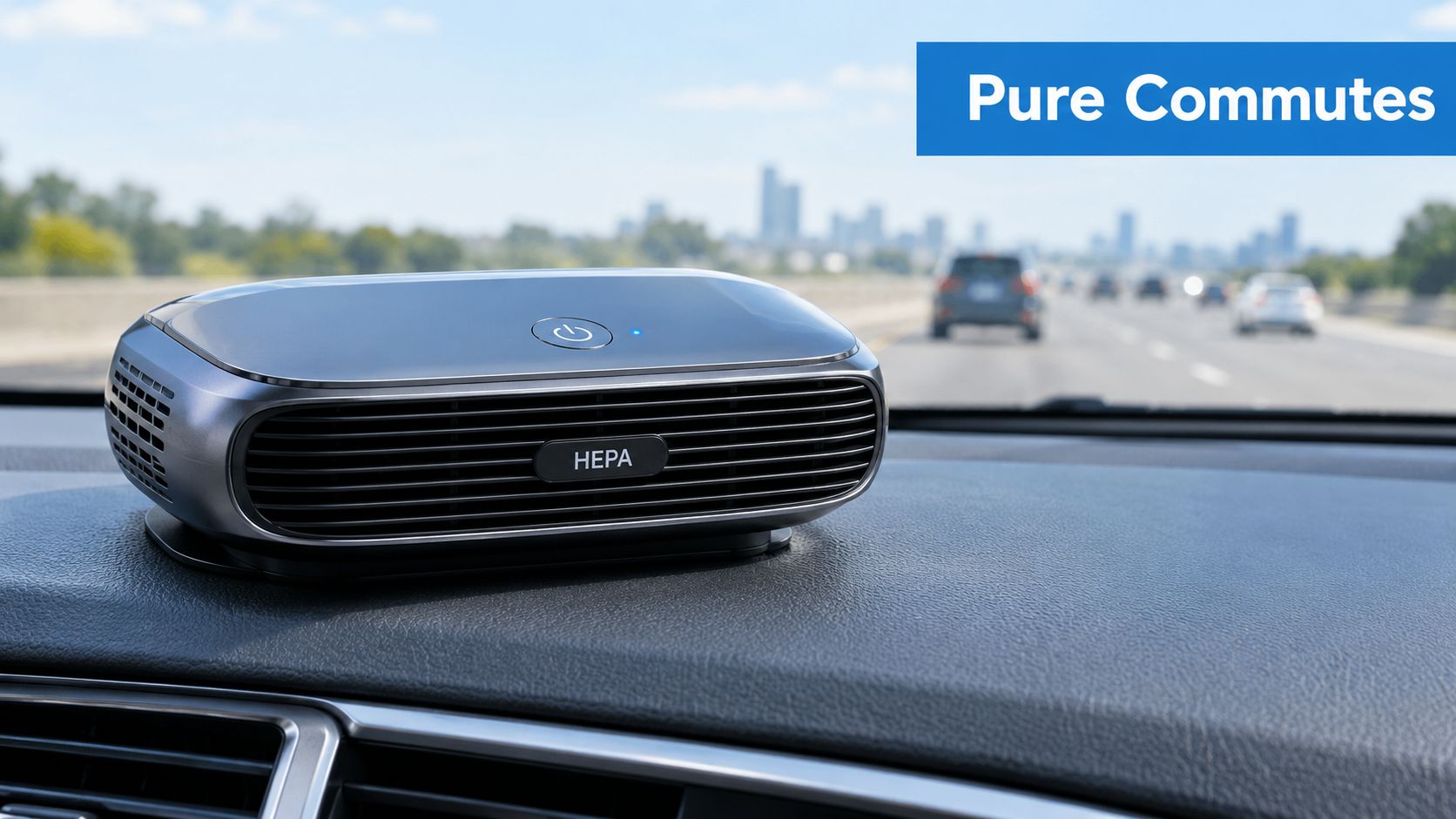
The HEPA badge matters less than whether the purifier moves enough air through its filter. Use case determines the acceptable trade-off between CADR, noise, runtime, and portability. A daily commuter in heavy traffic needs sustained, measurable airflow, while an occasional passenger may gain more from a maintained factory filter than from a low-flow portable device.
Heavy-traffic commuters
Choose the highest credible CADR you can tolerate acoustically, then verify that the device can sustain that output from the vehicle's power supply. Keep the factory filter installed, select the appropriate HVAC mode, and avoid a small unit whose outlet serves only one corner of the cabin. A higher-flow standalone purifier is more defensible when the factory filter is difficult to upgrade or when traffic exposes the driver for extended periods.
For a commuter, replace the cabin filter at the vehicle manufacturer's recommended interval, or sooner when airflow falls, the cabin is dusty, or the vehicle operates around heavy road pollution. A portable unit should be judged by its added airflow, not by its filter label. If its CADR is low and the HVAC system already has a clean, well-fitting filter, upgrading the cabin filter may produce broader coverage.
Families and sensitive passengers
Parents should prioritize particle capture, low byproduct risk, secure placement, and predictable operation. A loose device on a seat or dashboard can distract the driver, obstruct visibility, or conflict with airbag zones. A quiet setting that runs during the entire trip may be more useful than maximum output that passengers switch off.
Allergy and asthma concerns also require source-specific choices. Dust and pollen are particle problems, while odors and gases call for an effective gas-phase medium, such as appropriately sized activated carbon. Keep the cabin clean, maintain the HVAC filter, and favor transparent CADR and noise data over broad health promises.
Rideshare drivers and odor-sensitive owners
Rideshare cabins experience repeated door openings, changing passenger loads, and variable contaminant sources. Use a vehicle-powered purifier with measurable airflow for continuous operation, and inspect or replace its filter when odor or airflow performance declines. For frequent daily driving, a short maintenance check between shifts is more practical than relying on an indicator light alone.
Carbon capacity becomes relevant when food, smoke, or persistent odors dominate the complaint. A small car air purifier may suit drivers who move equipment between vehicles, but it should not be treated as a substitute for whole-cabin airflow. Define the target first, occupied breathing zone, full cabin, particles, or gases, then choose the hardware that can deliver that result.
Installation Placement Power and Maintenance for Best Results
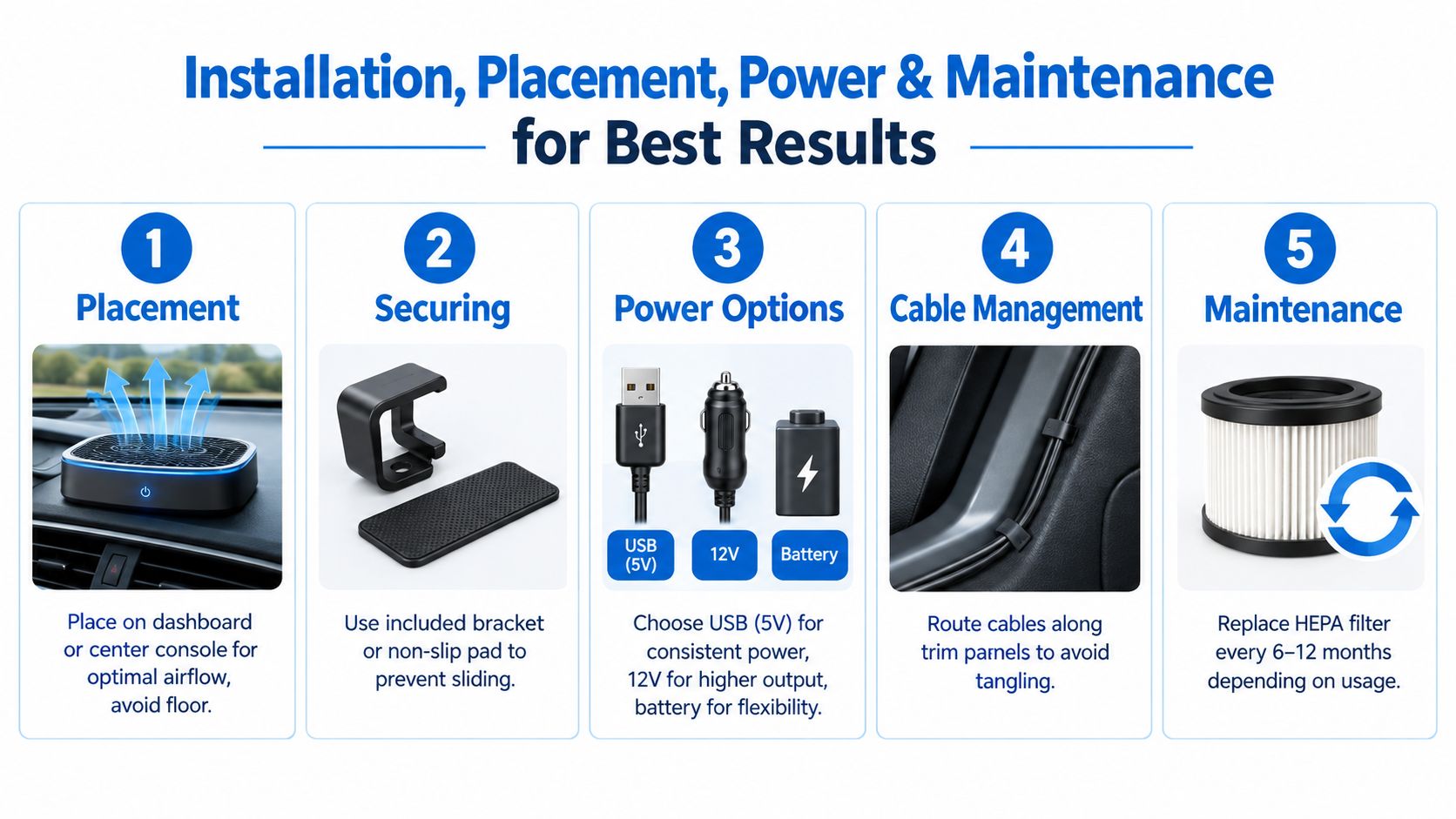
Placement controls how much cabin air the purifier can process. Keep the intake and outlet unobstructed, place the unit near occupants without impairing visibility, and secure it against movement. A center-console or seat-mounted position can work, but the mounting method and vehicle safety systems take priority.
Set up the airflow path
Place the unit in open air. Avoid footwells, luggage gaps, and spaces behind seats where restricted intake reduces usable airflow.
Secure the housing. Use the supplied bracket, strap, or non-slip base. A purifier that moves during braking can become a hazard and may circulate air less effectively.
Choose stable power. USB suits lower-power devices, while a 12V connection may support a higher-output design. Battery operation helps when the vehicle is parked or the unit is moved elsewhere, but it requires regular charging.
Route cables away from controls. Keep wires clear of pedals, steering movement, seat rails, and airbag deployment areas. A tidy route also makes damage easier to detect.
Test the purifier with the HVAC system set to your usual mode. Check whether the vehicle's airflow complements the standalone unit, overwhelms it, or sends air around it. Recirculation can limit intake from a nearby roadway source, but restore outside-air ventilation when conditions change rather than keeping the cabin sealed continuously.
Maintain the filter and verify performance
Inspect the filter when suction weakens, operating noise rises, or dust persists in the cabin. Replacement timing depends on driving conditions, use, and pollution load, so follow the device instructions instead of applying one universal interval. Filter condition matters because a clogged element reduces airflow, and reduced airflow can make a HEPA badge irrelevant to actual cabin cleaning.
For broader vehicle-maintenance context, these RV air filter replacement tips explain why filter access and replacement condition matter in mobile environments. Check the unit's airflow after maintenance, not only whether its indicator light has reset.
Final Recommendation How to Pick the Best HEPA Car Purifier for Your Vehicle
The best car air purifier with HEPA filter is not automatically the smallest, quietest, or most heavily advertised model. Choose the system that moves enough filtered air for the cabin, fits your driving pattern, and does not create new problems with noise, power, or maintenance.
Use this decision matrix:
| Your situation | First choice | Why |
|---|---|---|
| Factory filter is accessible and HVAC airflow is strong | Upgrade the cabin filter first | The vehicle HVAC system already circulates air through the cabin, and a higher-efficiency replacement can improve particle control without adding another device. |
| Small cabin, short trips, targeted breathing-zone cleaning | Portable HEPA purifier | A compact unit can work when expectations are limited and its CADR or airflow is clearly stated. |
| Large cabin, frequent traffic exposure, or high occupancy | Higher-flow plug-in system | Added airflow matters more than the HEPA badge alone when the goal is measurable cabin-wide improvement. |
| Odors and exhaust gases are the main complaint | HEPA plus meaningful carbon or another gas-phase stage | HEPA targets particles. Gas-phase media addresses a different contaminant class. |
| Continuous occupied use | Mechanical filtration with verified ozone performance | Ozone generation should not be treated as a default benefit inside a small occupied cabin. |
When the cabin filter beats the portable purifier
Choose an upgraded cabin filter when the HVAC fan moves substantial air, the housing accepts a higher-efficiency replacement, and you want filtration integrated into normal ventilation. This setup avoids another cable, mounting point, power draw, and noise source.
A portable purifier makes more sense when the factory filter is weak, inaccessible, poorly sealed, or unable to provide the desired performance. It can also focus cleaning near occupants, but only if its airflow is high enough to mix through the cabin. A small fan cleaning the air immediately beside the device should not be treated as whole-cabin purification.
The recommendation in plain terms
Check the cabin filter and HVAC operation first. Then reject portable models that disclose neither credible CADR nor useful airflow information. If output is modest, treat the unit as supplemental breathing-zone filtration rather than evidence that the entire cabin is being cleaned quickly.
The practical comparison is between a higher-flow system, a properly upgraded cabin filter, and a portable unit matched to actual driving conditions. Filter efficiency matters, but airflow determines how much treated air reaches occupants.
EcoQuest Purifiers offers portable car units, replacement parts, repair services, HVAC-integrated solutions, HEPA products, and charcoal-based purification options. Compare those categories by filtration type, measured airflow, noise, power requirements, placement, and maintenance rather than by badge or product wording alone.
Visit EcoQuest Purifiers to compare portable and vehicle-related air-quality products, replacement filters, and support options. Before buying, confirm that the unit's airflow, filtration stage, operating noise, power connection, and maintenance requirements suit your vehicle.