
Clean Air Machine for Smokers: What Actually Works
Most advice on a clean air machine for smokers is too simple. “Get a HEPA purifier” is only half right.
That advice focuses on what you can see. Smoke haze. Floating particles. A dusty beam of light near the window. But in real homes, the complaint that lingers is usually odor. The room smells stale even when the air looks clear. Jackets hold onto it. Curtains do too. Hair and upholstery keep releasing it back into the room long after the cigarette is out.
That's why the right question isn't just “Will a purifier catch smoke?” It's “Which parts of smoke can this machine remove, and what will still be left behind?” If you're shopping for a clean air machine for smokers, HEPA is the baseline. It isn't the whole answer.
Table of Contents
- Why Smoke Is Harder to Clean Than You Think
- The Four Technologies Explained
- How Each Technology Performs on Smoke
- Sizing a Purifier for the Tobacco Smoke Band
- Ozone and Active Oxygen Safety Considerations
- Matching the Unit to Your Space
- Placement Ventilation and Ongoing Maintenance
- Building a Realistic Smoke Mitigation Plan
Why Smoke Is Harder to Clean Than You Think
Smoke is difficult to clean because it behaves like two problems at once. One part is made of tiny airborne particles that create haze. The other part is a mix of gases and odor compounds that pass through many filters much more easily.
Public-health agencies treat secondhand tobacco smoke as a serious indoor exposure, not as a nuisance smell you can filter away. The WHO notes that there is no safe level of exposure and emphasizes smoke-free indoor environments rather than relying on air cleaning alone, as summarized in WHO indoor-air and tobacco smoke guidance. EPA guidance has also long distinguished between reducing smoke particles and removing the full gaseous mixture.
That difference explains a common homeowner complaint. The air monitor looks better, the visible haze drops, and the room still smells like an ashtray.
A HEPA filter helps with the particle side of smoke. It is built to trap very small solids suspended in air. That is useful for the fine smoke particles that hang in a room after someone lights up. But HEPA does little for the gas-phase chemicals that create the stale, lingering odor people notice in curtains, carpet, jackets, and sofas.
A kitchen example makes this easier to picture. After bacon or burnt toast, the visible smoke can clear first. The smell often stays behind and keeps drifting off surfaces. Tobacco smoke is more stubborn because it contains both fine particles and odor-carrying gases, and those gases can keep re-releasing from fabrics and soft materials long after the cigarette is gone.
So the shopping mistake is easy to make. Buyers see strong particle performance and assume that means strong smoke performance overall. In a smoker's home, the harder part is often odor control. That usually depends less on whether the unit has HEPA, and more on how much gas-phase filtration it has, especially activated carbon, and how quickly that media gets used up.
A low particle reading can mean the haze is under control. It does not guarantee the room is free of smoke-related gases.
What your nose notices that a particle filter misses
Your nose is often reacting to what the particle sensor does not measure well. Many consumer monitors are better at tracking particulate matter than tracking the odor-causing gases in smoke. So you can get a reassuring number on the display while the room still smells stale.
That is not a contradiction. It is a measurement gap.
The practical takeaway is simple. If smoke odor is the main complaint, judge a machine by more than HEPA and more than PM readings. Ask how it handles gases, how much carbon it carries, and how often that carbon will need replacement in a home where smoking happens regularly.
Four technology families matter
Smoke-control machines usually rely on some combination of four approaches:
- HEPA filtration for airborne particles and haze
- Activated carbon for many odor compounds and gases
- RCI or photocatalysis for breaking down some contaminants under specific conditions
- Ozone or active oxygen systems for oxidation-based odor treatment, with important safety tradeoffs
Each technology addresses a different part of the smoke mixture. That is why smoke performance is rarely about one spec alone. The question is which part of smoke is bothering you most, and whether the machine is built to handle that part for more than the first few weeks.
The Four Technologies Explained
A smoker-focused purifier is less like one magic filter and more like a small workshop with different tools. One tool catches ash and fine particles. Another handles the gases your nose notices first. Others try to change pollutants through chemistry or oxidation. That mix is why two machines can both say they are for smoke, yet perform very differently in a real home.
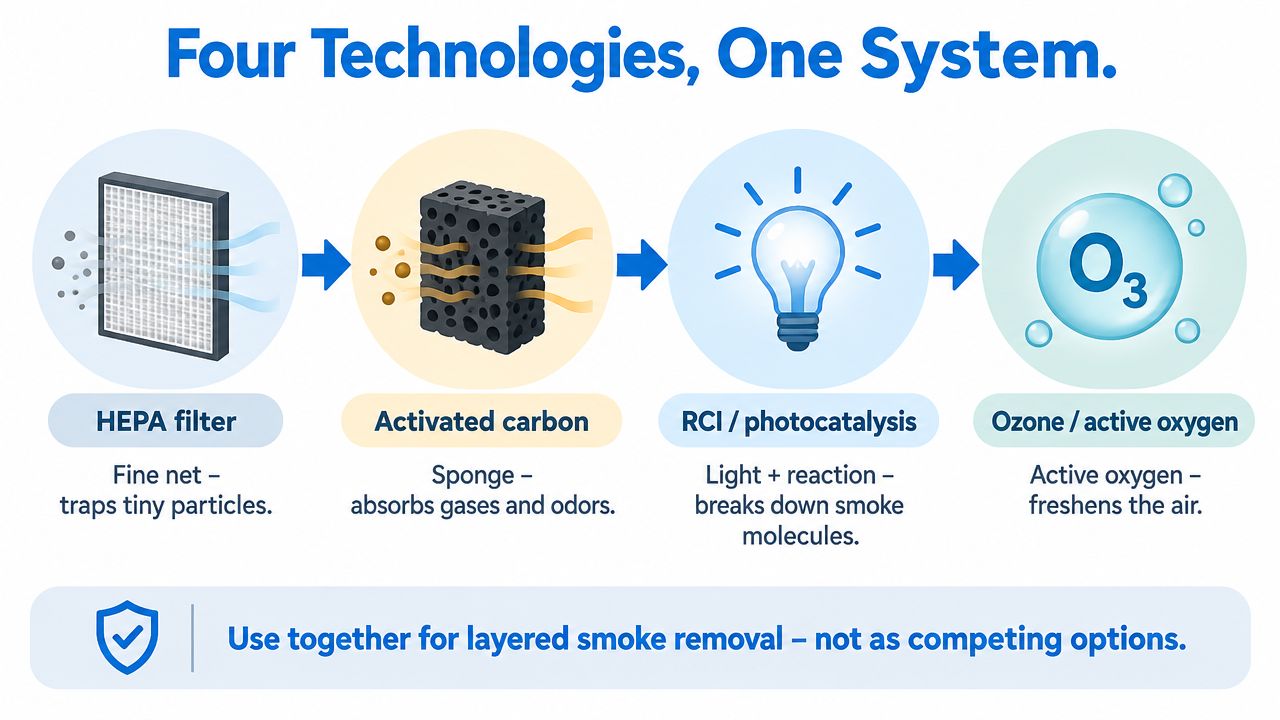
HEPA is the particle catcher
HEPA works like a very fine sieve. Air moves through the filter, and the solid bits in smoke get trapped. That includes much of the visible haze, soot, and fine particulate matter floating through the room.
Smoke is partly a particle problem. If the room looks cloudy after someone smokes, HEPA is the part doing the cleanup you can often see. But it does not do much for the stale smell that hangs around after the haze fades. A pasta strainer can catch noodles, but the smell of garlic still fills the kitchen. HEPA has the same limitation with smoke gases.
Activated carbon is the odor tank
Activated carbon handles a different part of smoke. It works like a sponge with countless tiny pores, holding onto many odor compounds and gases that pass straight through a particle filter.
For smokers' households, this is usually the decision point that deserves the most attention. Many buying guides stop at "HEPA plus carbon," but that skips the question that affects daily satisfaction: how much carbon is in the machine, and how fast will it fill up? A thin carbon sheet may help at first and then lose odor-control ability quickly in a room where smoking happens often. A heavier carbon bed usually lasts longer because it has more surface area to adsorb smoke gases before replacement is needed.
If odor is the main complaint, HEPA is the baseline. Carbon capacity is what often separates "the air looks better" from "the room stops smelling like smoke."
RCI and photocatalysis are reaction systems
RCI and photocatalytic designs try to change contaminants through chemical reactions rather than only trapping them. The easiest way to picture them is a small reaction chamber inside the purifier. Light and a catalyst work together to break down some compounds under the right conditions.
That sounds appealing, but it helps to keep expectations grounded. These systems are usually support technologies, not the main answer for tobacco smoke in a living room. Their real-world value depends on the design, airflow, contact time, and what byproducts the unit may create. If you want to see one product category where this kind of technology appears, EcoQuest includes options such as this plug-in air ionizer among its multi-technology products.
A tighter space can change how these added technologies are used. The EcoTravel Voyager Portable Car Air Purifier is described by the manufacturer as a car unit that purifies air inside the vehicle from exhaust gases, unpleasant odors, and other contaminants that penetrate the interior from the roadway, while also providing protection against viruses and bacteria from the air conditioning system.
Here's a quick visual summary of how these layers relate:
Ozone and active oxygen use oxidation
Ozone-based systems take a more aggressive route. They work more like a strong oxidizing cleaner than a filter. The bleach comparison is useful here. Bleach can knock down stubborn odors, but breathing bleach fumes in a closed room would be a bad plan.
The same caution applies to ozone and related "active oxygen" claims. Some products in this category are marketed for odor control, but the safety tradeoffs matter, especially in occupied spaces. For routine indoor smoke cleanup, households usually get a safer and more predictable result by relying on particle filtration for haze and enough carbon for odor, then treating oxidation-based features as a limited-use extra rather than the main strategy.
How Each Technology Performs on Smoke
Smoke is harder to clean than many buyers expect because it is not one pollutant. It is a mix of tiny particles you can sometimes see, gases you often smell, and sticky residue that settles onto surfaces. A machine can lower one part of that mix and still leave the complaint that matters most in smoker households. The smell.
That is why “has HEPA” is only the starting point, not the whole answer.
What clears first, and what keeps bothering people
Airborne haze usually improves first. A good particle filter can pull a noticeable amount of smoke particulate out of room air as it recirculates.
Odor is a different job. The stale tobacco smell comes largely from gaseous compounds, and gases pass through HEPA media the way cooking smells pass through a window screen. You need sorbent media, usually activated carbon, to capture that part of the problem. Even then, the carbon has a limit. Once it fills up, odor control drops off.
Surface residue is the third problem, and no room purifier fully reverses it. If smoke has coated curtains, carpet, walls, or upholstery, those materials can keep releasing odor back into the room long after the air looks clearer.
Research summarized earlier in the article found particle filtration alone was “rather unsuccessful” at eliminating tobacco smoke odor, while activated carbon paired with particle filtration was the recommended approach for gaseous smoke contaminants.
Active smoking changes the result
Performance also depends on whether the purifier is cleaning leftover smoke or competing with a cigarette that is still burning.
In a dormitory study, HEPA purifiers removed particles much more effectively in rooms without an active smoker than in rooms where smoking was happening at the same time, according to the dormitory HEPA study. That tracks with what homeowners often see. The room starts to recover, then a new cigarette adds another burst of particles and gases before the machine has caught up.
A purifier is closer to a mop than a force field. It can clean what passes through it. It cannot stop fresh smoke from entering the room every few seconds.
| Technology | Visible Haze | Lingering Odor | Surface Residue |
|---|---|---|---|
| HEPA | Strong for airborne particles | Weak for gases and smell | Little effect after residue has settled |
| Activated carbon | Little effect on haze by itself | Best tool here, until the carbon fills up | Little effect on already-coated surfaces |
| RCI or photocatalysis | Secondary role | May reduce some odor compounds gradually | Limited help with airborne and near-surface contaminants, often slowly |
| Ozone or active oxygen | Poor fit for haze removal | Can change odor through oxidation | Sometimes used for odor treatment in special cases, with safety limits |
The shopping takeaway is simple. For smoke, HEPA handles the visible part. Carbon often determines whether the room smells better.
Sizing a Purifier for the Tobacco Smoke Band
Big room claims mislead a lot of smoke shoppers. A purifier can be rated for a large space on paper and still feel disappointing in a smoker's home, because the problem people notice first is often odor. Smoke CADR still matters, but it only tells you how quickly the unit removes airborne particles. It does not tell you how much odor the carbon bed can hold, or how quickly that odor control fades under regular smoking.
Start with smoke CADR, then sanity-check the carbon
For tobacco smoke, the label to watch is the smoke CADR. As noted earlier in the smoke CADR review, that rating focuses on the smaller particle range that makes smoke harder to clear than larger household dust. A dust or pollen rating can make a machine look strong while telling you less about how it will handle cigarette haze.
A practical starting point is to match smoke CADR to about two-thirds of the room area in square feet when ceilings are standard height. That gives you a baseline for particle cleanup.
Then ask a second question that many guides skip. How much carbon is inside, and how often will it need replacement if smoking happens indoors? HEPA works like a fine sieve for the visible portion. Carbon works more like a sponge for the smell. If the sponge is small, the room may test cleaner for particles while still smelling stale.
Two room examples
A 12 by 12 bedroom is 144 square feet. Two-thirds of that is about 100, so a smoke CADR around that level is a reasonable minimum target for the particle side of the job. If smoking happens in that room often, a unit with a token carbon sheet may still leave you unhappy.
A 20 by 25 living room is 500 square feet. Two-thirds points to roughly 330 smoke CADR. In a room that size, one large unit may be enough, but two smaller units can sometimes clean more evenly if furniture, corners, or partial walls interrupt airflow.
High ceilings change the math. The floor area stays the same, but the machine has more air to cycle, like using the same bathroom fan in a room that suddenly got taller.
For smoke, a little extra capacity helps. Indoor smoking arrives in bursts, and the purifier has to catch up after each one. If you are comparing models built for this job, a smoke air purifier collection can help you sort by smoke use instead of lumping smoke together with general allergy needs.
What shoppers often miss
- Closed doors change results: CADR works best when the purifier is treating a defined room, not chasing smoke drifting in from a hallway.
- Open layouts lower real-world performance: The machine may be sized for the square footage, but the smoke spreads farther before enough of it reaches the filter.
- Odor has its own sizing logic: A strong fan improves air turnover, but smell control depends on carbon amount and replacement timing.
- Filter cadence matters: In smoker households, carbon can lose odor control before the HEPA filter looks dirty, so replacement schedules often need to be tighter than buyers expect.
Ozone and Active Oxygen Safety Considerations
This is the most emotionally charged part of the category, and it helps to separate product types instead of treating them all as identical.
The basic safety issue
Ozone is an oxidizer. That's why it can affect odors. It's also why many people are cautious about using ozone-emitting devices in occupied rooms, especially for long periods.
For smoker households, the practical question isn't “Does oxidation do anything?” It's “Is this the right tool for the room while people are in it?” In bedrooms, living rooms, nurseries, and other daily-use spaces, many buyers are better served by sealed particle-and-carbon filtration as the primary line of defense.
Product categories are not all the same
Some machines are built specifically to generate ozone for odor treatment. Others produce it as a byproduct of ionization, plasma, or related processes. That distinction matters because the intended use is different.
| Device Type | Ozone Output | Safe Use Setting | Key Caution |
|---|---|---|---|
| Dedicated ozone generator | Intentional ozone production | Best treated as a specialty tool for unoccupied spaces | Not a routine substitute for source control and filtration |
| Hybrid purifier with active oxygen or ionization | May produce ozone during normal operation | Needs careful reading of the manufacturer's operating guidance | Not every household will tolerate this category equally |
| Sealed HEPA plus carbon purifier | No ozone-based cleaning function | General occupied living spaces | Won't solve odor well unless carbon capacity and maintenance are adequate |
Who should be extra cautious
Households with sensitive occupants should be especially conservative. That includes:
- People with reactive airways: Asthma, COPD, or easily triggered respiratory symptoms change the risk conversation.
- Young children and infants: Their breathing zones and developing lungs leave less room for experimentation.
- Pregnant people: Most households prefer the lower-exposure path when safer alternatives exist.
- Bird owners and sensitive pets: Birds in particular have delicate respiratory systems.
If you're looking at this category for odor restoration, it helps to compare options intended for that purpose, such as ozone generators, but use them with a very clear occupancy plan. In most homes, they should be thought of as occasional tools, not everyday living-room appliances.
If the room is occupied for long stretches, start with source control, ventilation, and non-ozone filtration. Treat ozone-related options as specialty equipment, not default equipment.
Matching the Unit to Your Space
A good clean air machine for smokers fits the way the smoke moves through the building. The machine that works in a one-bedroom apartment may be the wrong shape of solution for a split-level house or a shared office.
Three common form factors
Some households need a movable room unit. Others need something tied into the HVAC system. And sometimes the right answer is a dedicated high-output unit for one problem room.
| Form Factor | Typical Coverage | Install Complexity | Best For |
|---|---|---|---|
| Portable single-room unit | One contained room or zone | Low | Renters, designated smoking rooms, flexible placement |
| Whole-house HVAC-integrated unit | Air handled through existing ductwork | Medium to high | Homes where smoke drifts beyond one room |
| Commercial or high-output room unit | Large rooms, garages, basements, lounges | Medium to high | Heavy odor control in dedicated areas |
How to choose without overbuying
A portable unit makes sense when one person smokes in one room and you can keep that room isolated. You can place the machine close to the source, run it hard during smoking, and move it later if needed.
Whole-house equipment makes more sense when smoke migrates through hallways, stairwells, or shared return ducts. It treats the building more evenly, but it also depends on how the duct system is laid out. If the smoke starts far from the return path, capture at the source is still the smarter first move.
Commercial-style units fit spaces where odor load is consistently high. Think basements, garages, smoking lounges, or back rooms in businesses. These setups are less about convenience and more about sustained treatment.
One more category deserves mention: the car. Cigarette odor builds fast in a cabin because the volume is small and surfaces are close to the smoker. In that setting, compact dedicated units can make more sense than trying to adapt a home purifier to vehicle use.
Placement Ventilation and Ongoing Maintenance
Even a well-chosen unit underperforms when it's parked in the wrong corner or run with a neglected filter. Smoke control is part equipment, part habits.
Placement changes capture
Place the purifier where smoke travels, not where it looks best. Corners, behind sofas, and tight spaces near drapes usually create dead zones. The intake needs room to pull air.
A good working position is near the smoking area but not so close that ash, heat, or bumping becomes a problem. In practical terms, the machine should sit where the person's exhale plume can be intercepted before it spreads across the room.
Ventilation helps the carbon stage
A purifier shouldn't have to fight the whole burden alone. When possible, crack a window and use an exhaust fan to create directional airflow out of the room. That lowers the gas load reaching the purifier and gives the carbon stage a better chance of keeping up.
This matters most when odor is the complaint. Carbon has finite capacity. If the room is tightly sealed and someone smokes repeatedly, the carbon fills faster and starts acting tired sooner.
A maintenance rhythm that makes sense
Use a simple log on your phone or utility shelf. In smoker homes, replacement and cleaning intervals matter more because the load is higher.
- Pre-filter care: Vacuum or clean the pre-filter regularly so hair and lint don't choke airflow.
- HEPA attention: Replace the HEPA element according to the machine's guidance, and expect heavier use to shorten its useful life.
- Carbon replacement: Change carbon when odor starts returning at the intake or when the room clears visually but still smells stale.
- Specialty components: If your machine uses RCI cells, plates, or other serviceable parts, clean them on a routine schedule so output doesn't drift downward.
When a smoker says “the purifier stopped working,” the problem is often carbon saturation, not fan failure.
One more practical tool can help: a basic PM monitor. It won't tell you the whole smoke story because gases and surface contamination aren't fully reflected in particle counts, but it can show whether smoking events are causing spikes and whether your placement changes are improving particle cleanup.
Building a Realistic Smoke Mitigation Plan
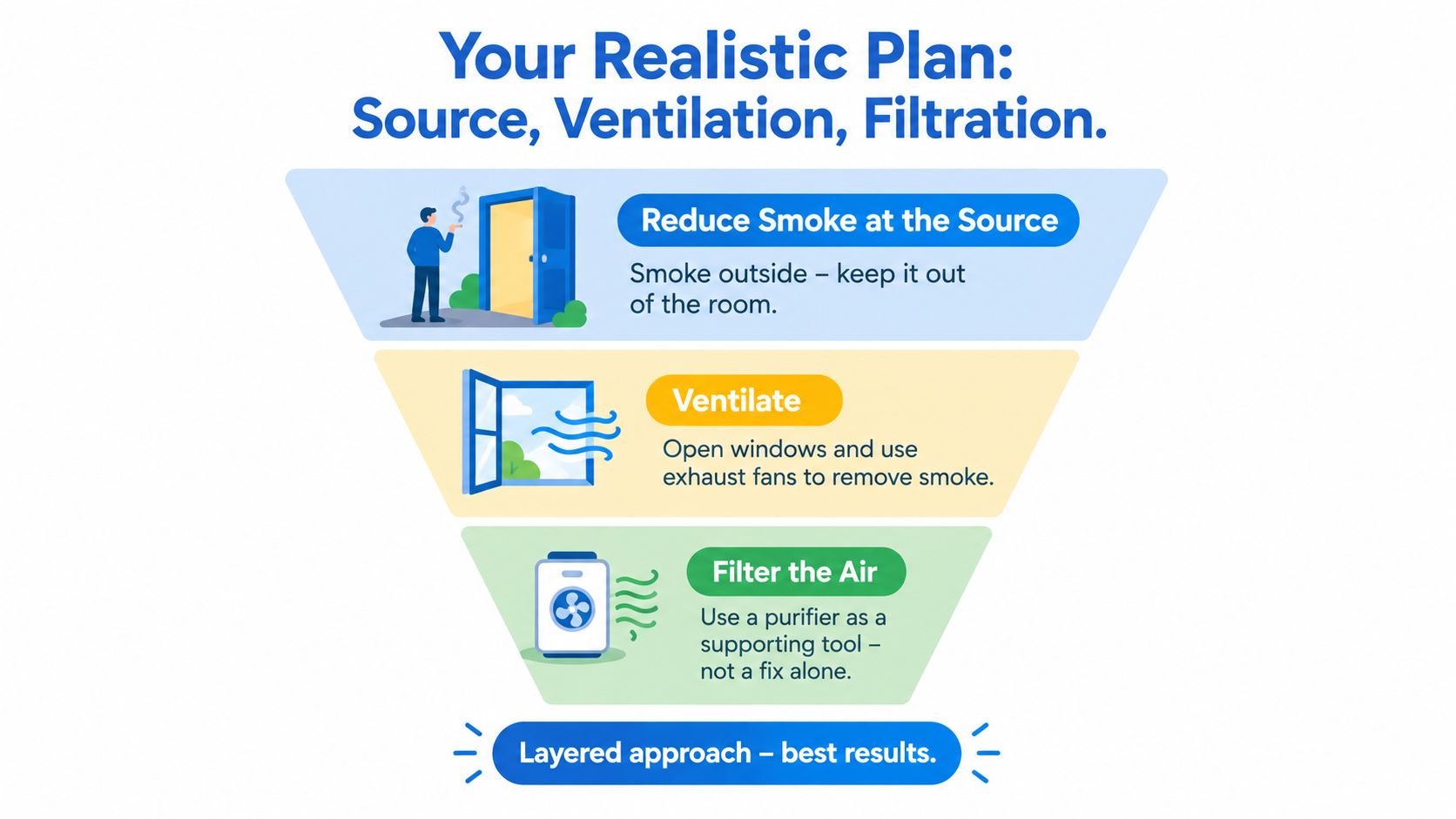
The best plan starts with a blunt truth. A purifier supports smoke control. It doesn't replace source control.
What a workable home plan looks like
Start at the source. If anyone in the home can smoke outside, that helps more than any appliance upgrade. If indoor smoking still happens, confine it to one room with the door closed and keep smoke from spreading through the rest of the house.
Then ventilate. Use windows and exhaust fans to move contaminated air out instead of just stirring it around. After that, filter what remains with a properly sized machine that combines particle capture and meaningful odor control.
A few realities are worth keeping in mind:
- Purifiers don't erase third-hand smoke: Residue on walls, fabrics, and soft surfaces often needs washing, deep cleaning, or repainting.
- A clear room can still smell bad: That usually points back to gases and saturated carbon.
- Uncontrolled smoke drift is harder: If smoke comes from a neighbor or another unit, a purifier helps most when the room can be closed off and treated as its own zone.
If you're comparing cleanup options beyond daily filtration, this overview of the cost of smoke odor treatment is useful because it frames when a household may need cleaning or restoration work instead of relying on air treatment alone.
Reasonable expectations matter. A good setup can make the air noticeably better. It usually won't make an actively smoked-in room smell like nothing at all.
EcoQuest Purifiers offers home, car, and specialty indoor-air products across HEPA, carbon, RCI, active oxygen, and related technologies, along with replacement parts and repair support for ongoing maintenance. If you're weighing odor control versus particle capture and want to compare different approaches in one place, visit EcoQuest Purifiers and look at the units that match your room size, smoking pattern, and maintenance comfort level.