
HEPA Air Purifier Small: How to Size One for Your Room
Your bedroom smells stale, dust has collected again by Friday, and you're considering a small purifier for the nightstand. The compact size looks convenient, but the packaging leaves you wondering whether it will clean the room or just move air around.
Choose by the filter's documented performance and the purifier's tested smoke CADR, not its footprint or biggest room-size claim. That distinction helps you separate useful particle filtration from odor treatment and avoid buying a device that's too small for the job.
Table of Contents
- What a Small HEPA Air Purifier Does
- Match Room Size to CADR in One Table
- Reading HEPA Labels and Filter Components
- What a Small HEPA Purifier Cannot Fix
- How to Replace the HEPA Filter on Schedule
- Noise and Placement for Quiet, Effective Cleaning
- Pick the Right Small HEPA Category for Your Room
What a Small HEPA Air Purifier Does
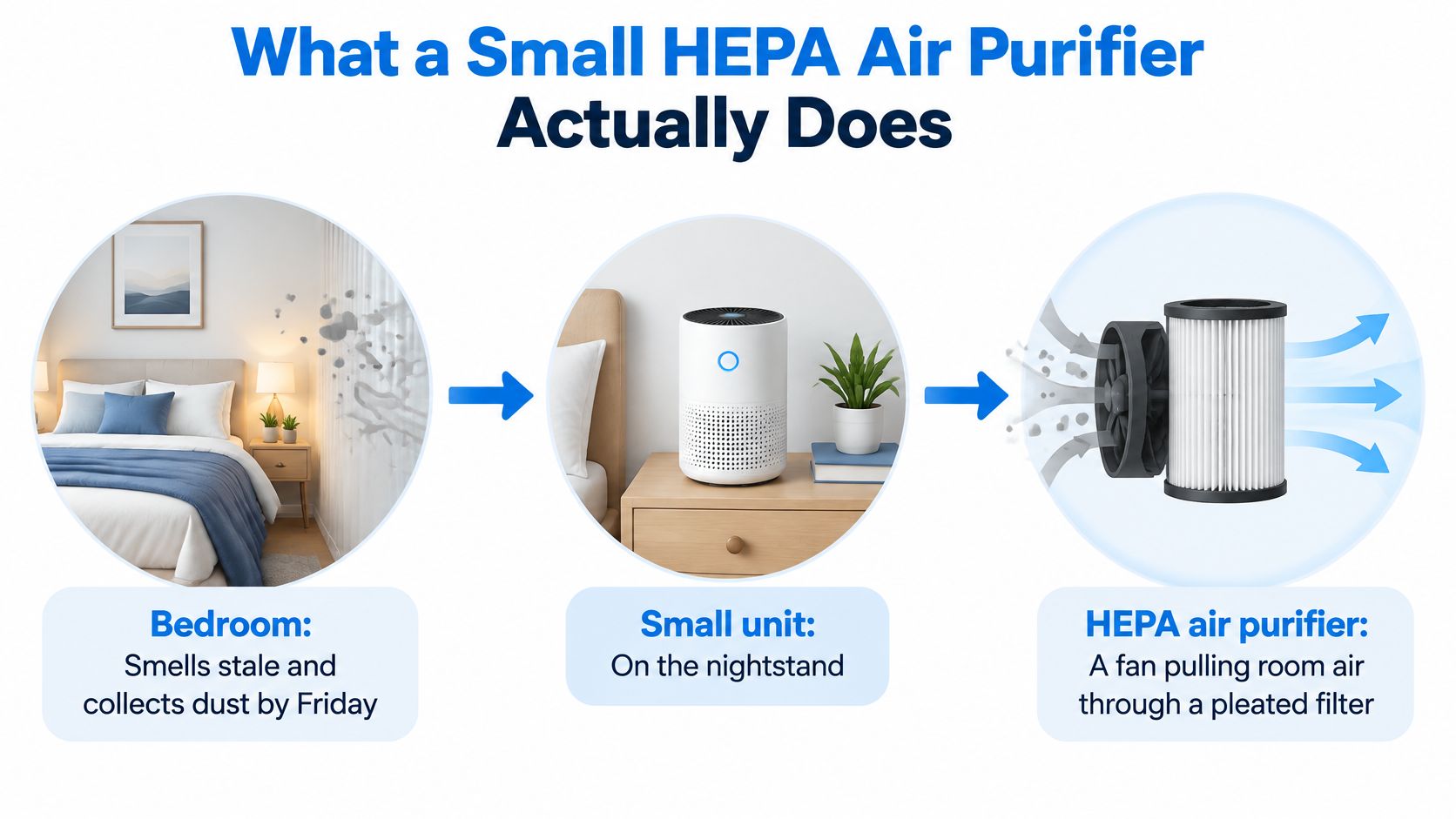
A fan on a bedroom nightstand moves air around. Add a HEPA filter, and the fan draws room air through a pleated mechanical filter that captures airborne particles as they pass through. The difference is like the difference between stirring dust and catching some of it in a filter.
The U.S. benchmark for a HEPA filter is at least 99.97% removal at 0.3 micrometers, approximately the most-penetrating particle size. Larger and smaller particles are captured even more efficiently, according to the ASHRAE filtration and disinfection resource. This test benchmark applies to particles passing through the filter. It covers particles such as dust, pollen, mold, and bacteria, not odors.
The illustration shows how a room fan and filter work together.
Filter efficiency isn't room-wide efficiency
A filter's capture percentage does not mean that the same percentage of particles disappears from the whole bedroom. Air must reach the filter, and the purifier needs enough airflow and operating time to circulate room air. Filter condition and gaps around the filter also affect performance.
A highly efficient filter can't clean air that never reaches it.
Ask what you want the purifier to do. If your concern is airborne dust, allergens, or smoke particles, look for particle filtration. If the main problem is smell, a HEPA filter alone is not an odor treatment. Carbon can help address odors, but its role is separate from HEPA particle capture.
Also consider which room the unit will serve and whether you'll run it continuously or only from time to time. A small purifier treats the air that passes through it; it doesn't replace cleaning surfaces where dust has settled. For a broader household perspective, Canes Cleaners explains healthier indoor air.
Match Room Size to CADR in One Table
For a 200-square-foot bedroom, the everyday sizing target is about 130 cfm, following the EPA's home air-cleaner sizing guidance. During heavy smoke, use the stricter smoke target in the table rather than assuming the everyday recommendation is enough.
Clean Air Delivery Rate, or CADR, describes the volume of cleaned air a purifier delivers per minute. It connects filter performance with airflow. A larger CADR means the device delivers more cleaned air, rather than merely having an efficient filter inside.
Target CADR by room area
The everyday column follows EPA sizing; the heavy-smoke column follows the AHAM recommendation summarized in the EPA's residential air-cleaner technical summary, with each figure below expressed in the units shown.
| Room area (sq ft) | Everyday CADR target (cfm) | Heavy-smoke CADR target (cfm) |
|---|---|---|
| 100 | 65 | 100 |
| 200 | 130 | 200 |
| 300 | 195 | 300 |
| 400 | 260 | 400 |
These targets aren't permission to ignore the room's layout. Open-plan spaces, ceilings higher than the standard room assumption, ongoing cooking or candle use, and a partly loaded filter can all increase the cleaning requirement or reduce delivered performance.
Read the specification, not just the box
Suppose your bedroom corresponds to a row in the table, and the purifier's packaging advertises matching maximum coverage. That still doesn't tell you whether the coverage claim reflects enough clean-air delivery for your intended use.
Find the tested smoke CADR in the manual or specification sheet. Smoke CADR is particularly useful when comparing removal of smaller airborne particles. A large coverage label without that supporting figure leaves an important question unanswered.
Ask which fan setting produced the published result, too. If you intend to use a quieter setting, don't automatically assume it delivers the headline CADR.
Buying rule: Choose documented clean-air delivery for the room you'll use, not the largest area printed on the packaging.
When comparing single-room air purifiers, keep the sizing table beside the specifications. If the tested smoke CADR isn't available, treat the room-size claim as incomplete rather than filling in the gap yourself.
For an open-plan room, identify the connected area the device must serve. Don't size it only for the corner where you plan to put it.
Reading HEPA Labels and Filter Components
A HEPA label needs supporting test information. The benchmark described earlier gives you a reference point, but a label alone doesn't establish the performance of the complete purifier.
Separate the filter's claimed efficiency from the machine's delivered airflow. A filter classification and a CADR rating answer different questions, so neither should substitute for the other.
Filter labels and components decoded
| Label or component | What it means | What it captures | Check before buying |
|---|---|---|---|
| True HEPA, U.S. benchmark | A claim that should match the benchmark described earlier | Airborne particles, rather than gases | Named test method and supporting documentation |
| EN 1822 H13 | A stated filter class requiring class-specific documentation | Particle filtration, subject to verified testing | Test standard and class shown in the specification |
| EN 1822 H14 | A different stated filter class, not a room-cleaning rating | Particle filtration, subject to verified testing | Explicit class documentation, not an implied upgrade |
| HEPA-type, HEPA-like, or HEPA-style | Wording that doesn't establish verified HEPA performance | Don't assume HEPA-equivalent capture | Test data rather than descriptive wording |
| Activated carbon filter | A separate medium for gas and odor control | Gases and odors, depending on its design and capacity | Carbon specification and replacement arrangement |
| Pre-filter | An upstream screening component | Coarse debris, according to the model's design | Manual-approved cleaning or replacement instructions |
Don't assume that every product described as HEPA-type failed a test. The practical problem is missing evidence, not proof of failure. If the manufacturer won't identify the relevant testing, you can't confidently compare its claim with a documented HEPA filter.
Likewise, an H-class label doesn't tell you whether a compact purifier moves enough air for your bedroom. Keep the room-sizing decision tied to tested CADR.
Check the replacement arrangement
Before buying, confirm these details:
- Documentation: Can you find the named test standard in the manual or specification sheet?
- Components: Are the particle filter and carbon component separately replaceable, or part of a combined cartridge?
- Exact fit: Is a replacement filter listed for the model number you're purchasing?
A product photograph isn't enough to establish compatibility. Check the model designation, filter dimensions where provided, and installation instructions.
For odor concerns, inspect the carbon provision separately rather than treating a dark-colored layer as proof of meaningful odor capacity. Keep your particle-cleaning and odor-control requirements distinct when comparing products.
What a Small HEPA Purifier Cannot Fix
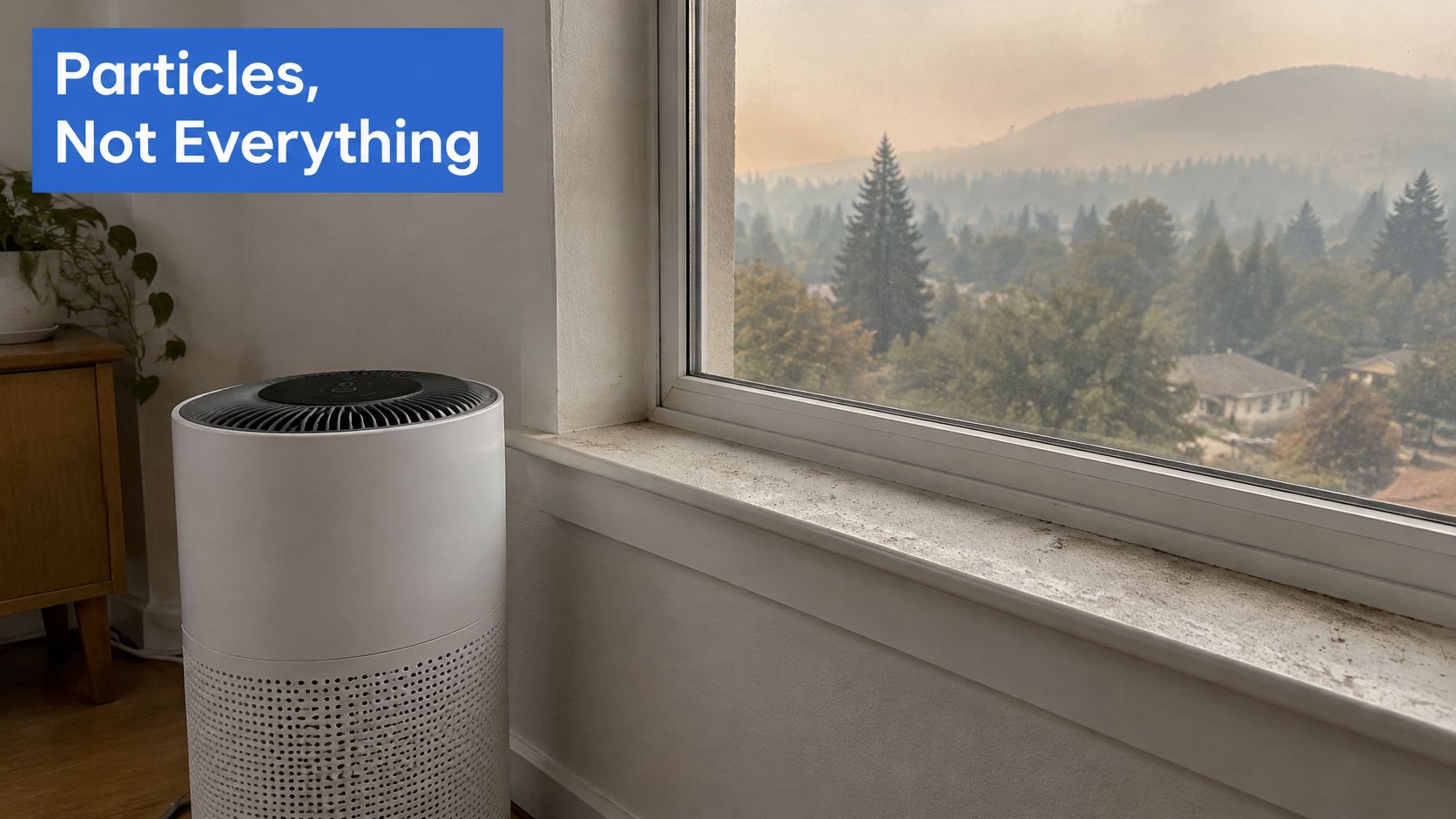
A small HEPA purifier can reduce airborne particles in its room, but it cannot control every source of poor air. For example, a unit may capture smoke particles while outdoor smoke continues to enter through an open window. Closing the window and addressing the source still matter.
HEPA filtration does not seal building leaks, remove carbon monoxide, or pick up dust that has settled on floors. The EPA's guidance on air cleaners and airborne infection describes filtration as one part of a broader approach and warns against devices that intentionally generate ozone.
Wildfire haze makes these limits easier to see.
Match the tool to the pollutant
HEPA filters capture particles; appropriately sized activated carbon can help treat gases and odors. Those jobs are not interchangeable. Reducing smoke particles does not show that smoke-related gases have also been removed, and a fresher smell does not show how well particles are being filtered.
For settled dust and allergens, clean the surfaces themselves. A purifier circulates and filters air; it does not vacuum rugs or floors. Rubber Ducky Rug Cleaning Birmingham's guide offers a companion resource on reducing allergens through surface cleaning.
Set up for a smoke event
Follow local safety instructions and reduce exposure where you can:
- Limit entry: Close windows and doors where appropriate to reduce incoming smoke.
- Run the unit: Use the highest speed you can tolerate continuously.
- Place it carefully: Keep it near the occupied breathing zone or relevant source, with airflow unobstructed.
- Check the filter: Look for loading or declining airflow, then follow the model's replacement guidance.
- Maintain separate protection: Use a dedicated carbon monoxide alarm.
Exclude intentional ozone generators from a HEPA purifier comparison. Ozone does not replace mechanical particle filtration, can irritate breathing, and is not an occupied-room solution for biological pollutants.
For airborne infection concerns, filtration can be an added measure, not a guarantee against transmission or a reason to disregard other precautions.
How to Replace the HEPA Filter on Schedule
Both the filter and the fan matter. A maintenance schedule helps preserve the performance you selected, but it must follow the actual model's manual rather than a generic replacement calendar.
Start by locating the instructions and the correct replacement part. Don't open a sealed cartridge, wash a filter, or substitute a similar-looking part unless the manufacturer permits it.
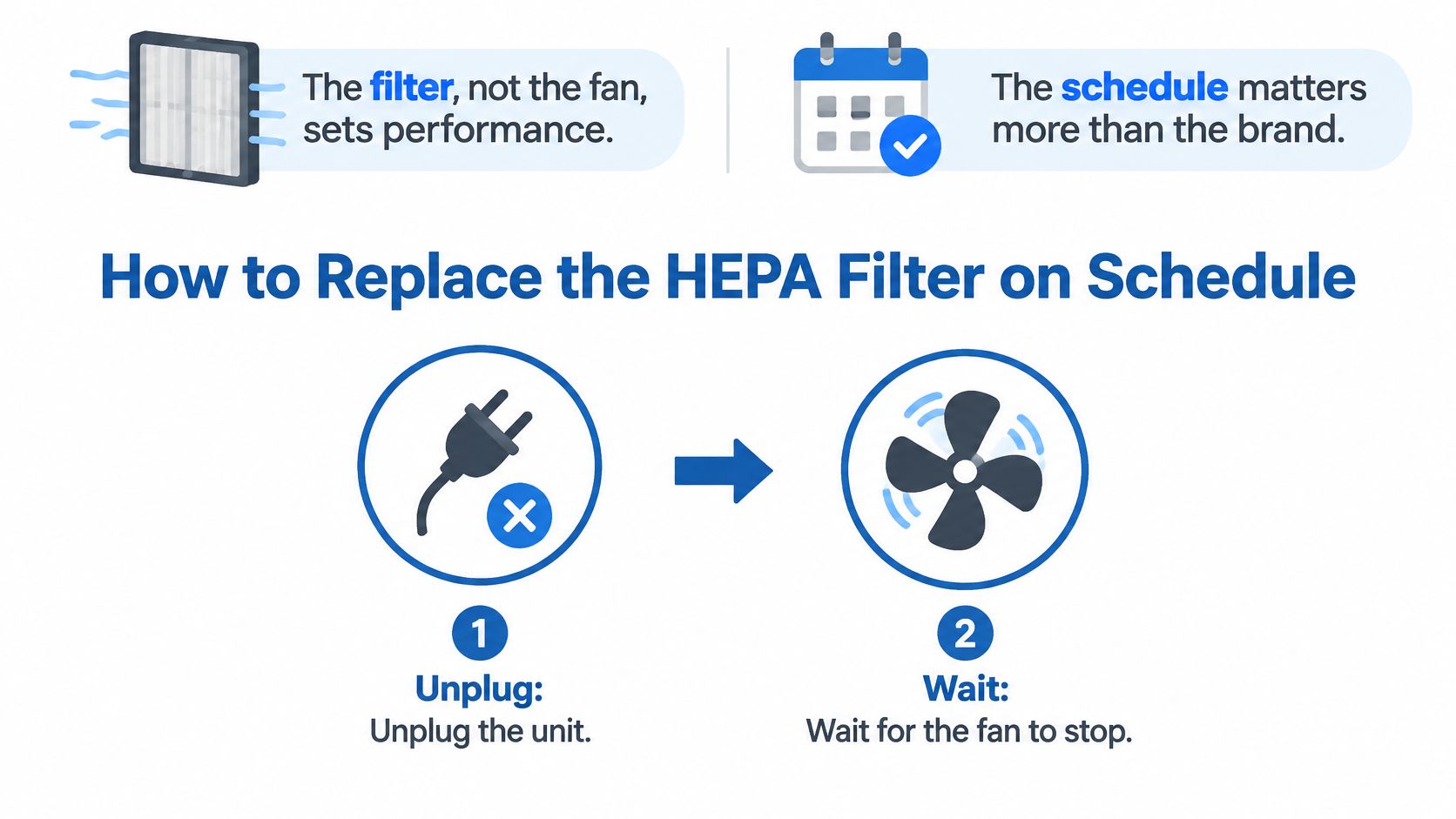
The maintenance illustration emphasizes the safe starting point.
Follow the airflow path
Use this procedure alongside the model-specific instructions:
- Disconnect power. Unplug the purifier and wait until the fan stops.
- Open the access panel. Follow the manual rather than forcing clips or covers.
- Check the pre-filter. Vacuum, rinse, or replace it only as directed. Let any washable component dry fully before reinstalling it.
- Record the orientation. Note airflow arrows and the old filter's position before removing it.
- Inspect the housing. Clean accessible surfaces as instructed and look for damaged seals or gaps.
- Install the correct replacement. Match the specified orientation and seat the frame securely.
- Reassemble the purifier. Close the panel and reset the indicator if the manual calls for it.
- Check operation. Listen for unusual rattling and confirm that airflow feels normal.
Don't assume a filter is installed correctly just because the panel closes. The frame and seal need to sit as intended so air travels through the filtration path rather than around it.
Before ordering, compare the model designation with the listing for replacement filters, screens, and HEPA components. Confirm compatibility rather than choosing by appearance alone.
Filter check and replacement intervals
There isn't a universal interval that applies to every small purifier. Use this condition-based checklist with the manufacturer's schedule.
| Filter | Typical check interval | Replace when | Faster wear from |
|---|---|---|---|
| Pre-filter | At the manual's inspection interval | Cleaning is due, damage appears, or the manual requires replacement | Coarse debris and dusty conditions |
| HEPA filter | On schedule and after substantial particle exposure | The indicator calls for replacement, loading is substantial, or airflow declines | Smoke, cooking particles, and sustained heavy use |
| Activated carbon | At the specified service interval and when odors recur | Odor-control performance declines or the manual calls for replacement | Repeated exposure to cooking, smoke, and other odors |
A discolored filter isn't, by itself, a precise measurement of remaining performance. Consider visible loading together with airflow, exposure history, the indicator, and the manual.
This video offers an additional maintenance reference; your own model's instructions remain the authority.
Don't use smell as a HEPA replacement test. Odor control and particle filtration involve different components, so a filter can need attention without producing an obvious smell.
Noise and Placement for Quiet, Effective Cleaning
The fan setting that delivers the most clean air may also be the setting you're least willing to leave running. Choose for usable performance, not just a maximum specification you won't tolerate during sleep or work.
When sound information is available, compare settings rather than relying on a single quiet-operation claim. Ask whether the airflow or CADR information applies to the same setting you intend to use.
Give the purifier an open airflow path
Placement should follow the manufacturer's clearance instructions. Don't substitute a universal distance for a model-specific requirement.
- Leave openings clear: Keep the intake and outlet away from furniture, curtains, and stored items.
- Avoid enclosed spots: A tucked-away shelf or concealed corner can interfere with the intended airflow path.
- Use a stable location: Near the occupied area is practical, provided the surface and position meet the manual's requirements.
- Consider the room's activity: In an open layout, avoid placing the unit where furniture separates it from the area you're trying to treat.
- Respect nearby equipment: Don't crowd heaters, vents, or doorways, and keep cords out of walking routes.
For bedroom use, prioritize a position you can maintain overnight without covering the intake or moving the purifier out of the way. Compare the specifications of bedroom air purifiers against that intended location, not just the room's decor.
Check operation before committing to a routine
Run the purifier at the setting you expect to use while reading, sleeping, or working. If you immediately turn it down, reassess whether its lower-setting performance fits your needs.
The importance of airflow is reflected in the ASHRAE filtration and disinfection FAQ, which discusses portable HEPA cleaning and clean-air delivery.
For electricity planning, use the purifier's stated power consumption at the intended setting and your electricity tariff. Calculate energy from power multiplied by operating time rather than assuming that every compact unit costs the same to run.
Pick the Right Small HEPA Category for Your Room
For a bedroom with smoke or allergy particles, start by checking a compact HEPA purifier's tested smoke CADR and filter label. For a closet with persistent odors, look for a carbon odor unit instead. Those devices address different needs, so compare the technology and documentation that match your situation.
A small purifier can suit a limited space, but the room-size label alone does not show how well it cleans the air. Use the measured room and the sizing guidance from the earlier table, then check whether the candidate's tested smoke CADR meets the target. A marketing room-size number is not a substitute for that comparison.
Model category by room need
| Situation | Model category to check | What to confirm |
|---|---|---|
| Bedroom or nursery | Compact HEPA purifier; assess plug-in candidates separately | Verified filter label, tested smoke CADR, and suitability for the measured room |
| Bathroom, closet, pantry, or garage odor | Carbon-filter odor unit | Carbon component, replacement details, and permitted operating conditions |
| Allergy or wildfire-smoke room | Compact HEPA unit with published smoke CADR | Tested delivery meets the relevant sizing target |
| Car or travel | Portable car purifier | Verified HEPA claim, power compatibility, and replacement-filter provision |
Compare two candidates for the same room by checking their filter labels and tested smoke CADR. If one lists only a room-size recommendation and the other provides the relevant test information, the second gives you firmer grounds for judging particle-cleaning capacity.
The EcoRoom Plug-In Air Purifier for Small Rooms is described as a compact wall-plug air cleaner for small rooms, bedrooms, bathrooms, and offices. That description identifies its format and intended settings, but does not verify a HEPA classification or tested smoke CADR. Count it as a HEPA option only if its product documentation confirms those requirements.
Keep odor control separate from HEPA particle cleaning. A carbon component is intended to address odors, while the HEPA label and smoke CADR help assess particle filtration. Check the device instructions for operating conditions and identify all included technologies. Exclude ozone generators from this recommendation.
Make the purchase conditional on documentation
Check replacement-filter compatibility before choosing a machine. Confirm the correct HEPA cartridge and any carbon component, then review current availability and terms on the product page.
If the seller cannot provide the test information you need, keep comparing. Missing documentation does not confirm that a purifier meets your requirement.
- Measure the space. Record floor area, ceiling height, and whether adjoining areas remain open.
- Choose the target. Use the sizing table for the particle conditions you want to address.
- Verify the model. Confirm tested smoke CADR, filter documentation, and the exact replacement filter before buying.
EcoQuest Purifiers offers indoor-air products, replacement parts, and repair services for different applications. Visit EcoQuest Purifiers with your room measurements and CADR target, then request the filter documentation and replacement-part details you need to assess a small-room purifier.