
HEPA Air Purifier vs Ionizer: How to Choose
A true HEPA purifier is the default for particles in occupied rooms, with a filter benchmark of at least 99.97% capture at 0.3 microns, while an ionizer isn't a substitute for gas or odor removal and may emit ozone. That benchmark describes the filter, not the percentage of pollution that will disappear from your room.
The popular advice to choose whichever device sounds more powerful misses the main issue: dust, smoke particles, odor-producing gases, and contaminated surfaces require different interventions. A useful HEPA air purifier vs ionizer comparison starts with what you're trying to remove, then asks where the pollutant goes and what the equipment adds to the air.
Table of Contents
- HEPA vs Ionizer in One Comparison
- How HEPA Traps What Ionizers Charge
- Particles Odors and Smoke Are Different Jobs
- Ozone Limits and How to Check Claims
- Measured Particle Removal and CADR Gaps
- Rooms and Pollutants That Change the Pick
- Maintenance and Running Costs
- Choose HEPA Ionizer or a Hybrid Next
HEPA vs Ionizer in One Comparison
Choose a mechanical HEPA purifier first when people need airborne-particle control in a home, office, or care room. Consider ionization only when its actual particle performance and ozone emissions are documented, not because the product promises fresher air.
HEPA air purifier vs ionizer at a glance
| Criterion | HEPA air purifier | Ionizer |
|---|---|---|
| Capture specification | Pleated mechanical filter; at least 99.97% of 0.3 micron particles on a filter test | Electric charge; no equivalent capture percentage |
| Where particles go | Held in the filter until it's replaced | May deposit on walls, floors, furnishings, or a collector plate |
| Larger allergens | Designed to trap pollen and household dust that reach the filter | Can be relatively ineffective against pollen and household-dust allergens |
| Gases and odors | Not removed by HEPA media alone | Doesn't remove gases or odors |
| Smoke particles | Mechanical filtration traps smoke particles without making ozone | Not recommended; performance is uncertain and ozone may be produced |
| Ozone by-product | Mechanical HEPA filtration doesn't generate ozone | May emit ozone; output must be verified |
| Default for occupied rooms | First choice for particle control in homes, offices, and care settings | Consider only after emissions verification and a clear pollutant goal |
The room-performance caveat matters: airflow, room size, filter loading, leakage, and clean-air delivery rate, or CADR, all affect the result. An efficient filter can't clean air that never passes through it, and an undersized appliance doesn't become suitable because its filter specification looks impressive.
Capture isn't the same as relocation
A HEPA unit combines a fan with a pleated mechanical filter. It provides a defined destination for captured particles: the filter medium that you'll eventually remove and replace.
An ionizer charges airborne particles electrically. Some electronic systems collect those particles inside the appliance, but others rely on deposition around the room. Those are different housekeeping arrangements, even if both reduce the amount of particulate matter suspended in the air.
Buying principle: Ask where the pollutant ends up, not just whether the appliance changes what's floating in the room.
This distinction also prevents a misleading comparison between a basic HEPA unit and a hybrid appliance. If a purifier contains HEPA, carbon, and ionization, evaluate each stage separately rather than crediting every result to the ionizer.
For a room with lingering smells, the relevant question is gas removal and source cleanup. For any electronic treatment in an occupied space, the separate question is verified ozone output.
How HEPA Traps What Ionizers Charge
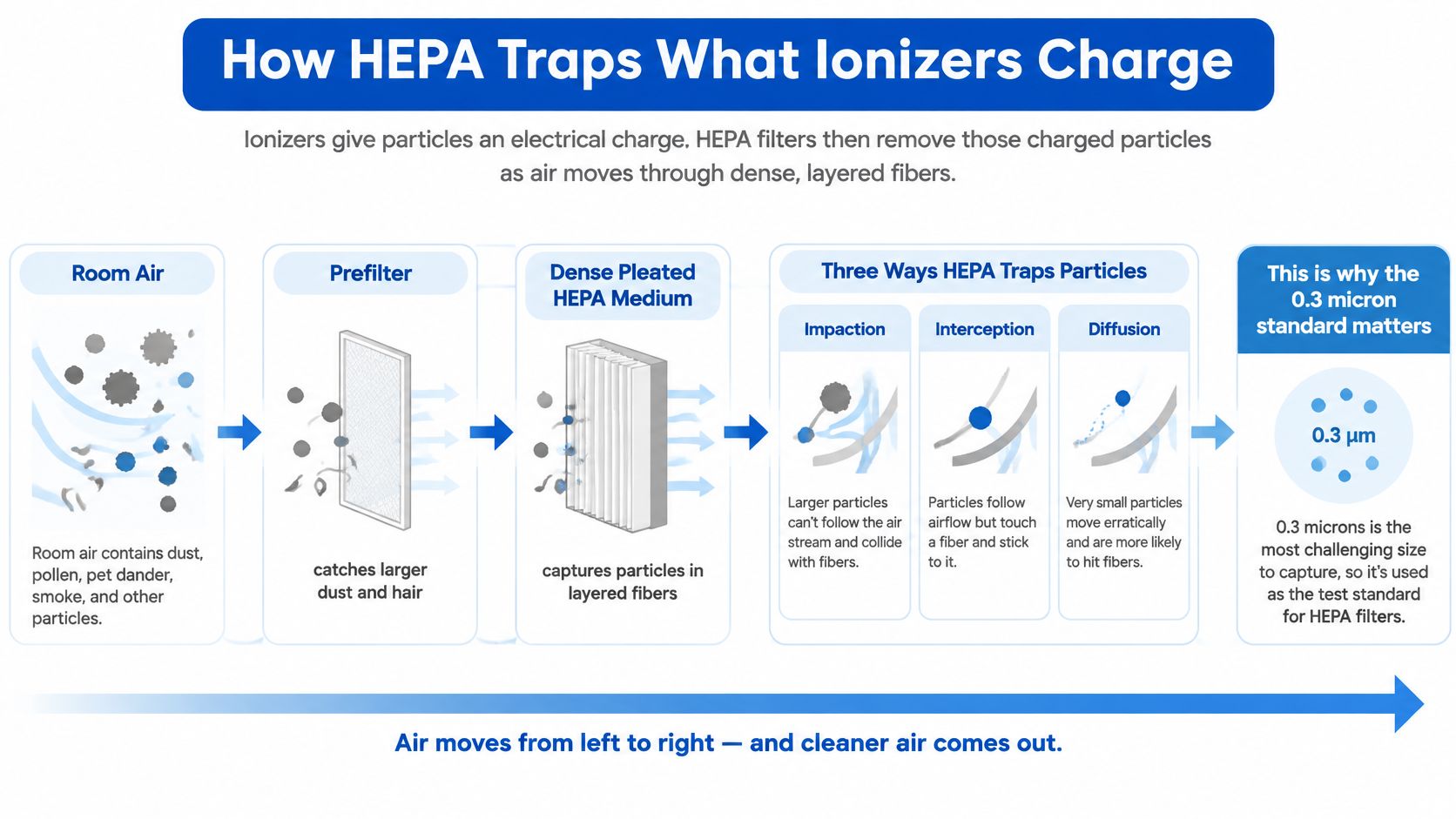
Follow the air rather than the marketing label. In a typical multistage HEPA purifier, the fan draws room air through a prefilter that catches larger dust and hair, then through a dense, pleated filtration medium.
The diagram shows the mechanical capture path.
Why the reference particle size matters
Fibers capture particles through impaction, interception, and diffusion. Some particles collide with fibers because they can't follow the airflow around them; others touch a fiber as they pass, while very small particles move irregularly and encounter fibers along their path.
The U.S. Environmental Protection Agency's HEPA explanation defines the filter as theoretically capable of removing at least 99.97% of airborne particles measuring 0.3 microns, a difficult reference size for efficient capture. That isn't a lower-size cutoff, and it isn't a guarantee that room contamination falls by the same percentage.
The practical distinction is between filter efficiency and room cleaning. Filter efficiency concerns particles in the air passing through the medium; room cleaning also requires enough contaminated air to reach that medium without bypassing it.
What happens after an ionizer charges particles
An ionizer uses an electrical field to charge particles instead of relying solely on mechanical capture. Charged particles may move toward collection plates or deposit on surrounding surfaces, depending on the equipment design.
When examining a plug-in air ionizer, check whether it includes a collection mechanism. A wall-plug format alone doesn't tell you where the particles go or how much clean air the device delivers.
The video offers another view of the filtration process.
The maintenance consequences follow from those air paths. A loaded mechanical filter can restrict airflow and needs replacement, while deposited charged dust requires cleaning from plates, furniture, floors, or walls.
- For a filter-based appliance: Confirm that air passes through a properly fitted medium rather than around its edges.
- For an ionizing appliance: Identify the collection surface and the procedure for removing accumulated material.
A clean-looking outlet and a dusty baseboard can both be true of an ionizer. The particles may have left the breathing zone without leaving the room.
Particles Odors and Smoke Are Different Jobs
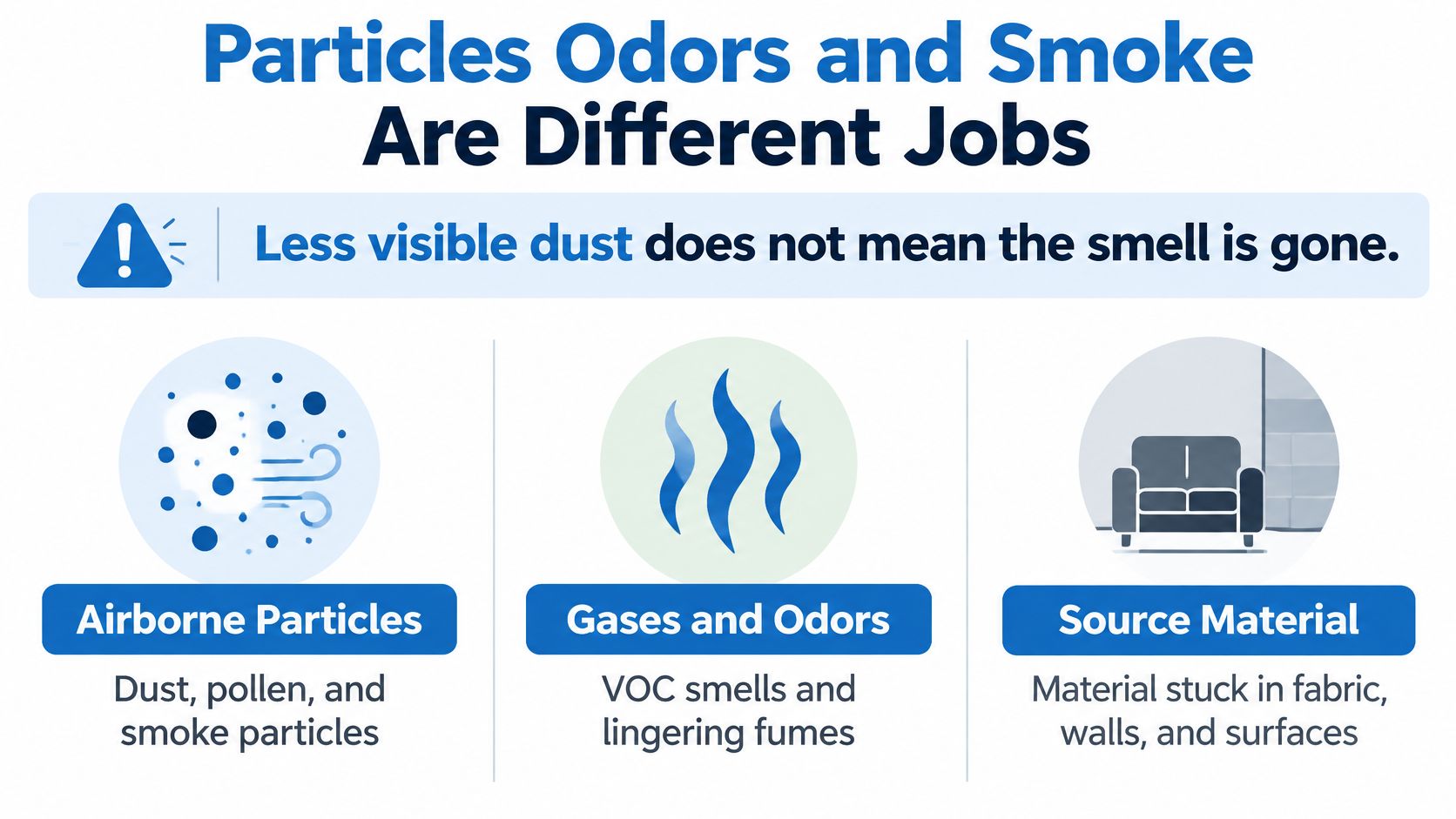
Less visible dust doesn't mean the smell is gone. A room can look clearer while odor-producing chemicals remain in the air or continue escaping from contaminated upholstery.
The EPA's guidance on ionizers and ozone-generating air cleaners says ion generators may remove some small particles, including tobacco-smoke particles, but don't remove gases or odors and can be relatively ineffective against larger pollen and household-dust allergens. That makes pollutant identification more useful than a general claim of purification strength.
These objectives need separate treatment.
Match the intervention to the material
Airborne particles include dust, pollen, and the particulate portion of smoke. Mechanical filtration captures this material when it reaches the filter, making airflow and placement part of the solution.
Gases and odors require a different approach. Start with source removal and appropriate ventilation, then consider a properly selected gas-phase medium such as activated carbon. HEPA media alone isn't a gas-removal stage, and adding ions doesn't make it one.
Surface-bound contamination requires cleaning, removal, or remediation of the affected material. A room air cleaner doesn't finish the job when smoke residue remains in upholstery or moisture-damaged drywall continues to support mold.
Which pollutant is causing the problem, and does the device actually capture or chemically remove it?
Smoke exposes the weakness in broad claims
Say a cigarette-smoked room has both suspended particles and a smoke-saturated sofa. A HEPA purifier can address the airborne particulate fraction, but the sofa can remain a source of odor. Replacing the air cleaner with an ionizer doesn't resolve that source.
Mechanical filters, including HEPA, trap smoke particles without producing ozone through the filtration process. Electronic cleaners aren't the preferred smoke intervention because their performance is uncertain and ozone may be produced.
Microbial claims need the same discipline. Capturing bacteria-containing material that reaches a filter isn't equivalent to disinfecting the room, treating an infection risk, or remediating a damp building.
- For smoke: Address the source and airborne particles separately.
- For persistent smells: Investigate fabrics, furnishings, drains, and other possible sources before adding equipment.
- For mold: Correct the moisture problem and deal with affected materials rather than treating filtration as remediation.
The useful outcome isn't air that merely seems different. It's a treatment plan that accounts for the pollutant's physical form and its source.
Ozone Limits and How to Check Claims
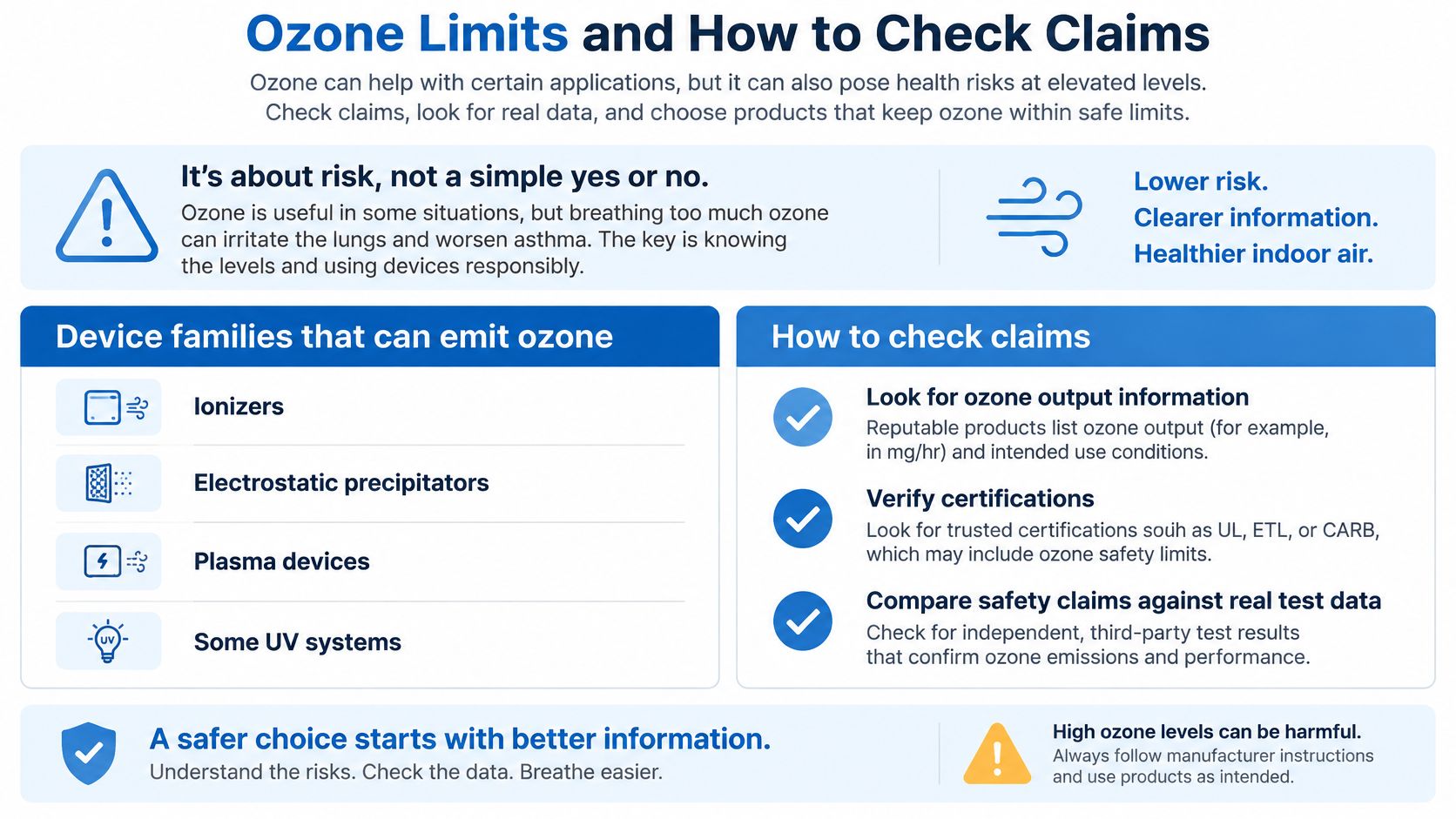
An ionizer isn't automatically an intentional ozone generator, but that distinction doesn't establish its suitability for an occupied room. Evaluate the specific device, its emissions, the installation conditions, and the people who'll breathe the treated air.
The California Air Resources Board's air-cleaner regulation fact sheet states that covered indoor air-cleaning devices must emit less than 0.050 parts per million of ozone. Regulatory compliance isn't a blanket assurance that every electronic air-cleaning arrangement is appropriate for every occupant.
The verification process should be more concrete than reading the front of the box.
Check the technology and the paperwork
Ionizers, electrostatic precipitators, plasma devices, and some UV systems can emit ozone. Terms such as ozone-free, negative-ion, and active purification don't provide equivalent evidence.
Use this checklist before operating an electronic treatment feature around people:
- Identify every active stage: Check whether the appliance uses ionization, plasma, UV, or intentional ozone production alongside its filter.
- Request model-specific emissions evidence: Look for an independent report or certification that identifies the model you're buying.
- Verify bipolar-ionization claims: Look for UL 2998 zero-ozone certification, not an unsupported badge or a general statement about the technology.
- Read the operating conditions: Confirm the stated room size, ventilation instructions, and any restrictions on occupied use.
- Account for vulnerable occupants: Children, older adults, and people with asthma or other respiratory disease warrant particular caution.
Recognize a failed verification
No accessible test report means the emissions claim remains unverified. A product sold specifically to generate ozone isn't an occupied-room substitute for filtration, and a small closed room isn't an appropriate place to improvise around unclear instructions.
EPA advises avoiding cleaners that intentionally produce ozone. Treat a statement about odor treatment as separate from evidence that the device can operate appropriately while people are present.
Verification rule: A low-emissions claim answers an emissions question. It doesn't prove particle-removal performance.
For particle control, mechanical HEPA remains the simpler default. Any ionization feature should wait until its ozone performance is documented and its intended use fits the health context of the occupants.
Measured Particle Removal and CADR Gaps
| Measure | HEPA portable cleaners | Ion generators | Reference point |
|---|---|---|---|
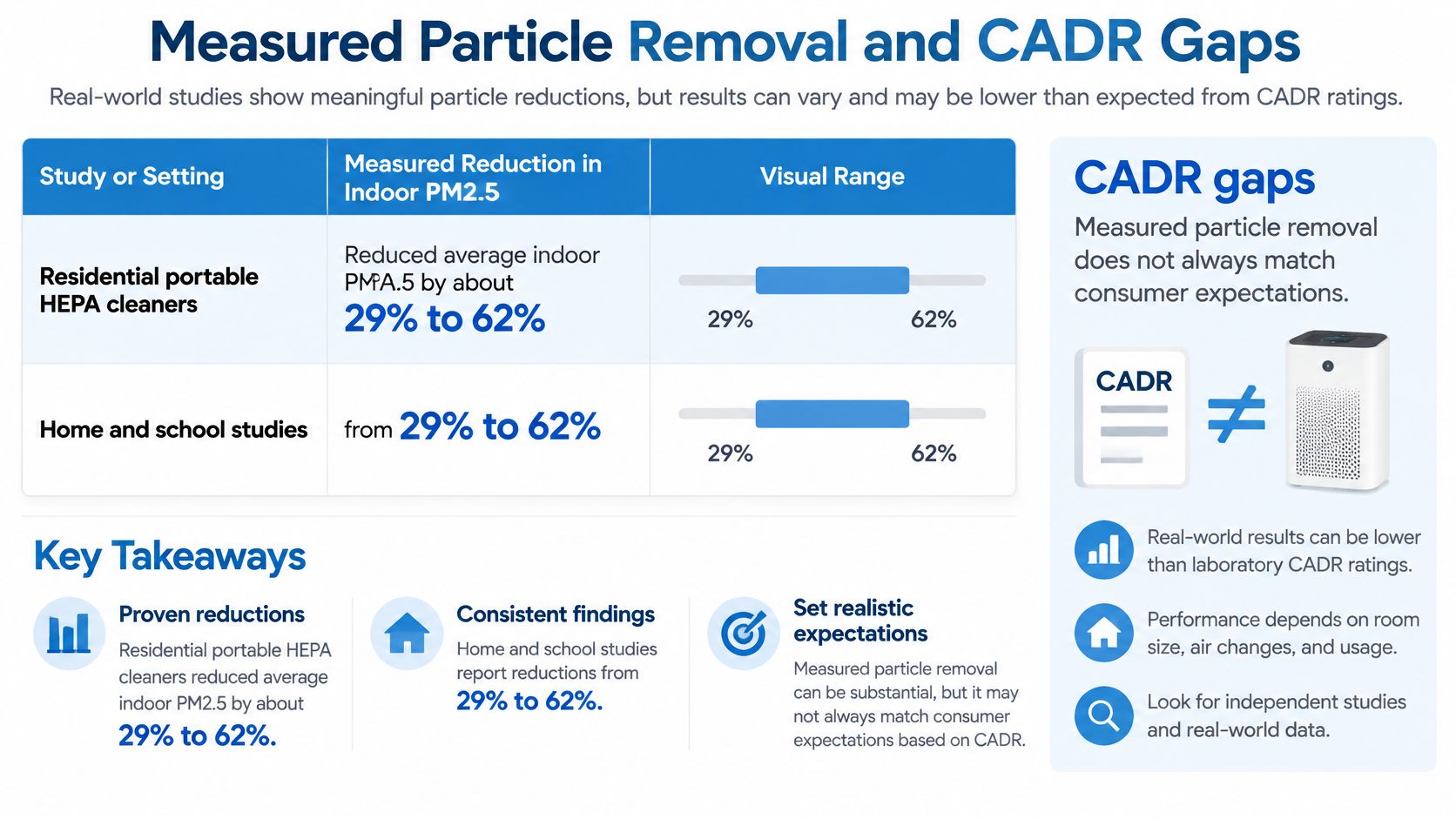
| Indoor PM2.5 change | About 29% to 62% average reduction; home and school studies from 22.6% to 92.0% | No equivalent PM2.5 range reported | Setting and equipment change the result |
| Particle CADR | Higher than ionizers in the reviewed evidence | 0 to 90 cubic meters per hour | Ion-generator CADRs were at least an order of magnitude below examined HEPA CADRs |
| Ozone emission | Not a by-product of mechanical filtration | 0.056 to 13.4 milligrams per hour for corona-based units | FDA medical-device ozone limit of 0.05 ppm |
| Other by-products | None cited from the filter itself | Some investigations found increased ultrafine particles, ozone, and certain aldehydes | Avoid ozone-generating cleaners in occupied spaces |
These published performance and ozone figures come from the review summarized by the Federation of European Heating, Ventilation and Air Conditioning Associations, which reports residential HEPA PM2.5 reductions of approximately 29% to 62%, broader home-and-school reductions of 22.6% to 92.0%, ion-generator CADRs of 0 to 90 cubic meters per hour, corona-unit ozone emissions of 0.056 to 13.4 milligrams per hour, and the FDA medical-device ozone reference of 0.05 ppm.
The visual below highlights the performance comparison; measured room reductions and CADR are different measures, not interchangeable percentages.
What changes the buying decision
CADR describes particle-cleaning output, making it more useful than the mere presence of ions. For a HEPA unit, a higher tested particle CADR means more equivalent clean-air delivery at the tested operating setting. Match that output to the room rather than selecting on filter efficiency alone.
An ionizer with negligible tested CADR won't provide meaningful living-room particle cleaning because it emits ions. Conversely, a capable purifier run infrequently or at a much lower setting than the tested setting won't reproduce an idealized result.
The ozone figures require another distinction: emission rate isn't room concentration. Milligrams per hour describe output, while parts per million describe concentration; room volume, ventilation, and ozone losses affect the relationship.
- Compare like with like: Use particle CADR to compare particle cleaning, not ozone output or an ion-count claim.
- Measure the relevant pollutant: If choosing an air quality monitor, verify which pollutants it measures.
- Keep the scope honest: These are study results across particular devices and settings, not promises for an untested appliance.
For smoke-particle control, the practical conclusion remains mechanical filtration with appropriate clean-air delivery, not electronic treatment selected on marketing language.
Rooms and Pollutants That Change the Pick
Bedroom pollen and dust, with someone sleeping nearby: Choose a true HEPA purifier sized for the bedroom. Start at a stronger setting, then use a tolerable overnight setting with enough airflow; don't assume a quiet sleep mode delivers the same cleaning output as the rated setting.
For a bedroom-focused setup, close the door to define the area being treated, but maintain the ventilation the occupants and building require. Keep the intake and outlet clear of curtains, bedding, and furniture.
Apply the pollutant-first choice
Wildfire smoke or cigarette particles around occupants call for mechanical HEPA filtration and source control. Avoid creating a second inhalation concern by substituting an ozone-producing treatment for particle capture.
Lingering odor in a home or rental calls for investigation before another appliance purchase. Renue Systems Four Points' discussion of source control for better indoor air is a useful companion when planning cleaning and source reduction alongside filtration.
- Restaurants, salons, and gyms: Identify whether the concern is particles, chemical vapors, or contaminated materials. Use filtration and suitable ventilation during occupied hours rather than describing an ionizer as an odor eraser.
- Daycare, eldercare, and clinics: Favor mechanical filtration for particle control, avoid intentional ozone around vulnerable occupants, and follow facility-specific ventilation and infection-control requirements.
- Cars and travel: Select particle filtration appropriate to the cabin and available power. Never operate an ozone generator in an occupied vehicle.
- Mixed particles and gases: Consider HEPA plus a suitable carbon stage, with ionization evaluated independently rather than accepted as a replacement for either.
Compact format doesn't establish performance
The EcoRoom Plug-In Air Purifier for Small Rooms is a compact wall-plug air cleaner described for small rooms, bedrooms, bathrooms, and offices. That format avoids using shelf or desk space, but it doesn't by itself establish HEPA capture, tested CADR, or ozone performance.
The same purchasing discipline applies to any compact appliance. Ask for the mechanism, room-performance evidence, and emissions documentation rather than inferring suitability from its size or placement.
For a hybrid, assess whether its mechanical stage can meet the particle goal on its own. Additional technology is useful only when it addresses a defined problem without introducing an unverified exposure.
Maintenance and Running Costs
A purifier's operating cost includes electricity, replacement media, and the work needed to keep its cleaning performance usable. Without model-specific prices and operating information, a credible comparison can't assign an annual total.
Upkeep and running cost by technology
| Item | HEPA air purifier | Ionizer |
|---|---|---|
| Routine upkeep | Replace filter when airflow drops or at the manufacturer's interval | Clean collector plates, if fitted, and deposited dust on surfaces |
| Gas-phase stage | Replace activated carbon separately when required | Ionization doesn't remove gases; a separate suitable medium is needed |
| Ozone verification | No ozone-producing mechanism in mechanical filtration alone; check added features | Check independent emissions evidence and applicable certification for the model |
| Replacement cost | Check the exact replacement filter's listed price | Check for other consumables; plate-only designs still require cleaning labor |
| Running cost | Calculate from electricity use and actual filter replacement schedule | Calculate from electricity, any consumables, and cleaning time |
Budget for the actual maintenance path
A HEPA filter accumulates particles, and loading can restrict airflow. Use the manufacturer's replacement guidance and investigate reduced airflow rather than continuing indefinitely with a visibly overloaded filter.
Carbon is a separate consumable. If odors return after source removal, inspect the gas-phase stage and replace it as appropriate; don't assume the HEPA filter is responsible.
With an ionizing system, remove deposits from collector plates and surrounding surfaces using the manufacturer's cleaning procedure. Washable collection doesn't mean maintenance-free operation.
- Inspect regularly: Check indicators and the prefilter, and keep intake grilles unobstructed.
- Record replacements: Log filter and carbon changes so recurring costs are visible.
- Retain documentation: Keep the rated room information, operating instructions, and model-specific emissions evidence together.
Ozone verification is a purchasing check for the model, not a routine cleaning charge. Neglecting filters or plates can make an inexpensive appliance poor value because you've paid for cleaning performance you're no longer maintaining.
Choose HEPA Ionizer or a Hybrid Next
- Name the pollutant. Decide whether you're addressing airborne particles, gases and odors, or soiled surfaces. If the complaint is merely stale air, investigate its source and ventilation conditions before selecting a treatment.
- Identify the occupants. Note whether children, older adults, or anyone with asthma or another respiratory condition will use the space while the device runs. Treat occupied-room use as a design requirement, not an afterthought.
- Match particle output to the room. Start with a true HEPA unit and compare tested CADR at the setting you'll actually use. When reviewing HEPA air purifier options, request the filter specification, room-sizing information, and replacement-media details.
- Add only what's justified. Consider suitable carbon when gases remain after source removal and appropriate ventilation. Consider ionization only with independent ozone evidence, or applicable zero-ozone certification for bipolar equipment, and a clear reason to include it.
What to buy and what to skip
Don't buy a standalone ionizer as the primary solution for pollen, household dust, or smoke. Don't run an ozone-producing cleaner in an occupied home, office, car, or care room.
A hybrid isn't automatically a stronger choice. HEPA plus carbon addresses different pollutant classes; an added ionization feature still needs its own emissions and performance assessment. If that feature can't be independently evaluated, don't treat its presence as a benefit.
The most useful appliance is the one whose documented performance matches the pollutant, room, and occupants, not the one with the longest technology list.
For most occupied rooms, a correctly sized mechanical HEPA purifier is the simplest particle-control choice. Add a suitable gas-phase stage for a demonstrated gas problem, while treating ionization as an optional feature that must justify itself.
Take this checklist to the store or use it when comparing specification sheets:
- Pollutant named: Particles, gases, surface contamination, or a defined combination.
- Occupants listed: Including people who need particular protection from ozone.
- CADR matched: Suitable for the room and intended operating setting.
- Carbon status confirmed: Present and appropriate if gas removal is required.
- Ozone status verified: Supported by model-specific evidence for electronic features.
EcoQuest Purifiers offers indoor-air equipment across HEPA, charcoal filtration, and electronic technologies, along with replacement parts and repair services. Visit EcoQuest Purifiers with your room dimensions and pollutant checklist, and request the relevant CADR, filter, and ozone documentation before choosing a unit.