
How Much Electricity Does an Air Purifier Use in 2026?
A standard room air purifier uses about 45 watts on average when running continuously, or roughly 394 kWh per year, according to ENERGY STAR. That annual figure is a reference point, not a prediction for every household: the wattage printed on a unit usually reflects its highest fan setting, while actual use depends on speed and schedule.
Power use alone does not show whether a purifier is good value. Compare its kWh consumption with the clean air it delivers. A low-wattage unit may move too little air for the room, while a higher-draw model may clean more effectively in less time. Fan speed, operating hours, filter condition, and automatic speed changes all affect the bill, so measured use varies between units and households.
Table of Contents
- Typical Power Draw and Annual Use Compared
- How to Calculate Your Purifier's Running Cost
- Monthly Cost at 8, 16 and 24 Hours a Day
- Why Real Use Falls Below the Rated Wattage
- Reading Energy Labels and Efficiency Ratings
- Cutting Your Bill and Choosing the Right Model
Typical Power Draw and Annual Use Compared
Published power figures vary because tests measure different settings and conditions. In 2025, Air Purifier First's test of 103 air purifiers reported an average draw of 39.1 watts, with units ranging from 1 to 215 watts. ENERGY STAR's air-cleaner guidance puts a standard room cleaner running continuously at about 394 kWh a year, equivalent to roughly 45 watts. Its certified models use more than 50% less energy, saving about 211 kWh annually.
| Purifier or test | Power draw | Annual energy |
|---|---|---|
| ENERGY STAR standard room cleaner, running continuously | About 45 W average | 394 kWh |
| ENERGY STAR certified model, running continuously | About 21 W average | About 183 kWh |
| HEPA portable unit, Seattle study, adjustable mode | 7.0 W mean (2.1–47.6 W range) | About 60 kWh |
| Airthings Renew, lowest setting | 2 W | About 17.5 kWh if that setting ran nonstop |
| Airthings Renew, boost mode | 26 W | 23 kWh projected, based on intermittent boost use rather than continuous operation |
| Average of 60 units at highest fan speed, HouseFresh 2025 | 57.69 W | About 505 kWh if held there all year |
| Average of 103 units tested, Air Purifier First 2025 | 39.1 W (1–215 W range) | About 342 kWh if that average ran nonstop |
The table combines a program benchmark, lab measurements, one product's settings, and a household study, so compare like with like. HouseFresh's 2025 test averaged 57.69 watts across 60 units at their highest fan speed. The annual figure assumes that top-speed draw continues around the clock; it is a ceiling-style comparison, not a typical-use estimate. Galaxus's Airthings Renew measurements report 2 watts on the lowest setting and 26 watts in boost mode. Its 23 kWh projection reflects intermittent boost use, not a year of continuous operation at 26 watts.
A lower wattage alone does not establish better value. Compare energy use with the clean-air delivery and the time needed to run the unit. Households covering several rooms may also compare several portable units with whole-house air purifiers, since each portable adds its own energy use.
How to Calculate Your Purifier's Running Cost
Start with watts for the speed you run, taken from the label or the spec sheet. If the sheet is unclear, clip a plug-in power meter on the cord and note each fan speed. The printed figure is a peak. Auto mode often sits far under it.
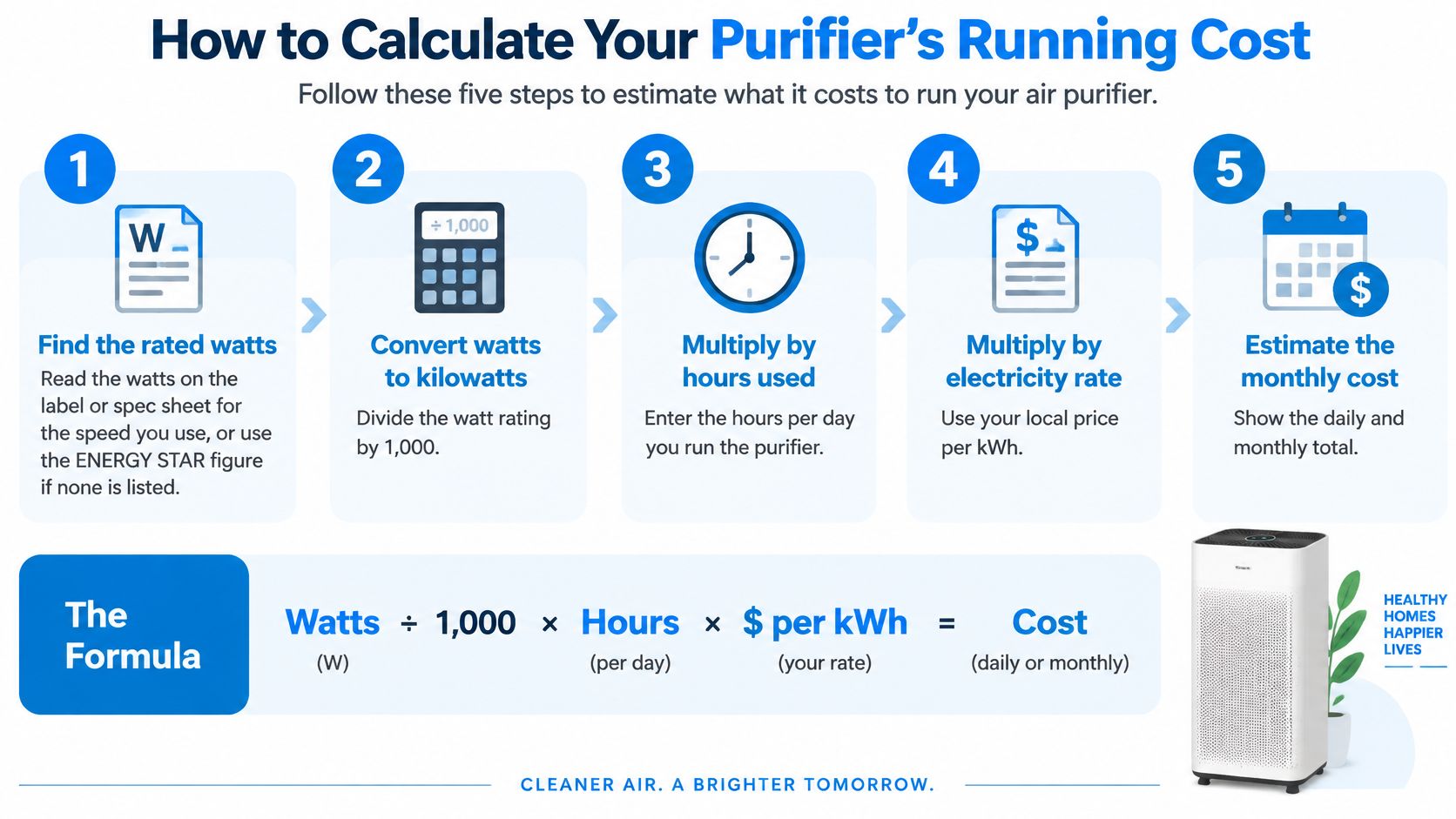
The same watt-to-dollar steps people use when they check how much aircon costs to run work here, only the watts are much smaller.
- Turn watts into kilowatts. Divide by 1,000. A 45-watt setting is 0.045 kW. Bills are priced in kilowatt-hours, so watts alone never become a charge.
- Multiply by hours per day. Sixteen hours is a sensible default for a bedroom or living room that is occupied most of the day and quiet overnight. Eight hours fits a room you only use in the evening.
- Scale to a month or a year. Multiply daily kWh by 30, or by 365. A 30-day month keeps the estimate easy to check against one billing cycle.
- Read your rate off the bill. Use the energy-charge line, or divide the energy charge by the kWh used. Ignore the fixed customer charge. It does not change when the purifier runs.
- Multiply kWh by that rate. That product is the running cost. It does not include filters.
Say a 45-watt purifier runs 16 hours a day at a hypothetical $0.17 per kWh. That is 0.045 × 16 = 0.72 kWh a day, 21.6 kWh a month, and about $3.67.
Three slips throw the estimate off. Using the maximum wattage while the unit sits on auto inflates the bill. Mixing watts with kilowatt-hours drops or adds three zeros. A tiered tariff charges a higher block once you pass a threshold, so the last kilowatt-hour can cost more than the first. Compare your calculated monthly kWh with the usage history on the bill. If the purifier is the only thing that changed and the meter did not move by roughly that amount, recheck the speed you metered.
Monthly Cost at 8, 16 and 24 Hours a Day
The monthly bill depends on how many hours the purifier runs and which setting it uses. The table compares three schedules for a 45-watt unit at a hypothetical $0.17 per kWh. A 30-day month puts 24-hour use at about 32.4 kWh, or $5.51. Sixteen hours costs about $3.67, while eight hours costs about $1.84.
| Scenario | Annual kWh |
|---|---|
| 8 hours a day, 45 W | 131 kWh |
| 16 hours a day, 45 W | 263 kWh |
| 24 hours a day, 45 W | 394 kWh |
The figures assume a steady 45-watt draw. A purifier running at lower settings may use less, while prolonged high-speed operation raises the total.
ENERGY STAR's 2025 key messaging says annual-use estimates commonly assume 16 hours of active operation a day, with standby use counted separately through the Integrated Energy Factor. Running a purifier continuously can therefore use more than its labelled annual estimate. The same messaging describes a proposed maximum standby requirement of 2 watts. It also reports that 2025 Most Efficient room cleaners used 72% less energy than the federal minimum and could save about $50 a year, depending on the model.
A short walkthrough of reading the label and the meter is here:
Electricity is only one part of ownership; filter replacement adds a separate yearly cost not included in the table. For a bedroom or office, compare one-room air purifiers by both clean-air delivery and power use: a low bill alone does not show whether a unit provides enough air cleaning for the room.
Why Real Use Falls Below the Rated Wattage
A sensor-controlled purifier can reduce its power use as the air clears. Filter condition and indoor pollution affect how long it stays at higher speeds, so the same unit can draw very different amounts across homes.
A peer-reviewed study of HEPA portable air cleaners in six Seattle residences measured mean power of 7.0 watts in adjustable mode and 6.8 watts in automatic mode. The study published via PubMed Central reported standard deviations of 3.5 and 2.6 watts, respectively. In adjustable mode, measured power ranged from 2.1 to 47.6 watts, while the manufacturer-listed maximum was 56 watts. The researchers estimated about 5 kWh per month for continuous operation in either mode, or roughly 60 kWh a year, compared with about 491 kWh a year at maximum power. The tested unit's stated dust CADR was 198 m³/h, and it used a pre-filter, activated carbon and HEPA filtration.
The gap between the average and maximum reflects changing fan speeds, not a guarantee that every home will use the same amount. Cooking, smoke or wildfire pollution can keep the fan running faster for longer. A loaded filter can also increase the effort needed to maintain airflow, while a sensor that responds to ordinary dust may delay the step-down to low speed.
High speed around the clock therefore produces a very different result from sensor-controlled operation in cleaner air. The Seattle measurements show why a maximum rating alone cannot predict a household's bill; CADR and energy efficiency still matter when comparing how much clean air a unit delivers for the electricity it uses.
For a bathroom, closet or pantry of 1–15 m², consider whether a full-size HEPA fan suits the space. The Air Ionizer Purifier EcoSpace is presented for small rooms and odor treatment. Match the purifier's purpose and room coverage to your needs, then compare its electricity use with the clean air it provides.
Reading Energy Labels and Efficiency Ratings
CADR and IEF answer different questions. CADR measures the volume of filtered air delivered per hour; IEF measures clean air delivered per watt. Read together, they show whether a purifier moves enough air for the room and how much electricity it uses to do so.
| Metric | What it measures | How to use it |
|---|---|---|
| ENERGY STAR certification | Meets ENERGY STAR efficiency requirements | Use certification to shortlist models, then compare CADR and IEF |
| Clean Air Delivery Rate (CADR) | Volume of filtered air delivered per hour | Match to room size; higher suits larger rooms |
| Integrated Energy Factor (IEF) | Clean air delivered per watt of power | Compare units of similar CADR; higher means more efficient |
| Maximum rated wattage | Draw at the highest fan speed | Treat as a worst case, not typical use |
| Standby power | Draw while on but not cleaning | Check the spec against the proposed ceiling; it matters most for 24/7 use |
A higher CADR supplies more filtered air each hour, which can matter in a large or polluted room. IEF shows how much power that delivery requires. Two purifiers with similar CADR can have different running costs if their IEF differs, even when their maximum rated wattage looks similar.
Match the room before you chase a low wattage
An oversized purifier can use more energy without a corresponding cleaning benefit, because it moves more air than the room needs. An undersized unit may need longer, louder operation while still falling short of the room's cleaning needs. Published yearly savings also vary with unit size and local electricity prices, so a national savings range may not match a household's bill.
Shortlist models that fit the room by certification and CADR, then compare their estimated kWh use. A low-watt unit can cost less to run yet deliver too little clean air; value depends on both its cleaning capacity and its energy use.
Cutting Your Bill and Choosing the Right Model
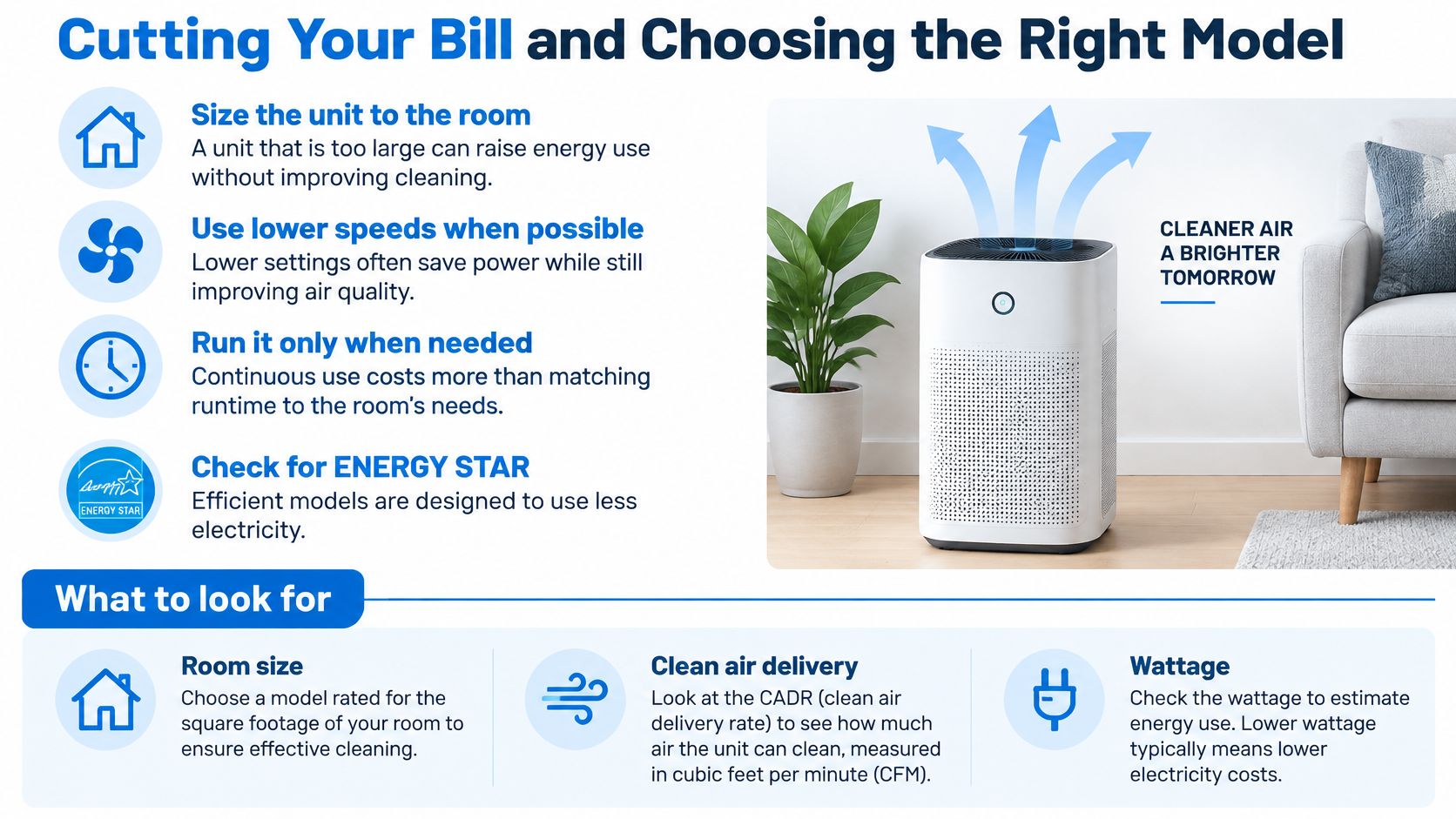
Small operating habits move the bill before you shop for a new machine.
- Size the unit to the room. Extra fan capacity you never need is energy with no cleaning gain.
- Keep the pre-filter clean. A loaded filter makes the fan work harder for the same air.
- Close the windows while it runs. Otherwise the fan is cleaning outdoor air as fast as it enters.
- Use a timer or smart plug for a room you only occupy in the evening, so the motor is not idling all day.
- Read standby on the spec sheet if the unit stays plugged in around the clock, and compare it with the proposed ceiling for always-on products.
The same habits sit inside a wider look at how to reduce your home electricity costs, where the purifier is one small load among larger ones.
Buying sequence
Decide room size and the CADR that matches it. Check certification and the Integrated Energy Factor. Drop anything that fails those two. Then run the watt-to-kWh steps on each remaining model at the speed you will use, not at the peak printed in the brochure. Browse air purifiers only after that shortlist exists, so price is the last filter rather than the first.
Calculate the monthly cost for your current schedule before you buy, and run the check again when the season changes. Smoke days and closed-up winters push the fan back to high, and a number you trusted in spring will not hold in August.
EcoQuest Purifiers carries room, whole-house, and small-space air cleaners, plus filters and replacement parts, so you can match capacity to the room instead of paying for fan power you do not need. Use the wattage and schedule math above, then compare certified and right-sized options against your own electricity rate. Visit EcoQuest Purifiers to look through the catalog and pick a unit whose clean-air delivery fits the space.