
Ozone Generator for Car: Safe Use and Legal Guide
An ozone generator can be useful for remediation in an empty vehicle, but it isn't a purifier for driving. EPA testing found some ozone-generating air cleaners producing approximately 0.20–0.30 ppm, so people and pets must never remain inside during treatment.
The popular advice to “run it for a while, then open the doors until the smell disappears” misses the most important safety question. A vanished odor doesn't prove that the air is safe to breathe. Ozone concentration depends on the generator, cabin volume, ventilation, temperature, humidity, upholstery, and HVAC configuration. A responsible treatment therefore ends with measured clearance, not a guessed waiting period.
Table of Contents
- What an Ozone Generator Actually Is
- Understanding Cabin Air Chemistry
- The Safety and Legal Boundaries
- Effective Use Cases and Treatment Results
- Ozone Generators vs Other Purification Methods
- Recommended Products and Equipment
- Safe Operation Protocol and Maintenance
What an Ozone Generator Actually Is
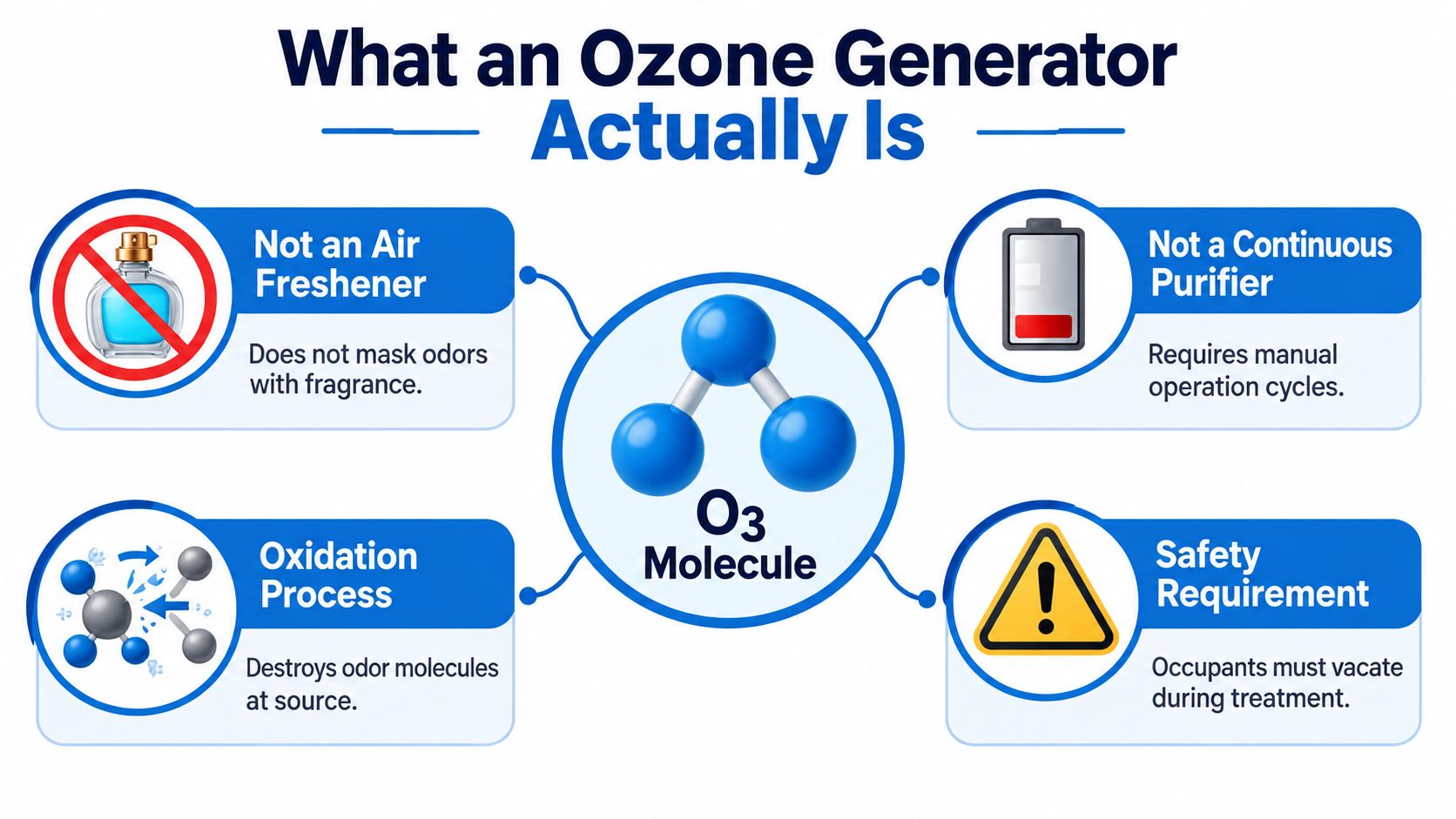
An ozone generator for car use isn't an air freshener, and it isn't a device you leave running while commuting. It produces ozone, a reactive gas that can oxidize odor-causing compounds. That operating principle makes it quite different from a mechanical filter, which captures particles without intentionally adding a respiratory irritant to the cabin.
The U.S. Environmental Protection Agency's guidance on ozone generators classifies ozone as a lung irritant. Inhalation can cause coughing, throat irritation, chest pain, and shortness of breath. EPA testing found that some ozone-generating air cleaners produced approximately 0.20–0.30 ppm in enclosed conditions, even when used according to manufacturers' directions. The FDA limit for ozone emissions from medical devices is 0.05 ppm, making the observed concentrations substantially higher.
Oxidation is not filtration
A filter traps or adsorbs contaminants. Ozone behaves chemically. It reacts with compounds associated with smoke, mildew, food, and other persistent smells, potentially changing their molecular structure rather than masking them with fragrance.
That doesn't mean the process is harmless or complete. Ozone can react with materials and volatile organic compounds inside the vehicle, and the resulting chemistry may introduce secondary pollutants. It also doesn't remove the physical source of an odor. A soaked carpet, contaminated cabin filter, moldy evaporator, or nicotine residue still needs cleaning or replacement.
Practical rule: Treat ozone as a controlled remediation step after cleaning, not as routine cabin maintenance.
The correct mental model is closer to a professional restoration tool than a portable purifier. The vehicle must be empty, the treatment must be controlled, and the cabin must be ventilated and checked before anyone gets back in. If you need continuous air treatment while driving, choose a technology that doesn't intentionally generate ozone.
Understanding Cabin Air Chemistry
A vehicle cabin is a small, enclosed environment with fabric, foam, plastic, rubber, glass, painted surfaces, and an HVAC system. Ozone doesn't float through this space unchanged. It moves with cabin airflow, contacts interior materials, and reacts with chemicals released by those materials or carried in from outside.
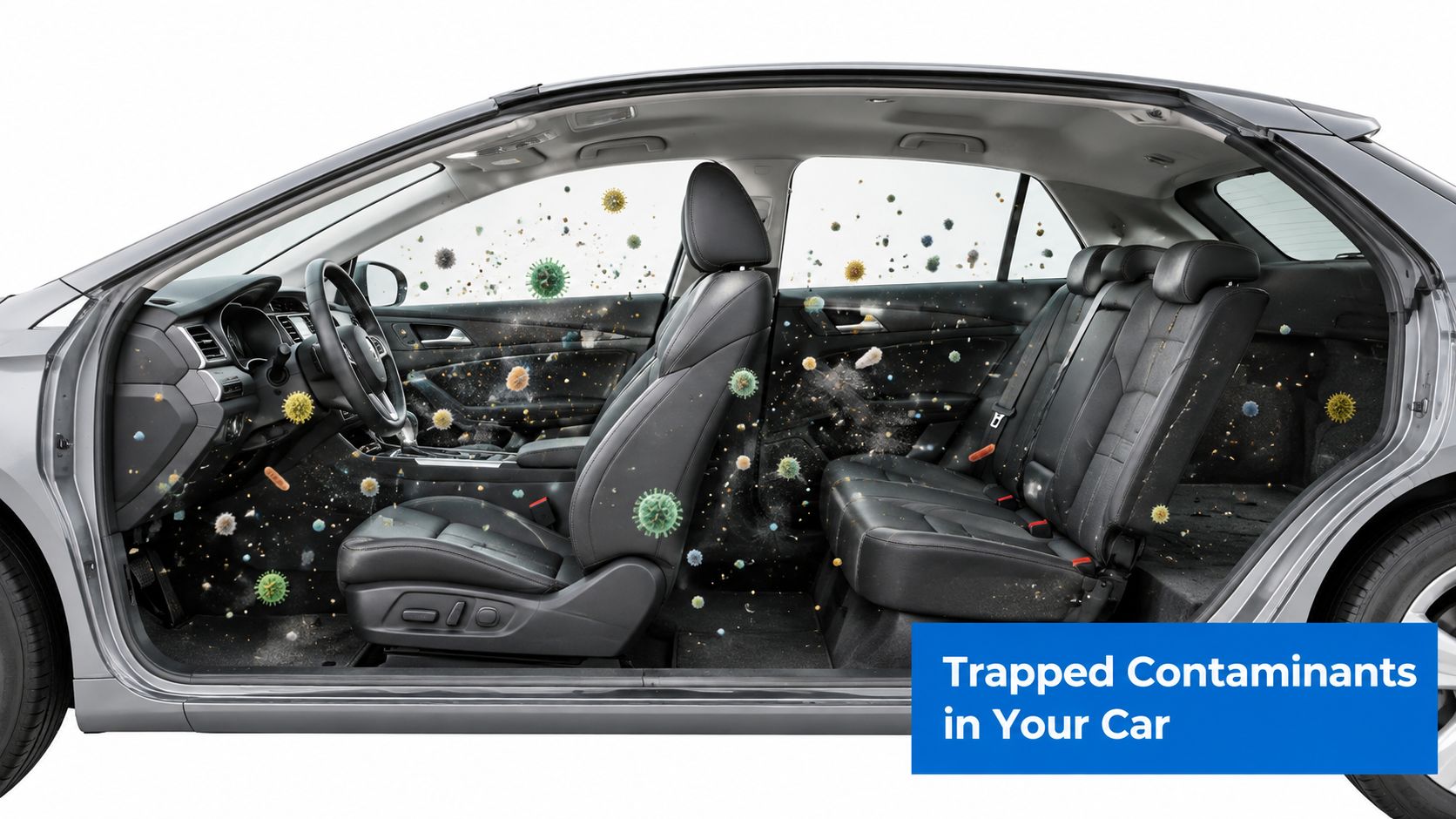
A peer-reviewed vehicle-cabin study found that ozone exposure changes with ventilation, recirculation, and driving conditions. Recirculation reduced ozone in the measured cabin environment, but carbon monoxide and nitric oxide increased. That trade-off matters because reducing one pollutant doesn't make recirculated cabin air automatically safe.
Recirculation changes the problem
During an unoccupied treatment, recirculation can help move ozone through the HVAC system and evaporator. During normal driving, however, recirculation changes how other pollutants accumulate. A setting that helps distribute ozone during remediation shouldn't be treated as a general-purpose air-quality solution for passengers.
Ozone chemistry also extends beyond the air itself. Research discussed in the same study indicates that ozone reacts with vehicle materials and volatile organic compounds, potentially affecting aldehyde and ketone concentrations. This is one reason repeated, poorly controlled treatments can create material and air-quality concerns rather than producing a cleaner cabin.
The generator's advertised output isn't enough to predict the result. Cabin volume, placement, leaks, HVAC operation, humidity, and the amount of reactive material inside all influence the achieved concentration. A compact car and a large passenger vehicle won't necessarily reach the same level during the same timed cycle.
Parts don't determine safe operation
Replacing a component doesn't turn an ozone-producing appliance into an occupied-space purifier. For example, the Standard Ozone Plate is listed as fitting models manufactured by Alpine, EcoQuest, Living Air, Vollara, Healthy Living, Spring Air, Lightning Air, and Natures Air, including Fresh Air, Fresh Air Double Plus, Classic, XL-15, XL-15C, XL-15S, Breeze, Breeze AT, Flair, 880, Ozone Blaster, Eagle 2500, Eagle 5000, and Salon Air. Compatibility is a parts question. Safe use still depends on the complete device, its output, the space, and measured clearance.
The practical conclusion is simple. A car's confined volume can make ozone concentration rise quickly, while its materials and HVAC system create additional chemical variables. Use the generator only when the vehicle is isolated and unoccupied, and don't infer safety from a pleasant smell or a short elapsed time.
The Safety and Legal Boundaries
The EPA's position is direct. Ozone generators shouldn't be used in occupied spaces, including a vehicle containing a driver or passenger. The agency identifies ozone-related risks including lung damage, coughing, chest pain, shortness of breath, and worsened asthma. EPA's technical summary of residential air cleaners also notes an OSHA occupational limit of 0.10 ppm as an 8-hour time-weighted average.
That limit isn't permission to operate an ozone generator around passengers. It provides occupational context, while the EPA warning addresses the more basic issue: don't expose occupants to intentionally generated ozone inside a confined vehicle.
A defensible operating boundary
For a private vehicle, the minimum control set is straightforward:
- Remove every occupant. Take out people, pets, plants, food, and anything that shouldn't be exposed to ozone.
- Work outdoors or in a thoroughly isolated area. Don't treat a vehicle in an attached garage, occupied workshop, or other connected space where ozone could migrate.
- Clean before treatment. Remove the source of the odor, vacuum contamination, address moisture, and replace a visibly compromised cabin filter where appropriate.
- Use the HVAC only as part of the treatment cycle. If the equipment instructions require HVAC operation for distribution, run it only while the vehicle is empty.
- Prevent accidental entry. Put the keys away, post a warning, and use the generator's timer if available. A timer controls the cycle, but it doesn't verify clearance.
- Ventilate aggressively afterward. Open doors, windows, and the hatch where applicable. Use the HVAC in fresh-air mode, not recirculation, while the vehicle is being aired out.
- Measure before re-entry. An ozone monitor is preferable to relying on odor. Re-entry should wait until the measured concentration has fallen to a safe level appropriate for the equipment and setting.
For commercial detailers, rideshare operators, dealerships, and fleet managers, the liability issue is practical as well as health-related. A business that returns a vehicle to a customer without a repeatable release procedure may expose passengers, employees, or vulnerable people to residual ozone. Documentation of isolation, treatment, ventilation, and measured clearance is more defensible than a handwritten note saying “aired out.”
The air quality monitor can be considered as part of a measurement-based process, but any monitor must be suitable for ozone and used according to its instructions. A general air-quality display shouldn't automatically be assumed to measure ozone accurately.
Release standard: The sharp smell may fade before the concentration reaches a level you can responsibly accept. Measure the air instead of using your nose as a safety instrument.
Effective Use Cases and Treatment Results
Ozone has a legitimate place in difficult remediation work, particularly when odor or contamination reaches areas that surface cleaning can't easily access. HVAC ducts, evaporator areas, upholstery, carpet backing, and headliners can all hold odor sources. Even then, ozone works best as one step in a broader process, not as a substitute for removing contaminated material.
A peer-reviewed study of 35 passenger cars evaluated ozone treatment for air-conditioning-system disinfection. The vehicles received treatment from a generator rated at 14 g/h for 20 minutes, with the engine and air conditioner operating in closed-loop recirculation. After approximately 15–20 minutes of ventilation, average bacterial aerosol concentration fell by 45.8%, while fungal aerosol concentration fell by 42.7%. The study is available through the peer-reviewed automotive ozone-treatment research.
Those results are useful, but they don't establish sterilization. The treatment took place under controlled, unoccupied conditions, and performance depends on cabin volume, humidity, ozone distribution, surface loading, and post-treatment decay. A measured reduction in airborne bioaerosols also doesn't prove that mold growth, residue, or the underlying moisture problem has been removed.
When treatment earns consideration
Ozone is most defensible when conventional cleaning has already addressed the source and a residual odor remains in difficult-to-reach areas. Smoke remediation, persistent mustiness, and HVAC-related odor are examples where a professional may consider it after inspecting the vehicle.
It isn't a sensible first response to a fresh spill, visible mold, or a wet carpet. Extracting the material, drying the cabin, repairing leaks, and cleaning the HVAC system address the cause. Ozone can then be considered as a controlled finishing step, provided the vehicle remains empty and the release process is measured.
What the result does not prove
A neutral-smelling vehicle may still contain residue. Conversely, a residual smell after treatment may come from upholstery, oxidation products, or an untreated source rather than remaining ozone. Treatment results can also vary from one vehicle to another because ozone doesn't distribute uniformly through every cabin and duct system.
For professional work, the useful question isn't “Did the odor disappear?” It is “Was the source addressed, was the treatment controlled, and was the vehicle verified safe before release?” That standard protects both the occupant and the operator.
Ozone Generators vs Other Purification Methods
The right technology depends on whether the vehicle is occupied. Ozone belongs to unoccupied remediation. HEPA and activated carbon belong closer to everyday air management. Ionization-based products require careful attention to their emissions and manufacturer documentation, especially when passengers are present.
| Method | Best For | Occupied Use | Safety Profile |
|---|---|---|---|
| Ozone generator | Controlled odor and remediation work in an empty vehicle | No | Requires isolation, ventilation, and measured clearance |
| HEPA filtration | Airborne particles and allergens | More appropriate for occupied use when designed for that setting | Captures particles without intentionally adding ozone |
| Activated carbon | Some odor and gas control | Appropriate when the product is designed for occupied use | Performance depends on the carbon media and airflow |
| Ionizer | Particle charging and collection in compatible systems | Depends on the device's emissions and instructions | Verify ozone output and occupied-space suitability |
| Cleaning and extraction | Physical removal of spills, residue, and embedded contamination | Yes, after the vehicle is safe to use | Addresses the source rather than treating the cabin air alone |
A HEPA unit can't replace extraction when a drink has soaked into padding, and ozone can't replace filtration when the concern is ongoing airborne particulate. The methods solve different problems. The room HEPA purifier is a better category to consider for particle control in settings where people remain present, provided the specific unit is intended for that use.
Pet odors also require source management. Remove fur and residue, clean affected surfaces, and address moisture before adding fragrance. For a non-ozone option intended to freshen around pets, some owners may consider calming agave oil pet spray, while following its product directions and keeping it separate from any ozone treatment.
Choose by occupancy: If someone will sit in the vehicle during operation, ozone isn't the appropriate tool. If the vehicle is empty and requires remediation, use isolation and measurement rather than treating it like a daily purifier.
A sensible maintenance strategy combines vacuuming, surface cleaning, moisture control, cabin-filter attention, and suitable filtration. Ozone should remain an occasional, controlled intervention for stubborn cases. Running it repeatedly because the smell returns usually indicates that the source hasn't been removed.
Recommended Products and Equipment
Equipment choice should follow the job, not the marketing label. A portable unit designed for occupied travel should be evaluated differently from a high-output ozone generator intended for an empty vehicle. Before buying, identify whether you need particle filtration during driving, odor adsorption, or controlled remediation after passengers leave.
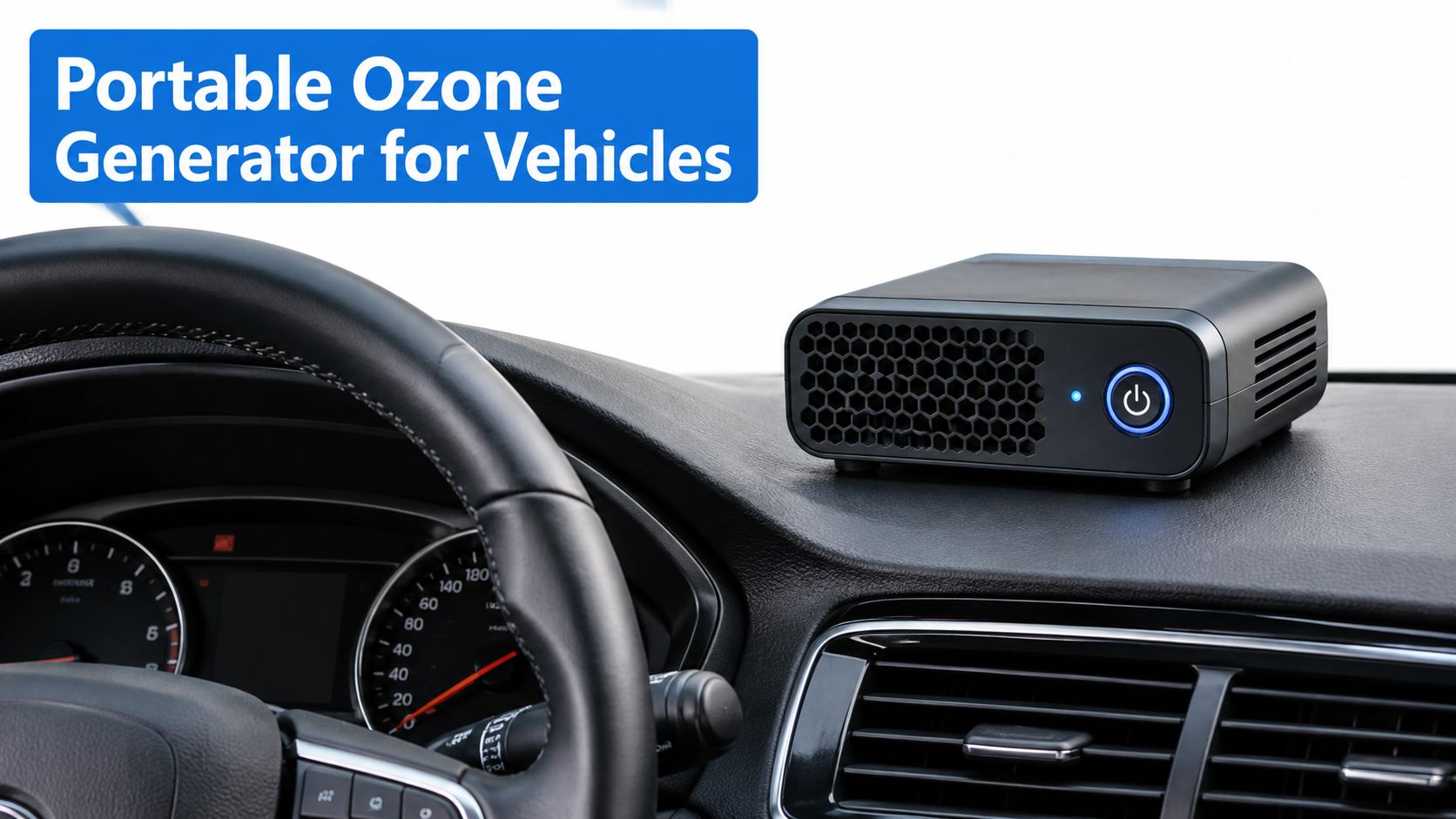
For commuting, child transport, and rideshare use, prioritize a device designed for occupied-cabin air treatment and verify whether it intentionally produces ozone. A product's small size or vehicle plug doesn't make ozone safe around passengers. The relevant questions are emissions, intended operating mode, filtration media, and whether the manufacturer provides clear occupied-use instructions.
For severe smoke or mold-related odor, the professional route may involve inspection, source removal, HVAC cleaning, controlled ozone treatment, and measured release. An ozone generator for car and home may fit the equipment category, but the same restrictions apply: it must be used only in an empty space, with ventilation and clearance verification afterward.
Here is a useful demonstration of how vehicle treatment equipment may be positioned and operated, but a video shouldn't override the EPA-based safety boundary or replace a concentration measurement.
EcoQuest Purifiers offers air-quality products, replacement parts, repair services, portable units, HEPA systems, charcoal-based options, and ozone equipment. Treat those as separate categories. A portable purifier for driving and an ozone generator for empty-vehicle remediation should never be presented as interchangeable.
Safe Operation Protocol and Maintenance
Remove people and animals, clean the cabin, isolate the vehicle outdoors, and run the generator only for a controlled cycle. Operate the HVAC only while the cabin is empty, then open the doors and hatch, switch the HVAC to fresh-air mode, and ventilate thoroughly.
Don't use a generic timeline as the release test. Measure ozone with a suitable monitor and allow re-entry only after the reading has fallen to a safe level. If you can't isolate the vehicle and verify clearance, skip DIY ozone treatment and use cleaning, extraction, activated carbon, or HEPA filtration instead.
EcoQuest Purifiers provides equipment across air-treatment categories, including portable car solutions, HEPA products, replacement parts, and ozone systems for controlled remediation. Visit EcoQuest Purifiers to compare the appropriate option for your vehicle's actual problem, and choose measurement and occupant safety over a generic “odor gone” test.