
Ozone Generator Not Working? Diagnose and Fix It Safely
The popular advice to turn up an ozone generator until you can smell it is a bad diagnostic method. A stronger smell doesn't prove better treatment, and a weak result doesn't prove a broken machine. For “ozone generator not working” problems, start by separating loss of power, loss of generation, and loss of delivery, without exposing anyone to ozone.
Table of Contents
- Match Your Symptom to Its Likely Cause
- Measure Real Output Instead of Trusting Your Nose
- How to Diagnose a Dead Generator Step by Step
- Repair Plates, Cells, Airflow and Tubing
- Check the Full Loop on Plumbed and Commercial Systems
- Decide Whether to Repair, Replace or Retire the Unit
Match Your Symptom to Its Likely Cause
Weak odor removal isn't automatically an electrical failure. A generator can run normally while its output is insufficient for the contaminant, room volume, ventilation, humidity, or treatment time. The first question is whether the unit is dead, producing less than expected, or producing gas that isn't reaching its intended destination.
There's also a fundamental limit to what safe indoor ozone levels can accomplish. The U.S. Environmental Protection Agency states that ozone has little potential to remove indoor contaminants at concentrations that don't exceed public-health standards, while concentrations used for some odor treatments can be unsafe around people. A conservatively limited device may therefore be functioning correctly without delivering the result you expected.
Sort the symptom before buying a part
Use these as starting points, not confirmed diagnoses. Perform visual checks with the unit unplugged, and leave internal electrical testing to qualified service personnel.
| Symptom | Likely cause | First check | Fix |
|---|---|---|---|
| No lights, fan or sound | No power, blown fuse, failed timer or relay | Outlet, breaker, accessible fuse and timer setting | Correct the supply fault; replace the specified fuse or have the timer or relay serviced |
| Fan runs but no ozone | Failed ozone plate or cell, high-voltage circuit fault | Inspect the disconnected plate for burns, dark spots or cracks | Clean an intact plate; replace a damaged plate |
| Runs but output is weak | Dirty plate, low airflow, unit undersized for the application | Plate, inlet and filters | Clean first; verify output before considering a replacement plate |
| Output fades after weeks | Dust, moisture or oil on electrodes | Inspect accessible components with power off | Clean and dry completely before restarting |
| Alarm or zero output on plumbed unit | Permissive interlock or blocked feed gas | Status signal and feed-gas flow | Correct the interlock condition and clear the blockage |
| Faint ozone smell, no delivered output | Blocked inlet, cracked hose, check-valve failure | Inlet, hose and check valve | Clear the inlet and replace damaged ozone-resistant tubing or a failed valve |
A faint smell alongside poor delivery can indicate a leak, not an absence of generation. Don't lean over the outlet to investigate.
Practical rule: Match the symptom, complete the first check, and record what you found before authorizing a repair.
If the complaint is that a room still smells, inspect the odor source as well. Removing contaminated material and improving outdoor-air ventilation may solve the actual problem without changing the generator.
Measure Real Output Instead of Trusting Your Nose
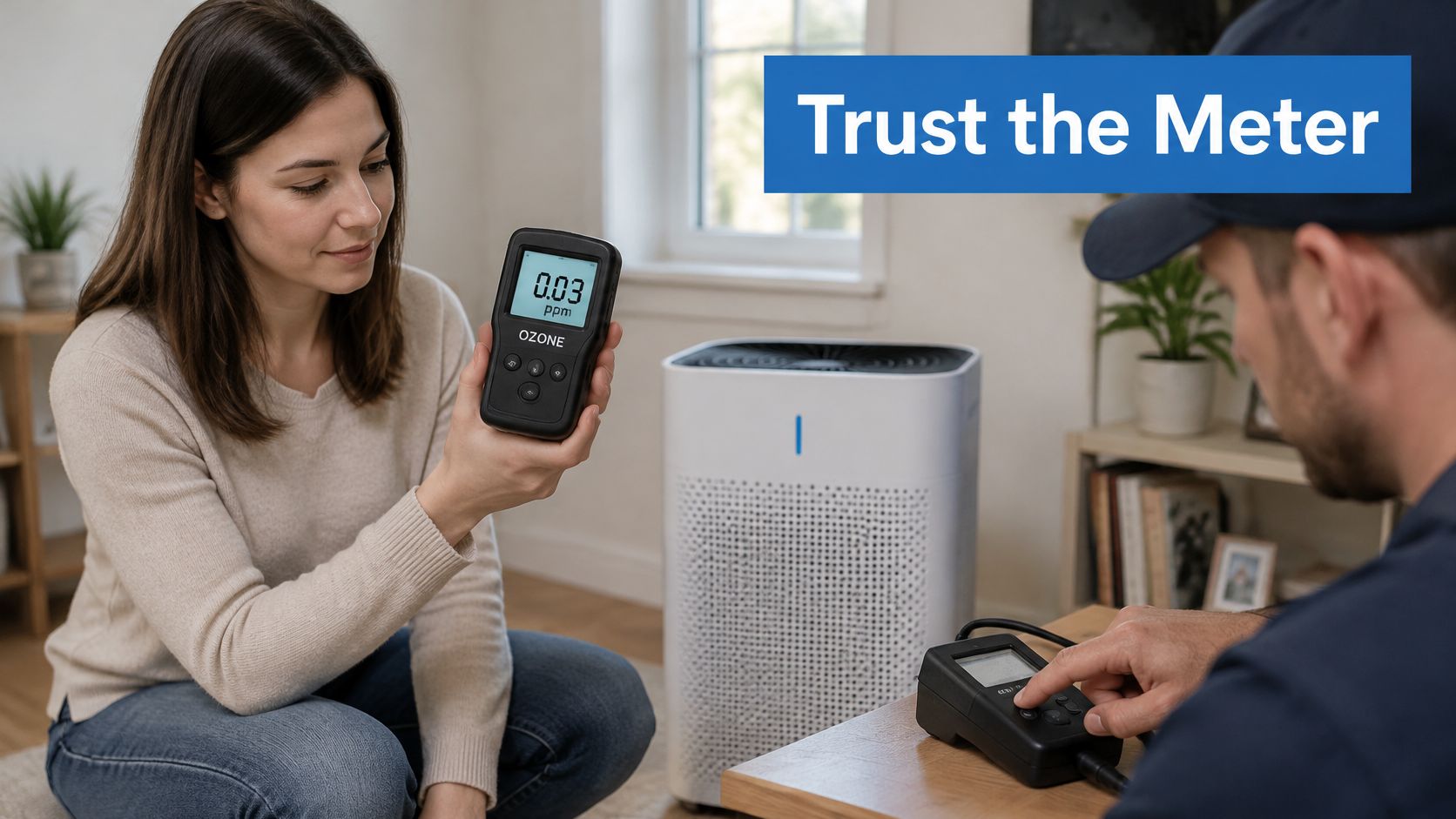
Your nose isn't an ozone analyzer. Odor perception isn't calibrated, and the absence of a smell doesn't establish that output is zero. Likewise, a lit indicator, warm enclosure, or running fan only confirms part of the operating sequence.
Use an ozone-specific monitor or a validated test method suited to the measurement. An ambient exposure monitor and an instrument designed for concentrated generator outlet gas aren't interchangeable. Confirm the instrument's range, calibration status, sampling requirements, and suitability before connecting it.
The measurement setup matters more than how noticeable the air smells.
Understand what the benchmarks actually mean
These benchmarks apply to different situations. An emission certification test isn't an occupied-room clearance test, and an occupational time-weighted average isn't an instantaneous ceiling.
| Benchmark | Value | What it means for troubleshooting |
|---|---|---|
| OSHA permissible exposure limit, eight-hour time-weighted average | Occupational exposure average | Not permission to run an ozone treatment around workers |
| OSHA listed short-term limit | Historical short-term benchmark | Have occupational-safety personnel determine applicable requirements |
| California certification limit for electronic air cleaners | 0.050 ppm, equivalent to 50 ppb | Maximum under the specified certification test, not a guarantee of safe room concentration |
| California eight-hour ozone standard | 0.070 ppm | Health-protective ambient-air benchmark, not a treatment target |
| California one-hour ozone standard | 0.090 ppm | Ambient-air benchmark, not a universal re-entry rule |
The California values above are published by the California Air Resources Board, which also advises against in-home use of uncertified ozone generators or air cleaners. Occupational values require separate interpretation and are addressed in the electrical-isolation procedure below.
An EPA study illustrates why turning up the dial is risky: a unit produced little or no measurable ozone at its recommended setting, but at maximum output produced more than 100 parts per billion in a well-ventilated room and nearly 1 part per million in a poorly ventilated room. Room conditions changed exposure dramatically.
Interpret the reading before replacing anything
A zero reading only supports a generation fault after you've verified the instrument, sampling location, operating mode, and startup sequence. Then inspect the plate or cell, wiring, high-voltage supply, and control board through an appropriate service procedure.
Low but measurable output may reflect intentional control rather than a defect. Consumer sensors can also be inaccurate, so don't condemn an expensive component on an unverified reading.
Record the model, age, plate replacement date, operating mode, measurement location, and output reading. Keep the test conditions consistent so a later comparison means something. Arrange remote sampling or a controlled service setup, never a test that requires standing in a treated room.
How to Diagnose a Dead Generator Step by Step
Start with isolation, not the cover screws. An ozone generator contains more than a fan and a replaceable plate, and disconnecting its plug doesn't automatically make every internal component safe to touch.
The safety sequence below applies before any inspection.
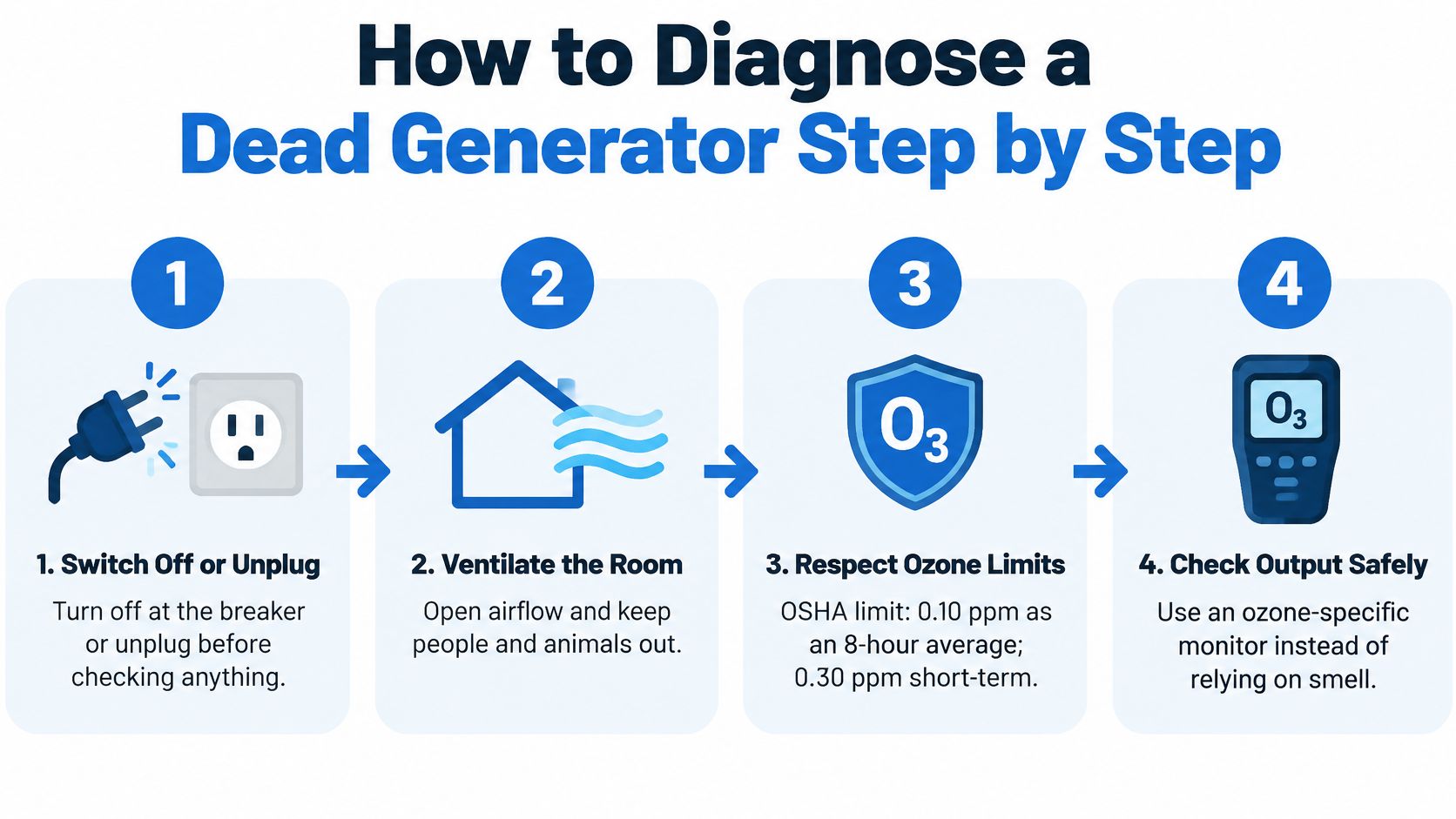
Work from the supply toward the outlet
Switch off, isolate, and ventilate. Unplug the unit or isolate its circuit, prevent unexpected restart, and keep people and animals out of the treatment area. The OSHA interpretation letter identifies 0.10 ppm as an eight-hour time-weighted average and lists 0.30 ppm as a short-term limit; the latter is a historical reference, not a universal current clearance criterion.
Confirm the power supply. Check the nameplate voltage against the supply, inspect the cord and plug, and test the outlet using a suitable outlet tester. A qualified technician should take voltage measurements where needed; replace an accessible fuse only with the specified type and rating, and don't repeatedly reset a tripping breaker.
Check the operating permissions. Verify the timer, lid or door interlock, cooling fan, and selected operating mode before assuming the generator has failed. Leave relay contacts, internal terminals, and damaged wiring to qualified service personnel, and never bridge an interlock to force operation.
Inspect the generation surfaces with power removed. Follow the manufacturer's discharge and access procedure before handling the dielectric barrier, corona plate, or electrodes. Dust, moisture, oil, and carbon tracking can divert the high-voltage field, so distinguish removable deposits from damaged insulation before cleaning.
Trace the gas path. Look for a blocked inlet, failed compressor, failed venturi, kinked ozone-resistant hose, or failed check valve. A functioning discharge cell can appear dead when the gas can't move through the delivery system.
Address back-flow protection. If liquid can return toward the generator, inspect the specified water trap, raised loop, back-flow preventer, or anti-siphon arrangement. Don't restart a wet generator because you've drained its hose; internal liquid ingress requires service assessment.
Verify output under controlled conditions. Reassemble guards and covers, restore the intended operating configuration, and have output checked with an appropriate analyzer. If ozone is detected in occupied space, stop the test, isolate the source, and ventilate without sending someone into the exposure.
Know when the fault needs electrical service
If the supply is correct but generation won't enable, a technician needs to distinguish a control fault from a high-voltage fault. Forge Reliability's resource on how to analyze electrical fault signatures provides context for that diagnostic approach; it isn't a substitute for model-specific service instructions.
Don't probe the high-voltage side with an ordinary multimeter or run the enclosure open to look for a discharge. That can expose you to electrical hazards and defeat the machine's protective arrangements.
A successful test confirms controlled operation, not merely a noise, glow, or smell.
A pass means the unit powers up correctly, cooling and airflow are available, the generation surfaces are serviceable, and measured output meets the manufacturer's expected range under documented conditions. Any unexplained trip, arcing, overheating, or leakage means the unit stays out of service.
Repair Plates, Cells, Airflow and Tubing
Clean before replacing, and check compatibility before ordering. For reduced fresh-air output, our repair sequence is to clean the unit and accessories, check that the ozone plate is installed correctly without burn damage, and try a replacement plate only if those checks don't resolve the fault.
Plate inspection is a condition check, not a reason to run the unit with its cover removed.
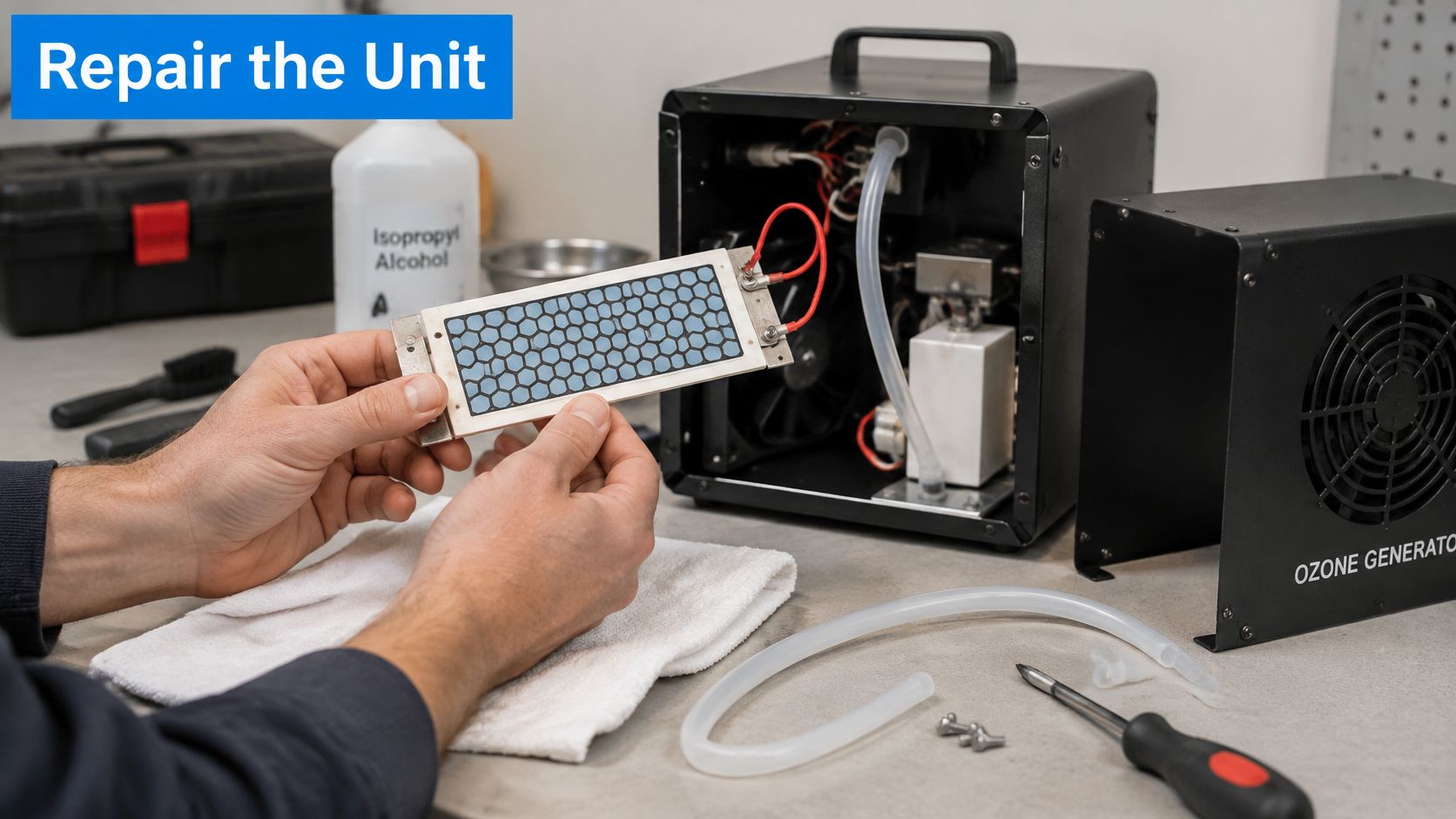
Clean and inspect before spending money
Remove loose dust from accessible inlets, screens, and fan passages with a soft brush and suitable vacuum attachment. Use only the plate-cleaning method specified for the model, and keep liquids away from the power supply, connectors, and controls.
Inspect the dry plate under good lighting. Dark pitting, cracks, damaged contacts, or persistent discoloration warrant closer assessment; discoloration alone doesn't establish that a plate is burned. Don't sand electrodes, scrape away coatings, or substitute a stronger solvent to make a damaged component look clean.
Check the plate's orientation and seating before reassembly. A sound plate installed incorrectly won't solve an output complaint.
| Part | Replace when | Before ordering |
|---|---|---|
| Ozone plate | Burned, pitted or cracked after cleaning | Match the exact model to the plate fit list |
| RCI cell | Damaged or confirmed faulty through the model's service procedure | Confirm the unit actually uses an RCI cell |
| UV lamp | Failed, damaged, or due under the model's maintenance instructions | Confirm lamp type and electrical compatibility |
| Ozone-resistant tubing | Cracked, stiff or leaking | Match dimensions and ozone compatibility; recheck seals under flow |
| Check valve | Restricted or allowing back-flow after permitted cleaning | Match flow direction, connection size and operating conditions |
| Inlet screen | Still obstructed or physically damaged after cleaning | Clean first and confirm the correct replacement size |
Match the part to the machine
Our ozone plates and replacement parts include the Original Heavy Duty Ozone Plate, whose listed fit includes Fresh Air, Fresh Air Double Plus, Classic, XL-15, XL-15C, XL-15S, Breeze, Breeze AT, Flair, 880, Ozone Blaster, Eagle 2500, Eagle 5000, and Salon Air models manufactured by the brands named in its fit list. RCI cells and UV lamps are separate components for machines that use them, not interchangeable substitutes for a corona plate.
For pool equipment, identify the component before comparing replacement budgets. Pool & Landscaping of Vistancia replacement costs concerns salt cells, not ozone cells, so don't transfer its pricing or replacement assumptions to an ozone generator.
Use the model manual alongside any repair demonstration.
Replace brittle tubing rather than trying to reseal a split with adhesive. Fit the correct ozone-resistant hose, preserve the check valve's flow direction, and test connections under their actual operating conditions.
The square-footage setting isn't a repair lever. Lowering it reduces ozone production, and it shouldn't be set to the house's actual square footage. If clean airflow and a correctly fitted replacement plate don't restore measurable, controlled output, stop swapping parts and arrange system-level diagnosis.
Check the Full Loop on Plumbed and Commercial Systems
Replacing the cell immediately can leave the actual fault untouched. A commercial system may have a healthy generator but no usable feed gas, no injector vacuum, or an interlock correctly preventing operation.
The Pool & Hot Tub Alliance guidance identifies a breached line and resulting vacuum loss as a reason a generator may stop producing ozone gas. That makes the delivery circuit part of the diagnosis, not an accessory check after replacement.
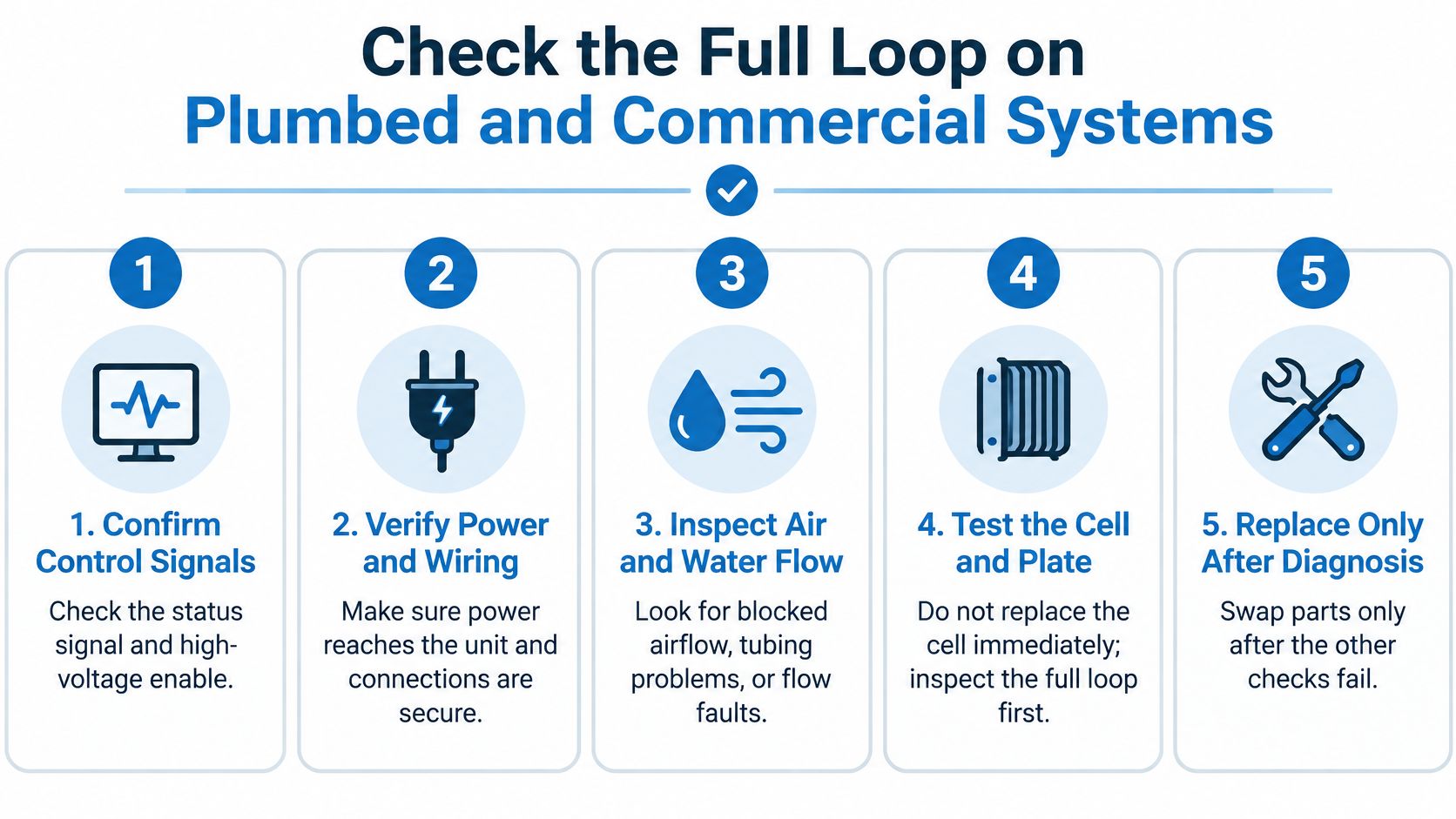
Test the process in operating order
Confirm the control signals agree. Compare the status signal, high-voltage enable, cooling status, feed-gas indication, and output setting. An alarm may represent a missing permissive, meaning a required safe operating condition hasn't been satisfied, rather than a failed plate.
Measure feed-gas flow and pressure against the manufacturer's specification using instruments rated for the service. Wet, contaminated, or insufficient feed gas reduces corona efficiency and promotes contamination, so inspect the dryer, filters, and gas supply before blaming the discharge cell.
Separate generation from downstream delivery. A qualified technician can isolate the generator from the downstream line and test outlet production through an approved contained sampling arrangement. If output returns, investigate back-pressure, injector blockage, collapsed tubing, liquid ingress, or loss of vacuum rather than purchasing a new cell.
Check the complete gas circuit for leaks using the manufacturer's approved procedure, then retest under operating flow. Keep ozone within compatible tubing and pipe, and never discharge a disconnected outlet into the work area.
Establish a measured baseline. Record outlet concentration, feed-gas flow, temperature, humidity, pressure, and operating setting after the repair. Also confirm that the receiving process is accepting the gas and that shutdown interlocks still work.
Define success beyond the outlet
Stable, specified output at the generator outlet confirms generation, but it doesn't alone prove successful treatment. The injector, contact arrangement, containment, ventilation, and any off-gas handling must also function as designed.
Say the outlet reading is normal but treatment performance falls whenever process flow changes. Replacing the generator won't correct an injector or pressure problem. Compare readings under the same operating conditions and identify where performance first departs from the expected range.
Use the exact equipment designation when checking commercial ozone-generator model information. A different model's hose arrangement or control sequence isn't a reliable service template.
Acceptance criterion: Restore specified generation and prove safe delivery, containment, and shutdown.
Never use an occupied room as a functional test. Room size, ventilation, and output setting affect exposure, and a room-size label doesn't establish that a treatment is safe around people.
Decide Whether to Repair, Replace or Retire the Unit
Preventing exposure takes priority over restoring maximum output. That boundary matters especially around children, pets, people with asthma, healthcare occupants, and workers. If safe isolation and verification aren't available, leave the generator off.
The federal regulation on ozone-emitting devices states that ozone is toxic, warns that symptoms may be delayed, and specifies 0.05 parts per million for covered devices in occupied enclosed spaces. Don't interpret an absence of immediate irritation as evidence that a room is safe.
Choose based on the verified fault
| Decision | Appropriate circumstances | Required next action |
|---|---|---|
| Repair | A confirmed plate, tubing, fuse, or interlock fault can be corrected | Verify electrical safety, controlled output and protective functions |
| Replace | A failed power supply or control board makes repair impractical, or parts are unsupported | Check that the replacement suits the intended application and exposure controls |
| Retire | Unsafe wiring, damaged housing, repeated unexplained faults, or inability to verify safe operation | Keep it disconnected and arrange appropriate disposal |
Age alone isn't a diagnosis, and a new plate that doesn't restore output isn't proof that the whole machine is beyond repair. It means the original diagnosis may have been incomplete. Ask for a service assessment before funding another round of replacement parts.
Check recall and safety-alert records against the exact model and identifying details before repair. Recall Atlas lists two official recalls or safety alerts involving OZON Specialista ozone generators since December 2022, based on EU Safety Gate records. Those notices don't establish a problem with unrelated brands, but an applicable notice should stop use immediately.
Control re-entry and disposal
Don't assume a closed door contains the treatment. Consider adjoining rooms, shared ventilation, and access routes when isolating the equipment, then verify conditions in all potentially affected occupied areas before permitting re-entry.
- Isolate access. Prevent accidental restart and entry during assessment.
- Ventilate safely. Avoid directing contaminated air toward other occupants.
- Verify clearance. Use a suitable, checked instrument and the applicable site procedure, not a generic waiting period.
- Document the decision. Retain readings, fault findings, replaced parts, and service recommendations.
For an unserviceable unit, check local electronic-waste or hazardous-waste requirements. Beyond Surplus explains how to compare refurbishing and recycling IT assets; apply that repair-versus-material-recovery distinction without assuming an ozone generator belongs in the same collection stream.
Find your model manual and review our repair-service information before shipping or dismantling equipment. Our U.S.-based phone support is available daily; confirm the contact channel and hours printed in your model manual, and have the model number, matching symptom, and logged readings ready.
EcoQuest Purifiers offers replacement parts, model support, and repair services to help you address an ozone generator fault without guessing at the cause. Visit EcoQuest Purifiers with your model number and diagnostic notes to identify the appropriate next step before ordering parts or restarting the unit.