
Ozone Smell Removal: Safe Steps That Actually Work
Running an ozone machine before cleaning is popular advice, but it puts the device ahead of the diagnosis. Ozone smell removal starts with what's producing the odor, not how powerful a generator you can buy. A room that smells different after treatment hasn't necessarily become cleaner or safer.
There are also two different problems behind this search: removing an existing household odor with ozone, and getting rid of ozone's sharp smell after a machine has run. For the first, identify and remove the source. For the second, keep people out, ventilate safely, and measure ozone rather than trusting your nose.
Table of Contents
- Match the Odor to Its Source Before Treating It
- How to Remove the Odor Step by Step
- Why Ozone Masks Odors and Where It Turns Hazardous
- Safer Alternatives When Ozone Is Not the Right Tool
- Ozone-Only Protocol and Clearance Before Re-entry
Match the Odor to Its Source Before Treating It
Ozone is rarely the first fix. A dry drain trap needs water and a sound seal, while urine beneath carpet needs treatment at the depth of contamination. Neither problem becomes a device-selection problem just because the smell spreads through the room.
Use the location and timing of the odor to narrow the cause. A smell strongest beside a floor drain points toward plumbing; one that intensifies around a damp exterior wall calls for a moisture inspection.
Odor sources, causes and first actions
| Odor source | Typical cause | First action | Follow-up treatment |
|---|---|---|---|
| Smoke residue | Particles and tar bonded to fabric, carpet and paint | Remove contaminated contents and wash hard surfaces | Launder textiles; activated carbon for what remains |
| Mold or mildew | Damp porous materials and trapped moisture | Dry the area and remove affected material | Dehumidify, ventilate and check for hidden growth |
| Sewage or drain | Dry P-traps or cracked drain lines | Refill traps and repair the leak | Confirm trap seals and ventilate the room |
| Pet urine | Residue soaked into carpet pad and subfloor | Apply enzymatic cleaner deep into the padding | Repeat treatment; carbon filter for residual smell |
| Cooking or garbage | Grease film and decomposing food | Clean hood filters and empty and wash bins | Run exhaust fans; carbon filter in problem areas |
| Stale or musty room | Trapped moisture and off-gassing from materials | Open windows and run fresh-air ventilation | Clean carpet and upholstery; check humidity |
Check the material, not just the air
For smoke residue, start with curtains, upholstered furniture and washable wall surfaces. When comparing smoke air purifier options, distinguish particle capture from gas adsorption rather than treating every smoke claim as equivalent.
For mold or mildew, a musty cupboard beside a leaking pipe needs the leak repaired and damaged material assessed. Don't spray fragrance over damp backing or close the cupboard before it dries.
For drain odors, an infrequently used guest shower may have a dry trap. If refilling it doesn't resolve the problem, have the trap, connections and venting inspected rather than repeatedly deodorizing the bathroom.
For pet urine, cleaning the carpet face won't reach contamination underneath. Follow the enzymatic cleaner's material instructions, and replace contaminated padding when it can't be cleaned effectively.
For cooking odors, inspect grease-coated hood filters and cabinet tops. For a stale room, check behind furniture and beneath rugs for trapped dampness.
Diagnostic rule: Match the smell to a material, moisture condition or drain before choosing a treatment.
How to Remove the Odor Step by Step
Work from removal to cleanup, then deal with what remains in the air. Otherwise, you'll spend time filtering emissions from material that still needs to leave the room.
The practical sequence is stop, clean, dry and reassess.
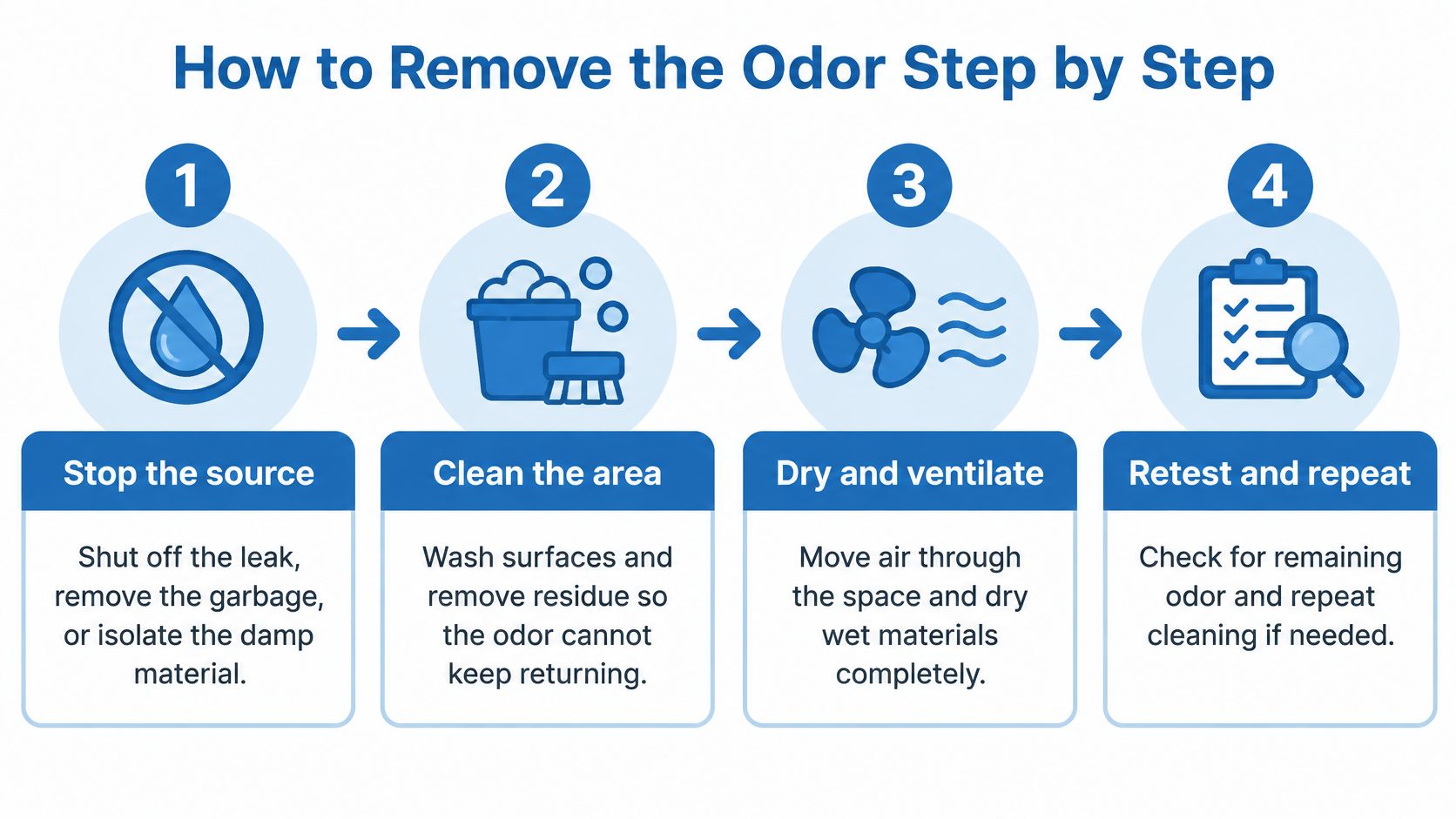
Remove contamination before polishing the air
Stop the source. Repair the water leak, remove decomposing waste or take the odor-producing item out of service. Don't disconnect or disturb suspected hazardous chemical containers just to investigate a smell.
Remove contents that can't be recovered. Bag contaminated soft goods before carrying them through clean areas. Cushions, insulation and carpet padding deserve particular scrutiny because a clean-looking surface can conceal contamination.
Wash hard surfaces. Use a cleaner suitable for the finish, working through walls, cabinets, fixtures and other affected surfaces with clean cloths. Change dirty cleaning solution rather than redistributing residue, and never mix cleaning chemicals.
Clean textiles at the appropriate depth. Launder curtains and bedding at the warmest setting their care labels permit, and use suitable extraction equipment for recoverable upholstery or carpet. Don't soak the assembly indiscriminately or apply heat to urine contamination unless the treatment instructions allow it.
Dry and ventilate. Establish an outdoor-air inlet and an exhaust path, provided outdoor conditions are suitable. A fan circulating air inside a closed room doesn't remove the contaminant, and exhaust discharge shouldn't be drawn straight back into the building.
Add activated carbon for residual gaseous odor. Choose equipment with a meaningful quantity of carbon and accessible replacement media, not merely a thin dark-colored filter. Replace media when odor breaks through, while checking airflow and filter condition.
Reassess under normal conditions. Let cleaning fragrances dissipate and materials dry before judging the result. Check again when the room returns to its usual temperature and ventilation pattern, rather than declaring success beside an open window.
Investigate distribution only when the pattern supports it
If odor appears when the HVAC blower starts, inspect the filter, accessible return areas and nearby moisture sources. Comfort Experts' information on duct cleaning is a useful resource when contamination within the air-distribution system is a plausible concern, not a reason to order duct work for every smelly room.
Keep brief notes on where the odor remains strongest and what changes it. That record helps distinguish a missed source from an airflow problem and prevents another round of unfocused cleaning.
Why Ozone Masks Odors and Where It Turns Hazardous
The claim that ozone removes odors leaves out the most important qualifications: which compound, at what concentration, and with whom present? Oxidizing some chemicals under particular conditions doesn't establish that a generator will safely deodorize an occupied room.
The U.S. Environmental Protection Agency's assessment of ozone generators finds little demonstrated ability to remove many odor-causing chemicals at concentrations within public-health standards; it describes no formaldehyde reduction in an embalming-studio simulation and earlier experiments in which ozone masked body odor with its own smell. The same assessment supplies the workplace benchmarks and generator measurements below.
Ozone exposure limits and test results
| Measure | Level | Context |
|---|---|---|
| OSHA workplace limit | 0.10 ppm | Average over an 8-hour workday |
| NIOSH recommendation | 0.10 ppm | Should not be exceeded at any time |
| Generator test, closed room | 0.20 to 0.30 ppm | Measured in generator testing |
| Generator test, adjacent room | 0.12 to 0.20 ppm | Measured in neighboring space |
| Smell as a warning | Not reliable | Olfactory fatigue can reduce awareness of ozone |
A different smell isn't proof of removal
Masking changes what someone notices. Chemical removal reduces the substance responsible for the odor. Those outcomes can feel similar during a quick walkthrough, especially when ozone's sharp smell dominates the room.
If the original odor returns after the ozone smell disappears, treat that as a reason to investigate remaining contamination. It isn't a reason to assume the machine needed a longer run.
Even a lasting reduction in perceived odor doesn't establish that the air is free of harmful contaminants. Some substances don't provide a useful smell warning, and ozone reactions can produce secondary pollutants.
A room can smell less objectionable without becoming safer to occupy.
Occupancy changes the decision
Turning up output to pursue a stronger deodorizing effect can create a separate exposure problem. The adjacent-room measurements matter because closing a door doesn't prove that someone elsewhere in the building is protected.
Ozone exposure can irritate the airways and cause coughing, throat irritation, chest discomfort or breathing difficulty. People with asthma and other respiratory vulnerabilities need particular caution; don't interpret a fading smell as evidence that exposure has ended.
If symptoms occur, move to fresh air and seek medical advice, with urgent assistance for significant breathing difficulty. Don't send someone into the room to retrieve the machine.
The workplace figures are exposure benchmarks, not a universal residential safety certificate. They don't establish that a recently treated room is suitable for a child, a person with asthma or prolonged occupancy. At concentrations compatible with occupied spaces, ozone is a limited odor tool; increasing the dose introduces hazards rather than fixing the original diagnosis.
Safer Alternatives When Ozone Is Not the Right Tool
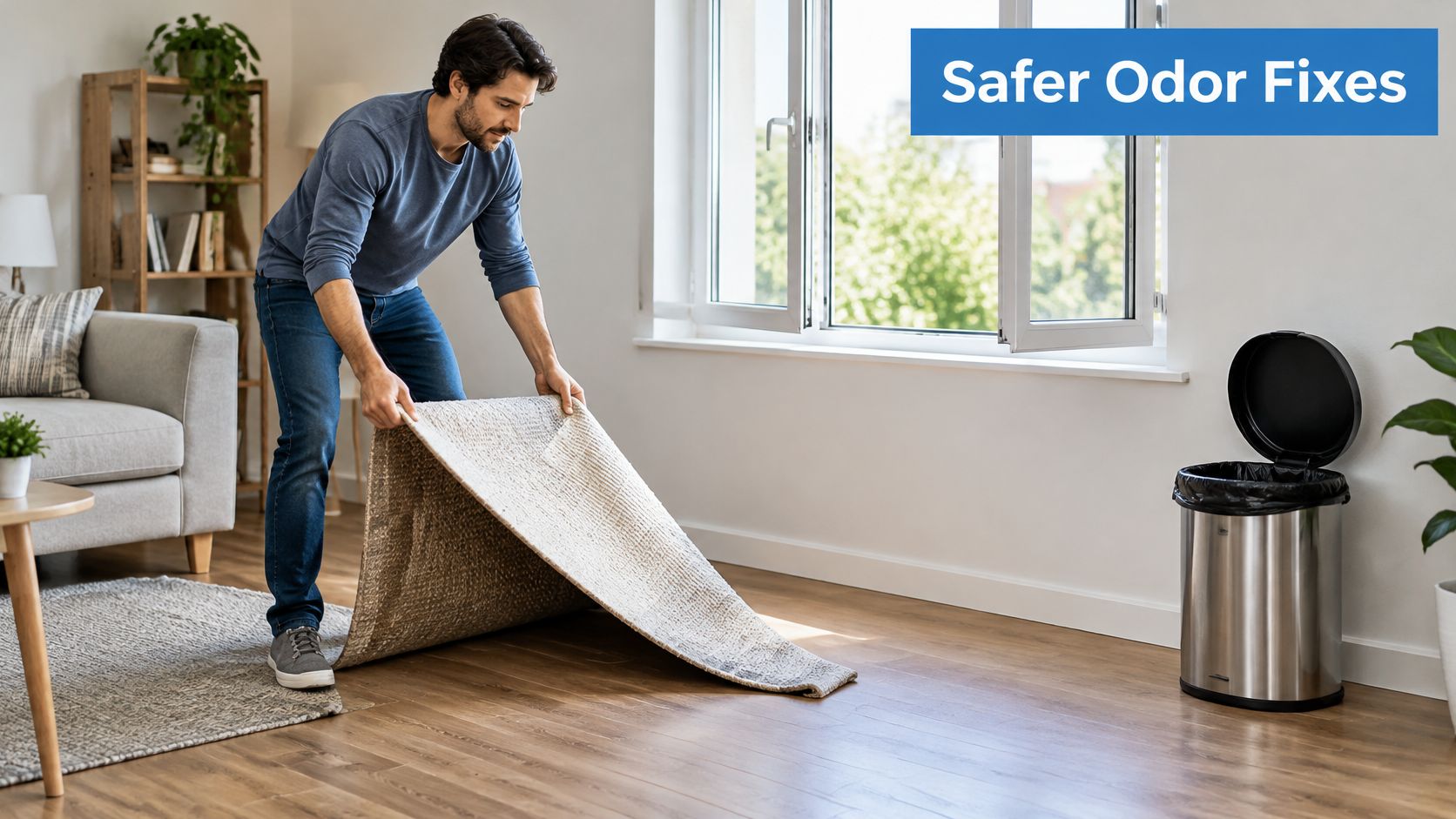
For an occupied home or workplace, choose the method that addresses the contaminant without intentionally introducing ozone. The trade-off is usually maintenance and physical work, not a choice between a weak cleaner and a powerful generator.
Removing an odor-bearing carpet may accomplish more than repeatedly treating the room around it.
Odor methods compared by use, limit and check
| Method | Best use | Main limit | Clearance check |
|---|---|---|---|
| Source removal and cleaning | Smoke, food, pet and sewage odors | Only as good as the source work | Recheck after the room is dry and aired |
| Outdoor-air ventilation | Stale or lingering air | Doesn't resolve an active source | Odor neutral under normal conditions after airing |
| Activated carbon filtration | Residual gaseous odors | Media saturates and needs replacement | Check odor breakthrough, media schedule and pressure drop |
| HEPA filtration | Particles such as smoke and dust | Doesn't capture gases | Check filter condition and replacement schedule |
| Ozone generator, unoccupied space only | Conditional treatment after source control and isolation | Exposure risk and uncertain odor outcome | Instrument-verified clearance, not smell alone |
Match the filter to the contaminant
HEPA filtration captures particles, including airborne smoke particles and dust. It doesn't substitute for gas-phase treatment, so a particle-only purifier may improve particle levels while leaving a noticeable odor.
Activated carbon adsorbs certain gaseous compounds, but performance depends on the compound, media quantity, airflow and remaining capacity. Pressure drop helps track airflow restriction, while odor breakthrough can indicate exhausted adsorption capacity; neither check replaces the other.
Passive products such as bamboo charcoal bags shouldn't be treated as equivalent to a fan-driven unit with substantial gas-phase media. Nor should any carbon product become a substitute for investigating a leak, persistent dampness or strong chemical contamination.
The accompanying video offers another visual reference for the topic.
Choose by the job, not the freshness claim
For lingering cooking odor, ventilation and appropriate carbon media are more relevant than particle filtration alone. For dust disturbed during cleanup, particle capture has a clear supporting role.
Ventilation also has limits: outdoor smoke, high humidity or unsuitable weather can make unrestricted window opening counterproductive. Use the building's mechanical ventilation where appropriate, and correct moisture conditions rather than importing more damp air.
No single method clears every odor. Match the treatment to the source and contaminant type, then judge the result under the conditions in which people use the room.
Ozone-Only Protocol and Clearance Before Re-entry
Ozone treatment belongs only in an unoccupied, isolated space, never as an occupied-room purifier. If you can't prevent exposure in adjoining rooms or connected areas, don't run the generator. For a homeowner without suitable monitoring and isolation arrangements, I recommend choosing another method or using a qualified remediation professional.
The EPA's guidance on ionizers and other ozone-generating air cleaners warns that ozone used for odor treatment can exceed concentrations considered safe for humans. A generator's timer or output rating isn't a clearance instrument.
Establish the controls before switching on
Remove people, pets and plants. Account for adjoining occupants, shared corridors and connected ventilation, not just the room containing the machine. Prevent accidental entry with clear access controls.
Finish the source work. Remove contaminated contents and clean recoverable porous materials before considering treatment. Ozone isn't a way to leave sewage contamination, wet mold-damaged material or chemical spills in place.
Isolate the treatment zone. Evaluate door gaps, penetrations, supply ducts and return-air paths that could carry ozone elsewhere. Don't improvise alterations to shared HVAC equipment, fire protection or required building ventilation.
Use only validated equipment instructions. Measure the room dimensions and establish volume rather than estimating by eye. If the instructions don't provide an appropriate treatment procedure for the space and conditions, don't invent a run time.
Plan outdoor-air ventilation in advance. Arrange controls so the equipment can be stopped and the room ventilated without an unprotected person entering contaminated air. Direct exhaust away from people, neighboring openings and outdoor-air intakes.
Measure before allowing entry. Use an ozone-specific instrument with an appropriate measurement range, resolution and calibration status. A general air-quality display, particle sensor or volatile-organic-compound reading doesn't establish the ozone concentration.
Clearance is a measurement decision
When choosing an air-quality monitor, confirm explicitly that it measures ozone. Don't assume that a device reporting an overall air-quality score can perform this task.
Check representative locations, including areas where air movement is poor and adjoining spaces where leakage is possible. Follow the applicable clearance requirements and the professional treatment plan; a single reading below a workplace benchmark doesn't establish universal residential safety.
There's no dependable smell-based waiting period. Room conditions, airflow and reactions with materials affect what remains, so don't replace measurement with a fixed countdown or a quick sniff at the doorway.
Re-entry rule: No one should enter simply because the machine has stopped or the sharp smell has faded.
After measured clearance, assess whether treatment solved the odor problem under normal room conditions. If the original smell returns, investigate concealed contamination or moisture rather than scheduling progressively stronger ozone treatments.
If your concern is the ozone smell itself, stop generating more ozone. Keep the affected area unoccupied, ventilate through the planned safe route, and arrange ozone-specific testing before resuming use.
EcoQuest Purifiers offers indoor air-quality equipment, charcoal filtration options, replacement parts and repair support. Visit EcoQuest Purifiers to compare options for the odor source you've identified, and check filtration technology, maintenance needs and ozone-free operation before choosing equipment for an occupied room.