
Ozone Smoke Removal Car Safely: Limits and Steps
The most popular advice for removing smoke odor from a car is also the least useful: run an ozone generator, wait a while, then get in when the sharp smell disappears. That approach confuses odor reduction with cleaning and a timer with an exposure measurement. Neither tells you what's left in the upholstery or what a passenger will breathe.
For ozone smoke removal in a car, the practical starting point isn't a run-time recipe. It's source removal, an unoccupied treatment setup if specialized treatment is justified, and a way to measure residual ozone. I would spend money on cleaning and reliable measurement before buying a more powerful generator.
Table of Contents
- Ozone Exposure Limits to Check Before You Start
- Clean the Source Before Any Ozone Treatment
- How to Run an Unoccupied Ozone Treatment
- Measured Clearance Versus Waiting Before Re-entry
- Symptoms After Treatment and How to Respond
- Decide Whether to Treat It Yourself or Call a Professional
Ozone Exposure Limits to Check Before You Start
Ozone exposure limits describe specific settings and uses. They are not interchangeable, and a figure for workplace exposure or a device's emissions does not by itself establish that a car is safe to re-enter.
Ozone benchmarks for car treatment
| Benchmark | Ozone level | What it means for a car |
|---|---|---|
| OSHA 8-hour workplace limit, according to the EPA's residential air-cleaner assessment | 0.10 ppm | Workplace time-weighted average, not a general passenger-safety clearance |
| NIOSH recommended limit, according to the EPA's residential air-cleaner assessment | 0.10 ppm | Recommended ceiling that shouldn't be exceeded at any time |
| FDA limit for indoor medical devices, according to the EPA's residential air-cleaner assessment | 0.05 ppm | Device-output restriction, not a vehicle re-entry standard |
| CARB certification limit for portable air cleaners | 0.050 ppm | Device-emission limit, not a post-treatment clearance |
| California 8-hour ambient standard | 0.070 ppm | Health-protective outdoor reference, not a car-treatment protocol |
| Enclosed-room readings from tested generators, reported by EPA | 0.20–0.30 ppm | Above the exposure and emission benchmarks listed |
| Adjacent-room readings from a powerful unit, reported by EPA | 0.12–0.20 ppm | Demonstrates potential exposure beyond the treatment area |
OSHA and NIOSH figures concern workplace exposure. FDA's figure applies to a device category, while California's ambient standard concerns outdoor air. These benchmarks do not establish that a recently treated vehicle is safe for every passenger, including someone with asthma.
The EPA-reported room readings are not predictions for a car. They do show why a generator's output rating and elapsed time cannot replace an ozone measurement, including in nearby enclosed spaces.
Use the numbers without turning them into permission
A generator's output specification describes how much ozone it can produce, not the concentration at a passenger's breathing level. A fading smell is not a clearance measurement, and ozone may reach spaces beyond the vehicle.
Before treatment, establish:
- An exclusion area: Keep people, pets, and plants out of the vehicle and neighboring enclosed spaces that could receive ozone.
- Controlled access: Lock or label the vehicle and keep keys away from anyone who might enter unexpectedly.
- A measurement plan: Arrange an ozone-specific monitor and set a clearance criterion before treatment begins.
Practical rule: If you can't verify the air before someone enters, don't create a high-ozone atmosphere in the first place.
For devices sold in California, CARB's consumer guidance on portable air cleaners explains that certification requires a maximum ozone-emission concentration of 0.050 ppm. Certification addresses the applicable device-emission requirement. It does not establish treatment effectiveness or make a generator appropriate for use around occupants.
Clean the Source Before Any Ozone Treatment
Ozone doesn't extract dirty water, lift ash out of carpet backing, or wipe smoke film from glass. Its chemical reactions may change the odor while leaving physical contamination behind. Cleaning must therefore be a separate, completed job, not something you expect the generator to accomplish.
The EPA reference on ozone generators explains that ozone at concentrations within public-health standards has little effect on many indoor contaminants and tobacco-smoke pollutants, while reactions can produce secondary pollutants such as formaldehyde. That's a poor trade if the original residue is still sitting in the car.
Follow the contamination, not just the smell
Stop the source. Remove ash, cigarette ends, packaging, burnt material, and contaminated loose belongings. Empty door pockets, seat-back pockets, and the trunk so overlooked debris doesn't recontaminate cleaned surfaces.
Vacuum before adding moisture. Use a sealed, HEPA-filtered vacuum on seats, carpets, seams, the trunk, and accessible crevices. Approach the headliner gently with an upholstery attachment, since aggressive brushing can damage its fabric and backing.
Clean surfaces and upholstery appropriately. Wipe hard trim and glass with compatible detergent, changing cloths rather than redistributing smoke film. Extract suitable fabric upholstery when needed, but avoid soaking the headliner, seat electronics, or leather.
Remove the contaminated cabin filter. Inspect its housing and accessible intake area, then replace the filter with the correct fitment. Don't put a fresh filter into a housing that still contains loose ash and debris.
Investigate the ventilation system. If the vents carry the odor, inspect the accessible ducts and arrange evaporator cleaning using a vehicle-appropriate procedure. Spraying fragrance into the vents isn't evaporator cleaning.
Reassess after everything dries. Check the cabin and ventilation separately before considering specialized odor treatment. If you can still identify a dirty component, address that component rather than increasing the ozone dose.
For seat-cleaning preparation, WipesBlog.com's hygiene guidance for facility managers is a supplementary resource, but the seat material and vehicle instructions should determine your method. When evaluating an interior cleaning solution, check its intended surfaces, dilution instructions, and hidden-area test results rather than assuming any odor-related product suits automotive trim.
Tobacco smoke and wildfire smoke need different inspections
With tobacco smoke, don't focus exclusively on visible particles. Much of the persistent odor comes from gas-phase compounds and contamination associated with porous materials.
For wildfire exposure, investigate how smoke entered, where ash accumulated, and whether the filter and air intake were exposed. Don't assume every wildfire-affected vehicle contains heavy ash, or that a clean-looking cabin escaped contamination.
There's no defensible universal success rate for ozone treatment. Smoke loading, material porosity, temperature, humidity, dose, and the quality of physical cleaning all affect the outcome.
How to Run an Unoccupied Ozone Treatment
A vehicle must remain unoccupied while ozone is being generated because concentrations used for odor treatment can exceed levels considered safe for people. The EPA's guidance on ozone-generating air cleaners identifies ozone as a lung irritant. That does not establish that a particular generator, vehicle, or DIY procedure is safe.
Use this workflow to control the treatment. Measured clearance is still needed before anyone returns.
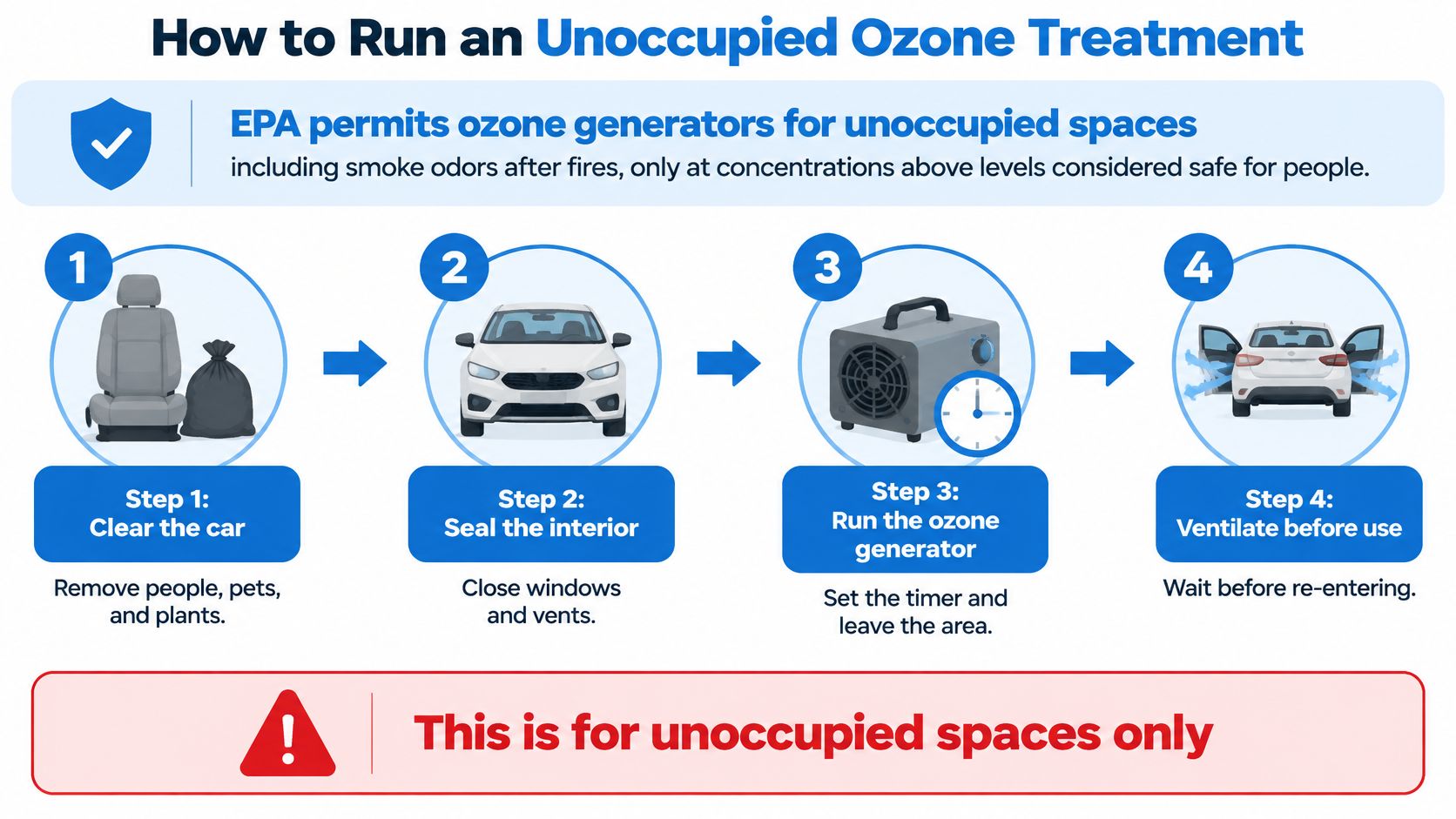
Establish control before switching on
Record the approximate cabin volume, the generator's stated output, its available settings, and the manufacturer's vehicle-use instructions. Check commercial ozone generator specifications against the intended application. A higher output alone does not make a treatment more suitable for a car. If the instructions do not support vehicle use, choose another method or consult a qualified professional.
Confirm the exclusion checklist from section 1. Tell everyone with access to the keys that the vehicle is unavailable.
Choose an isolated outdoor location. Avoid an attached garage or any location where escaping ozone could reach occupied rooms. Keep the engine off, and plan how to ventilate the car without entering the cabin.
Set up the equipment securely. Follow the generator's instructions for placement, keeping its inlet and outlet unobstructed. Route power without crushing cables, creating a trip hazard, or improvising an unsafe electrical connection.
Close and secure the vehicle. Attach a visible warning and prevent accidental entry. Leave the HVAC off unless a qualified treatment protocol specifies another configuration.
Arrange remote observation. Place an appropriate ozone sensor inside the cabin where you can read its display or remote output from outside. Do not open the door and lean in to check it.
Run only the documented cycle. Use the specified controls and remain outside the exclusion area. Stop if the equipment malfunctions or ozone may be reaching an occupied location.
Shut down remotely and begin controlled ventilation. Do not enter immediately to retrieve the generator. Remove it only after ventilation and clearance procedures make access safe.
Keep a treatment log of the output setting, start and stop times, ventilation actions, and monitor readings. This record can help a professional assess what has been done and discourage undocumented repeat cycles.
A timer controls operation, not exposure clearance
The same elapsed time can produce different conditions in different cabins. Without the equipment instructions, vehicle conditions, and measurement capability, a universal cycle length is not a sound recommendation.
The following video offers visual context, but the generator manual and an exposure-control plan should guide the procedure.
Ending the machine's cycle starts the clearance work. It does not establish that the cabin is safe to enter.
Measured Clearance Versus Waiting Before Re-entry
How do you verify conditions for a child, someone with asthma, or a pet when the car no longer smells? Measure ozone, but don't mistake that measurement for a complete assessment of every remaining pollutant.
PandaHub's car ozone-treatment guide discusses unoccupied treatment and post-treatment ventilation. Residual conditions are affected by generator output, cabin volume, temperature, humidity, leakage, HVAC operation, and the amount of reactive material inside. A fixed waiting period doesn't account for those differences.
Clearance methods compared
| Method | What it measures | Suitable for sensitive occupants | Main weakness |
|---|---|---|---|
| Fixed waiting period | Elapsed time only | Low confidence on its own | Ignores output, cabin volume, humidity, and HVAC use |
| Smell check | Human odor perception | Not reliable | Odor doesn't establish a safe ozone concentration |
| Fresh-air purge with fan on fresh-air mode | A dilution process, not a pollutant measurement | Useful preparation, insufficient clearance | Doesn't establish what remains in upholstery or air |
| Calibrated ozone monitor reading before entry | Ozone concentration at the sensor | Stronger ozone-specific evidence, not complete safety proof | Limited by calibration, placement, and inability to measure other pollutants |
Measure after the purge
Open doors and windows from outside without placing your head inside. Where the vehicle allows safe external operation, run the ventilation fan on fresh-air mode, not recirculation. Never run an engine in an enclosed space to power ventilation.
Choose an ozone-specific monitor with a documented calibration status and a measurement range suitable for low residual concentrations. A generic particulate or VOC display isn't a substitute.
Place the sensor near passenger breathing height, away from a vent outlet or an open window. Take the clearance reading after the active purge, not while fresh air is blowing directly over the sensor. Record the value, time, instrument, and vehicle conditions.
Then reassess under representative closed-cabin conditions using a professional protocol, rather than relying solely on a reading taken with every door open. A low measurement during aggressive ventilation may not describe the conditions passengers will encounter later.
Separate ozone clearance from overall cabin safety
Workplace exposure limits aren't automatic family-vehicle clearance targets. Have a qualified professional establish an appropriate criterion when vulnerable passengers will use the car, and account for monitor uncertainty and outdoor background conditions.
An ozone monitor also won't tell you whether reaction byproducts or smoke residues remain. Persistent irritation, chemical odor, or unresolved contamination requires further investigation even when the ozone reading is low.
For sensitive occupants, a measured assessment is the minimum evidence to seek, not an optional upgrade to an arbitrary waiting period.
Symptoms After Treatment and How to Respond
Persistent or returning symptoms call for a specific response. The EPA wildfire guide for public-health officials warns that ozone treatment for smoke odor can produce potentially dangerous byproducts through reactions with smoke-related chemicals.
Post-treatment symptoms, possible sources and responses
| Symptom | Possible source to investigate | Response |
|---|---|---|
| Smoke smell returns within days | Residue in upholstery, headliner or evaporator | Inspect and clean affected materials and the evaporator. Replace a contaminated cabin filter. |
| Sharp chemical odor persists | Residual ozone, reaction byproducts or cleaning chemicals | Ventilate outdoors, measure ozone and arrange professional investigation if the odor persists. |
| Smoke smell appears when the heater or AC runs | Contamination in ducts, filter housing or evaporator | Clean affected HVAC components before considering further treatment. |
| Eye or throat irritation on re-entry | Residual ozone or other airborne irritants | Leave the vehicle, ventilate it and obtain a measured assessment before returning. |
| Cracked rubber seals or brittle plastic | Possible oxidation damage, particularly after repeated exposure | Stop further cycles and have the affected materials inspected. |
Treat symptoms as a stop signal
A chemical smell cannot identify a specific byproduct, and irritation may have more than one cause. Use these signs to guide investigation, not to identify a diagnosis.
If anyone develops coughing, chest tightness, breathing difficulty or persistent eye or throat irritation, move them into fresh air and seek medical advice. Severe breathing difficulty requires emergency care. Do not send someone back into the car to investigate by smell.
Stop condition: Irritation after treatment calls for fresh air and assessment, not another ozone cycle.
Repeated oxidation can damage susceptible rubber, leather, plastics and adhesives. Inspect seals, trim and upholstery, and give the treatment log to whoever evaluates the damage.
A fading odor is a sensory observation, not proof that the cabin is safe to re-enter. Check that contaminated surfaces, the filter housing and affected HVAC components have been addressed, and use measured clearance before anyone returns.
Decide Whether to Treat It Yourself or Call a Professional
DIY cleaning is reasonable for light, localized smoke contamination. DIY ozone treatment requires a much higher level of control. You need to complete source removal, understand the equipment instructions, isolate the vehicle, and obtain meaningful measurements before anyone returns.
I would start with cleaning alone and reassess after the cabin dries. If the remaining problem requires a generator but you can't measure ozone reliably, the next purchase shouldn't be a stronger machine.
When professional help is the better choice
- Fire-related contamination: Burnt materials and widespread deposits need an assessment beyond cosmetic detailing.
- Heavy or hidden residue: Contaminated headliners, seat foam, carpet padding, and inaccessible trim may require removal or replacement.
- Ventilation-system odor: An evaporator or duct problem needs appropriate access and cleaning, not repeated treatment of the cabin air.
- Recurring odor after cleaning: Stop repeating the same process when the source remains unidentified.
- Sensitive passengers: Arrange professional assessment when children, pregnant passengers, or people with asthma will use the vehicle.
- No reliable measurement capability: Don't create an atmosphere you can't assess afterward.
Ask the detailer to describe what they'll physically remove, how they'll address the HVAC system, and how they'll document any chemical treatment and clearance. A service described only as a timed ozone session doesn't answer those questions.
Professional cleaning can replace repeated treatment cycles rather than merely adding another cycle to the bill. The useful outcome is removal of contaminated material and documented conditions, not the strongest possible odor change.
Keep equipment selection separate from the remediation decision
For disclosure, we sell ozone generators at EcoQuest Purifiers. Compare stated output, controls, operating restrictions, and measurement requirements across brands rather than treating a retail listing as a treatment recommendation. A smoke air-purifier category is a place to compare equipment, not evidence that a particular device will remove embedded automotive residue.
Before switching anything on, write down the cleaning checklist, exclusion arrangements, and clearance plan. If you can't complete that document, book a professional assessment instead.
EcoQuest Purifiers offers ozone generators, air purifiers, replacement parts, and product manuals and support. Visit EcoQuest Purifiers to compare equipment specifications and operating requirements before choosing a device, with source removal and measured clearance planned first.