
Portable Air Purifier for Room: How to Choose by Size
A portable purifier should be sized for the room it will fill, not the largest square-foot figure on its box. Buying by advertised coverage without checking the Clean Air Delivery Rate (CADR) can leave a unit too weak for an open layout or too loud to run at the speed needed.
Measure the room first, then compare CADR, particle-removal technology, ozone output, energy use, noise, and filter costs. A portable air purifier for room use is equipment for a specific volume of air, not a universal appliance.
Table of Contents
- Match Clean Air Delivery Rate to Room Size
- What Each Purification Technology Actually Removes
- Ozone, Ionizers and Energy Trade-offs
- How Much Particle Levels Really Drop
- Placement and Noise for a Real Room
- Filter Costs, Warranty and Upkeep
- Pick a Model by Room Type
Match Clean Air Delivery Rate to Room Size
Clean Air Delivery Rate (CADR), measured in cubic feet per minute (cfm), decides whether a portable purifier fits your room. The U.S. Environmental Protection Agency guide to air cleaners in the home states a higher CADR means the unit can filter more particles and serve a larger area, and gives minimum CADR values of 65 cfm for 100 square feet and 390 cfm for 600 square feet.
| Room Size (sq ft) | Minimum CADR (cfm) |
|---|---|
| 100 | 65 |
| 200 | 130 |
| 300 | 195 |
| 400 | 260 |
| 500 | 325 |
| 600 | 390 |
Reading the Table Without Doing Extra Math
Every row works out to 0.65 cfm per square foot. A 150-square-foot bedroom therefore needs about 98 cfm, and a 450-square-foot living room needs about 293 cfm. Don't round down to make a favorite model fit, because an undersized cleaner processes the room too slowly while new particles keep entering or being generated indoors.
A 100-square-foot nursery can work with a compact unit if it delivers 65 cfm at a speed you'll tolerate. A 300-square-foot bedroom needs three times that output, even if both products look similar in photographs. At 600 square feet, you're in large-unit territory, and one small desktop model won't become adequate because you place it in the center.
Practical rule: Move up one table row for high ceilings or an open layout, because the extra air volume and connected spaces dilute the cleaner's output.
Why Physical Size Misleads Buyers
A tall cabinet doesn't prove high output, and a compact cabinet doesn't prove weak output. Fan capacity, filter resistance, seals, and speed settings determine how much cleaned air leaves the unit. Marketing area can also assume conditions that don't match your ceiling height, door position, or preferred fan speed. CADR gives you a comparable output number across brands.
Portable units often reach high CADR through HEPA filtration, which is why particle performance and airflow belong together. A dense filter paired with a weak fan may trap particles well in a test pass but clean the room slowly. A strong fan with poor filtration moves plenty of air without removing enough fine particles. You need both.
For virus-related particle control, look for a room-sized unit that's HEPA-designated, has a high smoke CADR, or states it removes most particles in the 0.1 to 1 micrometer range. That specification is more useful than a generic germ claim. Measure length multiplied by width, find your row, then filter listings by CADR first. I would reject any shortlist model that won't state CADR clearly.
What Each Purification Technology Actually Removes
No single technology does every job equally well. Particle removal, odor and gas removal, and microbial treatment are separate tasks, and a spec sheet that blends them into one promise leaves you guessing.
| Technology | What It Targets | Main Limitation | Role in a Room Unit |
|---|---|---|---|
| HEPA filter | Fine particles, dust, pollen, smoke | Does not remove gases or odors on its own | Core particle removal |
| Activated carbon | Odors, gases and VOCs | Adsorbent saturates and needs replacement | Odor support |
| UV-C lamp | Microbes that pass close to the lamp | Effect depends on exposure time and airflow | Supplement to filtration |
| Photocatalytic oxidation (PCO) | Odors and some VOCs | Catalyst cells wear and need UV activation | Odor support |
| Ionizer | Charged particles | Can produce ozone; particles settle rather than leave the room | Use with caution |
| Ozone generator | Odors | EPA advises against use in occupied spaces | Avoid in occupied rooms |
Filters Do the Measurable Particle Work
A HEPA filter is the core choice for dust, pollen, smoke, pet dander, and other fine particles because contaminated air physically passes through media that traps them. Check that the filter grade is named and the housing seals around it. Gaps let air bypass the media, so a premium filter in a leaky cabinet underperforms its label.
Activated carbon handles many smells and gases by adsorbing them onto a large internal surface. It doesn't refresh itself. Once saturated, odors pass through and can even seem to return, so carbon weight, replacement access, and cost matter. A thin carbon sheet is light odor support, not a serious solution for persistent cooking, litter, or chemical smells.
Light Based Stages Depend on Exposure
UV-C and photocatalytic oxidation act only where contaminants receive enough exposure near the lamp or catalyst. Fast airflow can shorten contact time, while lamp aging and dirty surfaces reduce output. Treat these stages as supplements inside a filtered system, not substitutes for capturing particles. A useful overview of using UV light in air conditioning helps separate installed UV applications from what a small portable lamp can realistically do.
PCO includes RCI cells in some catalogs. The cell needs UV activation and eventually wears, so ask how you'll know it needs service and what the replacement costs. If a seller can't answer that, you're buying a feature without an upkeep plan.
Ionizers charge particles so they settle or stick to surfaces. That isn't the same as collecting them in a filter, and deposited material can be disturbed later. Ozone generation is a different risk category and doesn't belong in an occupied bedroom because it changes odor perception.
Before buying, make two checks. Is the HEPA grade named, and is there a real carbon stage if odors matter? If either answer is no, know exactly which job the unit won't do.
Ozone, Ionizers and Energy Trade-offs
Ozone settings and electrical demand can change how useful a portable purifier is in an occupied room. The EPA guidance on air cleaners, HVAC filters, and respiratory viruses warns against air cleaners that intentionally generate ozone in occupied spaces. It also notes that ozone at concentrations meeting public-health limits does not effectively remove viruses, bacteria, mold, or other biological pollutants.
Check every operating mode before buying. Some units pair filtration, ionization, UV, or PCO with an ozone or active-oxygen setting. For a room where people or pets will remain, choose a mode that does not intentionally generate ozone, and check the operating instructions before purchase. EcoQuest's ozone generators are a separate category from purifiers intended for routine use in occupied rooms.
Energy Use Depends on Mode and Runtime
A purifier's power use depends on its mode and how long it runs. A South Korean apartment analysis reported portable HEPA operation drawing 8.9 to 62.4 watts, depending on mode, with modeled PM2.5 removal near 99.9% for the purifier component. The low end points to a modest draw in a quieter mode; running at the high end for longer will use more energy.
A New York State energy study concluded that ceiling-mounted systems can be more energy-efficient and potentially more effective than portable units when occupancy-based controls and suitable airflow are provided. Portable purifiers still suit renters and rooms with a specific air-quality concern. For an office or classroom, permanence, controls, and building airflow affect the comparison.
Compare watts and CADR at the speed you'll run day to day. A low-watt setting may not deliver the airflow needed for the room.
Four Questions Before You Commit
- Does it generate ozone? Check every mode, including boost, sanitize, and away settings.
- What is the quiet-mode draw? Use that wattage when estimating energy use in a bedroom, nursery, or office where high speed may be too loud.
- How long will it run? Daily runtime can matter more than a small difference in rated watts.
- What is producing the pollution? Cooking smoke, dampness, cleaning chemicals, and smoking also call for source control or ventilation.
A purifier supplements source control and outdoor-air ventilation. It cannot replace them. Address dampness, vent cooking at the stove, and stop indoor smoking where possible. Then size the purifier for the airborne pollution that remains.
How Much Particle Levels Really Drop
In the linked real-world study, portable air cleaners operating in primary rooms were associated with average reductions of 78.8% for PM2.5 and 63.9% for PM10. Those results describe the tested rooms, not a guaranteed reduction in every home. The peer-reviewed study of portable air cleaners reports the figures.
The infographic compares the primary-room results.
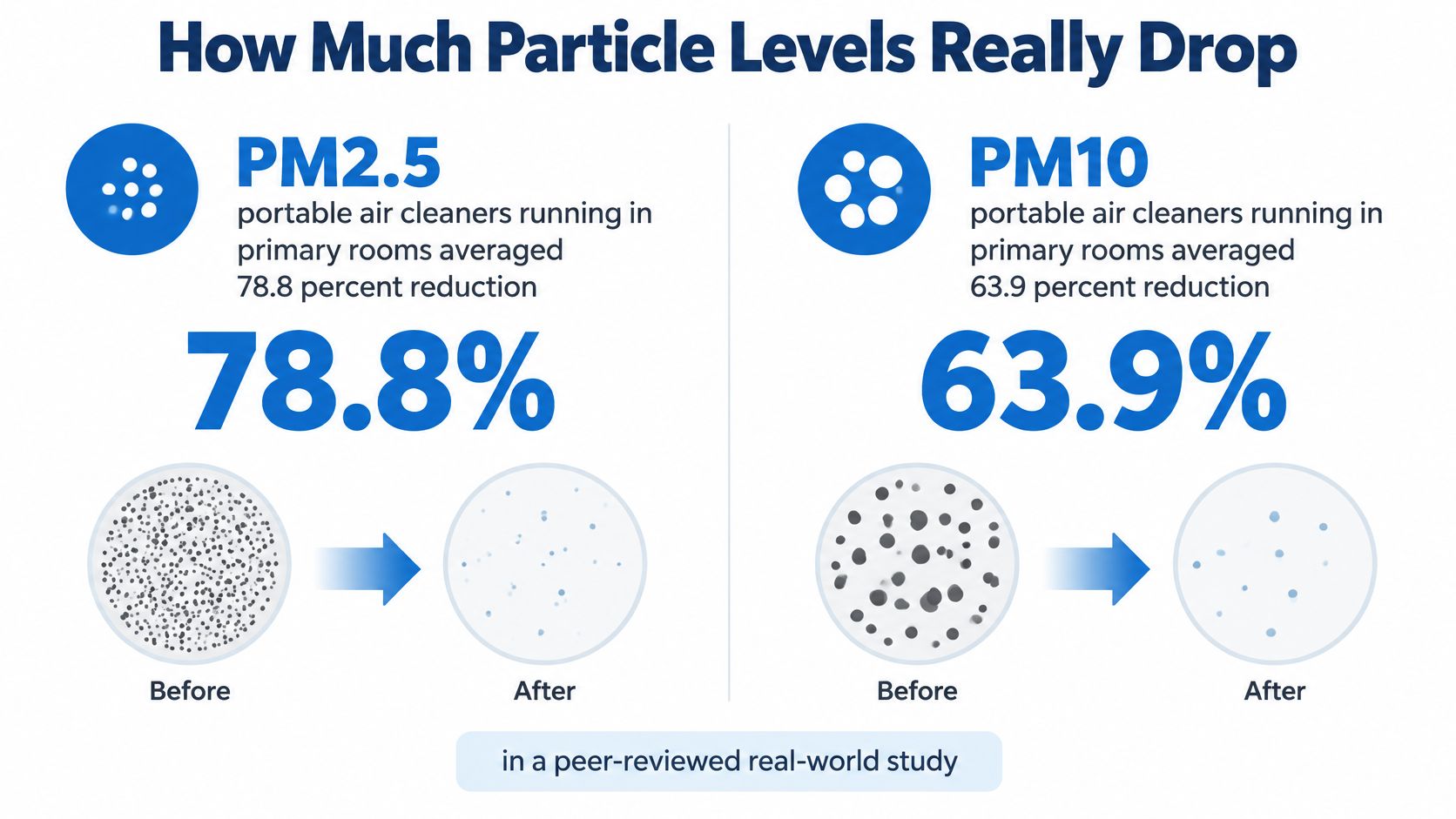
| Measurement | Reported Reduction |
|---|---|
| Real-world study, primary rooms | 78.8% PM2.5 and 63.9% PM10 |
Why the Range Is So Wide
A reading from the room holding the purifier does not predict the same result in a connected room. Air must move between spaces, and particles can enter or settle along the way. Room size, doors, operating time, fan speed, filter condition, and particle sources all affect what a monitor records.
Fine particles deserve particular attention when the concern is smoke, fine dust, or combustion pollution. Coarser particles settle faster, so a reduction in large dust does not establish how well a purifier handles smaller airborne particles.
The short video below illustrates how room airflow affects the reach of a portable cleaner.
A Three Part Test for Any Claim
Check which particle size was measured, which room was tested, and whether the reading came from the treated room or a neighboring one. A separate air quality monitor for tracking room readings can show whether particle levels fall where you spend time, rather than relying on a purifier's indicator light.
Correct sizing, steady operation, clean filters, and fewer particle sources make strong reductions more attainable. A short run after particles have accumulated will not necessarily produce the same result as ongoing operation.
Placement and Noise for a Real Room
A sizing table assumes a defined room. Your home may have a vaulted ceiling, a leaky rental window, an open kitchen, or a bedroom door that stays open. The ENERGY STAR 2025 air cleaner guidance is a useful cross-check on that table: its minimum smoke CADR targets follow the same cfm-per-square-foot ratio, so where the room and the numbers disagree, suspect the room. Tall ceilings, open floor plans, and leaky envelopes add volume and leakage that a floor-area figure never captures.
The advertised maximum area may assume a high fan setting, while you'll run lower settings at night because of noise. Real coverage shrinks accordingly. Two smaller units can sometimes outperform one large unit in a long or divided space because they mix air from two points and can run at lower speeds. They also add a second filter, fan, and electricity draw, so the benefit has to justify the upkeep.
Placement Procedure
- Measure floor area and ceiling height: Calculate the CADR target first, then allow extra capacity if the room connects to another space.
- Use incoming airflow: Place the unit next to an incoming air vent so natural airflow carries cleaned output across the occupied area.
- Raise the unit: Place it as close to the ceiling as possible, or at least five feet from the floor, when the model's design and safe support allow it.
- Clear the intake and outlet: Keep curtains, bedding, upholstered furniture, and storage away from every grille so air can enter and leave freely.
- Limit leakage: Close doors during focused cleaning and seal obvious window gaps, especially during outdoor smoke.
- Run continuously at a tolerable speed: Use low or medium as the baseline and reserve high for arrival, cleaning, cooking fallout, or smoke events.
A unit placed behind a sofa or in a corner recirculates its own exhaust and leaves the far side of the room stale. Move the outlet into open space so the intake pulls from the room rather than a wall.
Test Noise Where You'll Hear It
Compare decibel ratings at the speed you'll run, not only the maximum-speed figure. A spec sheet's highest noise number describes turbo operation rather than sleep mode. Tone matters too, because a low hum may be easier to accept than a whine at the same measured level.
Run the purifier at your intended night speed and listen from the bed or desk before deciding it's quiet enough. If you have to turn it down below the CADR your room needs, the right answer may be a larger unit on a lower setting. That combination often costs more upfront, but it delivers usable clean air without forcing a choice between sleep and performance. Check the wattage at the speed you'll use, since a small unit straining at maximum can draw more power and make more noise than a larger unit cruising at medium.
For wildfire smoke, allergies, or respiratory-virus concerns, protect the room where people spend the longest continuous time first. A closed bedroom with adequate CADR is a defensible clean-air zone. Expecting that same unit to handle the kitchen, hallway, and living room through open doors isn't.
Filter Costs, Warranty and Upkeep
The purchase price is only the entry cost. A portable purifier keeps working only if you replace or clean the parts that collect pollution and generate the secondary treatment stages.
HEPA filters and activated carbon need replacement when loaded or saturated. Washable pre-filters need cleaning so large dust doesn't choke airflow before air reaches the main filter. PCO cells and UV bulbs also wear and need replacement on the manufacturer's schedule, even though they don't look dirty in the same way a filter does.
Most air purifiers are covered by a one-, two-, or three-year warranty, which does not include replacement parts such as filters, screens, PCO cells and UV bulbs. Don't mistake warranty length for free maintenance. A longer warranty can still leave you paying for every consumable from the first scheduled change.
Calculate the Annual Cost Before Buying
Use this formula for each replaceable part.
Annual consumable cost: Replacement price multiplied by changes per year, using the manual's schedule for your actual daily run hours.
- Confirm exact part names: Match the model and stage, especially when similar units use different filters.
- Price every consumable: Include HEPA, carbon, cells, bulbs, and shipping if that affects your decision.
- Date each filter: Write the installation date on the frame where you'll see it during cleaning.
- Wash the pre-filter on schedule: Let it dry fully before reinstalling it.
- Keep records together: Store the manual with the warranty card and replacement dates.
Price replacement filters, screens, and HEPA parts for both finalists before comparing sticker prices. I would choose the model with the clearer parts list and sustainable annual cost over a cheaper unit whose filters are obscure or disproportionately expensive. Continuous operation also shortens calendar intervals, so a filter described in months may not last those months in a smoky or dusty room.
Pick a Model by Room Type
Choose by the room's main constraint, not by the broadest advertised coverage. A bedroom prioritizes quiet operation and the intended purification method; a car prioritizes safe use in a confined cabin; an open-plan space needs enough airflow to reach separated areas.
| Situation | Spec to Prioritize | Model Family to Compare |
|---|---|---|
| Bedroom or nursery | Low-noise operation, filtration type, and CADR matched to the room | EcoRoom Plug-In Air Purifier for Small Rooms |
| Home office or small room | CADR at a usable speed and a footprint suited to the desk area | Fresh Air Purifier Desktop |
| Car or commuter cabin | Compact size and clear instructions for ozone use | EcoTravel Voyager Portable Car Air Purifier |
| Larger open-plan room | Coverage and airflow suited to the layout | Breeze AT |
| Smoke-prone home | High smoke CADR and a HEPA-designated filter | HEPA-based portable models |
Bedrooms, Offices, and Cars
For a bedroom or nursery, consider both operating noise and whether the model's stated coverage and CADR suit the room. The EcoRoom Plug-In Air Purifier for Small Rooms costs $279.99 and covers one room up to 500 square feet with ActiveOx and plasma ionization. Its plug-in format saves shelf or desk space. For allergy-focused bedrooms, you can also choose mattress protectors for allergy protection, since a purifier cannot remove particles that have settled into bedding.
A home office may favor a compact unit that can run at a tolerable speed while meeting the room's target. The Fresh Air Purifier Desktop costs $79.99 and covers one room up to 300 square feet with ions, ozone, and charcoal. Check its operating mode before placing it near a desk or bed.
In a car, cabin size makes operating instructions especially important. The EcoTravel Voyager Portable Car Air Purifier costs $199.99 and uses ozone, ions, UV, and photocatalysis. Follow its instructions for ozone operation, particularly when people are in the vehicle.
Larger and Smoke-Prone Rooms
For open-plan spaces, the Breeze AT covers up to 1,500 square feet and is portable and quiet, with UV and ozone plus a washable pre-filter. Compare its stated coverage with the room's calculated CADR target and layout. Corners and partial dividers can limit how well one unit circulates air, so a two-unit arrangement may distribute airflow more effectively.
Smoke-prone homes need a different priority: a HEPA-designated filter and sufficient smoke CADR. Compare models that disclose those specifications, along with ozone behavior and operating noise. Check the current price and include replacement parts in the purchase comparison.
Visit EcoQuest Purifiers to compare room and car models with your CADR, noise, ozone, and upkeep requirements. Bring your room dimensions and target cfm, then choose a unit suited to the space you will occupy and maintain.