
Quietest Room Air Purifier: The Honest Noise Guide
Shopping for the quietest room air purifier often means sorting products from the lowest advertised decibel figure upward. That sounds sensible, especially if you're trying to sleep, but it can produce the wrong result. A purifier can be nearly inaudible because it moves very little air, runs only in a weak setting, or uses a technology that raises separate safety questions.
The better question is not “Which purifier makes the least noise?” It's “Which purifier removes enough particles at a sound level I can tolerate at 2 a.m.?” That shift puts sound, airflow, filtration, operating speed, and maintenance into the same decision instead of treating silence as proof of performance.
Table of Contents
- The Quietness Trap in Air Purifier Shopping
- Understanding Acoustic Ratings and Standards
- Comparing Noise Levels Against Cleaning Performance
- Evaluating Sleep Modes and Fan Speed Options
- Selecting the Quietest Room Air Purifier for Your Space
- Maintenance Impact on Air Purifier Noise
- Implementing Your Quiet Air Purifier for Best Results
The Quietness Trap in Air Purifier Shopping
The lowest-decibel purifier is often the wrong bedroom choice. Its quiet rating may describe a barely moving fan, a setting too weak for the room, or an ionizing technology with separate ozone concerns. A quiet machine can protect your sleep while doing little for the air you breathe.
A typical comparison looks straightforward. One unit advertises a lower noise figure, so it goes beside the bed with the display turned off. For the first few nights, nothing seems wrong. Then cooking smoke, dust, or seasonal particles enter the room, and the purifier stays on its lowest setting because higher speeds are too distracting.
That exposes the central trade-off: acoustic comfort and cleaning performance are separate outcomes. The quietest setting may be pleasant at 2 a.m. but ineffective when the room's particle load changes.
Why the lowest number can mislead
Noise figures are difficult to compare when manufacturers use different fan speeds, distances, room conditions, or measurement methods. One headline figure may describe the minimum setting, while another reflects a different operating condition. Product packaging may provide no standardized acoustic information at all.
The operating point matters as much as the advertised number. Faster fans generally move more air and produce more sound. If the purifier is undersized, you may have to accept a louder setting or tolerate weak overnight circulation. A larger unit can often clean at a lower speed, which is the more useful form of quietness.
Practical rule: Confirm that the purifier's low-speed CADR covers at least two-thirds of your room's square footage before choosing it for sleep.
Technology creates a second trap. Some ionizers, electrostatic precipitators, UV systems, and plasma cleaners may emit ozone. The U.S. Environmental Protection Agency's technical summary identifies ozone as a lung irritant. A low-noise unit is a poor bedroom choice if its quiet operation depends on an emission-producing method or if its cleaning claims lack independently verifiable performance data.
What works in an actual bedroom
Compare low, medium, and high settings, not just the sleep-mode label. Check measured sound data, smoke CADR, and the stated room-size recommendation. Then ask whether the purifier can handle normal changes in air quality without running at maximum speed all night.
A capable purifier gives you more room to adjust. Run it faster after cooking or cleaning, then reduce the speed once the air improves. That approach usually works better than a tiny unit that must operate loudly whenever particles enter the room.
Understanding Acoustic Ratings and Standards
A decibel figure only helps when you know what was measured. Noise can come from the fan, motor, vibration through a table or floor, electrical components, and tonal sounds that are more distracting than a broad, steady airflow. Two machines with similar published numbers may feel very different in a quiet bedroom.
What ANSI/AHAM AC-2-2006 adds
The ANSI/AHAM AC-2-2006 method was created specifically to determine and compare the sound produced by portable household electric room air cleaners. It was approved as an American National Standard on January 5, 2006, establishing a more structured basis for acoustic evaluation than subjective labels such as “silent” or “whisper-quiet” AHAM comments and standard background.
Its rating includes an A-weighted sound-power level and loudness. Those terms aren't interchangeable with a casual phone reading taken beside the air outlet. Sound power describes the acoustic energy produced by the device under test conditions, while perceived loudness reflects how that output is experienced. The testing framework helps evaluators compare products, but it doesn't eliminate the need to understand the test setup.
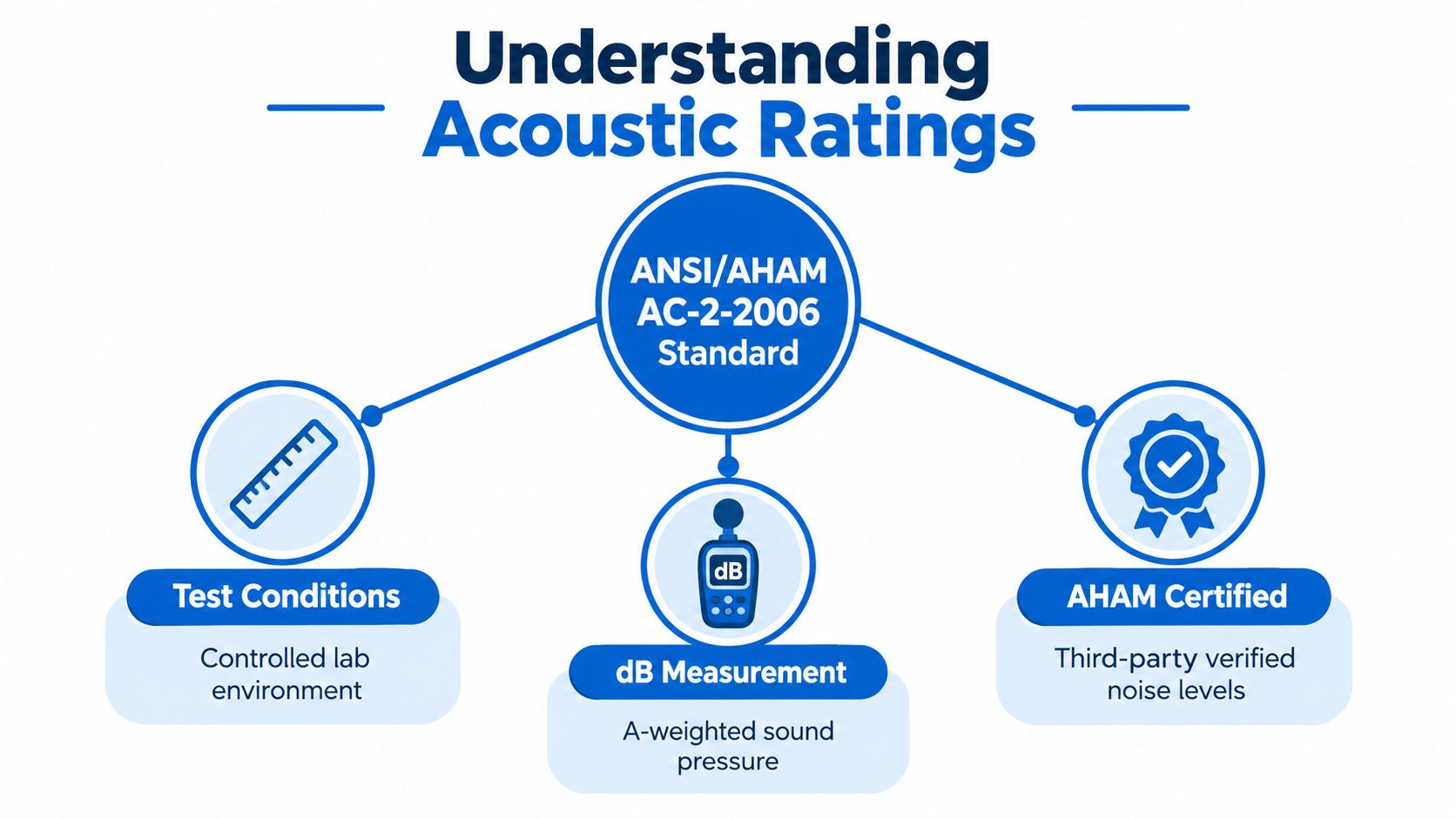
The standard isn't international, so figures from different countries or laboratories may still require careful interpretation. A trustworthy product comparison should tell you the test method, fan speed, acoustic measure, and test conditions. If those details are missing, treat the number as a marketing clue, not a final verdict.
Reading a product page critically
A compact plug-in device may suit a small bedroom or office where shelf and floor space are limited. For example, the EcoRoom Plug-In Air Purifier for Small Rooms is described as a wall-plug air cleaner for small rooms, bedrooms, bathrooms, and offices, with a design that avoids taking up shelf or desk space. Its catalog description emphasizes low maintenance and long-lasting use, but those statements don't replace independent noise and CADR measurements.
Use this checklist before comparing models:
- Test condition: Find out whether the figure applies to the lowest, sleep, or maximum setting.
- Measurement type: Check whether the rating is sound power, sound pressure, or an informal reading.
- Sound character: Look for comments about hum, clicking, vibration, and changing fan tones.
- Room context: Remember that a purifier beside your pillow will seem louder than one farther away.
- Verification: Prefer repeatable testing over adjectives such as “silent.”
A purifier's sound profile matters more than a single attractive number. Consistent, low-toned airflow may fade into the background, while a smaller tonal whine can remain noticeable even when the average reading appears modest.
Comparing Noise Levels Against Cleaning Performance
The useful comparison is CADR versus noise at the speed you will use. Portable air-cleaner ratings are generally measured at maximum airflow, which usually produces the most noise. Lower fan settings reduce sound, yet they also reduce pollutant removal. A bedroom purifier can therefore advertise strong CADR while delivering far less cleaning during overnight operation. The EPA technical summary explains this relationship and the limits of comparing maximum-speed figures with sleep-mode performance.
The same EPA summary reports smoke and fine-particle CADR ranging from below approximately 20 cubic feet per minute for some ionizer and photocatalytic-oxidation portable units to roughly 150 to 300 cubic feet per minute for many HEPA and electrostatic portable cleaners, depending on device size and design. That range makes “quiet purifier” an incomplete category. A device that produces little fan noise may also move too little air, and some specialized technologies require careful checking of emissions and independent cleaning results.
Air Purifier Performance vs Noise Trade-off
| Technology Type | Typical Smoke CADR (CFM) | Noise Profile | Best For |
|---|---|---|---|
| Some ionizer and photocatalytic-oxidation portable units | Below approximately 20 | May be quiet when little fan-driven airflow is used, but verify emissions and independent performance data | Buyers considering specialized technologies who can verify safety and cleaning output |
| Many HEPA portable cleaners | Approximately 150 to 300, depending on device size | Fan noise usually rises with airflow, especially at maximum speed | Bedrooms and living spaces where measurable particle removal matters |
| Many electrostatic portable cleaners | Approximately 150 to 300, depending on device size | Sound varies with fan design and operating speed; technology-specific safety information matters | Users comparing airflow-based cleaning with electrostatic assistance |
The table compares operating trade-offs rather than ranking technologies. Technology labels do not replace measured output. A low-CADR unit may sound attractive but provide limited useful air exchange. A higher-CADR model gives you more room to reduce fan speed while maintaining meaningful cleaning, provided its sound quality remains tolerable beside the bed.
Buy capacity, then slow it down
Washington State health guidance recommends selecting a purifier rated for a larger room or using multiple devices, allowing each unit to run at a lower fan speed. It describes roughly 40 dB as refrigerator-like background noise and recommends keeping indoor noise below 45 dB where feasible Washington State Department of Health guidance.
For a 300-square-foot living room, the two-thirds sizing rule implies about 200 cfm smoke CADR, according to the same guidance. Extra capacity can let you lower the fan setting without giving up as much particle removal. That matters at 2 a.m., when a steady low hum may be acceptable but a higher setting can interrupt sleep.
Request three figures before buying:
- Smoke CADR, preferably from a standardized test.
- Noise at low, medium, and high settings, rather than only the quietest mode.
- Power consumption at the intended setting, so overnight comfort and operating cost are considered together.
Before checkout, ask the retailer for the smoke CADR at the low setting. If that figure does not exist, treat the quietness claim as marketing rather than a measured performance result.
Evaluating Sleep Modes and Fan Speed Options
A sleep mode should change the way the purifier behaves overnight, not merely dim a display. The important questions are whether the fan remains steady, whether the unit can surge unexpectedly, and whether the quiet setting still moves enough air to matter.
Start with the lowest-speed measurement, then listen for the qualities a meter may miss. A low mechanical hum may be easy to ignore, while vibration against a nightstand can travel through the bed frame or floor. Auto mode can also create sudden bursts when its sensor detects a particle event, which may be useful for cleaning but disruptive when you're trying to stay asleep.
A practical overnight test
Independent bedroom-focused guidance treats under 34 dBA at the lowest fan speed as a useful threshold. It describes 30 to 32 dBA as practically inaudible and notes that 35 dBA or higher may distract light sleepers, although personal sensitivity and testing conditions vary bedroom air-purifier testing guidance.
Use that threshold as a screening point, not a guarantee. Test the purifier in the room where you'll sleep, with the bed, walls, and furniture in their normal positions. Listen from the pillow, not only from the location where a manufacturer or reviewer placed a meter.
A useful overnight checklist includes:
- Low-speed output: Confirm that the quietest setting still provides documented airflow or CADR.
- Tonal behavior: Listen for pulsing, electrical whine, rattling, and blade turbulence.
- Auto-mode response: Check whether the fan accelerates abruptly after doors open, cooking occurs, or dust moves.
- Indicator controls: Make sure lights can be disabled rather than merely reduced.
- Technology safety: Verify whether ionization, plasma, UV, or other features can emit ozone or be switched off.
- Filter loading: Observe whether the unit becomes louder as resistance increases.
The bedroom-focused EcoQuest purifier selection page can be a starting point for reviewing room-oriented options, but product suitability still depends on verified sound data and cleaning performance at the selected speed.
The most useful sleep mode is predictable. It should run steadily, avoid unnecessary surges, and keep operating conditions within the range you tested. A mode that produces silence by nearly stopping airflow isn't a complete solution.
Selecting the Quietest Room Air Purifier for Your Space
The quietest purifier on paper is rarely the best bedroom choice. A very low decibel rating may describe a near-idle fan, not useful cleaning, or a device that depends on ionization or other ozone-generating technology. Choose by comparing sound with filtration output at the speed you will use overnight.
Start with the room. A compact bedroom, nursery, office, and open living area place different demands on airflow and create different tolerances for fan noise. Measure the space, identify the main pollutant concern, and decide whether the purifier will run continuously, only during sleep, or in response to changing air quality.
Use the two-thirds sizing rule as a starting point, then check the manufacturer's smoke CADR. For a 300-square-foot living room, the rule indicates approximately 200 cfm smoke CADR. That capacity is useful only if the purifier can deliver it without forcing you to tolerate its loudest setting. Extra capacity can provide a lower-speed operating margin, but compare the measured sound and CADR at each relevant speed rather than relying on the maximum rating.
Match the strategy to the room
A compact bedroom with limited floor or desk space may suit a plug-in design. The EcoRoom description presents a small-room air cleaner for bedrooms, bathrooms, and offices, with wall-plug installation and a low-maintenance design. Its form factor may fit a tight room, but request measured sound and CADR data before treating it as a sleep solution.
For a larger room, select a model that reaches the required smoke CADR at a moderate setting. A purifier that meets the target only at high speed may clean adequately while disturbing sleep. A stronger unit can run at lower volume, provided its acoustic measurements are transparent and its filtration technology is safe for occupied rooms.
Refurbished equipment can work when the manufacturer or seller documents filter condition, replacement parts, repairs, and testing. Do not assume that an older unit remains quiet because its original model included a sleep mode. Fan bearings, housings, filters, and vibration points determine the sound you hear now.
Compare complete ownership, not just the shell
Check maintenance access before buying. Filter loading can increase airflow noise, while difficult replacement procedures may lead to delayed servicing and reduced performance. Confirm that compatible parts are available and that routine cleaning is practical for your household.
A broader explanation of air purification can help clarify when a single-room device is appropriate and when a whole-home approach deserves consideration. Even with whole-home equipment, a bedroom still requires attention to local airflow, placement, and sound.
Review single-room options in EcoQuest's one-room air purifier catalog. Apply the same standard to every brand: measured sound at the intended speed, documented smoke CADR, clear information about ozone risk, and a realistic maintenance path. The right purifier is the one that cleans enough to remain on without making sleep harder.
Maintenance Impact on Air Purifier Noise
Filter loading changes a purifier's acoustic profile. As resistance builds, the fan may work harder to move air through the restricted path. The result can be a stronger rush of air, a higher-pitched sound, or added vibration, even when the motor itself has not changed.
Maintenance therefore affects both sleep comfort and cleaning performance. A first-day noise rating says little about overnight behavior after dust and particles collect. Use the purifier's sound as an early sign that airflow or filtration needs attention.
Protect the original sound profile
Check the unit in the same location and at the same fan setting. A consistent listening routine makes changes easier to identify, while repeatable measurements help when comparing performance before and after service. Listen for rattles, pitch changes, and vibration, not only a rise in overall loudness.
Follow the manufacturer's filter schedule, then inspect the intake grille and outlet for dust or obstructions. A blocked grille can disturb airflow and create turbulence. Debris near the fan can produce irregular noise. Choose the correct replacement filters and screens for your model, because a poor fit or unsuitable resistance can affect both sound and particle removal.
Mark your calendar: if the low setting sounds one step louder than it did when you bought the unit, inspect the intake grille and check the filter's surface loading before ordering parts.
Fan-driven purifiers depend on clear airflow, while systems with additional cells, plates, lamps, or electronic components may require different inspection routines. Some technologies also raise separate questions about filtration performance and ozone safety. Whichever design you use, judge it by verified low-speed cleaning and sound rather than a promise of permanent silence.
Make replacement decisions from three observations: visible filter condition, any change in airflow, and increased operating noise. This approach keeps attention on consistent overnight performance and helps distinguish routine loading from a developing mechanical fault.
Implementing Your Quiet Air Purifier for Best Results
Place the purifier where air can enter and leave freely. Keep it away from walls, curtains, bedding, and furniture that can obstruct airflow or reflect sound toward the bed. A stable surface matters too, because vibration through a lightweight nightstand can be more irritating than the fan's direct airflow.
Run the unit before bedtime so the room isn't relying on a last-minute high-speed burst. Once the air is in a better condition, reduce it to the tested low or medium setting. If auto mode produces sudden surges, use a steady manual speed overnight and reserve higher operation for periods when the room needs faster cleaning.
Check power consumption at the setting you'll use, then include filter condition in your routine. A short monthly listening check can reveal rattles, airflow changes, or rising fan effort before they become a sleep problem. For workplaces and care environments, a practical facility hygiene guide from WipesBlog.com provides broader context for monitoring indoor conditions beyond a single bedroom.
Don't place the purifier so close to your head that a modest airflow sounds amplified. Give it enough distance to circulate air without creating a draft, and use a stable, vibration-resistant base when needed.
EcoQuest Purifiers offers single-room and whole-house air-cleaning products, replacement parts, repair support, and new or refurbished options across several purification technologies. Review the available specifications and maintenance components, then visit EcoQuest Purifiers to find an option that balances verified cleaning performance with the quiet overnight operation your room requires.