
Room Air Purifier Dust: How HEPA Filters Handle It
You turn on a purifier, hear the fan working, and assume the dust problem should fade. Then you wipe a dark shelf and your finger leaves a pale line. That moment confuses a lot of homeowners because the machine seems busy, but the room still looks dusty.
The missing piece is simple. A purifier works on dust that is floating in the air right now. Your eyes usually notice dust that has already landed on shelves, floors, bedding, blinds, and fabric. If you mix those two together, purifier performance never makes sense. If you separate them, it starts to.
Table of Contents
- Why a Room Can Still Look Dusty With a Purifier Running
- What Household Dust Is Actually Made Of
- How HEPA and Pre-Filters Catch Dust at Each Size
- Sizing a Purifier With Dust CADR Instead of Square Foot Hype
- The Resuspension Cycle That Keeps Dust Coming Back
- Placement, Runtime, and Upkeep Habits That Actually Help
- Common Beliefs About Air Purifiers and Dust Worth Retiring
Why a Room Can Still Look Dusty With a Purifier Running
The classic scene goes like this. You run the purifier all afternoon. The room smells fresher. The sunbeam looks a little cleaner. Then you drag one finger across the dresser and get that chalky streak anyway.
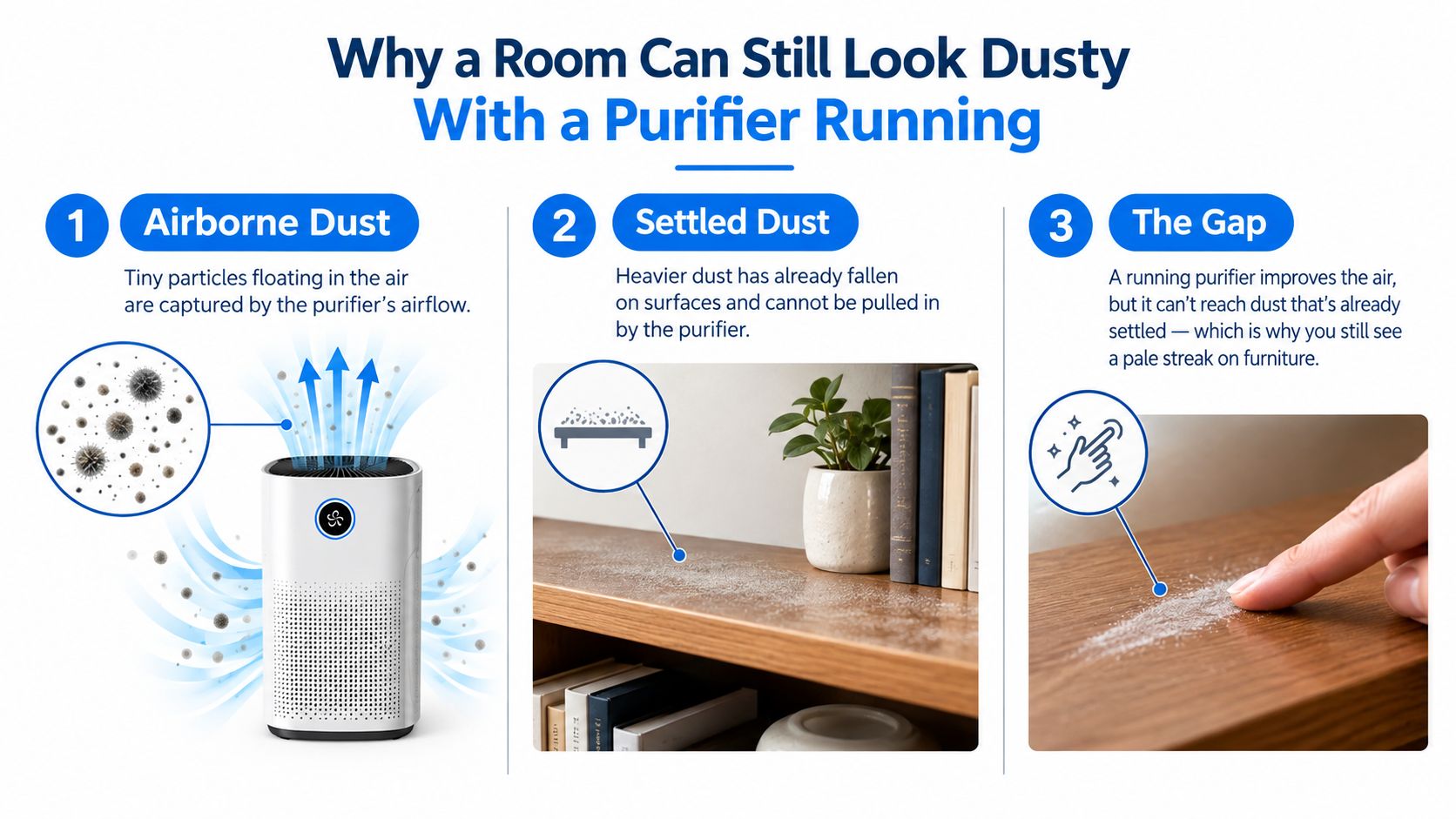
That doesn't automatically mean the purifier failed. It usually means you're looking at the difference between airborne dust and settled dust.
Two dust problems live in one room
A room has an airborne fraction and a settled reservoir.
The airborne fraction is what a purifier can pull through its intake and trap. The settled reservoir is everything already resting on the nightstand, baseboards, carpet, curtains, and bedspread. A purifier doesn't reach out and lift that layer off surfaces. It waits for some of it to become airborne again.
That's why a bedroom can still look dusty even when the air is cleaner. The machine is handling one part of the problem, not all of it.
Practical rule: A purifier lowers what you breathe first. It doesn't automatically erase what you see on furniture.
Why the dust keeps showing up
Normal life keeps feeding the air from the settled reservoir. You walk across the room. The dog jumps off the sofa. The HVAC starts. You shake out a towel. You make the bed. Small particles rise again, drift through the breathing zone, and only some of them pass through the purifier before settling somewhere else.
The National Academies notes that indoor particles are repeatedly resuspended, and that airflow direction and velocity affect removal behavior. In the experimental work it summarizes, forced resuspension required a flow velocity of 5 m/s or greater, and four-way airflow removed deposited particulate matter more effectively than one-way airflow (National Academies). That's a technical way of saying dust doesn't stay put nearly as well as people think.
If your goal is cleaner breathing air plus less visible dust, pair filtration with physical dust removal. Homeowners often get better results when they combine the purifier with routines like vacuuming fabric surfaces, washing bedding, and damp dusting. If allergens are part of the concern, this guide to Birmingham allergen reduction is a useful complement because it focuses on reducing what settles into rugs and soft surfaces.
What Household Dust Is Actually Made Of
Household dust is a mixed pile, not a single material. In one room, the dust you notice on a black table may be mostly fabric fibers and skin flakes. In the same room, the dust that matters more for breathing can be much smaller and too tiny to pick out with your eyes.
That split is where a lot of confusion starts.
Visible dust often behaves like crumbs on a floor. It lands quickly and builds up on shelves, baseboards, and screens. The finer portion behaves more like a light mist. It can float longer, move with air currents, and pass through the part of the room where people breathe.
Dust has different ingredients and different sizes
A practical way to sort household dust is by size band and by source. Size helps explain why some material keeps coating furniture while other material hangs in the air longer.
| Particle Band | Size Range | Typical Contents | Common Sources |
|---|---|---|---|
| Coarse particles | Larger than 10 microns | Skin flakes, pet hair fragments, textile fibers, visible debris | Bedding changes, carpets, upholstery, clothing, pets |
| PM10 | Up to 10 microns | Fine pollen, many mold spores, dust mite waste | Open windows, damp areas, tracked-in outdoor material, bedding |
| PM2.5 | Up to 2.5 microns | Fine combustion particles, smoke residue, very fine dust | Cooking, candles, outdoor infiltration, attached garages |
| Ultrafine particles | Below 0.1 microns | Very small combustion and process particles | Traffic pollution, some heating sources, printers |
The U.S. EPA explains that PM2.5 includes fine inhalable particles with diameters generally 2.5 micrometers and smaller, while PM10 includes inhalable particles 10 micrometers and smaller (EPA particle pollution basics).
A shelf can collect material from every row of that table at the same time. That is why a room can look dusty even if the purifier is doing a decent job on the smaller airborne fraction.
What is in the mix in a normal home
A lot of household dust comes from the home itself. Common ingredients include shed skin cells, broken-down textile fibers, bits of paper, tracked-in soil, pet material, pollen, and tiny fragments from indoor activities such as cooking.
The National Center for Healthy Housing describes house dust as a mixture that can include soil, skin cells, hair, clothing fibers, pollen, dust mites, and other indoor contaminants (National Center for Healthy Housing). That broad mix helps explain why dust never has one single fix. Laundry, pets, open windows, foot traffic, and soft furnishings all add something different.
For the visible side of dust control, cleaning technique still matters. These residential dusting techniques from South Mountain are helpful because they focus on removing settled material instead of just pushing it around.
A room can feel cleaner before it looks cleaner, because the airborne fine fraction and the settled visible fraction do not behave the same way.
How HEPA and Pre-Filters Catch Dust at Each Size
A purifier works more like a series of screens than one magic filter. Each layer is built for a different part of the dust problem, and that matters because dust is not all the same size or weight.
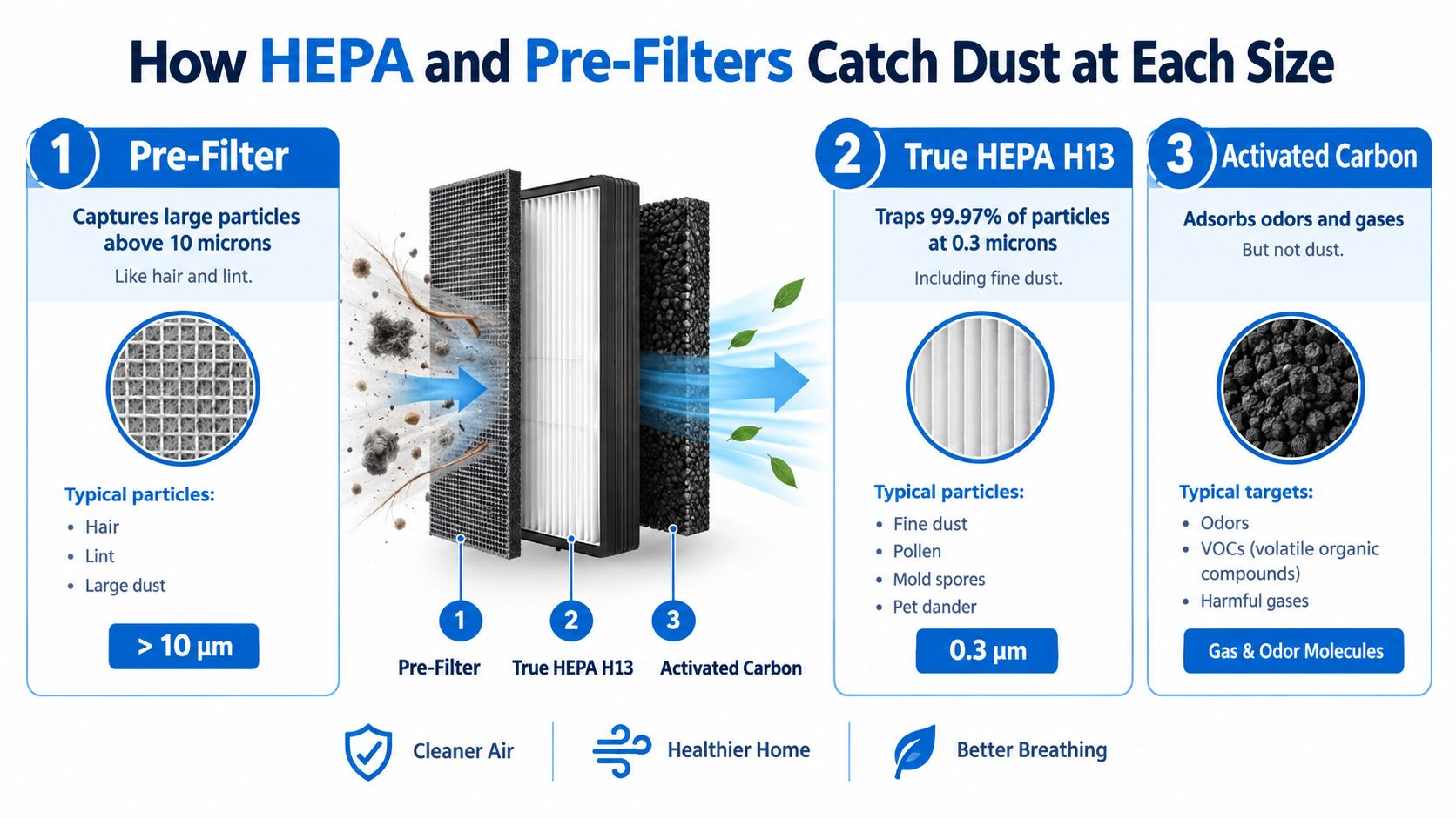
A useful way to picture it is a kitchen strainer set. The wide mesh catches pasta. The fine mesh catches sand. Air filters work on the same basic principle, except the smallest particles are influenced by airflow and fiber density, not just holes you can see.
The pre-filter catches the bulky material first
The pre-filter handles the pieces you can often see. Lint, hair, larger textile fibers, and bigger dust clumps tend to get trapped here before they reach the denser main filter.
That first stage protects airflow.
If large debris packs onto the main filter too quickly, the purifier has to work harder to pull air through it. A pre-filter helps the unit keep moving room air while saving the HEPA layer for the lighter particles that spend more time floating where you can breathe them in.
The HEPA layer targets the finer airborne fraction
The HEPA layer is the part built for the small suspended particles that stay aloft longer. That includes much of the fine dust people worry about for breathing, even when the room still has visible dust on dressers or floors.
That split is where confusion starts for many homeowners. A purifier can be doing a good job with floating fine particles while doing very little to remove the heavier dust that has already settled onto surfaces. Once dust lands on a shelf, the filter cannot grab it unless someone or something kicks it back into the air.
Particle size helps explain the difference. The U.S. EPA notes that finer particles stay suspended longer than larger ones, which is one reason air cleaners are better suited to airborne particles than to dust that is already sitting on surfaces (EPA particle pollution basics).
Why the room can still look dusty
Visible dust often skews larger. It settles faster, collects on horizontal surfaces, and may not pass through the purifier unless it gets stirred up again by walking, bedding movement, pets, or supply air from the HVAC system.
So a high-performing HEPA purifier can improve what you inhale before it improves what you see.
That is not a contradiction. It is the airborne-versus-settled dust split in action.
Carbon and ionization do different jobs
Activated carbon is mainly for odors and gases. It is not the main stage for dust capture.
Ionization changes how particles behave by giving them an electrical charge. That is different from pulling room air through a physical filter that traps particles in filter fibers. If your main goal is dust filtration, keep those approaches separate in your mind because they solve different parts of the air-cleaning problem.
If you want to see the replacement parts used in filter-based units, EcoQuest's HEPA filters and screens catalog shows the kinds of components used in systems that rely on physical particle capture.
Sizing a Purifier With Dust CADR Instead of Square Foot Hype
A lot of buyers start with the box claim that says a purifier covers a certain room size. That's a rough starting point, not the number I trust first for dust. For dust, I look at CADR, especially the dust CADR.
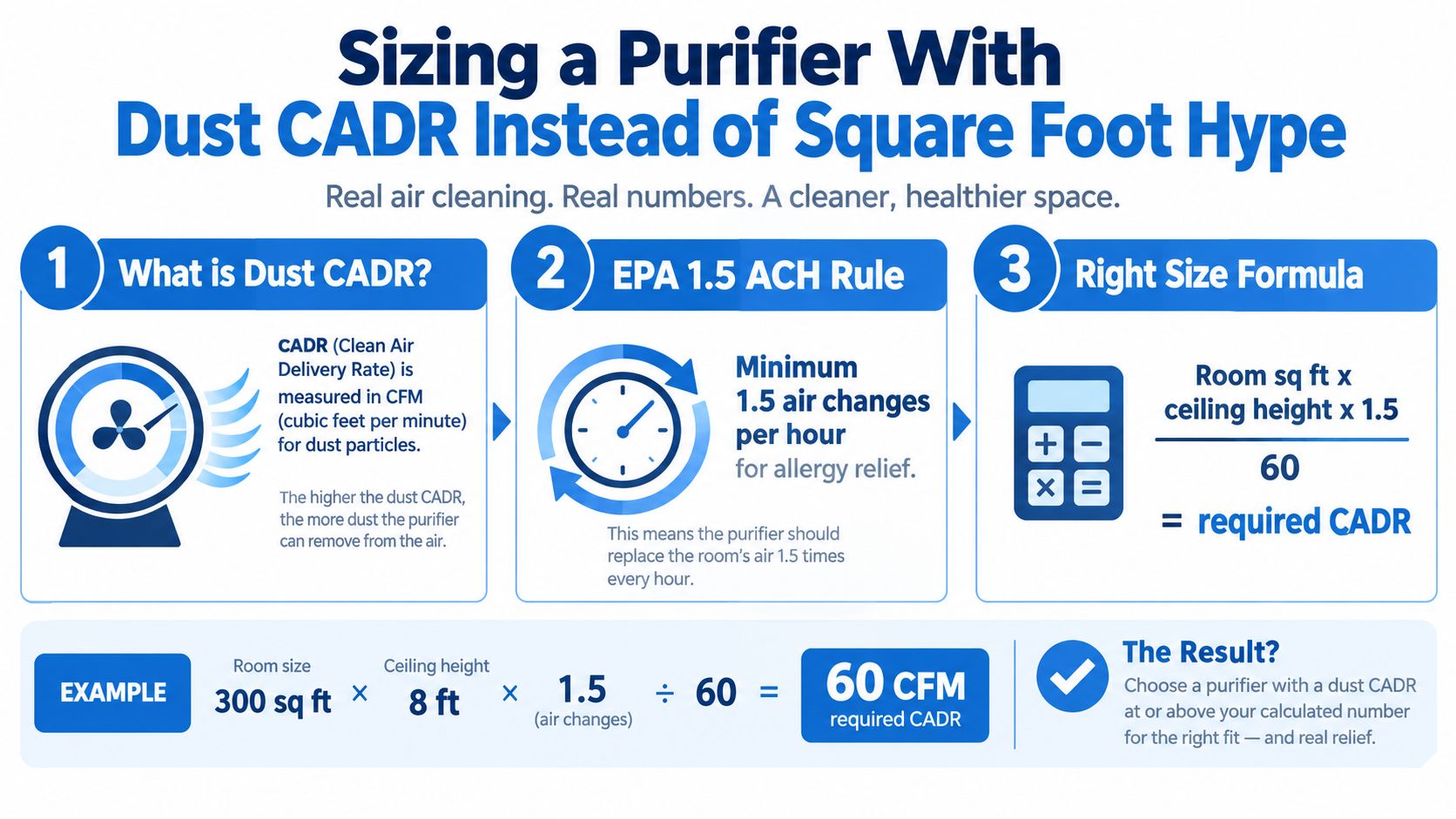
CADR tells you how much cleaned air the unit delivers. It's closer to asking, “How quickly can this machine clear suspended dust from this room?”
Use the EPA sizing baseline
The U.S. EPA says the CADR should be large enough for the room and provides a sizing table that works out to a minimum of 65 CADR per 100 square feet. That means a 300-square-foot room needs about 195 CADR, and a 600-square-foot room needs about 390 CADR (EPA guide to air cleaners).
That's much more useful than a vague “large room” label.
Here's the practical reading of those numbers:
- Small bedroom: Don't just ask whether the unit fits on a nightstand. Ask whether its dust CADR is enough for the room volume.
- Larger living area: Open layouts, carpet, pets, and constant foot traffic usually demand more airflow, not just a bigger housing.
- Tall ceilings: Square footage alone can understate how much air the purifier has to cycle.
A compact option such as the EcoRoom Plug-In Air Purifier for Small Rooms is designed for small rooms, bedrooms, bathrooms, and office spaces, with a wall-plug format that saves surface space. That kind of format can make sense where room size and dust load are modest, but CADR is still the better check than “small room” marketing language.
If you want to compare category options built around this use case, EcoQuest also has a dust air purifier product collection.
A quick visual explanation helps if the numbers still feel abstract.
If a purifier is undersized, it may still run all day and never pull dust concentration down fast enough for you to notice.
The Resuspension Cycle That Keeps Dust Coming Back
You finish cleaning, the room looks better, and then a shaft of light shows tiny specks floating again. That does not mean the purifier failed. It usually means the room just fed the air another batch of dust.
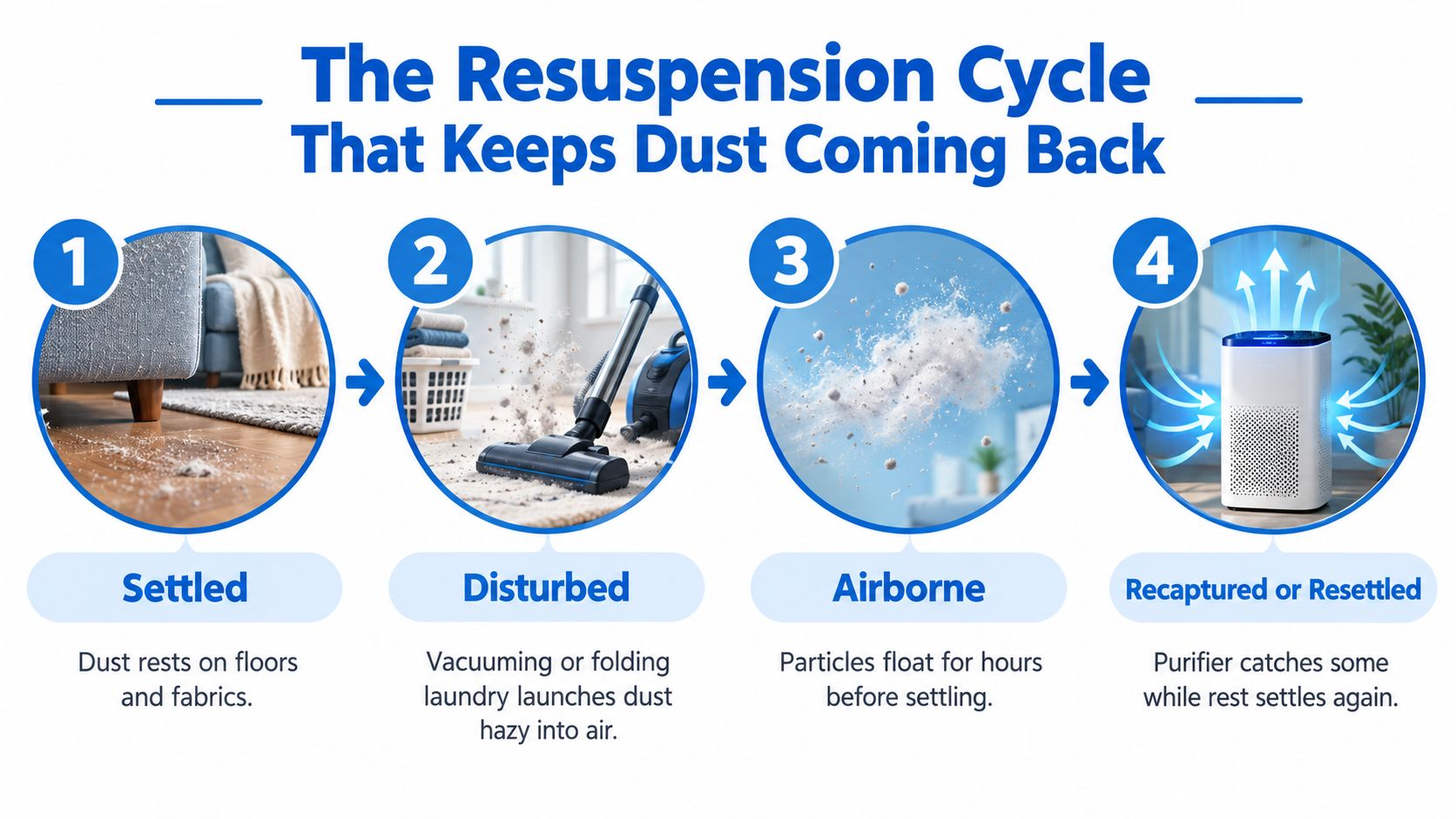
A room has two dust zones. One is the air you breathe. The other is the dust reservoir sitting on floors, bedding, upholstery, and shelves. A purifier only works on the first zone. The second zone keeps refilling the first.
That refill cycle is simple:
- Dust settles onto surfaces throughout the room.
- Normal activity disturbs it. Walking across carpet, sitting on a sofa, making the bed, or folding clothes can lift part of that settled dust back into the air.
- Air currents spread it. Supply vents, ceiling fans, people moving through the room, and the purifier's own airflow can carry those particles through the breathing zone.
- Some dust gets captured, and some lands again on new surfaces, waiting for the next disturbance.
This is why a room can keep looking dusty even with a properly working purifier. The machine may be lowering airborne particle levels while the settled layer on surfaces is still visible. Those are related problems, but they are not the same problem.
A snow globe is a useful comparison here. Once the dust layer gets shaken up, the air can look busy for a while even if particles are slowly being removed. If the room gets shaken again every few minutes by footsteps, fabric movement, or pet activity, the purifier is trying to empty the globe while the room keeps re-stirring it.
That also explains why performance can feel inconsistent from one hour to the next. During quiet periods, airborne dust often drops because fewer particles are being kicked back up. During active periods, the room may generate airborne dust faster than a smaller or lower-speed purifier can pull it in.
As noted earlier, research on portable filtration shows a clear pattern. Better filtration can reduce the particles people breathe. But even strong air cleaning does not make settled dust disappear from furniture, floors, or bedding. Clinicians who work with indoor dust complaints make the same distinction. Air purifiers help with floating particles, while the dust already sitting on surfaces still has to be removed by cleaning (indoor dust article).
The practical takeaway is straightforward. If you only judge a purifier by how your dresser looks tomorrow, you can miss what it is doing in the air today. A good unit reduces the airborne part of the dust cycle. It does not erase the settled reservoir by itself.
Placement, Runtime, and Upkeep Habits That Actually Help
Good placement and steady operation often matter more than one extra feature on a spec sheet. I'd rather see a correctly placed purifier run consistently than a fancier model tucked behind a chair and used only when the room already feels stale.
Placement that helps instead of fighting the room
Start with airflow.
Keep the unit clear of walls and bulky furniture so it can pull room air in and push cleaned air back out without immediately short-cycling that same pocket. If possible, place it where air can move across the occupied part of the room rather than into a corner or behind drapes. In dusty bedrooms, that often means somewhere with a clear path between the bed, the door, and the center of the room.
Avoid creating a strong direct jet over very dusty surfaces. The airflow guidance summarized by the National Academies supports a common-sense lesson: some air movement helps transport particles to the purifier, but badly directed airflow can also kick deposited particles back up.
Runtime that matches real dust events
A purifier usually works best when it runs before the room looks dirty.
Try this pattern:
- During high-dust activity: Use a higher setting while making beds, folding laundry, grooming pets, or cleaning.
- During normal daytime use: A medium setting often balances sound with useful particle removal.
- Overnight or when quiet matters: Use the highest speed you can comfortably tolerate, then lower it only if noise disrupts sleep.
If anyone in the home is sensitive to airborne particles, running continuously is usually easier than trying to guess the perfect on-off schedule.
Upkeep that keeps the machine effective
Dust control falls off when the purifier itself gets neglected.
Use a short routine:
- Check the intake: If you can see lint buildup, the machine is already working harder than it should.
- Clean the pre-filter on schedule: A quick check every couple of weeks is better than waiting until airflow drops.
- Watch room conditions: An indoor monitor can show whether dust-generating routines are pushing particle levels up. EcoQuest's air quality monitor collection is one way to track those changes and adjust runtime around them.
The best purifier routine usually feels boring. That's a good sign. Quiet, steady operation beats occasional panic mode.
Common Beliefs About Air Purifiers and Dust Worth Retiring
A lot of dust frustration starts with a reasonable but incomplete idea: if a purifier is running, the room should stop looking dusty. That sounds logical until you separate airborne dust from dust that has already landed on shelves, floors, bedding, and upholstery. A purifier can lower the particles floating through its filter path and still leave plenty of settled material behind, ready to get kicked back into the air later.
Bigger is always better
A very large purifier is not automatically a better dust solution.
What matters more is whether the unit can clean the room's air fast enough without creating a setup people avoid using. An oversized machine often ends up on a low setting because the high speed is noisy. In some rooms, strong airflow can also miss corners or stir up nearby dust reservoirs instead of steadily pulling suspended particles through the filter.
Dust control works better when the purifier is chosen by dust CADR and matched to the room's real use, not by a broad square-foot label on the box.
The EPA's CADR guidance is a better reference point because it focuses on cleaned airflow, which is the part that determines how much airborne dust the machine can remove.
Any fan helps with dust the same way
A fan and a purifier do different jobs.
A fan acts like a spoon stirring a pot. The dust moves around the room faster, but it does not leave the room or get captured. A purifier also moves air, but it adds a filter that gives those particles a place to stop. Without that capture step, dust is just taking another lap around the room.
As noted earlier, studies on filter-based room purifiers show that they can reduce fine particle levels indoors. The catch is that lower airborne particle levels do not always mean cleaner-looking furniture by the end of the day. Larger particles settle quickly, and settled dust can return to the air with foot traffic, bedding changes, or a pet jumping onto the couch.
Ionizers are a complete dust solution
Ionization can change how particles behave, but changing particle behavior is not the same as collecting them.
That distinction matters in a home. If dust sticks to a wall, drops onto a table, or clumps and settles, the room may have fewer floating particles for a while, but the dust has not disappeared. It has moved. Unless that material is captured in a filter or removed by cleaning, it remains part of the room's dust load.
For the fine suspended fraction, mechanical filtration gives homeowners a clearer path. Air goes in, particles get trapped, cleaner air comes out. If you use an ionizing or activated-oxygen device, treat it as a secondary tool rather than the whole plan.
A practical dust plan usually includes three parts:
- Reduce dust reservoirs: Vacuum floors, rugs, and upholstery, and damp dust hard surfaces.
- Limit new dust input: Wash bedding, manage pet hair, and cut back on fabric items that shed lint.
- Use filtration for the airborne share: Choose by CADR, place the unit well, and keep it running enough to catch particles before they settle.
The belief worth retiring is the simplest one: "If the purifier is good, dust should disappear." In a real room, dust behaves more like a cycle than a one-time mess. Some of it is airborne now. Some of it is settled and waiting for the next disturbance. A purifier helps most with the part still floating. The rest still needs housekeeping and source control.
EcoQuest Purifiers offers room and whole-home indoor air quality products, replacement parts, and related accessories for households trying to manage particles, odors, and stale indoor air. If you're comparing HEPA-style filtration options, filter replacements, compact room units, or other air-cleaning technologies as part of your dust-control plan, visit EcoQuest Purifiers and match the product type to the dust problem you're trying to solve.