
Activated Charcoal Odor Removal: What Actually Works
The most popular advice about activated charcoal odor removal is also the easiest to misunderstand: put a charcoal bag in a smelly room and expect the odor to disappear. Carbon can help, but it isn't a universal odor eraser. It stores some odor molecules, and its results depend on what's causing the smell, how much carbon is present, and how air and moisture move around it.
That distinction changes how you choose a filter and when you replace it. A fading smell doesn't prove that its source is gone, and a filter that still looks clean may already have little capacity left.
Table of Contents
- Does Activated Charcoal Really Remove Odors?
- Carbon Media Types and the Odors Each One Handles
- Which Odors Carbon Removes Reliably and Which It Misses
- Humidity and Airflow That Shorten Carbon Life
- How Long Carbon Lasts and When to Replace It
- Pairing Carbon with HEPA and Other Technology
- Choose the Right Carbon Setup for Your Space
Does Activated Charcoal Really Remove Odors?
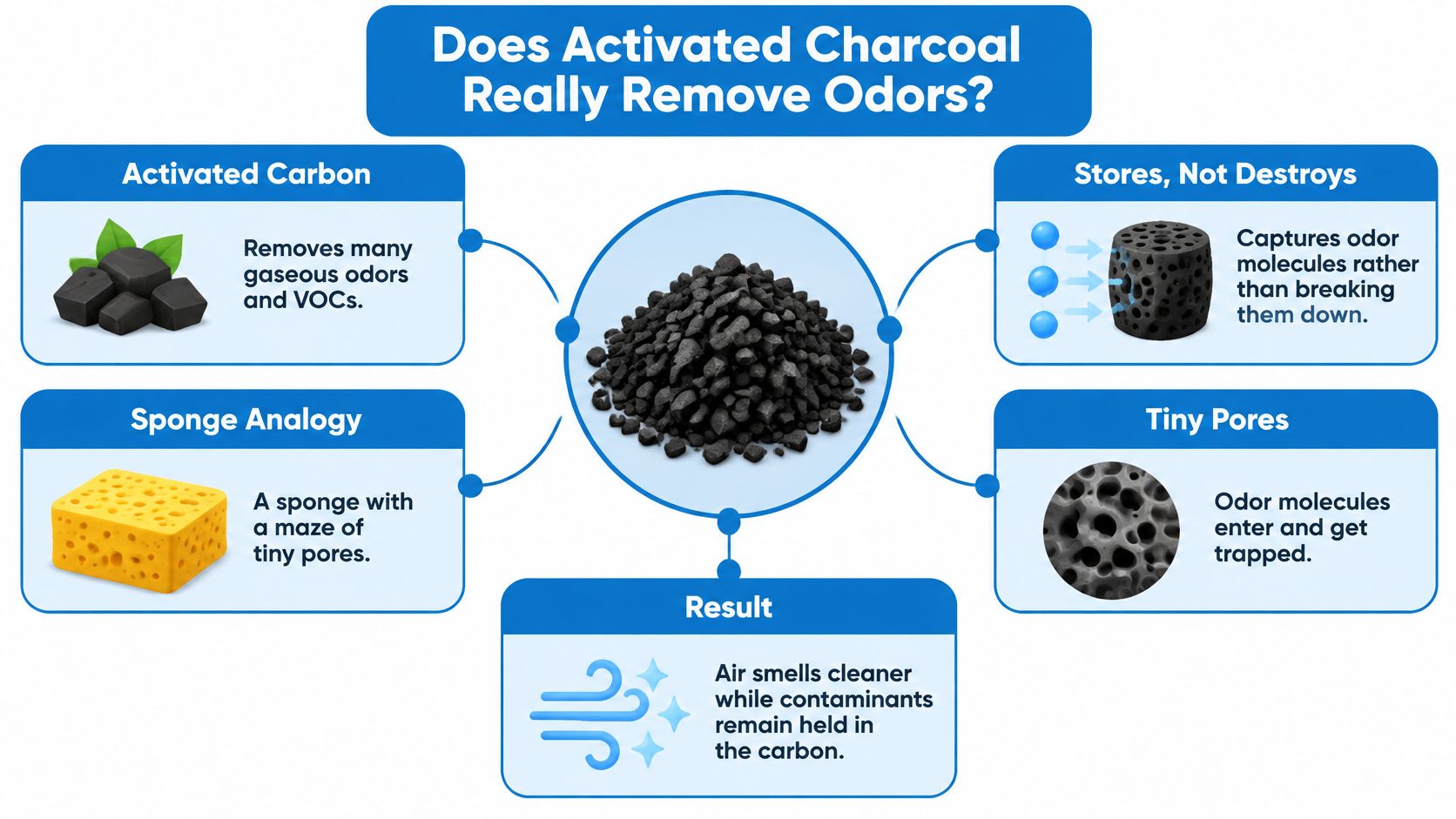
Yes, activated carbon can remove many gaseous odors and volatile organic compounds (VOCs), but it stores the molecules rather than destroying them. Think of it as a sponge with a maze of tiny pores. The sponge analogy is useful, though carbon doesn't soak up odor like a sponge absorbs liquid. Instead, gas molecules enter the pores and cling to the carbon's internal surfaces.
How adsorption holds odor molecules
This process is called adsorption. Odor molecules diffuse into a network of micropores and mesopores, where weak attractions known as van der Waals forces, along with pore-filling effects, hold them in place. The air can smell cleaner while the captured molecules remain inside the carbon.
Pore size matters because different odor molecules have different sizes. Pores slightly larger than the target molecule tend to hold it more strongly. Larger pores mainly help molecules travel through the material to reach smaller pores, so a useful carbon bed needs a combination of pore sizes rather than just a high surface-area claim.
Commercial activated carbons commonly have about 500 to 1,500 m²/g of specific surface area, and reported VOC capacities range from roughly 10 to 600 mg/g. Those figures are broad material ranges, not a promise about how much of a particular household odor a filter will remove. Capacity changes with the compound, concentration, temperature, humidity, and carbon surface chemistry, as described in a review of activated carbon's adsorption properties.
Why the carbon bed matters
The amount of carbon and the way it's arranged matter more than the word “charcoal” on a package. A deeper bed gives air more time in contact with the carbon. A well-designed blend of micropores and mesopores can offer both room to hold molecules and pathways for them to reach those holding spaces.
Carbon is best suited to gases and VOCs. It doesn't replace a particle filter for dust or smoke particles, and odor reduction alone doesn't show that germs or other biological contamination have been removed. Once the available adsorption sites fill, performance drops even if the filter looks unchanged.
Carbon Media Types and the Odors Each One Handles
| Media type | Typical format | Best-fit odors | Main limit |
|---|---|---|---|
| Impregnated carbon | Carbon treated with potassium permanganate or alkali | Hydrogen sulfide, ammonia, and some acid gases | Chemical reserve is used up; it's weaker on many non-target VOCs |
| Pelletized carbon | Extruded cylinders in air-cleaner cartridges | Cooking smoke, pet odors, and general household VOCs | Fixed pellet size limits bed depth in slim filters |
| Granular carbon | Loose grains in trays, beds, or deep cartridges | Heavy VOC loads such as solvents, paint, and fuel vapors | Grains can settle or channel if poorly packed; the bed needs enough depth |
Impregnated carbon has been treated to add reactive capacity for particular gases. It can be a better fit for odors such as hydrogen sulfide or ammonia than plain carbon, but its chemical reserve is finite. Choose it for the target gas it's designed to handle, not as a blanket upgrade for every household smell.
Pelletized carbon comes in formed cylinders that fit into many air-cleaner cartridges. The consistent shape makes it practical for replaceable filters and can support predictable airflow. The tradeoff is that a slim cartridge may not hold a deep enough bed for a demanding odor source.
Granular carbon consists of loose grains packed into a tray, bed, or cartridge. A deeper bed can provide more contact with the air, which makes this format useful for heavier VOC loads. Poor packing can let air form channels through the bed, however, allowing some of it to pass through with less contact.
Buying rule: Identify the odor source first, then select the media type that suits it. A larger bag or a higher “charcoal” content won't necessarily compensate for the wrong carbon chemistry or a shallow bed.
Which Odors Carbon Removes Reliably and Which It Misses
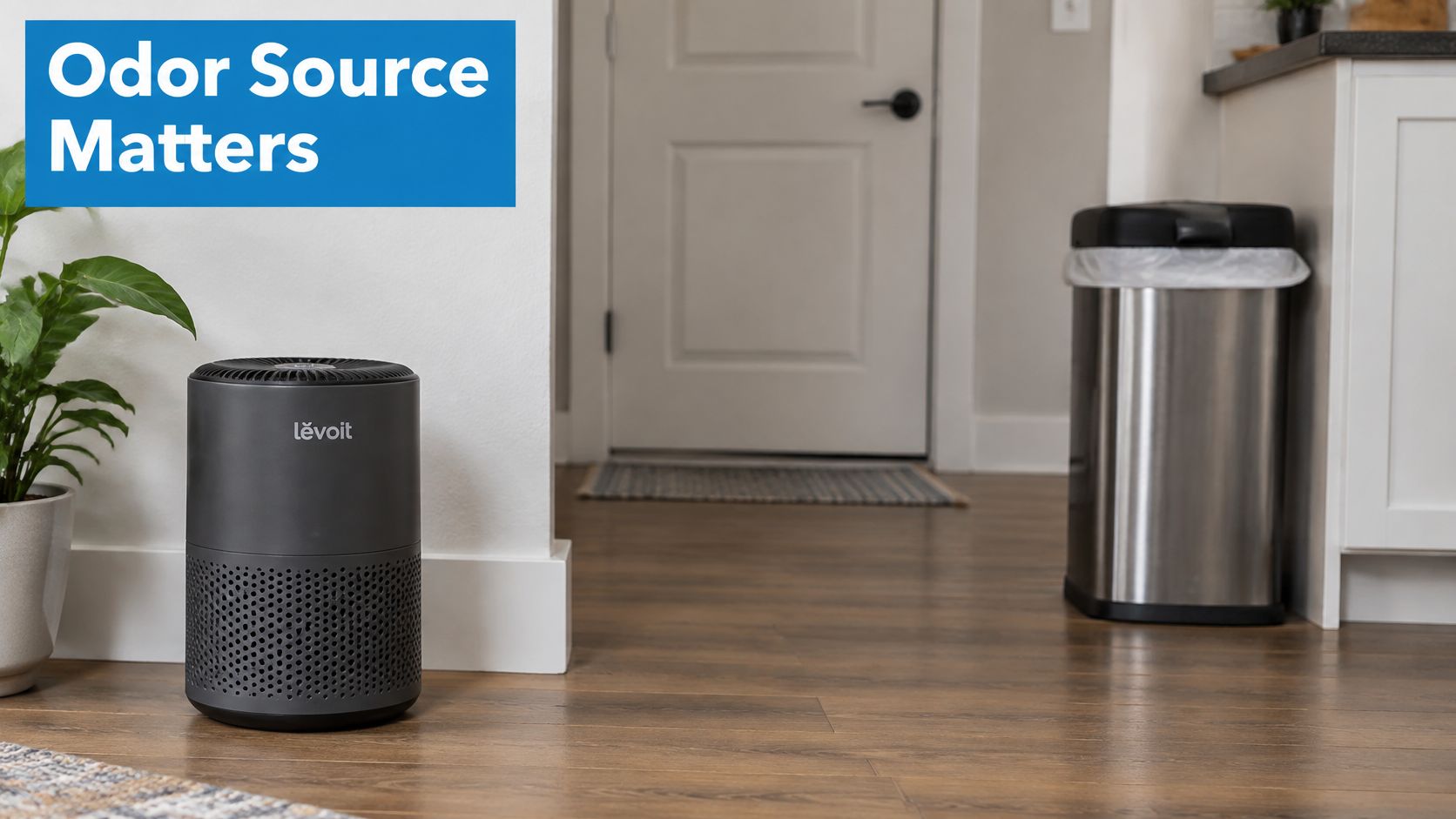
A carbon filter can make a room smell better while leaving the cause untouched. It captures some airborne odor molecules on its porous surface, storing them rather than destroying them. That distinction matters: carbon can reduce odors carried in the air, but it cannot repair a leaking drain, remove damp building materials, or clean up a spill.
| Odor source | What carbon may do | What it cannot do |
|---|---|---|
| Cooking and frying smoke | Reduce some airborne VOC-type odors when air passes through enough carbon | Remove grease or residue on nearby surfaces |
| Pet urine | Reduce some ammonia odor in the air | Clean urine from carpet, padding, or other affected materials |
| Drain or sewage | Capture some odor compounds, with results depending on the gas and carbon used | Fix a dry trap, leak, or plumbing fault |
| Mold and mildew | Reduce some airborne musty odor | Remove mold, spores, or the moisture source |
| Solvent, paint, or fuel vapors | Capture many VOCs when the filter has suitable carbon and sufficient contact with the air | Make a spill or ongoing vapor source safe |
| Tobacco smoke | Reduce some gaseous odor compounds | Capture smoke particles without particle filtration |
Performance varies because odors are mixtures, not single chemicals. A review of environmental odor control describes research focused on a relatively narrow group of sulfur compounds, while many VOC and nitrogen-containing odorants have received less attention; the review of activated carbon for odor control also explains why tests using one odorant may not predict results in a real room. Air can contain several odor-causing compounds alongside substances that have no smell, and carbon may capture them differently.
Treat the source, not just the air
For a drain odor, check the trap and plumbing rather than relying on a pouch near the sink. In a musty room, locate and address damp materials or the moisture problem. For pet urine, clean the affected area and any material the urine reached. A filter cannot pull residue out of carpet or padding.
The practical test is whether the source has been removed, not whether the room smells fresher for a while. If the smell returns after the filter is off, the source may still be releasing odor molecules. Carbon can help manage what reaches the air, but it is not a substitute for cleaning, repairs, or moisture control.
A short video illustrates the difference between treating an odor in the air and addressing what produces it.
Match the carbon to the molecule, and deal with the source first. If an odor comes from moisture, waste, a spill, or a plumbing fault, cleaning the air alone will not solve the underlying problem.
Humidity and Airflow That Shorten Carbon Life
Humidity can weaken carbon adsorption even when the odor source has not changed. A comparison cited in a discussion of humidity's effect on activated-carbon odor removal found removal efficiency fell from about 92% at 20% relative humidity to 60% at 90% relative humidity. Water vapor competes with odor molecules for adsorption sites, and condensation can obstruct micropores. Dry-room performance may therefore overstate what to expect in a humid bathroom, basement, kitchen, or coastal home.
| Condition | Effect on carbon | Practical response |
|---|---|---|
| High relative humidity | Water competes for adsorption sites and can fill micropores; efficiency can fall as humidity rises | Measure room humidity; ventilate or dehumidify before adding carbon |
| High airflow speed | Gas has less time in contact with the carbon | Use a moderate fan setting and a deeper bed |
| High contaminant concentration | Adsorption sites fill faster | Remove the source first; replace media sooner |
| High temperature | Adsorption for many compounds weakens | Keep the unit out of hot spots |
Make the room suitable for filtration
Check the room before adding more charcoal. Look for leaks, condensation, or liquid moisture reaching the filter, and address those conditions before expecting the carbon to work well. A damp room can keep challenging the media, while carbon stores odor molecules rather than destroying them.
Airflow affects contact time. When air moves too quickly through a carbon bed, odor molecules have less time to reach its surfaces. A deeper bed or moderate fan setting can improve contact, but airflow must remain strong enough to circulate air through the room.
Carbon types also respond differently to moisture. Pore-size distribution, surface chemistry, and material source all influence performance, and some granular carbons can retain strong adsorption at moderate humidity. If indoor conditions are difficult to assess, an indoor air quality monitor can help track them as you investigate the odor source.
When an odor returns quickly in a humid space, consider moisture, airflow, and the carbon's exposure to contaminants. More media alone may not solve the problem: if adsorption sites fill rapidly, the stored odor compounds can break through sooner. Addressing room conditions helps carbon last longer, while the odor source still needs attention.
How Long Carbon Lasts and When to Replace It
Carbon does not destroy odor molecules; it holds them on its surface until the available adsorption sites fill. That means a filter's service life is not a fixed calendar interval. The odor source, how much air passes through the media, and the conditions around it all affect when odors begin to break through.
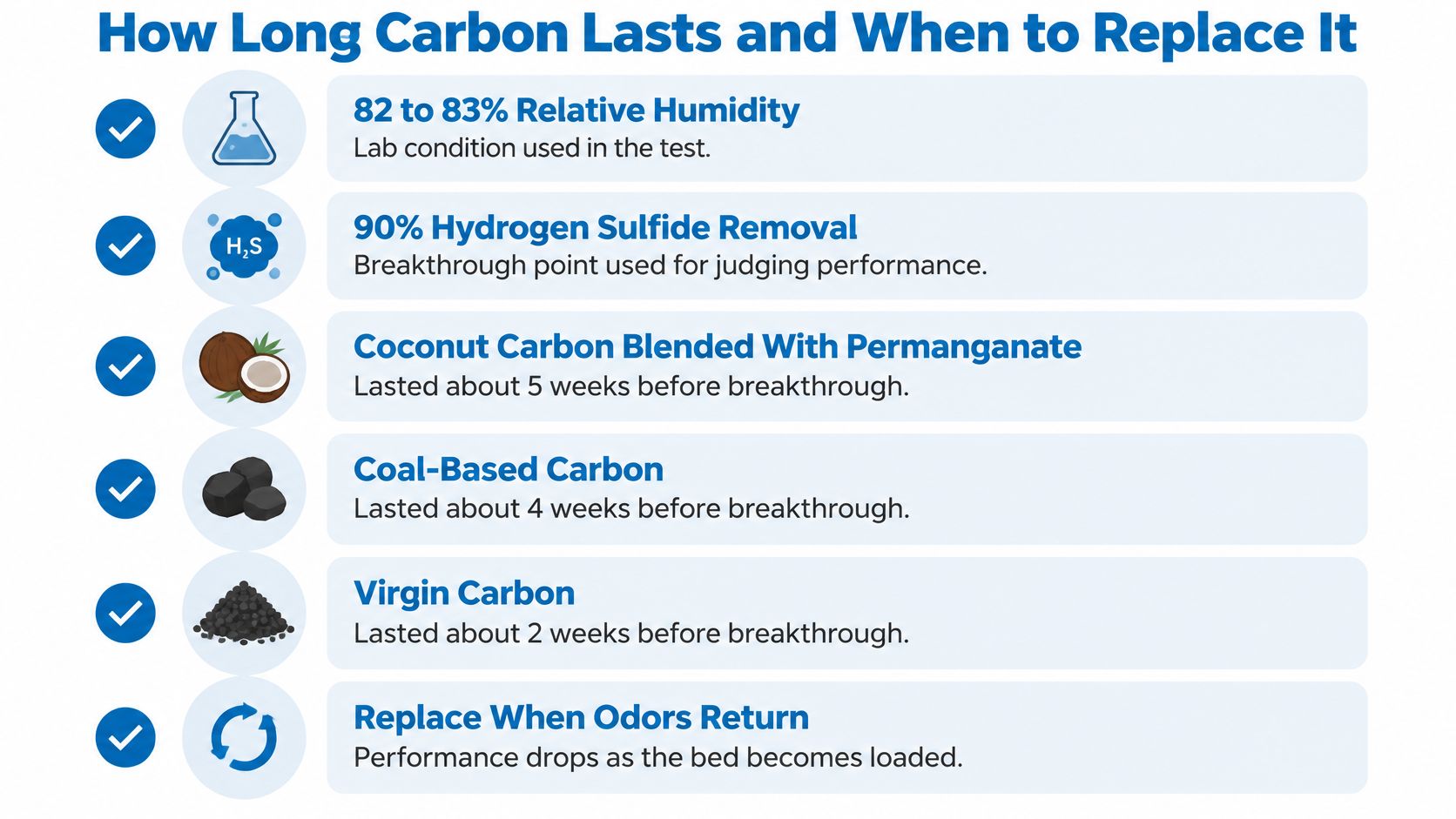
One granular-carbon foul-air evaluation tested media at 82–83% relative humidity, defining breakthrough as the point when hydrogen-sulfide removal fell below 90%. Coconut carbon blended with permanganate reached that point after 57 days, plain coconut carbon after 107 days, and coal carbon after 129 days. These are results from one test, not a household replacement schedule. The granular-carbon evaluation describes breakthrough as increasing amounts of contaminants passing through the media.
| Carbon type | Days to breakthrough | What it shows |
|---|---|---|
| Coconut carbon blended with permanganate | 57 days | Shortest life in this test; the blend did not extend breakthrough time |
| Coconut carbon | 107 days | Intermediate result among the three tested media |
| Coal carbon | 129 days | Longest time to breakthrough in this test |
A separate controlled study of carbon-loaded nonwoven material found that increasing relative humidity from 2–10% to 70% shortened complete-breakthrough time from about 30 minutes to 8.2 ± 1.0 minutes. Higher airflow reduced breakthrough time by up to 72%, while a higher challenge concentration reduced it by up to 30%. These figures describe that test's material and conditions, not every carbon filter. They illustrate why media near a strong odor source, or handling a heavy contaminant load, may need replacement sooner.
Use these replacement triggers
- Odor relief lasts for less time. If a familiar odor returns sooner after installation or replacement, the media may be loading up, or the source may have become stronger. Note how long relief lasts to make the change easier to spot.
- The unit runs continuously near an odor source. More air passing through the carbon brings more odor molecules into contact with its surface, using available sites faster.
- The odor persists despite normal operation. A measurable change in how long the room stays fresher can be a practical sign that the media is no longer keeping pace with the source.
- The media is wet, dusty, or damaged. Replace physically compromised media and address what caused the moisture or dust.
- The manufacturer's replacement interval arrives. Treat the stated interval as a practical limit, especially when the unit does not indicate breakthrough.
Carbon can be saturated while still looking clean. Smell alone also cannot measure its remaining capacity. Keep a simple log of the replacement date, the odor being addressed, and when it starts returning. Over time, that record helps you set an interval suited to your room and use, rather than relying on results from a different test.
Pairing Carbon with HEPA and Other Technology
A useful air-cleaning setup handles particles and gases in separate stages, while source control and ventilation address the reason pollutants are present.
- Pre-filter: Catches hair and larger dust before they clog the finer stages.
- HEPA filter: Captures particles such as dust, pollen, and smoke particulates.
- Activated carbon: Adsorbs some gaseous odors and VOCs.
- Source control and ventilation: Reduce or remove what's generating the odor and bring in cleaner air where appropriate.
Carbon and HEPA do different jobs. Carbon is not a substitute for a particle filter, and HEPA filtration doesn't remove gases. A setup without the stage suited to the pollutant leaves a gap, so choose based on whether the main concern is airborne particles, gaseous odor, or both.
UV, photocatalysis, and ionization also work differently from adsorption. They don't make a carbon bed unnecessary when the aim is to capture VOCs, and performance claims should match the technology and the specific concern. Ozone generators require particular care in occupied spaces because reaction byproducts matter; don't assume that an odor treatment is automatically appropriate for continuous use around people.
For example, the Living Air Classic XL-15 Air Purifier uses ionization and activated oxygen technology, rather than a replaceable carbon filter. If you want a purifier with a particle-filtering stage, compare its specifications with a room HEPA purifier and confirm what the unit does and doesn't filter.
- Keep the pre-filter clean. A dusty pre-filter can restrict airflow through the rest of the unit.
- Seal the housing. Air that bypasses the media won't be treated by it.
- Check the airflow path. The carbon stage needs to sit where the unit directs its main airflow.
- Use a suitable room rating. A unit intended for a smaller space may not keep up in a larger one.
- Place it thoughtfully. Keep it near the odor source, but not in a damp corner or where airflow is blocked.
A combined carbon-and-HEPA housing can address gas and particle concerns in one unit, provided its carbon bed and particle stage are both suitable for the room and the problem.
Choose the Right Carbon Setup for Your Space
Carbon selection comes down to what the media must capture, how much air passes through it, and how you will know when it is spent.
- Match the media to the source. Pelletized carbon can suit many household odors, including cooking smoke. A deeper granular bed offers more contact with the air for many solvent or paint vapors. For ammonia or drain-related sulfides, consider impregnated carbon, while addressing the source itself.
- Choose bed depth and airflow together. Check the unit's rated room size and airflow. A deeper bed can give odor molecules more time to contact the carbon, while a fan set too high may shorten that contact. A slower setting may help when the room or source demands more treatment.
- Decide how you'll maintain it. Compare replaceable cartridges with a separate filter, checking carbon mass, bed depth, HEPA specifications, and rated room size. Note when odors return, then use that pattern to adjust placement or replacement timing rather than automatically adding more carbon.
Carbon has a finite capacity: it stores captured odor molecules rather than destroying them. Humidity and competing odors can affect how long that capacity lasts, as discussed in the sections on humidity and airflow and carbon replacement. Check those factors when judging whether a setup is suitable, and keep the intake and media accessible for inspection.
If you're choosing between a carbon filter, a HEPA unit, or a purifier that combines different technologies, start with the pollutant and the room conditions you need to address. EcoQuest Purifiers offers indoor air quality products, replacement parts, and repair services for home, portable, HVAC, and commercial needs. Compare air purifiers for different spaces against those requirements. Visit the store to compare options and select a setup that fits your space.