
Air Purifier Filter Replacement Cost: What to Expect
Most homeowners spend roughly $40 to $200 per purifier per year on replacement filters, while high-end or commercial units can run $200 to $400 or more annually. Replacement intervals of 3 to 12 months drive the math as much as the cartridge price itself.
That recurring bill is easy to miss when you're comparing boxes on a shelf. The price of a purifier tells you what it costs to buy; the filter schedule tells you what it costs to keep using. For a useful comparison, separate particle filters, carbon stages, other replaceable components, and electricity, then look at the total across three years.
Table of Contents
- Why Replacement Cost Is an Annual Budget Line
- Replacement Costs by Filter Type
- What Drives the Price Up or Down
- DIY Replacement Versus Professional Service
- A Three-Year Cost Model for Real Households
- When You Can Safely Stretch the Interval
- Budgeting and Savings Tactics That Actually Work
- Cost Questions Buyers Ask After Reading the Guide
Why Replacement Cost Is an Annual Budget Line
Annualize every cartridge before you compare prices: filter price × 12 ÷ replacement interval in months. A $40 filter changed every six months costs about $80 per year. A $60 filter changed once a year costs $60 per year. The cheaper sticker price loses. The EPA counts replacement media, cleaning, and electricity as lifecycle costs and tells owners to service filters on the manufacturer's schedule, so treat every cartridge as a recurring bill from day one (EPA residential air-cleaner technical summary).
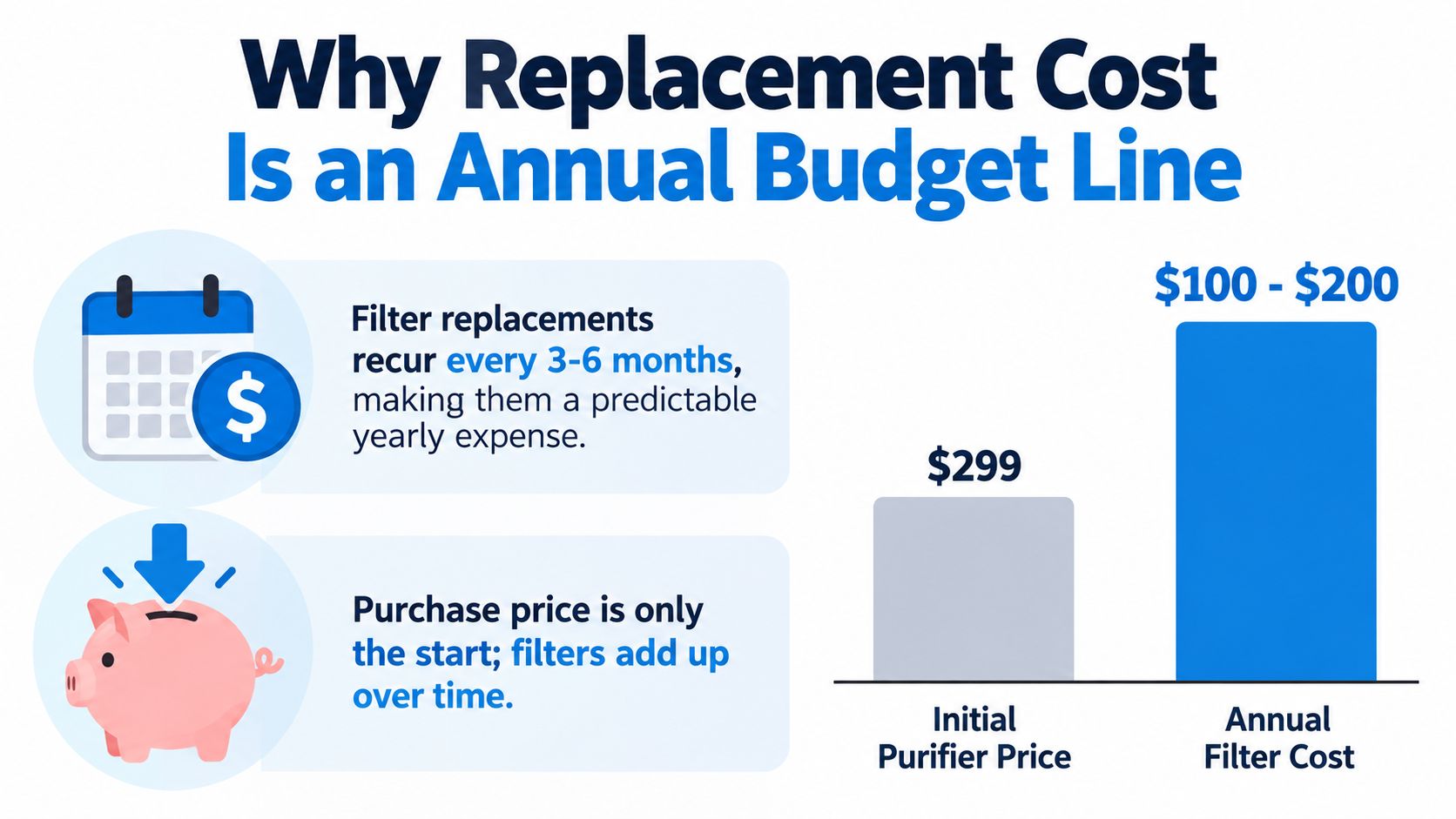
Consumer Reports puts mechanical filter replacement at 6 to 12 months and activated-carbon changes at roughly every 3 months, with tested replacement filters running $20 to more than $200 and larger purifiers near the top of that range (Consumer Reports buying guide). Two purifiers with identical shelf prices can land years apart on maintenance spend once those intervals hit your wallet.
Calculate the yearly and three-year totals
Write down the filter price, the manufacturer's replacement interval, and how many cartridges the unit uses. Calculate the annual amount, then multiply by three. Keep electricity on its own line unless you have a solid figure for the purifier's power draw and your local rate.
Give each stage its own row in that math: the HEPA-style particle filter, the carbon stage, any UV or RCI cell, and power consumption. These parts age at different rates, and a combined cartridge can force you to pay for a stage that still has working life left. Bundled replacements are where buyers overspend most often.
The gap adds up fast. One ownership-cost comparison puts a $50 filter replaced annually at $150 over three years, while a $138.99 filter replaced every six months reaches $834 in the same span. That is a $684 difference driven by cartridge price and frequency together (filter-cost comparison examples).
Running several purifiers? Add them up unit by unit. Two bedroom units mean two sets of cartridges; one larger unit means a different cartridge and different room coverage. The lowest purchase price rarely wins the three-year total, so compare what you will pay to keep each setup running clean.
Replacement Costs by Filter Type
Filter technology decides what you are paying to replace and how often the bill comes due. Each stage carries its own price and its own service clock, which is why a three-year budget needs separate lines for particle media, carbon media, UV or RCI hardware, and electricity. One "filter cost" figure on a product page hides more than it tells you.
Particle and carbon stages
Particle filters are where buyers overspend by shopping a sticker range instead of a part number. In the model-level comparison cited earlier, replacement cartridges for compact units like the Levoit Core 200S run near $20, while large-room units such as the Blueair 211i Max land closer to $60 per year. Same cleaning job, roughly three times the annual spend. Confirm the exact cartridge your purifier takes and its replacement interval before you buy the machine, not after.
Carbon runs on a faster clock than particle media. As noted earlier, the EPA advises servicing filters every 60 to 90 days depending on loading, and odor media typically saturates before a particle filter even looks dirty. Homes with pets, smokers, or a kitchen nearby will chew through carbon sooner, so budget that stage on its own schedule rather than letting it ride along with the HEPA interval.
A washable pre-filter is the cheapest savings in this whole category. Rinsing dust and hair off it once a month extends the main cartridge's life at zero cost. When you order parts, match the listing to your model and the specific stage you need; a supplier page for replacement HEPA filters and screens is only useful if the part number fits your unit.
The Living Air Classic XL-15 Air Purifier is described as a filterless purifier using ionization and activated oxygen technology rather than a conventional cartridge system. Its routine maintenance cost does not map onto a standard HEPA replacement schedule, so keep it out of the cartridge math.
UV lamps, RCI cells, and other hardware
UV lamps, RCI cells, and electrostatic or washable collector cells are not interchangeable with HEPA cartridges, and their prices vary too widely to quote a blanket range responsibly. Pull the part number from the manual, price it against the manufacturer's parts listing, and annualize it the same way as any other stage. If a seller cannot tell you what a cell costs or how often it needs service, treat that purifier's ownership cost as unknown and walk away.
| Filter type | Typical cartridge price | Replacement interval | Annualized cost |
|---|---|---|---|
| Mechanical (HEPA-style) particle filter | From near $20 for compact models to about $60 a year for large-room units in the cited comparison | Commonly 6 to 12 months | Part price times replacements per year |
| Activated-carbon stage | $20 per cartridge in the worked example | Quarterly in the worked example | About $80 a year in that example |
| UV lamp, RCI cell, electrostatic or washable cell | Pull the part number and price it directly | Set by the manufacturer | Listed price times service frequency |
Run the carbon math before assuming it is cheap. A $20 cartridge swapped quarterly is $80 a year, which beats the particle stage's cost on some units.
What Drives the Price Up or Down
The cartridge price is only part of the bill. Over three years, count each replacement stage separately, then add electricity and any service costs. Two purifiers with similar particle-filter descriptions can have very different ownership costs if one uses pricier cartridges or needs more frequent service.
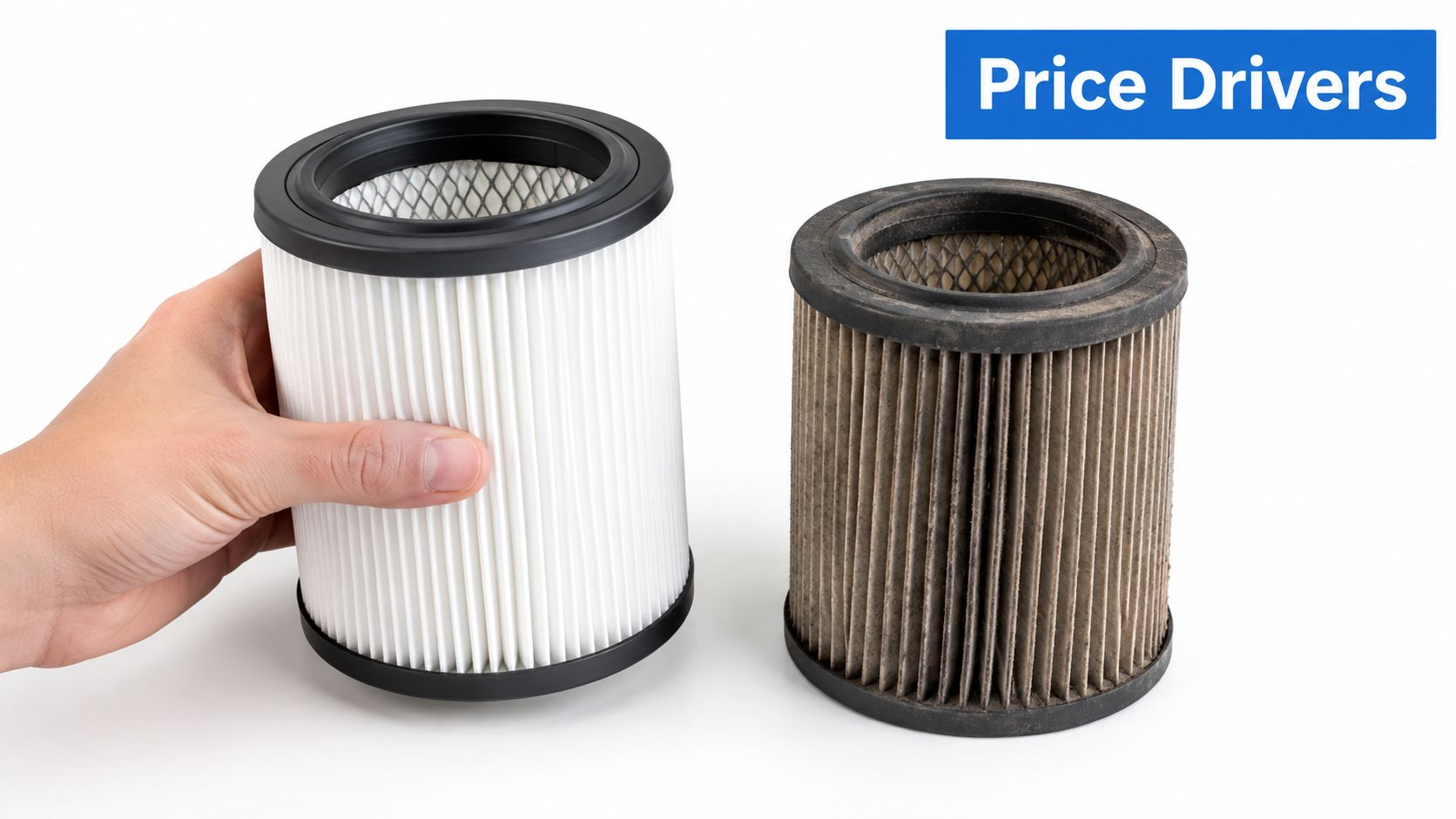
Compare the actual part, not just the label
OEM versus aftermarket: A compatible alternative may cost less, but check its fit and specifications before ordering. A poor fit can leave gaps or interfere with airflow. Review the purifier's warranty terms rather than assuming an aftermarket filter voids coverage.
Brand and cartridge design: Proprietary cartridges can limit your options. Check replacement prices before buying, and find out whether the carbon stage is separate from the particle filter. If the stages wear at different rates, a combined cartridge can force you to replace media that still has useful life.
Room size and rated airflow: Larger purifiers may require larger, more expensive filters. Compare the replacement bill with the unit's rated clean-air delivery and intended room size. A cheap cartridge is no bargain if the purifier cannot deliver the airflow the room needs.
Operating conditions: Continuous use, smoke, pets, renovation dust, and heavy occupancy can shorten replacement intervals. For example, a home with pets or active renovation may need a particle filter changed at six months instead of waiting a full year. As the EPA guidance cited earlier explains, service life depends on particulate loading and visible soil, so calendar intervals do not fit every home.
Before you buy: Find the exact replacement part, its price, and its recommended interval. Then estimate three years of HEPA, carbon, and any UV or RCI replacements separately, and add electricity use. If the seller cannot clarify the parts and schedule, the purchase price does not tell you the ownership cost.
For commercial rooms, include labor, shipping, downtime, and disposal. These costs can outweigh the cartridge price.
DIY Replacement Versus Professional Service
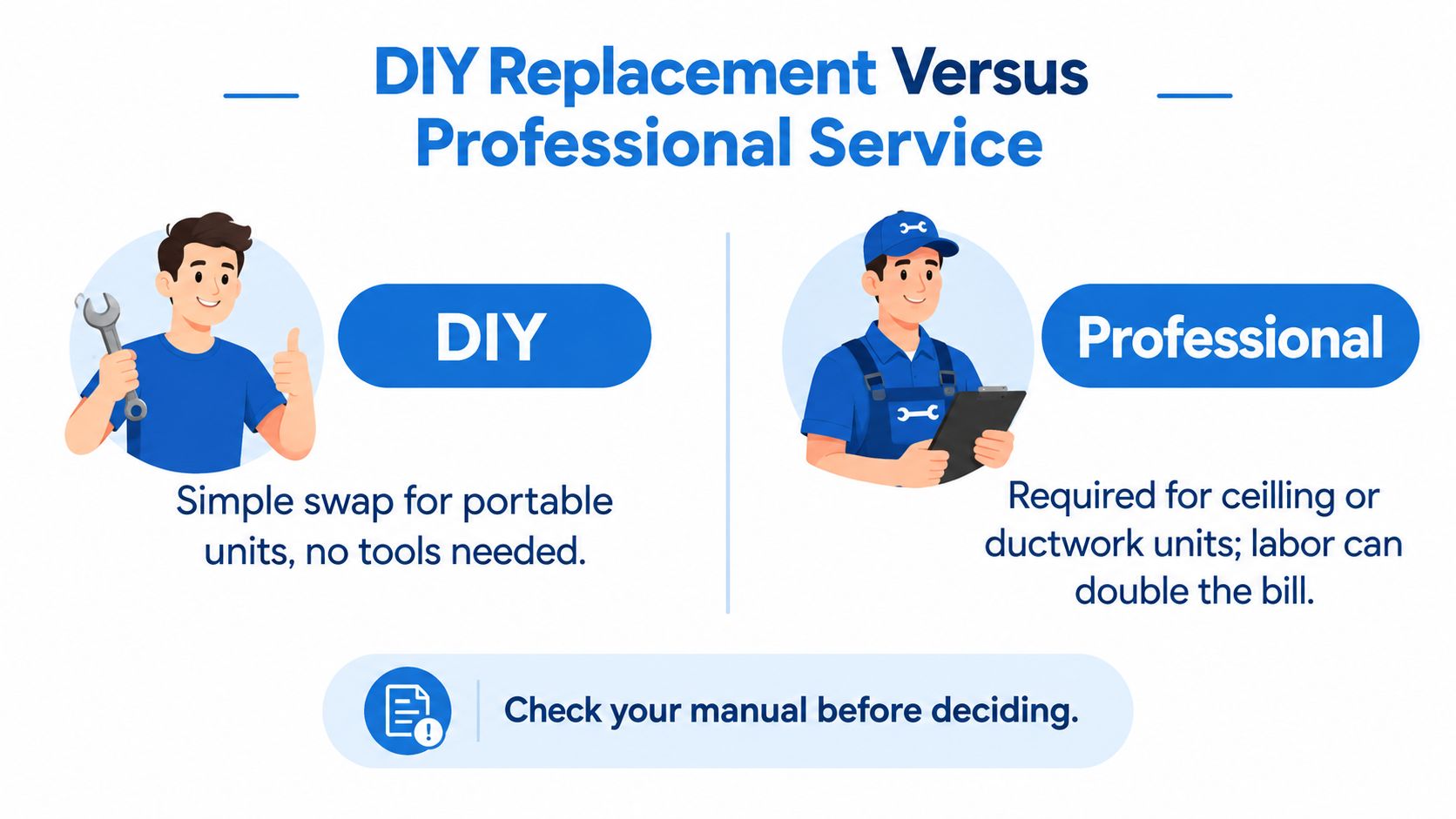
For a portable room purifier, changing a filter is often a straightforward owner task. A ceiling-mounted, duct-integrated, or commercial system may be harder to access, and paying for service can add labor and downtime. The honest comparison is not “DIY is always cheaper.” It's whether the work is simple and safe enough to do correctly yourself.
Where DIY usually makes sense
For a portable purifier, follow the manufacturer's instructions, switch off and unplug the unit if directed, and install the correct filter in the correct orientation. Keep the old filter contained while removing it, especially if it's visibly dusty. A simple cartridge change is a poor reason to pay for a service call if you can access the filter safely and follow the manual.
The calculation is straightforward: compare the quoted service charge with the time and travel you'd otherwise spend, plus any tools or replacement parts the job requires. If the professional fee is more than the task is worth to you, and the manual allows owner replacement, DIY is the sensible choice.
When a technician earns the fee
A technician may be the practical choice when the unit sits in a ceiling, inside ductwork, or in a commercial installation with several components to service. Access can be awkward, and a mistake can leave the unit improperly assembled or unavailable during business hours. Ask for a quote that separates parts, labor, travel, and any follow-up work.
UV lamps and RCI cells require model-specific handling. Don't assume they're as simple as swapping a portable purifier's filter; consult the manual or a qualified service provider if access or safe handling is unclear. EcoQuest Purifiers lists repair services and support for buyers who need help with service decisions.
Practical rule: Pay for expertise when access, electrical work, or the manufacturer's instructions make the job more than a simple filter swap. Otherwise, compare the service quote with the actual task, not with the purifier's purchase price.
A Three-Year Cost Model for Real Households
A two-filter purifier can cost $540 over three years if each $40 filter is replaced every eight months. That is the number to compare, not the price of one cartridge. Use the infographic's assumptions as planning examples, not model-specific forecasts or prices that apply to every household.
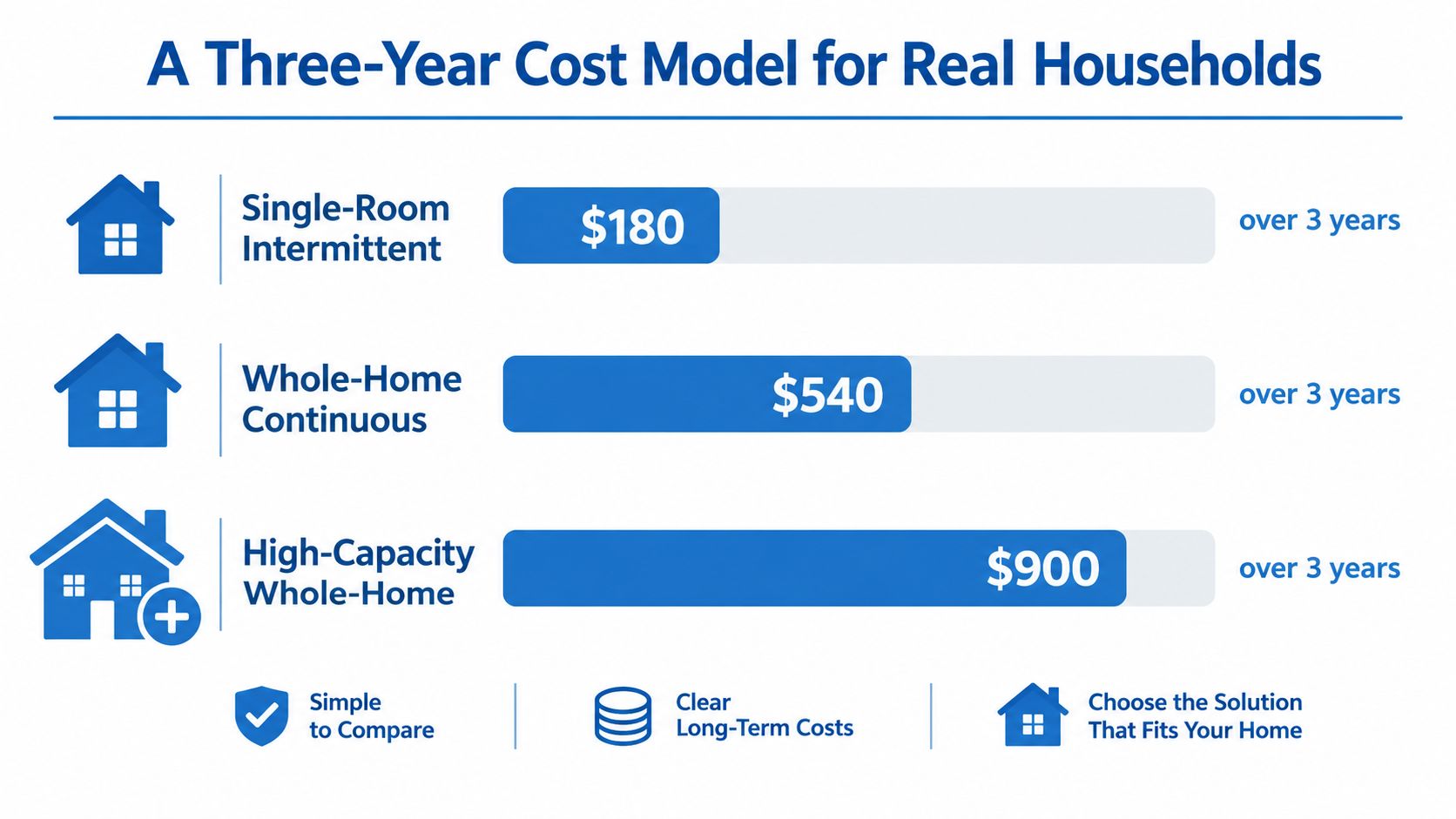
Three illustrative filter-cost scenarios
The chart assigns $180 over three years to a single-room, intermittent-use setup, $540 to a whole-home continuous-use setup, and $900 to a high-capacity whole-home setup. Treat these as illustrations of different filter-use assumptions, not as forecasts for a particular purifier.
| Scenario | Illustrative filter cost over three years | What to verify |
|---|---|---|
| Single-room intermittent | $180 | Cartridge price, replacement interval, and actual use |
| Whole-home continuous | $540 | Number of filters, service interval, and operating pattern |
| High-capacity whole-home | $900 | Replacement parts per unit and whether labor applies |
Calculate each replacement stage separately:
Three-year cost = price per part × 36 ÷ replacement interval in months × number of parts replaced each time.
For example, if a unit uses one HEPA filter at $40 every eight months and one carbon filter at $25 every six months, the three-year parts total is $255: $180 for HEPA and $75 for carbon. Add UV lamps or RCI cells as separate line items, using their actual prices and replacement schedules. Based on the verified examples cited earlier, compare each figure with the replacement parts and intervals specified for the purifier you are considering.
Keep energy and service separate
Electricity is another ownership cost, not a filter expense. Check the unit's power information and calculate usage with your electricity rate. For commercial installations, list quoted labor, shipping, downtime, and disposal separately so service costs do not disappear inside the parts estimate.
Compare purifiers with similar room needs and use patterns. A low purchase price can be offset by frequent, expensive replacements; a higher-priced unit may cost less to maintain. Calculate the three-year total before buying.
The following video offers additional information about purifier maintenance and costs.
When You Can Safely Stretch the Interval
“Replace every six to twelve months” isn't a universal rule. Consumer Reports gives that range for mechanical filters generally, but the EPA says filter life varies with particulate loading and visible soil. Follow the purifier's own instructions, then pay attention to actual condition and performance instead of treating a date on a calendar as proof that a filter is spent.
Start with the stages that behave differently. A particle filter may look dusty while still functioning, but visible damage or a substantial airflow problem should not be ignored. Carbon is different: it can lose odor-removal capacity as adsorption sites fill, and that change may not be obvious from the outside.
Use evidence, not a guess
Check the filter-life indicator and inspect the unit as its manual permits. Watch for declining airflow, persistent odors that the purifier used to reduce, or a damaged or heavily soiled filter. These signs don't replace the manufacturer's guidance, but they're useful reasons to check whether the filter needs service sooner.
A washable pre-filter is not the same as sealed particle media or carbon media. Clean only components the manufacturer identifies as washable, and don't wash or reuse a filter unless the manual specifically permits it. A clogged or damaged filter can reduce airflow, so stretching its service life to avoid a purchase isn't a saving if the purifier no longer performs as intended.
Know when not to wait
Smoke, renovation dust, heavy visible soil, and strong persistent odors can increase the burden on filters. If your purifier has been exposed to those conditions, inspect it and follow the model's maintenance instructions rather than relying on a routine interval. Carbon stages in odor-heavy rooms deserve particular attention because odor performance can decline before the media's condition is easy to judge visually.
Replace based on the part and the conditions. Don't extend an interval just because the filter looks clean, and don't replace usable media solely because a generic calendar says so. Use the manual, performance signs, and the specific filter type together.
Budgeting and Savings Tactics That Actually Work
Cutting filter costs doesn't mean buying the cheapest part you can find or leaving a clogged filter in place. Start by confirming the exact replacement part and interval, then look for savings that don't compromise fit or ignore the manufacturer's instructions.
A short cost-control checklist
- Track each unit: Record its model, filter price, installation date, and expected service interval. Keep separate entries for particle and carbon stages.
- Compare multi-packs: Check the total price per filter, not just the advertised bundle price. Buy only if the parts match your purifier and you can store them properly.
- Evaluate alternatives carefully: Compare compatible replacements with the original part's specifications and the purifier's warranty terms. A cheaper filter isn't a deal if it fits poorly.
- Maintain the pre-filter: Clean it only as instructed. Removing larger debris can help keep the main filter from taking on unnecessary loading.
- Consider planned ordering: A maintenance pack or recurring delivery can make replacements easier to budget, but verify its contents and price against buying each required part separately. EcoQuest Purifiers lists a yearly maintenance pack for Fresh Air Everest.
For broader household budgeting ideas, Fintrack's guide to practical ways to cut costs can help you review recurring expenses beyond purifier maintenance.
Before the next replacement, check the manual, inspect the filter, confirm the part number, and calculate the annual cost. That small routine catches wrong-part purchases and makes the next three-year comparison much more useful.
Cost Questions Buyers Ask After Reading the Guide
How often should I replace a HEPA filter if I have pets?
With pets, inspect the filter monthly and plan on the shorter end of Consumer Reports' general 6-to-12-month range for mechanical filters, cited earlier. Dander adds particulate load. Follow the manual's replacement guidance, and watch for reduced airflow or a filter that looks heavily soiled.
Do aftermarket filters void the warranty?
Check the warranty for your specific purifier. Confirm that a replacement fits and meets the manufacturer's stated specifications, and get the warranty terms in writing. A seller's general assurance is not enough.
What does an RCI cell or UV lamp cost to run?
The cost depends on the model's part price and replacement interval. Check the manual and parts listing, then divide the part cost across its service life to estimate an annual expense. Add electricity separately using your local rate.
How do I estimate lifetime cost before buying?
List every replaceable part, including separate HEPA and carbon stages, plus any UV or RCI cell. For each part, divide its price by the recommended service interval to get an annual cost. Add those amounts, then multiply by three. Include electricity and professional service as separate line items when you have a model-specific power figure or service quote.
EcoQuest Purifiers sells indoor air-quality products, replacement parts, and repair services for residential and commercial customers. Compare the parts and maintenance requirements for your model, then review the EcoQuest Purifiers catalog and support options.