
Best HEPA Air Purifier for Bedroom: CADR and Noise Guide
Bedroom testing found that a purifier can lose 59% of its peak clean-air output on a quiet setting, so its overnight airflow may fall below the room's target. Judge a bedroom purifier by its air changes per hour at the sleep setting and by its ozone status. Peak CADR and a “True HEPA” label do not show how much clean air reaches the room while you sleep.
The comparison below separates the room's airflow target from the purifier's nighttime output. A suitable model must deliver enough clean air at a noise level you can tolerate overnight, while providing the particle filtration you need and avoiding ozone concerns.
| Bedroom area | Minimum smoke CADR | Volume at 8-ft ceiling | Approximate air changes per hour |
|---|---|---|---|
| 100 sq ft | 65 cfm | 800 cu ft | 4.9 |
| 200 sq ft | 130 cfm | 1,600 cu ft | 4.9 |
| 300 sq ft | 195 cfm | 2,400 cu ft | 4.9 |
| 400 sq ft | 260 cfm | 3,200 cu ft | 4.9 |
| 500 sq ft | 325 cfm | 4,000 cu ft | 4.9 |
| 600 sq ft | 390 cfm | 4,800 cu ft | 4.9 |
Table of Contents
- Minimum CADR for Your Bedroom Size
- HEPA Variants Compared for Bedroom Use
- Sleep-Mode CADR and Night Noise Trade-offs
- Filter Life, Replacement Cost and Smart Controls
- Matching Bedroom Situations to the Right Specs
- EcoQuest Configurations for Bedroom Use
- Confirm Your Bedroom Purifier Before You Buy
Minimum CADR for Your Bedroom Size
For a 200-square-foot bedroom, the EPA sizing guidance specifies a minimum smoke CADR of 130 cfm. Its recommendations range from 65 cfm for 100 square feet to 390 cfm for 600 square feet. CADR measures the volume of filtered air a portable cleaner delivers; a higher rating supports faster particle removal or a larger room. EPA guidance on choosing an air cleaner
These values correspond to roughly 0.65 cfm of smoke CADR per square foot. Floor area is a useful starting point, but it can understate the need in rooms with high ceilings or open connections to other spaces. Air changes per hour (ACH) accounts for room volume by comparing the clean-air delivery rate with the volume of air in the room.
Convert the room into an airflow target
With an 8-foot ceiling, the EPA sizing values equate to approximately 4.9 air changes per hour. To estimate a target for a different ceiling height, calculate the room volume, then apply the same ACH:
Room volume (length × width × ceiling height) × 4.9 ÷ 60 = minimum CADR in cfm.
For example, a 200-square-foot bedroom with a 10-foot ceiling contains 2,000 cubic feet. The calculation gives a minimum target of about 163 cfm. The increase from 130 cfm reflects the additional air volume, not a change in floor area.
Practical rule: Measure the full connected space. If the bedroom opens into a hallway or adjoining room without a door, include that volume instead of sizing the purifier from the bedroom floor area alone.
Why adequate airflow matters
CADR sizing is a volume-based airflow calculation, not a guarantee based on floor area alone. A 2021 CDC laboratory study found that two HEPA cleaners meeting EPA-recommended CADR reduced exposure to simulated exhaled aerosol particles by as much as 65% without universal masking. CDC 2021 laboratory study on HEPA cleaners
Placement affected performance: the cleaners worked best near the aerosol source. In a bedroom, position the unit near the sleeping area while keeping its intake and outlet clear. Use the room-volume calculation to establish the required airflow, then assess whether the purifier can supply it at the setting used overnight.
HEPA Variants Compared for Bedroom Use
A HEPA label describes particle capture, not overnight room performance. Under the CDC benchmark, a true HEPA filter captures at least 99.97% of particles measuring 0.3 micrometers. Mechanical filters can find particles around that size difficult to capture, while diffusion, interception and impaction help collect particles both smaller and larger. CDC explanation of HEPA filtration and CADR
The benchmark applies to particle-capture capability. It does not establish how much air a complete purifier cleans, whether it removes gases, or how many air changes it can deliver at the setting used for sleep. Those questions depend on airflow, a sealed filter path, room volume and operating speed. Judge a bedroom purifier by its air changes per hour at the sleep setting, then verify its ozone status, rather than relying on a HEPA label or peak CADR alone.
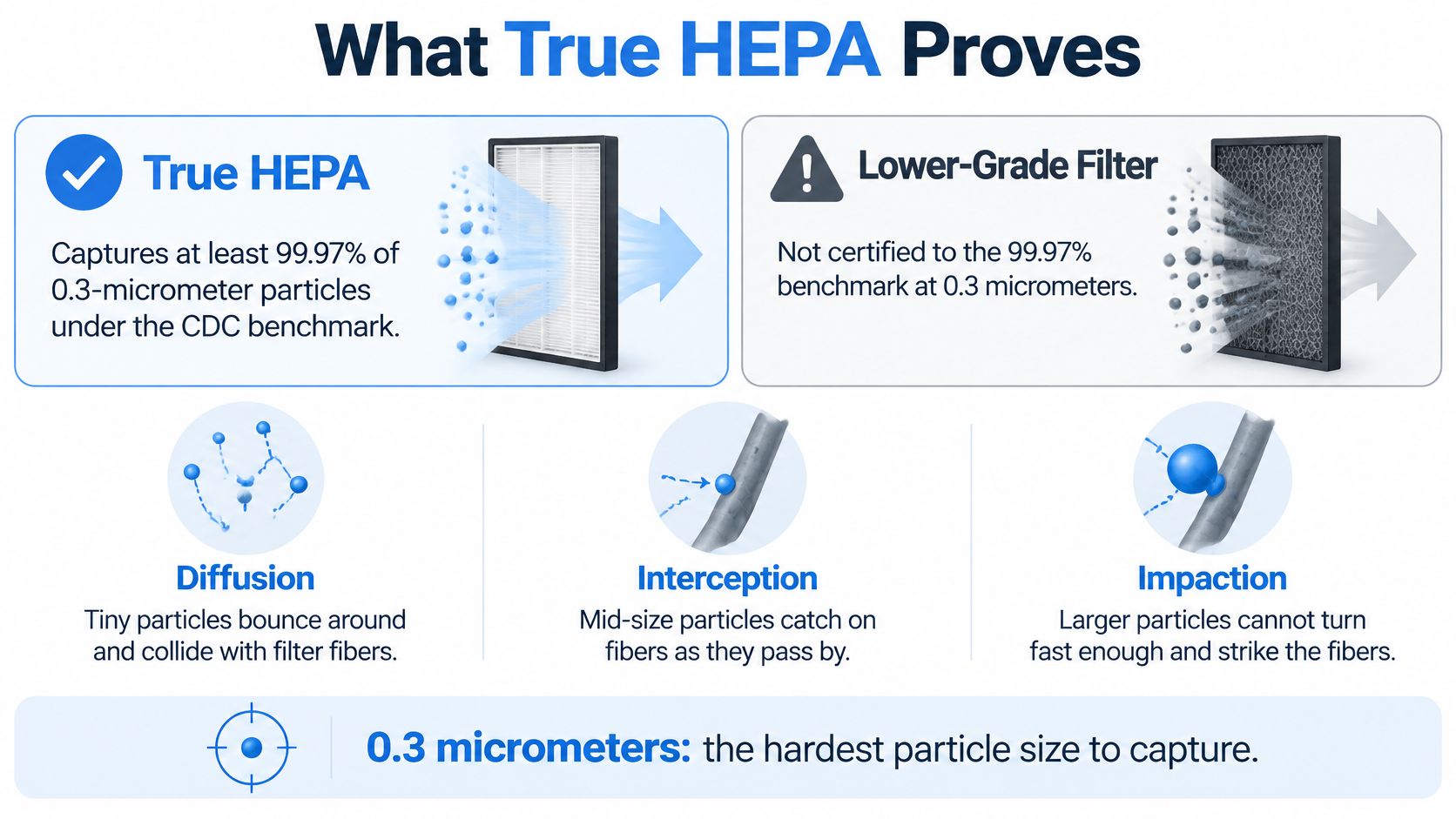
The table separates filter performance from other specifications. Ozone status requires model-specific documentation, especially for devices that use ionization or other active technologies.
| Variant | What the specification establishes | What to verify for bedroom use |
|---|---|---|
| True HEPA, independently tested | At least 99.97% capture at 0.3 µm | Sleep-setting airflow and filter fit |
| HEPA-type or HEPA-style | No verified benchmark without test data | Whether a report covers the exact model |
| True HEPA plus activated carbon | Particle capture benchmark; carbon is intended to help with odors | Carbon quantity and condition |
| Ionizer or filterless, including Living Air Classic XL-15 | No HEPA rating stated in the catalog | Independent particle-cleaning evidence and ozone documentation |
| UV or photocatalytic add-on | Not a HEPA particle-capture rating | Evidence for the specific function and potential byproducts |
Match the technology to the pollutant
For airborne particles such as allergens and smoke particles, an independently tested True HEPA filter provides a defined capture benchmark. Activated carbon addresses a different need: it can help with odors, but its performance depends on the amount of carbon and its condition. Look for product-specific information about the carbon rather than treating the presence of a carbon layer as proof of a particular level of odor control.
“HEPA-style” and “HEPA-type” do not establish that a filter meets the CDC benchmark. Without independent test data, its capture performance cannot be compared with a verified filter. Check that the report identifies the model under consideration, rather than only a filter material or another product in the same series.
For any option, compare the product's sleep-setting CADR with the room target and calculate air changes per hour from room volume. Then check ozone documentation for the exact model. California Air Resources Board testing found that some portable air-cleaner technologies emitted ozone and, in the presence of volatile organic compounds, some generated ultrafine particles. California Air Resources Board testing
Before buying, match the model number on the independent test report to both the product and its replacement filter. A filter label alone does not establish whole-unit airflow, overnight air changes or performance against gases.
Sleep-Mode CADR and Night Noise Trade-offs
Two tested examples show why peak CADR can overstate what a bedroom receives overnight. One unit drops from 246 cfm at peak to 100 cfm at its quiet setting, a loss of about 59%. Another falls from 321 cfm to 108 cfm, about 66% lower. Coverage summarizing quiet-speed CADR testing
In a 200-square-foot bedroom with an 8-foot ceiling, those settings translate into the following approximate air changes per hour. The EPA-based target is about 4.9 ACH, so both examples fall below the target at the quiet setting, even though each exceeds it at peak.
| Unit and setting | CADR | Approximate air changes per hour | Share of peak lost |
|---|---|---|---|
| Unit A, peak | 246 cfm | 9.2 | 0% |
| Unit A, quiet setting | 100 cfm | 3.8 | 59% |
| Unit B, peak | 321 cfm | 12.0 | 0% |
| Unit B, quiet setting | 108 cfm | 4.1 | 66% |
| EPA target for 200 sq ft | 130 cfm | 4.9 | n/a |
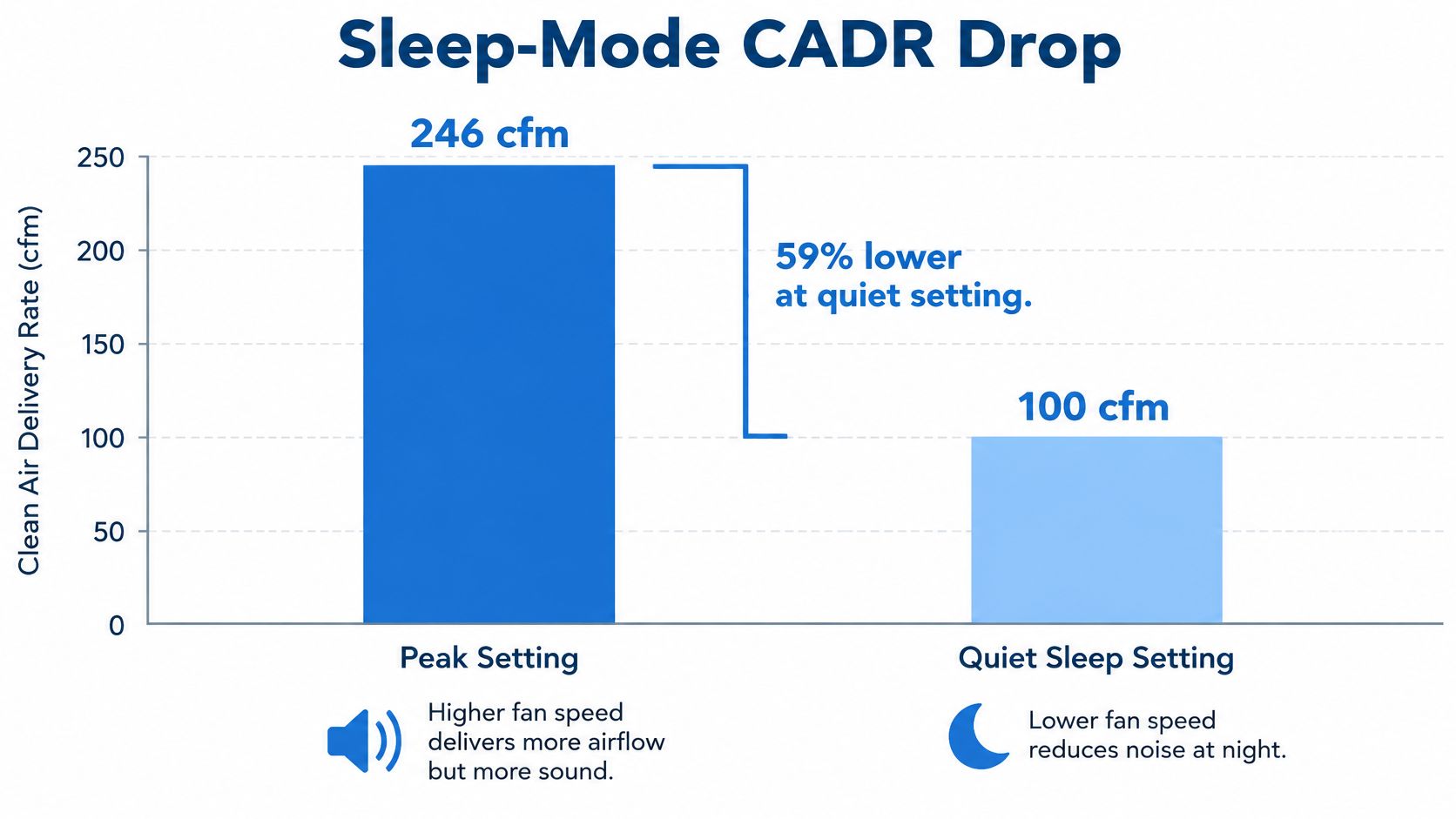
Compare performance where you sleep
Lower airflow means the purifier takes longer to deliver the same amount of clean air. The trade-off isn't solved by buying a model with a large peak rating if its sleep setting is too weak for your room or too loud for the person sleeping beside it. If the sleep setting falls short, one practical approach is to run the unit at a stronger, tolerable setting before bed, then lower the fan overnight. That can improve the air before sleep, but it doesn't turn an underpowered sleep mode into a target-meeting one.
Noise measurements need context. Look for sound-pressure ratings on the sleep setting and a realistic medium setting, and check how the manufacturer measured them. A rating taken far from the bed or only at maximum speed may not tell you what the fan sounds like at pillow distance.
Also check airflow direction and display behavior. A bright indicator may disturb a light sleeper, and automatic mode may reduce filtration for long periods if its sensor doesn't call for a higher fan speed. Ask whether the unit keeps moving air at night or only shifts to its lowest setting after detecting darkness.
Compare sleep CADR with your room target before comparing noise. A quieter setting is useful only if you can accept the clean-air turnover it delivers.
Filter Life, Replacement Cost and Smart Controls
Calculate ongoing cost using the parts you'll really replace:
Annual cost = filter price × replacements per year + electricity at the sleep setting + carbon refills.
That calculation prevents a common comparison error: treating the HEPA element as the only maintenance expense. Some designs combine particle media and carbon, while others separate them. A washable pre-filter may also collect larger debris and need regular cleaning even when it isn't replaced.
Check every filter stream
Ask whether the unit has a separate HEPA filter, activated-carbon layer and washable pre-filter. For odor control, request the carbon quantity in measurable terms and check whether the carbon is replaced separately or as part of a combined filter. A general claim that a purifier “has carbon” doesn't establish how much odor control it provides.
Filter indicators also deserve scrutiny. A runtime timer offers a predictable replacement interval based on use, while a sensor-based indicator depends on how that particular model measures pollution or filter condition. Confirm how the indicator is calibrated and whether the manufacturer gives a clear replacement schedule. Before purchase, verify the filter part number, current stock and whether replacement filters come from the manufacturer or a third party.
For model-matched replacement screens and filters, EcoQuest's filter and HEPA accessory listings provide one place to check the catalog. Confirm that the listed part fits your exact purifier rather than assuming filters are interchangeable across a product family.
Test the controls, not just the feature list
An app, schedule or voice-assistant connection can make a purifier easier to run consistently. An air-quality sensor can adjust fan speed automatically, while a night mode may dim or turn off the display. The test that matters most is whether automatic mode maintains useful airflow overnight or leaves the fan at a very low setting for long stretches.
Use a comparison sheet with these entries:
- Filter system: Identify separate particle, carbon and pre-filter components.
- Replacement plan: Record part numbers, availability and the stated replacement interval.
- Annual cost: Apply the formula above using the sleep setting's electricity use and any carbon refills.
- Night controls: Check display dimming, scheduled operation and automatic fan behavior.
EPA's technical review reports that many HEPA portable units deliver approximately 150–300 cfm of fine- and ultrafine-particle CADR, although output varies by device size and fan setting. Its broader point for a bedroom buyer is practical: compare clean-air output at the noise level used overnight, not only the filter name or maximum fan speed. EPA technical review of residential air cleaners
Matching Bedroom Situations to the Right Specs
The right specification depends on who sleeps in the room and what you're trying to address. A family choosing a purifier for a young child should assess ozone risk before celebrating a high peak CADR. Someone concerned about smoke needs to consider odor and gas control separately from particle filtration.
| Situation | Priority spec | Trade-off to accept | Verify before buying |
|---|---|---|---|
| Infant or young child | Verified low- or zero-ozone status; quiet sleep mode | Slower clean-air turnover at night | Independent ozone data and an ionizer-off option |
| Asthma or allergy sleeper | True HEPA plus sleep-mode CADR at target | Potentially higher filter cost if replacements are frequent | Independent HEPA test report and sleep CADR |
| Pets in the bedroom | Accessible pre-filter; adequate sleep-mode output | More frequent pre-filter cleaning | Removal and cleaning method |
| Light sleeper | Low noise at pillow distance; dimmed display | Slower particle removal | Sleep-setting sound measurement and display behavior |
| Smoke or wildfire season | Activated carbon plus CADR at or above target | Additional replacement expense | Carbon quantity and smoke CADR |
| Bedroom over 300 sq ft or open plan | At least 195 cfm smoke CADR under EPA guidance | Larger footprint or more noise on higher settings | Smoke CADR and noise at medium setting |
Put ozone ahead of peak output for sensitive occupants
For infants and young children, don't treat “HEPA” as a complete safety assessment. California Air Resources Board testing found that ozone generators operated in a small bedroom could raise ozone above the state health-based standard of 90 ppb and the FDA limit of 50 ppb; the agency concluded that these devices weren't safe in occupied spaces. California Air Resources Board material on ozone-generating air cleaners
That finding makes the buying check concrete: seek independently verified ozone information, and confirm whether optional ionization can be switched off. If a child, an asthmatic sleeper or a pet shares the room, don't accept an unclear answer about ozone output just because the purifier advertises strong airflow. The same caution applies when a device combines mechanical filtration with plasma, photocatalytic or active-oxygen functions.
Smoke creates a different trade-off. HEPA is designed to capture particles, while odors and some gases require activated carbon. Carbon quantity and replacement condition matter, so a carbon layer that isn't described clearly is difficult to evaluate. For a larger or open-plan bedroom, use the full connected volume to set the CADR target, then check whether the needed fan speed is tolerable.
Readers comparing options for allergy concerns can also review EcoQuest's allergy air purifier listings, while applying the same checks for airflow, ozone status, noise and replacement filters.
EcoQuest Configurations for Bedroom Use
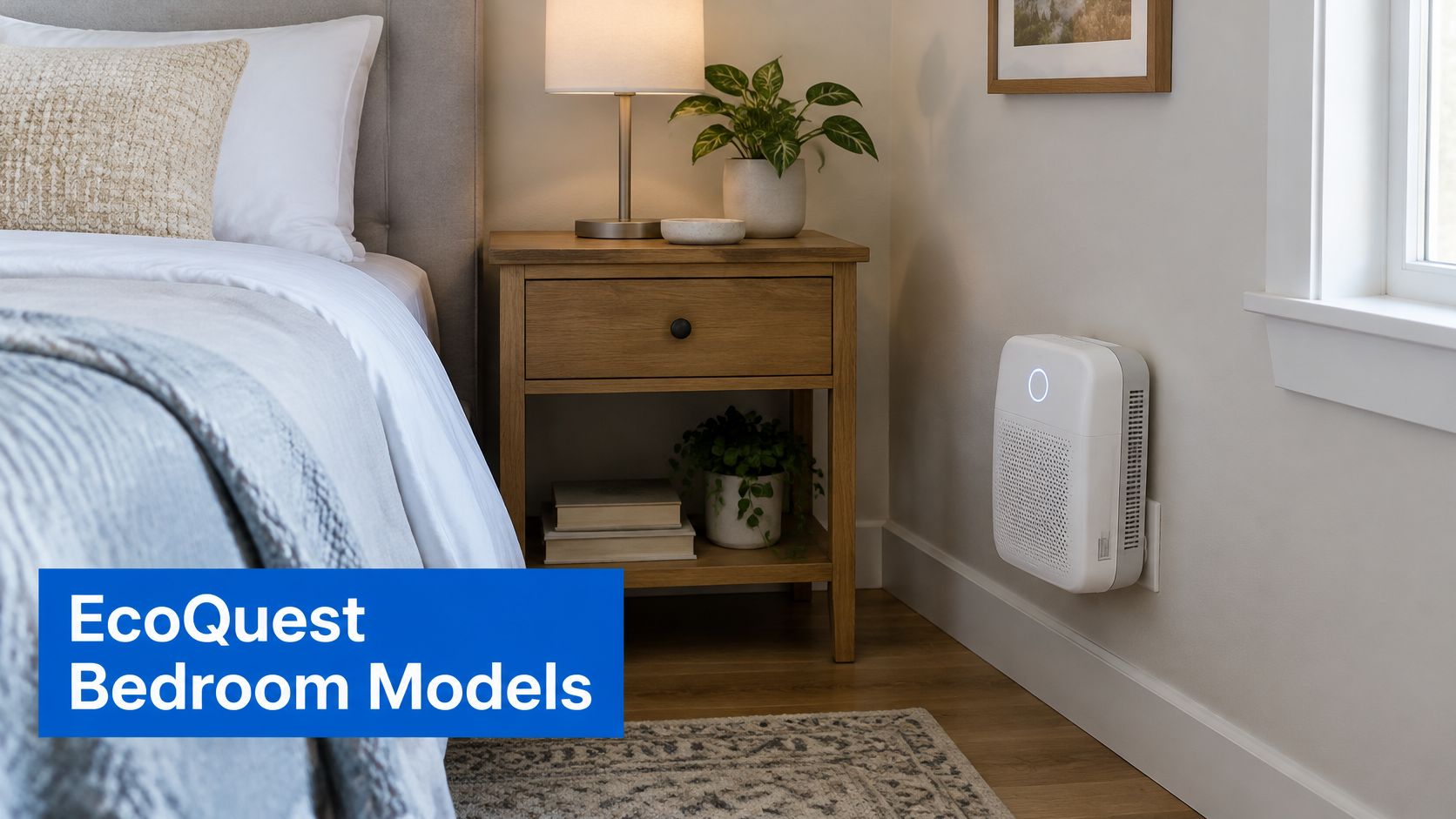
The EcoRoom Plug-In Air Purifier for Small Rooms is described as a compact, wall-plug air cleaner for bedrooms and other small spaces. Its plug-in format avoids taking up shelf or desk space, and the catalog calls it low maintenance and long-lasting. Those descriptions do not establish how much air it cleans while running with little noise overnight. Before choosing it, ask EcoQuest support for the EcoRoom's smoke CADR at its sleep setting, then compare that airflow with your bedroom's required air changes per hour.
Separate filterless designs from HEPA units
The Living Air Classic XL-15 is a filterless unit that the catalog describes as using ionization and activated oxygen to reduce particles, odors and stale air. That design is different from mechanical HEPA filtration. If verified HEPA performance is your requirement, assess it separately rather than treating the XL-15 as an equivalent. For bedroom use, request its ozone information and ask whether ionization can be disabled.
Fresh Air, Breeze 2 and EcoTravel also appear in EcoQuest's catalog, but the available product details do not establish their filtration grade, smoke CADR, sleep-setting noise or ozone status. Treat those specifications as unverified until confirmed for the exact model. A product name alone cannot show whether its airflow meets your room target or supports the air changes you want at night.
EcoQuest offers U.S.-based phone support for product questions. Ask for documentation tied to the precise model, including the EcoRoom's sleep-setting smoke CADR and the operating conditions used to measure it. If support cannot provide that figure, you will not be able to calculate its bedroom air changes per hour at the setting you plan to use.
Confirm Your Bedroom Purifier Before You Buy
Use this checklist to turn room dimensions and product documentation into a decision. Each step checks a different failure point, from an incorrect room target to a purifier that becomes too quiet to clean effectively.
- Write down the room target. Calculate the volume-based smoke CADR and the approximate 4.9 air changes per hour it represents, so room-size marketing doesn't substitute for an airflow figure.
- Check ozone options first. Rule out a unit whose ozone-producing or ionizer mode can't be switched off if a child, asthmatic sleeper or pet shares the room.
- Verify the filter claim. Confirm True HEPA with independent test data and make sure the report's model number matches the purifier and filter being sold.
- Compare sleep CADR with the target. Calculate the air changes per hour at the nighttime setting, because peak CADR won't tell you what the room receives while you sleep.
- Check the sound at the bed. Look for noise data at pillow distance on the sleep setting, and confirm whether the display dims or goes dark.
- Confirm the replacement plan. Record the exact filter part number, price and availability, then estimate annual cost using filter replacements, sleep-setting electricity and carbon refills.
- Choose a clear location and operating speed. Place the purifier near the sleeping area without blocking airflow, then run it continuously at a speed the sleeper can tolerate.
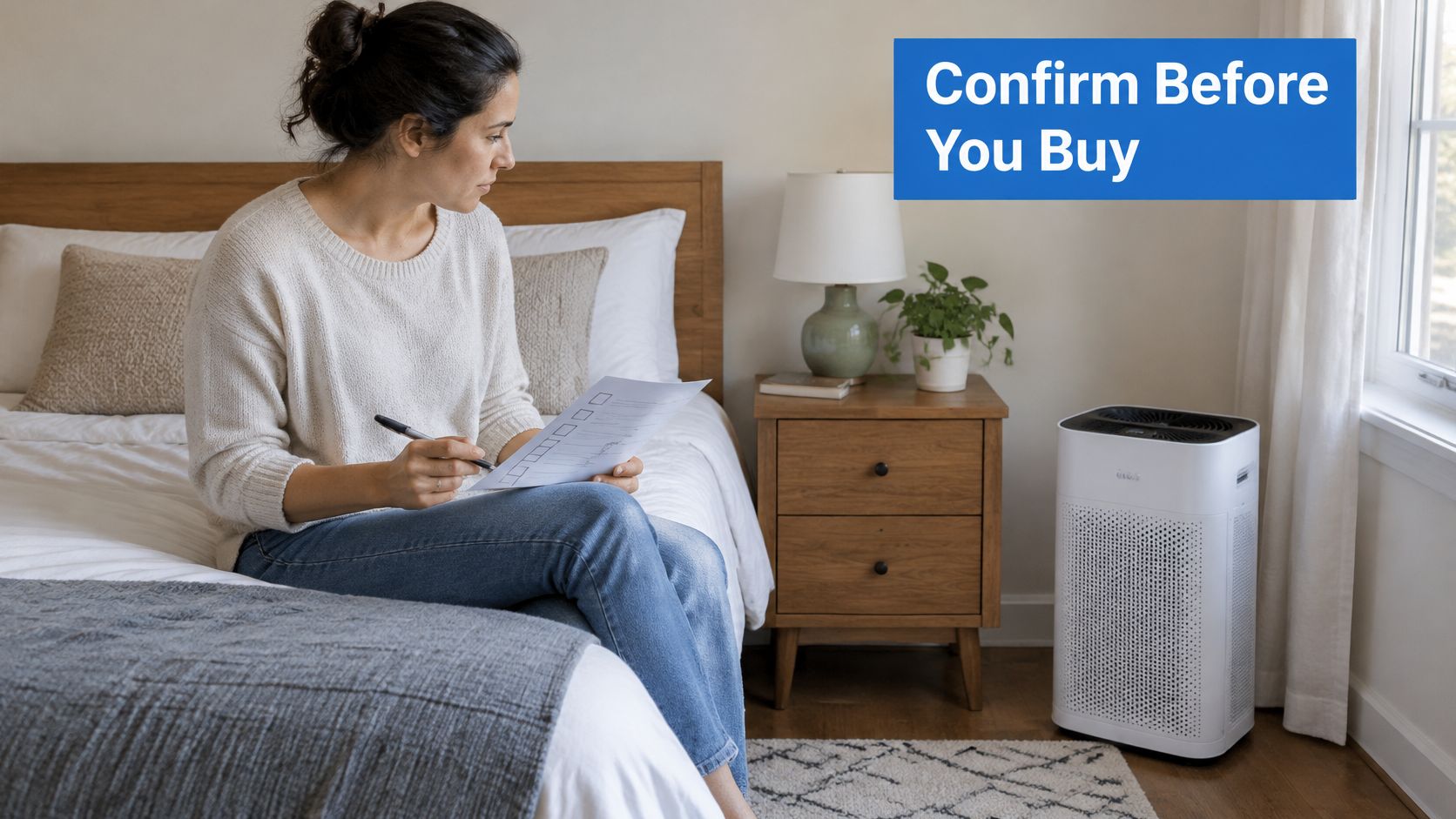
For most bedrooms between 150 and 300 square feet, choose an independently tested True HEPA unit whose sleep-mode CADR meets the room target at an acceptable noise level. For infants, people with asthma and households with pets, verified ozone status should take priority over peak CADR. EcoRoom may suit a small room once its missing performance and safety specifications are confirmed.
Before buying, request the model's specification sheet and replacement-filter prices. If the seller can't confirm sleep-mode CADR, noise and ozone status, keep comparing.
EcoQuest Purifiers offers single-room air purifiers, replacement parts and support for matching products to specific models. Visit EcoQuest Purifiers to review its bedroom-relevant options and ask for the specifications and filter details you need before choosing a unit.