
Best HVAC Air Filter: A Practical Buyer's Guide
The most popular advice about HVAC filters is also the most incomplete: buy the highest MERV rating you can find. That sounds sensible until a dense filter chokes airflow, makes the blower work harder, and leaves your home less comfortable. The best HVAC air filter isn't the one with the biggest number. It's the most efficient filter your system can move air through reliably, installed at the correct size and replaced before dust loading turns it into a restriction.
A sound choice balances particle capture, pressure drop, system compatibility, and maintenance. MERV gives you a useful performance baseline, but it doesn't tell you whether your blower, ductwork, filter cabinet, or replacement habits can support that rating.
| Filter choice | Particle capture | Airflow concern | Best starting point |
|---|---|---|---|
| MERV 8 pleated | Handles larger dust, pollen, and common household particles | Lower restriction than denser filters | Older or airflow-sensitive systems |
| MERV 11 pleated | Stronger capture of smaller particles | Moderate restriction | Many homes with allergies or pets |
| MERV 13 pleated | Strong fine-particle performance | Must be checked against system limits | Compatible residential systems |
| MERV 17–20 or HEPA range | Very high small-particle capture | Often too restrictive for standard HVAC equipment | Dedicated filtration equipment |
Table of Contents
- Why the Highest MERV Rating Is Not Always the Best Filter
- How MERV Ratings Actually Measure Performance
- Pleated, HEPA, Electrostatic, and Charcoal Filters Compared
- The Airflow and Energy Trade-Off Most Buyers Miss
- Matching the Filter to Your Home and Health Needs
- Replacement Timing Built Around Loading, Not the Calendar
- A 60-Second Decision Protocol for Choosing Your Filter
Why the Highest MERV Rating Is Not Always the Best Filter
A filter only works when air can pass through it. If the media is too restrictive for the blower and duct system, the rating on the frame becomes a misleading victory. You may capture more particles at the filter while delivering less conditioned air to the rooms, extending heating or cooling cycles and creating comfort problems.
The U.S. Department of Energy Building America summary places efficient residential system operation around 0.4–0.5 inches of water column total system pressure drop, and reports that commonly available MERV 12 filters produced more than four times the pressure drop of basic MERV 2 filters. The same source reports that clean MERV 8 filters reduced airflow by about 7% in systems using PSC motors. The Department of Energy's filter-selection guidance makes the practical point clear: filter efficiency and airflow can't be separated.
The four checks that matter
Start with the filter's MERV band, then check the media construction and physical depth. A deep, pleated filter can provide more surface area than a thin filter, sometimes reducing the airflow penalty compared with an equally dense filter in a shallow frame. But depth only helps if the cabinet is designed for it.
Next, verify the HVAC manufacturer's supported rating. A variable-speed blower may tolerate a denser filter better than an older PSC motor, but you shouldn't guess based on motor type alone. Duct restrictions, cabinet design, coil cleanliness, and existing static pressure all affect the result.
Finally, consider whether you'll replace the filter when it loads. A clean, compatible MERV 13 can be a smart choice. A neglected MERV 13 can become a serious airflow obstacle.
The practical rule: choose the highest-efficiency filter your system can breathe through, not the densest filter that fits the slot.
That framework governs the rest of the decision. MERV rating tells you what the filter can capture, filter type affects airflow and odor handling, compatibility protects system performance, and loading determines when the filter has stopped doing its job well.
How MERV Ratings Actually Measure Performance
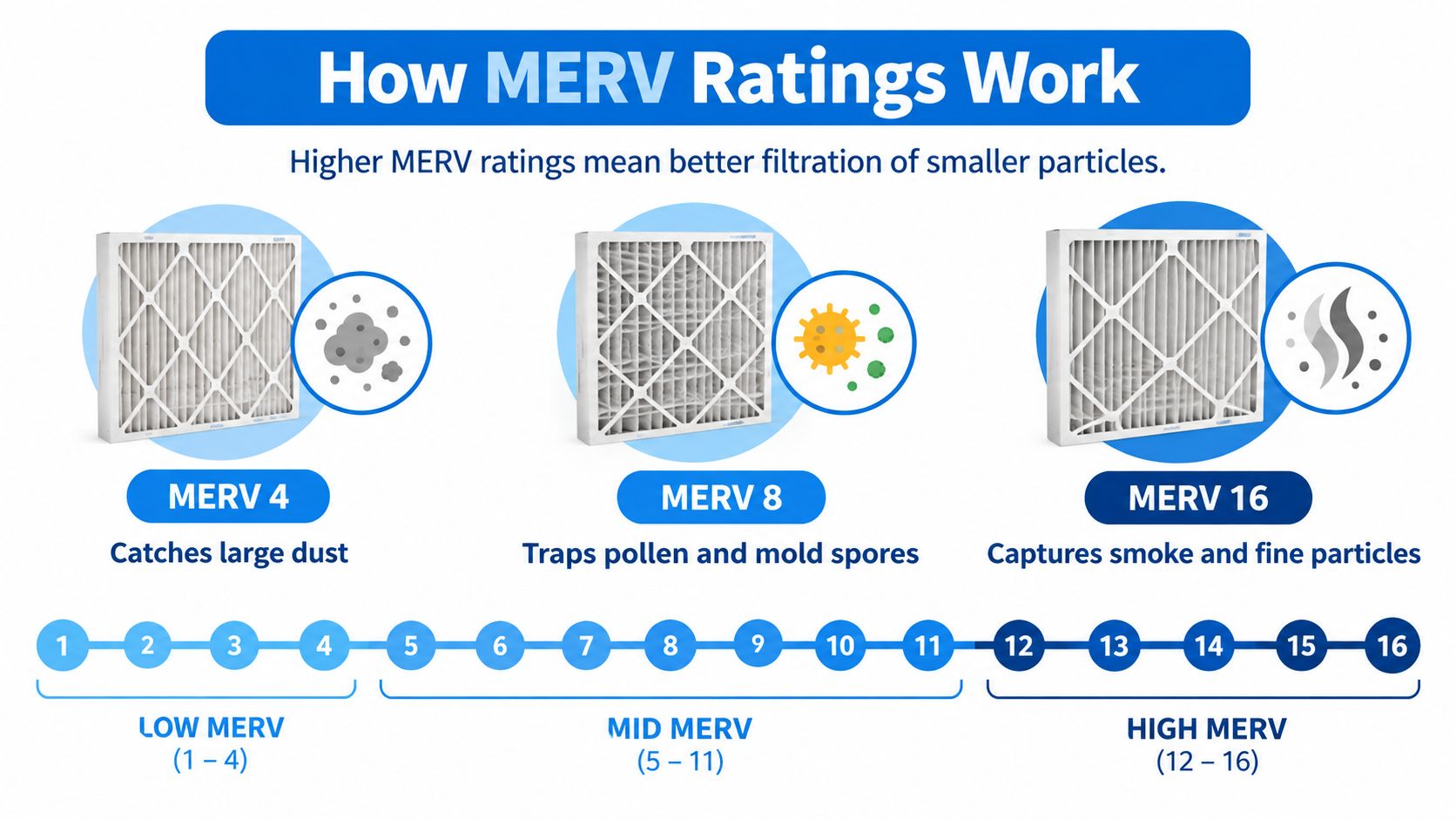
MERV stands for Minimum Efficiency Reporting Value. It isn't a single overall capture percentage, and it doesn't grade every aspect of a filter. The rating comes from testing particle removal across three size bands under ASHRAE Standard 52.2: 0.3–1, 1–3, and 3–10 micrometers.
That distinction matters because different indoor contaminants occupy different size ranges. Smoke and many fine combustion-related particles partly overlap the smallest test range. Larger dust, fibers, pollen, and lint are generally easier for filters to capture. A higher MERV rating means stronger performance across the tested bands, but it doesn't mean every particle is removed from the entire home.
Read the rating by particle size
MERV 8 is a useful baseline for many homes. Under the cited test conditions, it reaches at least 20% efficiency for 1–3 micrometer particles and at least 70% for 3–10 micrometer particles. That makes it a reasonable choice where airflow capacity is limited and the main concern is larger household dust, pollen, and fibers.
MERV 11 moves further into the smaller ranges. It must reach at least 20% for 0.3–1 micrometer particles, 65% for 1–3 micrometers, and 85% for 3–10 micrometers, according to EPA guidance on MERV performance. It's a strong middle-ground option for homes with pets, ordinary allergies, or more noticeable dust, assuming the equipment can handle it.
MERV 13 is the benchmark I'd target for a compatible residential system. It must reach at least 50% for 0.3–1 micrometer particles, 85% for 1–3 micrometers, and 90% for 3–10 micrometers under the test conditions described by the EPA's home air-cleaner guidance. The CDC recommends MERV 13, or the highest efficiency the HVAC system can handle without harmful performance effects, for occupied buildings.
Why HEPA isn't an automatic upgrade
EPA materials place MERV 17–20 in the high-efficiency range. Those filters are more capable against smaller particles, but they can impose substantially greater airflow resistance and aren't automatically interchangeable with a standard residential furnace or air handler.
Think of MERV as a particle-size performance tool, not a universal quality score. The right number depends on what you need to capture and what the equipment can support.
Pleated, HEPA, Electrostatic, and Charcoal Filters Compared
Filter construction changes the trade-offs before the MERV number even enters the conversation. A pleated filter, a true HEPA filter, a washable electrostatic filter, and a charcoal filter don't solve the same problem.
For most homes, a pleated filter is the sensible default. The folds increase the media surface area, allowing the filter to capture particles without relying on one flat, tightly packed sheet. MERV 8 through MERV 13 pleated filters cover the most useful residential range, although the actual pressure drop still depends on depth, surface area, airflow, and loading.
| Filter Type | Typical MERV Range | Airflow Cost | Best For |
|---|---|---|---|
| Pleated | MERV 8–13 | Low to moderate when correctly sized | Everyday dust, pollen, pet particles, and fine-particle reduction |
| True HEPA | MERV 17–20 range | High in standard HVAC applications | Dedicated air cleaners designed for high-efficiency filtration |
| Electrostatic or washable | Varies, often lower to mid-range | Can vary as the media loads or is maintained | Reducing disposable-filter waste where performance is verified |
| Activated charcoal | Not a primary MERV solution | Adds media resistance depending on construction | Odors and selected gases, alongside particle filtration |
Pleated filters are the workhorse
A pleated MERV 8, 11, or 13 filter is usually the best place to start because it addresses the contaminants homeowners notice while remaining compatible with common residential equipment. Choose MERV 8 when airflow is sensitive, MERV 11 when you want a stronger general upgrade, and MERV 13 when the system manufacturer permits it and fine particles matter.
The EcoQuest Purifiers filter and screen catalog can be useful when you're comparing replacement components, but don't buy by appearance alone. Confirm the nominal size, actual dimensions, depth, and system requirements.
HEPA captures more, but demands more
True HEPA filtration belongs in equipment designed around its resistance. Installing a dense HEPA-style filter into a cabinet built for a basic furnace filter can reduce airflow enough to undermine heating and cooling performance. If your goal is high-efficiency filtration, use a dedicated air-cleaning setup or have an HVAC professional measure system pressure before making the change.
A separate option is the Living Air Classic XL-15 Air Purifier, a filterless unit that uses ionization and activated oxygen technology to help reduce airborne particles, odors, and stale indoor air in homes, offices, and other indoor environments.
Electrostatic and charcoal serve narrower purposes
Washable electrostatic filters appeal to people who want less disposable waste. Their real-world performance depends heavily on the product design, cleaning routine, and condition of the media. If the filter isn't cleaned thoroughly or doesn't seal well, its theoretical advantage won't matter.
Activated charcoal is different. Charcoal helps address odors and some gases, but it isn't a substitute for a particle filter. If cooking smells, smoke odor, or stale air is the main complaint, charcoal can be a useful specialty layer. It won't replace a properly selected pleated filter for dust, pollen, or fine particles.
The Airflow and Energy Trade-Off Most Buyers Miss
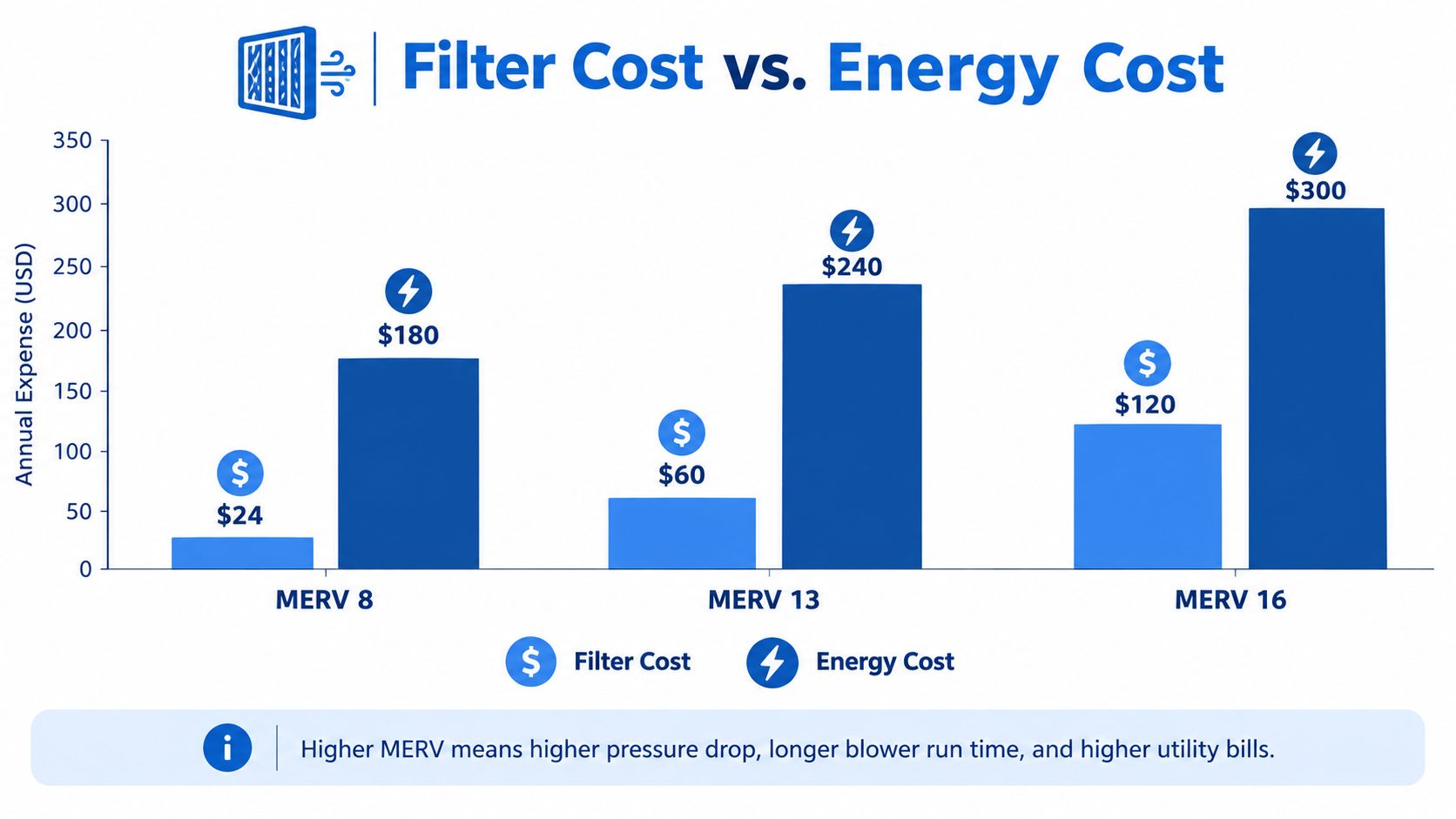
Pressure drop is the part buyers ignore until comfort slips. It changes how much air reaches each room, how hard the blower works, how long heating and cooling cycles run, and whether the system can hold the set temperature.
The key question is system fit, not the biggest number on the box. A study summarized in A bar graph comparing annual filter costs and energy expenses across three different MERV filter ratings. found that MERV 10 to 13 filters generally raised energy use by less than 1% across many conditions, while MERV 16 filters could push energy use up by more than 5% and create usability problems. That does not make MERV 16 bad in every case. It shows why a high rating needs a system check.
Watch the system, not the marketing copy. Weak register flow, longer runtimes, uneven rooms, and a blower that sounds strained after a filter change all point to a restriction problem. Supply air that feels weaker than usual is another clue. Once airflow falls, the house takes longer to recover after each cycle.
Motor type changes the margin
Older PSC blower motors usually have less tolerance for added resistance. Variable-speed systems handle changes better, but they still have limits. A variable-speed motor is not a license to drop in any filter you want.
A pressure measurement beats any guess based on the thermostat, equipment age, or the box label. If you are cleaning the house air side too, a guide to best pathogen control vacuums can help with surface dust and debris, but a vacuum does not replace HVAC filtration.
Start with a clean MERV 10 to 13 filter when the system can support it, then watch comfort and loading. A MERV 16 filter that chokes airflow is a worse choice than a clean, properly fitted MERV 13.
Matching the Filter to Your Home and Health Needs
A filter recommendation only makes sense in context. A low-dust home with a strong air handler can handle more filtration than an older house with narrow ductwork and a PSC blower.

Match the particle problem to the filter
Mild allergies: Start with a properly fitted MERV 8 or MERV 11 pleated filter. It targets larger pollen and dust particles without loading the system more than necessary, which makes sense in older equipment.
Severe allergies or asthma: Target MERV 13 if the HVAC manufacturer permits it. The CDC recommends MERV 13, or the highest efficiency the system can safely handle, and identifies MERV 13 as at least 50% efficient for 0.3–1 micrometer particles and 85% efficient for 1–3 micrometers in its air-filtration guidance.
Homes with pets: MERV 11 is a practical starting point for dander and household dust. Move to MERV 13 if airflow stays strong and fine particles matter more, but do not expect any furnace filter to pull hair off furniture or floors.
Urban pollution or wildfire smoke: Use MERV 13 when compatible, and add dedicated air cleaning for sustained smoke events. A furnace filter helps with particles, but it does not handle every part of outdoor pollution.
Light cooking odors: Keep a pleated particle filter for dust and allergens, then add an odor-focused approach if smells linger. Charcoal can complement particle filtration, while source ventilation still matters most.
Daycare or eldercare settings: Use the highest compatible filtration rating, watch loading closely, and do not sacrifice airflow for a number printed on the frame. Occupied spaces need consistent ventilation and maintenance more than they need a denser filter.
Small commercial offices: MERV 11 or MERV 13 can be reasonable targets when the system supports them. Confirm cabinet dimensions, blower capacity, and replacement responsibility before standardizing across multiple rooms.
A denser filter only helps when the system can move air through it. If you are weighing add-on cleanup options, HVAC-integrated air purifiers can complement the right filter, but they still need a compatible setup.
For household dust control, practical routines also matter. Good housekeeping can reduce the load that reaches the filter in the first place, and keep your home dust-free is part of that job.
The ActiveOx RCI PCO Cell with ozone is a replacement part for compatible Fresh Air units, and it should be replaced when the UV lamp burns out. That is a maintenance item, not a magic upgrade.
Replacement Timing Built Around Loading, Not the Calendar
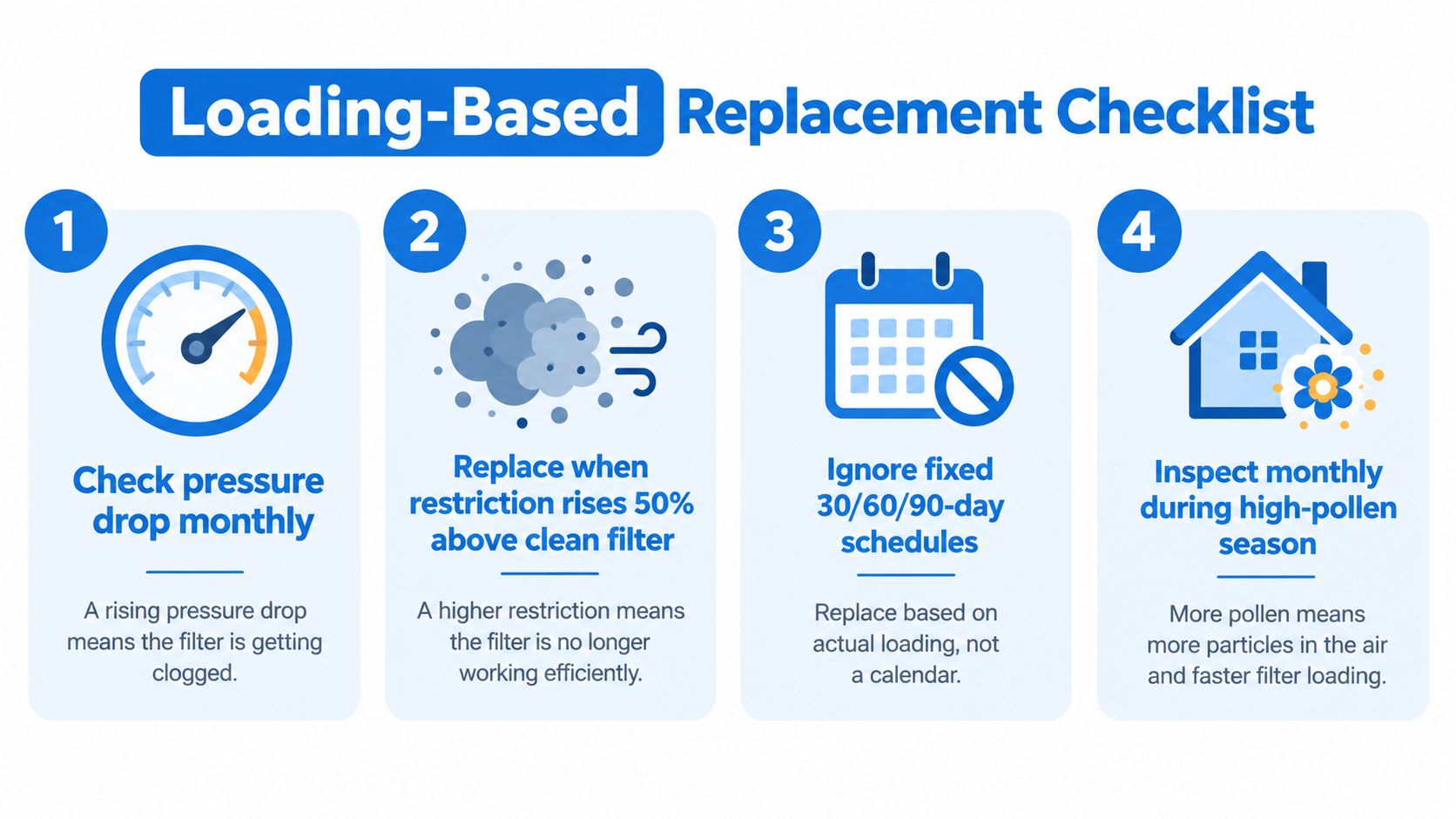
A fixed replacement schedule is easy to remember, but it ignores how hard the filter is working. Runtime, pets, occupancy, renovation dust, pollen, smoke, and fan settings all change the loading rate.
The clearest evidence comes from what happens when filters become heavily clogged. A 2025 study reported that heavily clogged filters reduced net supply airflow by 37% and increased exhaust-air transfer from 7.2% to 17.7%, exceeding compliance limits in the tested system. Those results come from the tested system, but the lesson applies broadly: a loaded filter can affect more than energy use. The study in Energy connects filter condition with airflow and air-transfer performance.
Use three replacement signals
Start with a visual inspection. Gray media isn't automatically a failure, but matted dust, blocked pleats, and visible debris across much of the surface are warnings. Compare the used filter with a new one under the same lighting.
Listen to the system and feel the registers. Longer heating or cooling cycles, weaker supply airflow, rising fan noise, and uneven comfort all justify an earlier inspection. Don't wait for the calendar if the system is telling you the filter is restricting flow.
Record high-loading events. Note wildfire smoke, renovation work, heavy dust, unusual occupancy, and seasonal shedding. After a major particle event, inspect the filter even if you installed it recently.
A deeper filter can improve the geometry of the decision. The cited study notes that a 4-inch pleated filter has roughly twice the surface area of a 2-inch filter, which can reduce pressure drop. That doesn't make every deeper filter compatible. The cabinet must accept the thickness, the seal must remain tight, and the HVAC manufacturer's limits still apply.
Use an air quality monitor to track indoor conditions alongside the filter inspection. It won't measure filter pressure drop by itself, but it can help you notice changes after smoke, dust, or ventilation events.
A 60-Second Decision Protocol for Choosing Your Filter
You don't need a complicated buying process. Run these checks at the filter cabinet.
Confirm the size and depth. Read the dimensions on the existing filter, then verify that the replacement sits snugly without gaps or forced compression.
Check the equipment limit. Look in the HVAC documentation for the highest supported MERV rating. If the information is missing, ask a qualified technician to measure pressure rather than guessing.
Choose the densest compatible MERV. Use MERV 8 when airflow is the limiting factor, MERV 11 for a stronger general-purpose option, and MERV 13 when fine-particle reduction matters and the system can support it.
Add specialty media only for a real problem. Use charcoal for persistent odors, not as a replacement for particle filtration. Consider dedicated purification when the HVAC cabinet can't safely support the filtration level you want.
Set a loading trigger. Inspect the filter, listen for airflow changes, and write down high-dust or smoke events. Replace based on condition and system behavior, not a universal calendar reminder.
The best HVAC air filter is the one your system can breathe through, your household can maintain on time, and its MERV rating actually describes.
If you're comparing maintenance practices for other filter systems, 3M AP910R replacement filter guidance offers a useful reminder that replacement decisions depend on the equipment and loading conditions. For HVAC work, bring in a professional after a major smoke event, duct renovation, suspected pressure imbalance, or any filter upgrade that causes weak airflow, unusual noise, or unstable comfort. Whole-house purification can complement a correctly selected HVAC filter, but it can't rescue an incompatible filter choice.
EcoQuest Purifiers offers HVAC-integrated air purifiers, single-room units, replacement parts, filters, and indoor-air-quality accessories for homes and professional spaces. Visit EcoQuest Purifiers to compare options that complement a properly sized, compatible HVAC filter.