
Best Smoke Air Filter: Expert Comparison and Guide
The most expensive purifier on the shelf isn't automatically the best smoke air filter. A poorly sized unit with a leaking filter path, a saturated carbon layer, or ozone-producing technology can perform worse, and create more concern, than a correctly selected mechanical cleaner.
Wildfire smoke brings two different problems indoors. Fine particles, including PM2.5, threaten respiratory comfort and health, while gases and volatile compounds create the persistent smell. The practical answer isn't a magic appliance. It's a properly sized, tightly sealed, well-maintained system that targets particles first and handles odors without adding another pollutant.
Table of Contents
- The Myth of the Single Best Smoke Filter
- Understanding HEPA Efficiency and Carbon Limits
- Technology Showdown Safety vs Performance
- Sizing Your Purifier with CADR Mathematics
- Best Strategies for Home Car and Commercial Use
- Calculating Real Total Season Cost
- DIY vs Commercial Units Worth the Upgrade
The Myth of the Single Best Smoke Filter
The pricey unit with the glossy marketing is not automatically the right answer for smoke. I see homeowners spend extra on features they do not need, then get disappointing results because the machine is undersized, the filter path leaks, or the carbon layer is too small to matter after a few smoky days.
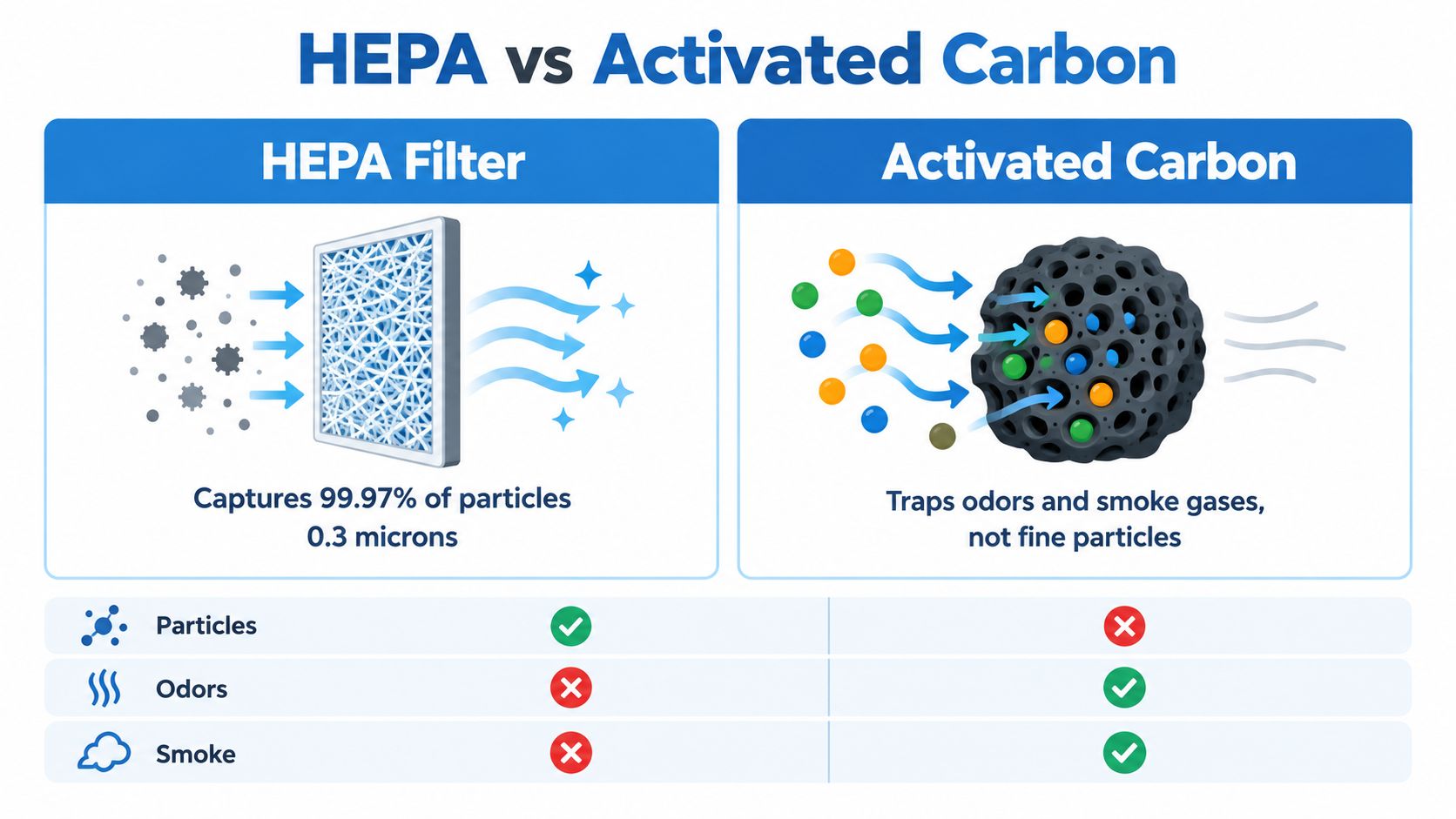
Smoke has to be handled as two separate problems. Mechanical filtration targets particles. That is the job that protects indoor air quality during wildfire events and heavy smoke episodes. Activated carbon targets gases and odors through adsorption. That can help with the burnt smell, but it does not replace a strong particle filter. The reverse is also true. A purifier can do a good job on airborne particles and still leave a chemical odor in the room.
The CDC's wildfire air-filtration review describes HEPA filtration as having a minimum efficiency of 99.97% for particles measuring 0.3 micrometers. Use that as a filter-media benchmark, not a promise about whole-room performance. Real rooms have leakage, open doors, imperfect placement, and changing smoke levels. A purifier still has to move enough clean air, through a sealed filter path, for that rating to matter where you sit and breathe.
Why smoke requires two jobs
Judge a smoke purifier on separate practical questions, not on a single brand claim or price tag:
- Does it remove fine particles? Look for true mechanical HEPA filtration and a published smoke CADR.
- Does it reduce odor and gases? Look for meaningful activated-carbon capacity and enough contact time for air to pass through it.
- Does it avoid creating a new hazard? Skip equipment that intentionally produces ozone in occupied rooms.
- Will you keep it performing? Check filter access, replacement availability, noise, airflow, and the ongoing cost of filters.
That last point gets ignored too often. A thin carbon sheet can knock down light odor for a short period, then load up fast during wildfire season. A larger carbon bed usually lasts longer and works better, but it also costs more to replace. That is why the cheapest machine to buy, and the most expensive one on the shelf, can both be poor values over a full smoke season.
Practical rule: Buy for particle removal first, then judge odor control as a separate requirement. A room that smells better is not proof that PM2.5 has been removed.
The best smoke air filter is usually a system choice, not a trophy appliance. Tighten the house, size the unit correctly, keep the filter path sealed, and maintain it on time. Brand matters less than setup, safety, and cost to keep it working.
Understanding HEPA Efficiency and Carbon Limits
HEPA earns its keep during smoke events because it captures particles mechanically. The 99.97% rating at 0.3 micrometers is a filter-media efficiency benchmark, not a whole-room result. Homeowners get misled here all the time. Expensive machines and budget machines both fail if airflow is weak, the filter path leaks, or the unit is undersized for the room.
A purifier can have excellent media and still clean slowly. Another can move a lot of air but lose performance if air slips around the cartridge instead of through it. Room volume, open doors, leakage, run time, filter loading, and placement all change what you actually breathe. That is why I do not treat a HEPA label as proof of real smoke control by itself.
What the evidence says about particle reduction
Independent clinical literature summarized in a 2025 review of portable air cleaners reports that portable HEPA cleaners can reduce indoor PM2.5 concentrations by approximately 50% to 80%. The same source describes a controlled bushfire-smoke study in which appropriately used HEPA units produced indoor air-quality improvements of roughly 30% to 74%.
Those numbers are useful, but they are not a promise. A properly sized unit running continuously in a closed bedroom has a much easier job than one trying to clean a large open-plan area with people moving in and out. The filter rating tells you what the media can catch under test conditions. CADR, air sealing, and how the room is used determine whether that cleaned air reaches you fast enough to matter.
Carbon is a separate tool with a different limit. It helps with odors and some gaseous compounds, but performance depends on carbon quantity, bed depth, contact time, and saturation. A thin carbon sheet or light coating may cut the smell for a while, yet it has very little reserve during sustained wildfire smoke. Once the available adsorption sites fill up, odor control can drop fast even while the HEPA stage still removes particles.
Cost of ownership matters more than sticker price. A unit with a small carbon layer may look like a bargain, then burn through replacement filters during smoke season. A machine with more carbon usually lasts longer on odor control, but replacement sets often cost more and airflow can drop sooner as the media loads. Compare the actual carbon design when the manufacturer discloses it. Do not assume every product with the word carbon performs the same way.
The Living Air Classic XL-15 Air Purifier uses ionization and activated oxygen technology and is described for reducing airborne particles, odors, and stale indoor air in homes, offices, and other indoor environments. For wildfire smoke, verify occupied-room operating guidance and independent emissions information before relying on that type of device.
A specification sheet worth trusting
Prioritize these details:
| Specification | What it tells you | What it doesn't tell you |
|---|---|---|
| HEPA efficiency | Particle-capture capability of the media | Whole-room performance |
| Smoke CADR | Delivered particle-cleaning capacity | Odor or gas removal |
| Carbon quantity and depth | Potential odor adsorption reserve | Guaranteed performance after saturation |
| Filter seal | Whether air can bypass the media | How quickly the filter will load |
| Operating noise | Whether you'll tolerate continuous use | Actual particle removal by itself |
Smoke control works best when the particle stage is strong, the carbon stage is honest about its limits, and maintenance costs do not get ignored until the first bad week of fire season.
Technology Showdown Safety vs Performance
Price does not make a smoke cleaner safe. In occupied rooms, the safest starting point is still a sealed mechanical filter with enough airflow to actually turn the room air over. Add carbon if odor matters. Be much more careful with devices that market odor removal through ozone, ionization, or plasma, because a room that smells better is not automatically a room with safer air.
| Technology | Useful role | Main limitation or concern |
|---|---|---|
| Mechanical HEPA | Captures fine smoke particles | Doesn't remove gases or odor by itself |
| HEPA plus activated carbon | Addresses particles and some gaseous compounds | Carbon capacity and saturation vary |
| Ozone generator | May be used for controlled treatment of unoccupied spaces | Not appropriate for occupied-room smoke cleaning without strict safety controls |
| Ionizer or plasma system | May affect airborne particles or odors depending on design | Requires credible ozone-emission evidence and realistic performance claims |
The practical trade-off is simple. Mechanical filtration is boring, but boring is good during wildfire season. It targets the particulate load that makes smoke dangerous indoors. Carbon can help with the sharp smell and some gaseous compounds, but only if there is enough of it and air can still move through the unit.
By contrast, some electronic air-cleaning products promise a lot while giving homeowners the wrong signal. A major review by researchers from the University of Colorado Anschutz and CDC/NIOSH found large evidence gaps, including limited testing of whether many air-cleaning technologies reduced illness in people and limited evaluation of harmful by-products such as ozone tied to ionizers and plasma systems. Read the review's discussion of evidence gaps in air-cleaning technologies. That is why I do not treat antimicrobial wording, fresh-air claims, or odor reduction by itself as proof that a device is a good smoke tool.
Ozone is not a shortcut for wildfire smoke
Wildfire smoke already irritates the lungs. Adding ozone to that situation can make the room harder to tolerate, not easier. EPA health warnings on ozone note risks such as coughing, breathing difficulty, and lung injury. For a homeowner choosing a smoke cleaner, that should end the idea that an ozone mode is a harmless bonus feature.
If a product includes ozone generation, treat it as a separate category from an occupied-room smoke purifier. Check whether the manufacturer limits use to unoccupied treatment, how re-entry is handled, and whether there is independent emissions information. If those answers are vague, skip it for wildfire season.
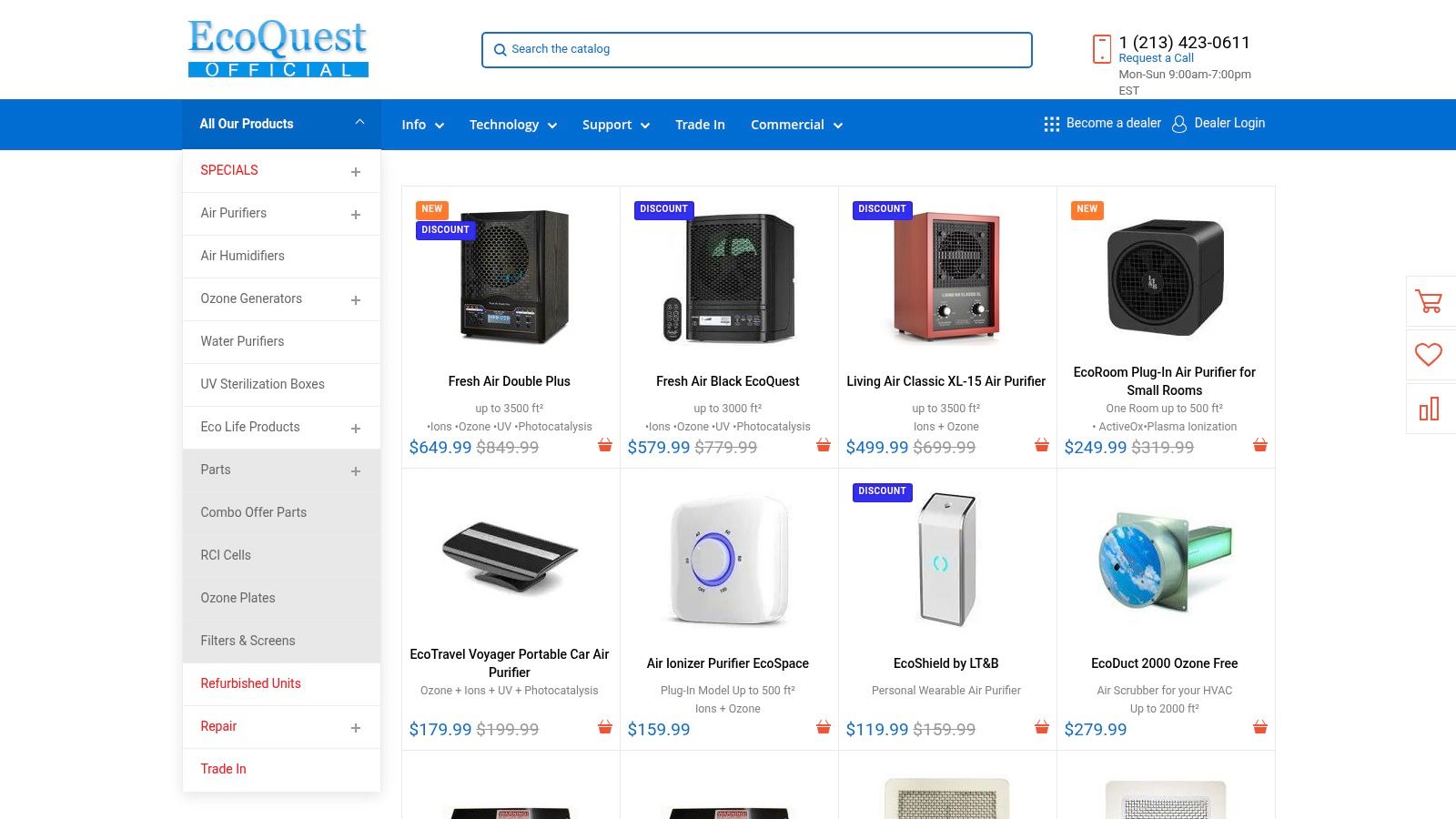
EcoQuest's catalog includes air purifiers and ozone generators, so buyers need to separate those uses carefully instead of assuming every unit belongs in a bedroom or living room during a smoke event. The ActiveOx RCI PCO Cell ozone free is described by the manufacturer as an ozone-free cell for an air purifier. That is a product description, not smoke-performance proof, and it does not replace published particle data.
A purifier that reduces odor while adding ozone has not solved the smoke problem. It has changed the problem.
Sizing Your Purifier with CADR Mathematics
The expensive unit is not automatically the right one. For wildfire smoke, sizing decides whether a purifier clears the room or just makes noise while the air still feels harsh. Start with tobacco-smoke CADR if the manufacturer publishes it. That number reflects how much cleaned air the unit delivers for particles. It does not tell you how well the machine handles odors, gases, or how long any carbon stage will last.
A practical baseline is the EPA rule of thumb from its portable air-cleaner sizing guidance: aim for a smoke CADR of at least two-thirds of the room area in square feet.
Minimum smoke CADR = room area in square feet × two-thirds
For a 120-square-foot room, that works out to 80 CADR. Treat that as the minimum starting point. Go higher if the room leaks air, doors stay open, the ceiling is tall, or outdoor smoke is pushing indoors hard. In real houses, those factors matter more than brand prestige.
Calculate airflow instead of guessing
If you want a cleaner answer than the coverage claim on the box, calculate ACH.
ACH = CADR × 60 ÷ room volume
Room volume is length × width × ceiling height. Use the same units all the way through, and use the smoke CADR when you have it, not the dust or pollen rating. The same EPA guidance says a portable cleaner should ideally provide filtered airflow equal to at least four to five room air changes per hour during smoke events. That is why a small desktop purifier can look good on a product page and still fall short in a living room.
A meter helps confirm the result, but it does not fix undersizing. An EcoQuest air quality monitor can show whether indoor particle levels are dropping or climbing. If the purifier is too small for the space, the monitor will show the problem. It will not solve it.
Check the installation
Placement changes performance. Keep the unit where intake and discharge air can move freely, not jammed behind a sofa, under shelving, or against curtains. During severe smoke, keep windows and doors shut as much as possible, and make sure the filter is seated tightly. Air follows the easiest path. If the cabinet leaks, some of the airflow bypasses the filter media.
If the house has central HVAC, use a filter the system can handle. A MERV 13 filter can help if the equipment is designed for that resistance and the fan can run continuously when needed. If the system struggles with the added load, do not force it. Use a properly sized portable purifier in the rooms where you need clean air most.
Best Strategies for Home Car and Commercial Use
Price does not decide smoke control. The enclosure does. A car, a house, and a commercial space all leak air differently, load filters differently, and punish bad placement in different ways. The expensive mistake is buying for the label instead of the space.
Cars need recirculation and compact airflow
In a vehicle, start with the factory HVAC on recirculation during heavy smoke. That reduces outside intake, but it does not seal the cabin, especially with frequent stops, passengers, and door openings. If the cabin filter is dirty, replace it first. A small purifier is only a supplement.
The Smart Car Air Purifier is one catalog option for drivers who want a purpose-built in-car unit. Judge any car purifier by whether it has credible particle-cleaning performance, tolerable noise, practical power draw, and no intentional ozone production. In a car, airflow path matters as much as the device itself. Block the intake with a bag or wedge the unit behind a seat, and performance drops fast.
Smoke residue settles everywhere. For practical household steps beyond filtration, this guide to making indoor air cleaner is useful. Damp wiping and careful cleaning help keep settled particles from getting kicked back into the air.
Homes need zones, not optimistic coverage labels
In homes, the best strategy is usually to protect the rooms people typically occupy, not chase whole-house claims. Put the strongest unit in the main bedroom or the room where vulnerable occupants spend the most time. Open-plan layouts count as one larger zone. They should not be treated like several closed rooms just because furniture breaks up the space.
Central HVAC can support the effort if the system can handle the filter resistance and the ductwork is reasonably tight. It cannot make up for an undersized portable unit in a problem room, and it cannot fix smoke entering through door gaps, attic bypasses, or repeated traffic in and out.
Be careful with coverage claims. The Fresh Air air purifier is described on the manufacturer's product page as purifying up to 280 m2. Treat that as the maker's description, not proof that it will handle wildfire smoke equally well in every room or operating mode. For smoke, sizing, maintenance, and the cleaning method matter more than paying extra for a premium-looking cabinet.
Commercial spaces need a written operating plan, because usage changes by hour and by zone. A front counter, waiting area, kitchen-adjacent room, salon chair line, or workshop bay can all have different particle and odor loads. Use occupied-space filtration where people breathe, keep any unoccupied treatment process separate, and service filters before loaded media chokes airflow. A single unit labeled commercial grade does not answer the key question, which is whether the space gets enough clean air where people are.
The video below provides additional product context, but product familiarity still needs to be paired with smoke CADR, emissions data, and maintenance planning.
Calculating Real Total Season Cost
The purchase price is only the first line on the ownership ledger. A smoke purifier also consumes electricity, uses replacement media, creates noise, and loses capacity as the filter loads. A cheap unit that you stop running because it is loud, or whose replacement filter is unavailable, isn't cheap in practice.
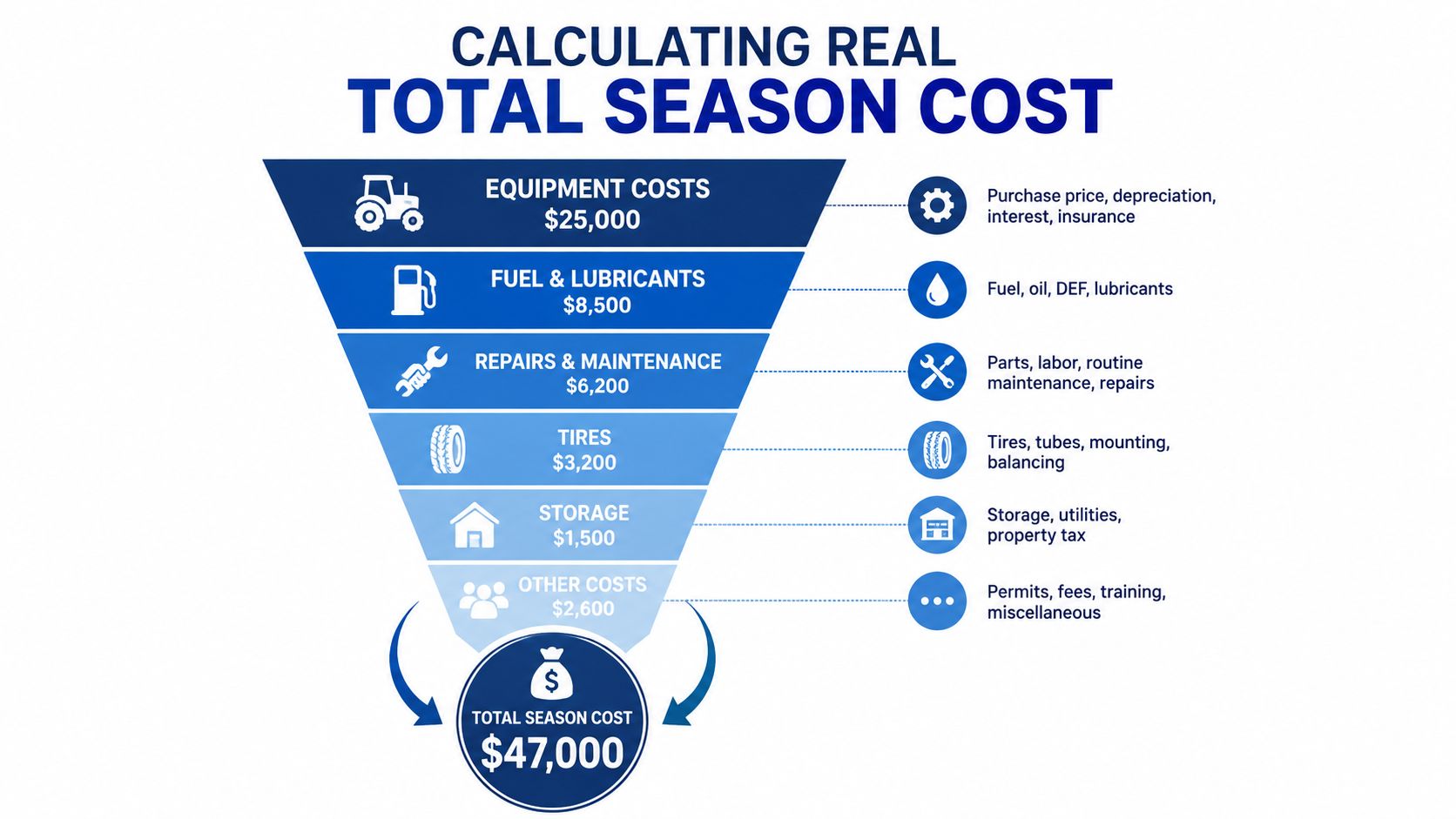
Use a simple season-cost worksheet:
- Purchase: Record the unit cost and any required accessories.
- Replacement media: Check the price, availability, and carbon or HEPA components separately where possible.
- Electricity: Use the unit's wattage, operating hours, and your electricity tariff.
- Performance loss: Allow for reduced airflow or odor control as filters collect smoke.
- Noise and usability: A unit that runs continuously at a tolerable setting may deliver more practical cleaning than a louder unit used intermittently.
Don't calculate cost per cubic foot of clean air from the laboratory CADR alone. That number assumes the rated operating condition and a clean filter. Real rooms add leakage, door openings, furniture obstruction, and filter loading.
The EPA's wildland-fire research found that DIY filter effectiveness in reducing infiltrated PM2.5 declined over two to three months. That supports temporary deployment during smoke episodes, not the assumption that a filter can remain maintenance-free indefinitely.
Inspect the filter rather than waiting for a calendar reminder. Heavy discoloration, reduced airflow, rising noise, or a persistent smoke smell can indicate loading or carbon saturation. Replace media according to the manufacturer's instructions and sooner when smoke exposure is severe. The least expensive system is the one that continues delivering the airflow you paid for.
DIY vs Commercial Units Worth the Upgrade
The expensive unit is not automatically the better smoke setup. A well-built box fan with a MERV-13 filter can be a sensible short-term choice when wildfire smoke rolls in, especially if the room is small enough and you stay on top of maintenance. EPA research found that low-cost DIY cleaners can cut indoor smoke about as well as commercial portables in the same performance range when they are assembled correctly, sized properly, and kept in good working order.
The trade-offs are real. DIY builds are often bulky, louder than people expect, and poor at smoke odor control if there is little or no activated carbon. Fit and stability matter. If the filter leaks around the edges, or the fan is set up carelessly, you lose performance and can create avoidable safety problems.
A commercial unit is worth the extra money when its design helps you run it consistently through smoke season. Useful advantages include:
- Better enclosure: A tighter filter path cuts bypass.
- Usable controls: Multiple fan speeds make all-day operation more realistic.
- Replacement support: Available media keeps the unit serviceable.
- Integrated sensing: Indoor readings can help you react to changing smoke conditions.
- Lower noise: Quieter units tend to stay on longer.
The Living Air Classic XL-15 represents a different filterless approach using ionization and activated oxygen technology. Compare that kind of unit carefully. For smoke, the safety questions matter as much as the marketing. Look at particle removal, ozone risk, operating instructions, and whether it performs acceptably in occupied rooms.
If money is tight, a correctly sized DIY build or basic MERV-13 setup can do the job. If you want simpler day-to-day use, judge commercial units by smoke CADR, sealing, carbon design, noise, and total season cost, not brand prestige.
EcoQuest Purifiers offers single-room, whole-house, car, HVAC-integrated, and commercial indoor-air products across several purification technologies, along with replacement parts and support. Review the specifications and safety guidance at EcoQuest Purifiers, then choose a smoke setup based on verified airflow, occupied-room safety, and a maintenance plan.