
Car Air Filter Types: A Complete Guide for Cleaner Cabin Air
You're inching through traffic on a humid afternoon. The air conditioner is running, but the cabin still feels stale. Outside, exhaust hangs between the cars, while inside, an old smoke smell lingers in the upholstery. You adjust the fan, close the windows, and wonder why the air never feels clean.
That discomfort often starts with a part drivers rarely see: the cabin air filter. Choosing among car air filter types isn't just a maintenance detail. It affects what enters the passenger compartment, how well the HVAC system moves air, and whether a filter suits your actual driving conditions.
Table of Contents
- Why Your Car's Air Quality Matters More Than You Think
- Cabin Air Filters vs Engine Air Filters Understanding the Difference
- The Three Main Cabin Air Filter Types Explained
- The Filtration vs Airflow Tradeoff That Most Drivers Miss
- When and How Often to Replace Your Cabin Air Filter
- Choosing the Right Filter for Your Driving Situation
- Hidden Contaminants and What Standard Guides Don't Tell You
- Your Action Plan for Cleaner Car Air
Why Your Car's Air Quality Matters More Than You Think
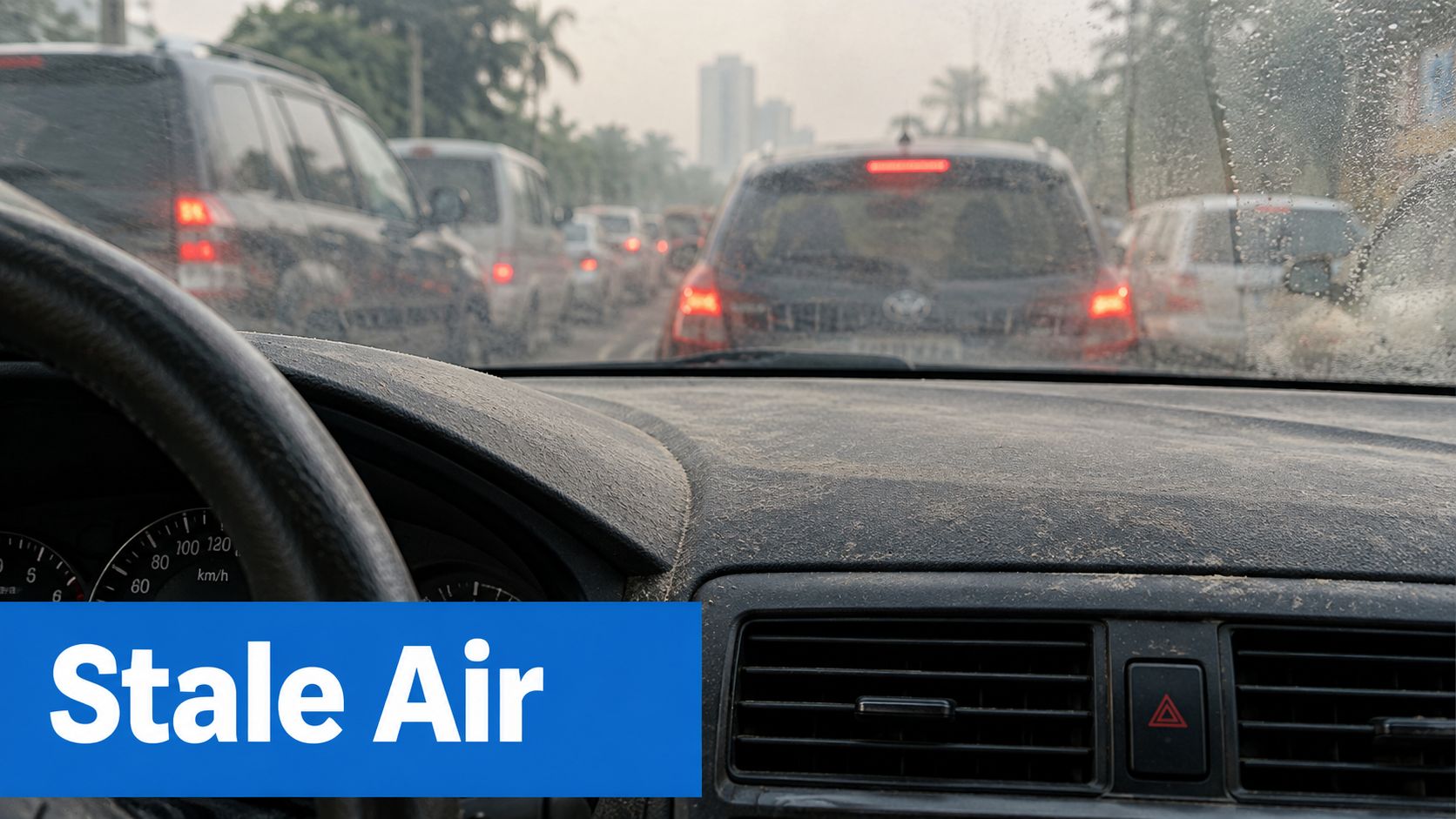
A cabin filter has to deal with more than visible dust. Traffic pollution, roadside debris, pollen, moisture, smoke, and odors can all affect the air moving through the HVAC system. If the filter is dirty or poorly suited to the vehicle, you may notice weak airflow, unpleasant smells, or windows that fog more easily.
A filter can't solve every source of poor cabin air. Odors can also come from carpets, seats, spilled liquids, or the evaporator housing. For practical ideas on dealing with persistent interior smells, SwiftJet's car odor solutions can complement, but not replace, proper filter maintenance.
Clean air starts with the right question
Many drivers ask, “Which filter is strongest?” A better question is, what problem are you trying to solve?
A basic particulate filter may be suitable for a driver who mainly wants protection from dust and pollen. Someone who regularly sits in congested traffic may care more about exhaust-related odors and gases. A person with strong allergy concerns may prioritize fine-particle capture, but still needs to consider whether the vehicle's blower can move air through a denser element.
Practical rule: A filter is only useful if it captures the contaminants you care about without reducing HVAC performance beyond what your vehicle can handle.
Your car's cabin is a small enclosed space, so every design choice becomes noticeable. The right solution balances particle filtration, odor control, airflow, replacement condition, and driving environment. That balance matters more than a label alone.
Cabin Air Filters vs Engine Air Filters Understanding the Difference
Your car has two separate air filtration jobs. Think of them as two different breathing systems, each protecting a different part of the vehicle.
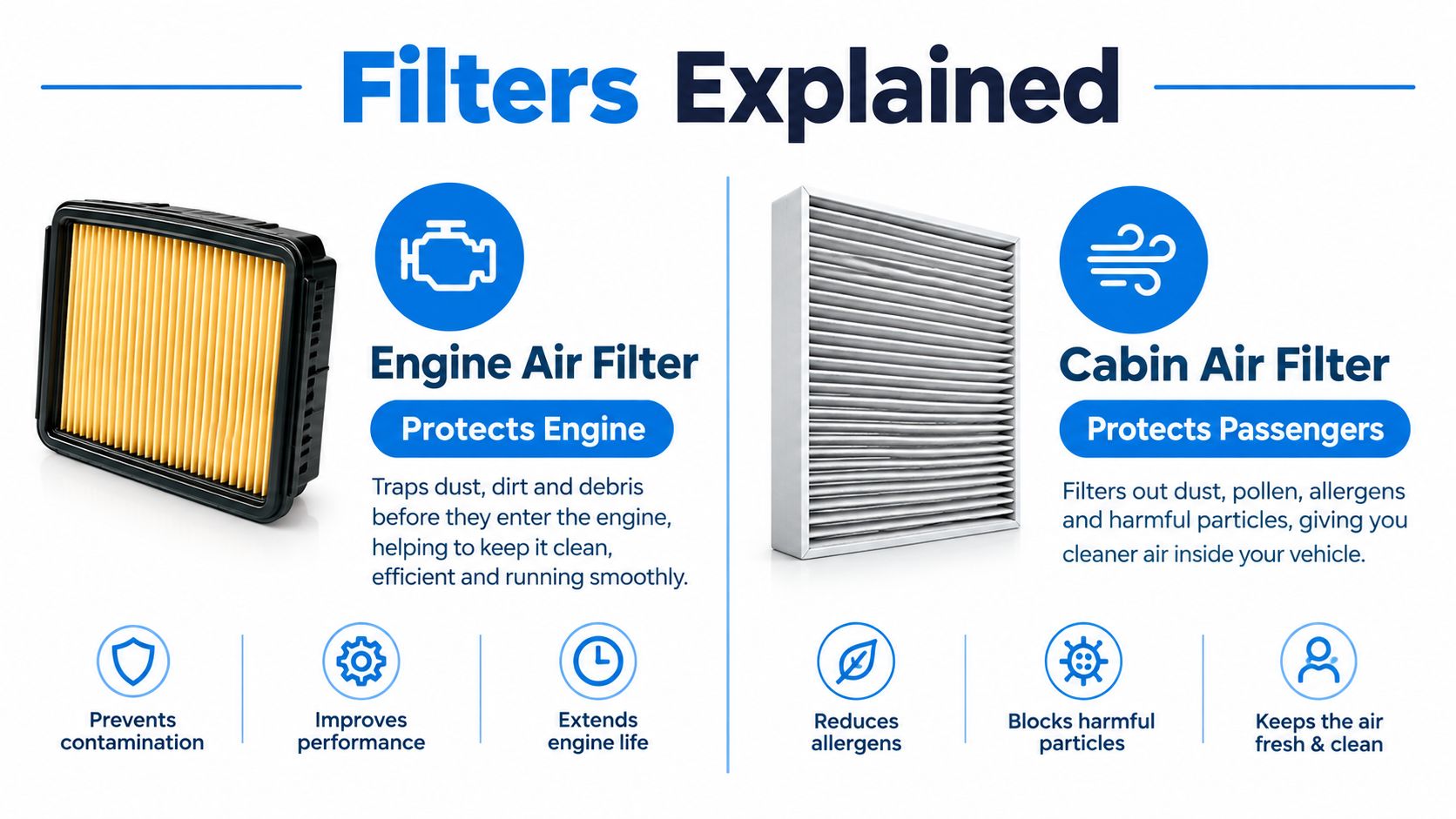
The engine air filter sits in the intake path before air reaches the engine. Its job is to keep dust and debris away from the combustion system. The cabin air filter sits in the HVAC intake path, usually near the glove compartment, beneath the dashboard, or near the base of the windshield. It filters air before that air reaches the passengers.
What each filter protects
An engine filter supports clean intake air for the motor. A restricted or damaged engine filter can affect how the engine breathes, but replacing it won't clean the air inside the passenger compartment.
A cabin filter serves the occupants. It screens air drawn through heating, ventilation, and air-conditioning ducts, helping reduce airborne particles before they reach the cabin. Replacing an engine filter won't fix a musty AC smell, and replacing a cabin filter won't protect the engine intake.
| Filter | Location | Main purpose | What it does not do |
|---|---|---|---|
| Engine air filter | Engine intake system | Protects the engine from incoming debris | Clean air entering the cabin |
| Cabin air filter | HVAC intake system | Filters air reaching passengers | Protect the combustion system |
Engine and cabin filters can use similar material families, including pleated paper, composite multilayer media, synthetic fleece, cotton gauze, or foam. The pleats increase effective media area and dust-holding capacity, while the material affects the balance between filtration efficiency and airflow resistance, as explained in Hengst's technical brochure.
The same distinction applies to air-cleaning equipment outside the vehicle. For example, the Living Air Classic XL-15 Air Purifier is a filterless indoor unit that uses ionization and activated oxygen technology to help reduce airborne particles, odors, and stale indoor air in homes, offices, and other indoor environments. It isn't a substitute for a vehicle's cabin filter because it serves a different space and airflow system.
The Three Main Cabin Air Filter Types Explained
Most replacement choices fall into three broad groups: standard particulate filters, activated carbon filters, and HEPA filters. The labels describe the filter media, not a universal guarantee that every product will perform identically in every vehicle.
Standard particulate filters
A standard filter is designed primarily to catch airborne particles such as dust, pollen, and road debris. Pleated paper or synthetic media creates a larger surface area in a compact housing, allowing the element to hold captured material while air passes through.
This is often the sensible choice for ordinary road use when your main concern is dust and seasonal pollen. Its limitation is important: particulate media doesn't usually address gases or odors. If a vehicle smells like exhaust or smoke, a basic particle filter may leave that problem largely unchanged.
Activated carbon filters
An activated carbon filter adds a carbon layer to the particulate media. Carbon helps adsorb certain gases and odor-causing compounds, so it can make more sense for urban commuters, drivers who regularly pass through tunnels or congested roads, and anyone dealing with lingering smoke smells.
Carbon isn't a universal chemical shield. Its performance depends on the amount and condition of the carbon, the air passing through it, and the contaminants present. A carbon filter can also become loaded, which is one reason replacement condition matters.
HEPA-style filters
HEPA media is designed for very fine particle capture. AAA describes standard cabin filters as typically about 98% efficient at trapping particles from 5 to 100 microns, while premium HEPA claims may reach 99.97% at 0.3 microns, as reported in its cabin air filter guidance. Those figures describe different performance profiles, so they shouldn't be treated as a simple ranking without considering airflow and vehicle compatibility.
HEPA is attractive for drivers focused on fine particles and allergens. The tradeoff is that denser media can create greater resistance, particularly when the filter becomes loaded. A practical comparison looks like this:
- Dust and pollen: Start with a standard particulate filter.
- Traffic fumes and odors: Consider activated carbon alongside particle filtration.
- Fine-particle concerns: Consider a vehicle-compatible HEPA option, then verify airflow requirements.
- Several concerns at once: Look for a combined particulate and carbon design, or a compatible higher-efficiency filter that won't overwhelm the HVAC system.
The Filtration vs Airflow Tradeoff That Most Drivers Miss
A filter can capture more particles and still make the cabin experience worse if it restricts too much air. The blower must push air through the media, and resistance rises when the filter is dense, undersized, poorly fitted, or heavily loaded with debris.
That matters during defogging and defrosting. In a humid climate, the HVAC system needs enough airflow to clear moisture from the glass. A filter that promises maximum particle capture but leaves the vents weak may compromise visibility and comfort.
A 2025 vehicle study tested portable air cleaners and cabin filters, with tested portable units ranging from about 80 lpm to about 8,500 lpm. That wide range shows why device size and airflow matter as much as the filtration label, according to the study on vehicle air-cleaning performance.
Why the vehicle matters
A factory cabin filter is selected for a particular HVAC housing and blower. A portable purifier has a different job and may circulate cabin air independently. Neither should be judged only by its headline efficiency.
Use these checks before choosing a denser option:
- Confirm fit. The filter must seal properly in the housing. Gaps can allow air to bypass the media.
- Watch vent strength. A noticeable drop in airflow after installation is a warning sign.
- Test defogging. If the windshield clears more slowly, the filter may be too restrictive or already dirty.
- Consider climate. Hot, humid, smoky, or dusty conditions increase the practical importance of airflow.
- Check the vehicle manual. Some models support only specific filter constructions or dimensions.
The best cabin filter isn't automatically the densest one. It's the one that provides useful contaminant control while preserving the airflow your HVAC system needs.
Drivers comparing higher-efficiency media can review EcoQuest's HEPA filters and screens as part of a broader air-quality equipment search, but any vehicle installation still needs to match the manufacturer's housing and airflow requirements.
When and How Often to Replace Your Cabin Air Filter
Replacement timing depends on what the filter has been exposed to. A car driven through construction dust, heavy traffic, wildfire smoke, or intense pollen will load its filter differently from a vehicle used mainly on cleaner roads.
Don't rely on a calendar or mileage figure alone. Start with the vehicle owner's manual, then adjust based on symptoms and inspection.
Signs the filter needs attention
- Weak airflow: The fan runs, but less air reaches the vents at the same setting.
- New odors: Musty, sour, smoky, or stale smells appear when the HVAC starts.
- More window fogging: The system struggles to move enough air across the glass.
- Visible loading: Dust, leaves, discoloration, or damp debris cover the filter media.
- Recent exposure: Driving through dusty roads, polluted corridors, or smoky conditions can justify an earlier inspection.
The filter location varies, but many cabin filters are accessible behind the glove compartment or beneath the dashboard. Some replacements require only basic tools, while others involve removing trim panels or working in a cramped space.
A simple replacement check
Turn off the vehicle, locate the filter housing, and photograph the old filter before removing it. Note the airflow arrow on the frame, compare the replacement's dimensions, and inspect the housing for leaves or moisture before installing the new element.
If the filter is damp, damaged, heavily contaminated, or difficult to reach, professional service may be the safer choice. A technician can also check whether the odor comes from the filter, the HVAC case, or another part of the cabin.
Choosing the Right Filter for Your Driving Situation
The most useful choice begins with your dominant exposure, not the most impressive label on the package.

Match the filter to the problem
Allergy-focused driving: A HEPA-style cabin filter may be worth considering when fine particles are your main concern. Confirm that the design fits your vehicle and doesn't cause a harmful reduction in ventilation.
Urban commuting: Activated carbon paired with particulate media can address a broader mix of road dust, smoke, and unpleasant traffic-related odors. It won't remove every gas, but it targets concerns a basic particle filter doesn't address.
Dusty roads and outdoor use: A standard or synthetic particulate design may provide a practical balance between capture and airflow. Inspect it more often when the vehicle regularly travels on unpaved or dusty routes.
Families and frequent passengers: Prioritize a correctly sealed filter, steady airflow, and a replacement routine based on actual conditions. A filter that sits clogged in its housing isn't providing the intended benefit.
Portable purification as a supplement
A portable unit can complement, rather than replace, the vehicle's cabin filter. The EcoTravel Voyager Portable Car Air Purifier is described as purifying air inside the car from exhaust gases, unpleasant odors, and other contaminants that enter from the roadway, while also providing protection against viruses and bacteria from the air-conditioning system.
That kind of device may be relevant when the cabin filter can't be changed immediately, when passengers have strong odor concerns, or when the vehicle spends time in polluted surroundings. It still needs adequate placement, power, maintenance, and realistic expectations.
Drivers looking for a compact in-car option can also review EcoQuest's small car air purifier alongside the vehicle's normal filter replacement plan. The key is to treat portable purification as an added layer, not permission to ignore a dirty or incorrectly installed cabin filter.
Hidden Contaminants and What Standard Guides Don't Tell You
Most filter discussions stop at dust, pollen, smoke, and odor. Those categories matter, but they don't cover every substance that can collect in filtration media.
A 2025 analytical study measured 47 PFAS in vehicle cabin AC filters and compared them with engine air filters. The finding raises a less familiar question: can cabin filtration media become a reservoir for persistent chemicals that aren't visible and aren't identified by a smell? The research is described in the study of PFAS in vehicle air filters.
This doesn't mean every dirty filter creates the same exposure or that a particular filter removes all PFAS. It does mean buyers should be cautious about treating “HEPA,” “carbon,” or “odor control” as complete chemical protection claims. Particle capture and gas-phase adsorption are different functions.
What this means in practice
Replacement deserves more attention in polluted, dusty, or wet-weather environments. A loaded filter may hold a mixture of particles and contaminants, so handle an old element carefully, bag it before disposal, and avoid shaking dust into the cabin.
Use a filter's construction as a clue, not a guarantee:
- Particulate media targets suspended particles.
- Activated carbon can help with certain gases and odors.
- HEPA-style media focuses on fine particles.
- No single label automatically addresses every chemical contaminant.
Indoor and respiratory comfort are connected topics, but persistent breathing problems shouldn't be diagnosed through a car filter. For general background on symptoms that can accompany airway obstruction and sleep health, consult a qualified health professional rather than relying on product claims.
A compact air quality monitor may help you observe changes in cabin conditions, but monitoring doesn't replace source control, ventilation, or proper filter maintenance.
Your Action Plan for Cleaner Car Air
Start by identifying the complaint you notice most often. Dust and pollen point toward a standard particulate filter. Traffic smells and smoke point toward activated carbon. Fine-particle concerns may justify HEPA-style media, provided the vehicle can maintain adequate airflow.
Then inspect the existing filter. Look for debris, discoloration, dampness, or a collapsed frame. Check the vent strength and see whether the windshield clears normally. Those observations tell you more than a generic “maximum filtration” claim.
Use this quick decision guide:
- You mainly see dust or pollen: Choose a correctly fitted particulate filter.
- You notice exhaust or smoke odors: Choose particulate filtration with activated carbon.
- You prioritize fine-particle capture: Consider compatible HEPA-style media and check airflow.
- You drive in severe pollution or dusty conditions: Inspect more frequently and consider supplemental portable purification.
- Your airflow is already weak: Restore HVAC flow before upgrading to denser media.
The right car air filter type is a compromise between cleaner air, odor control, particle capture, and dependable ventilation. Replace the filter based on its condition and your driving environment, not just an arbitrary routine.
EcoQuest Purifiers offers portable car units, indoor air purifiers, replacement parts, and air-quality equipment for different spaces and filtration needs. Review the available options at EcoQuest Purifiers, then compare any portable solution with your vehicle's cabin-filter requirements before choosing.