
Commercial Air Purifier for Mold: A Practical Guide
Most buying guides start with the purifier. That's backwards. A commercial air purifier for mold can remove airborne spores, but it can't stop a roof leak, dry wet drywall, clean a contaminated HVAC plenum, or remove growth hidden behind a wall. Facilities teams that buy filtration before fixing moisture often spend money making a symptom less visible while the building continues feeding the problem.
The right question is not “Which purifier is best?” It's “Has the moisture source been corrected, and what airborne load still needs control?” Once remediation is complete, properly sized HEPA filtration can help maintain cleaner air, support occupied spaces during cleanup, and reduce residual airborne spores. The guidance below treats purification as it should be treated, a measured supplement to remediation, not a substitute for it.
Table of Contents
- Why a Purifier Alone Will Not Fix a Mold Problem
- Identifying the Moisture Source Before You Plug Anything In
- Matching the Technology to the Job
- Sizing the Unit for a Real Commercial Room
- Verifying Performance After the Unit Is Running
- Placement, Runtime, and Maintenance Habits
- The Three Checks Before You Buy
Why a Purifier Alone Will Not Fix a Mold Problem
A purifier pulls particles from the air. Mold grows on wet or damp materials. Those are different jobs, and confusing them is how offices end up with a humming machine beside a still-active leak.
Visible mold, a persistent musty odor, or airborne counts above normal should trigger a moisture investigation. Filtration may reduce what occupants breathe, but it won't remove colonies on drywall, under carpet, above ceiling tiles, or inside HVAC components. EPA facilities guidance emphasizes drying, removing contaminated materials, and HEPA vacuuming after cleanup, which places air cleaning in a supporting role rather than treating it as the primary remedy. EPA mold remediation guidance for facilities makes that distinction especially important for schools and commercial buildings.
Facilities rule: If water remains available to mold, a purifier is treating the room, not the cause.
That doesn't make a commercial air purifier useless. It makes its proper timing clear. Use one after the affected materials have been cleaned or removed and the moisture source has been corrected. It can also support an occupied area while contractors work elsewhere, provided the unit is correctly sized and the work zone is properly contained.
The same moisture-first logic applies to smaller building systems. A facilities manager reviewing condensation and ventilation should also understand practical prevention measures, such as those described in this guide to avoid black mould on Dublin bathroom ceilings. The lesson carries across building types: reduce moisture, improve drying, then manage airborne particles.
A purifier is justified when residual aerosols remain, when post-remediation verification is underway, or when sensitive occupants need additional airborne particle control. It isn't justified as a way to postpone opening a wall, repairing a drain, or replacing saturated porous materials.
Identifying the Moisture Source Before You Plug Anything In
Begin with a walkthrough of the affected room and adjacent spaces before consulting any product comparison. Inspect stained ceiling tiles, bubbling paint, warped baseboards, condensation on cold ductwork, and earthy odors that intensify after rain. Complaints clustered around one HVAC zone may indicate a shared moisture or distribution problem, not isolated occupant sensitivity.
Use smell and sight to form a working hypothesis, not to declare the source found. A ceiling stain may follow a rooftop drain backup, while a damp patch near a vending area may originate at a floor drain or poorly sealed joint. Cooling-coil condensate pans can also retain moisture and biofilm in places occupants rarely see.
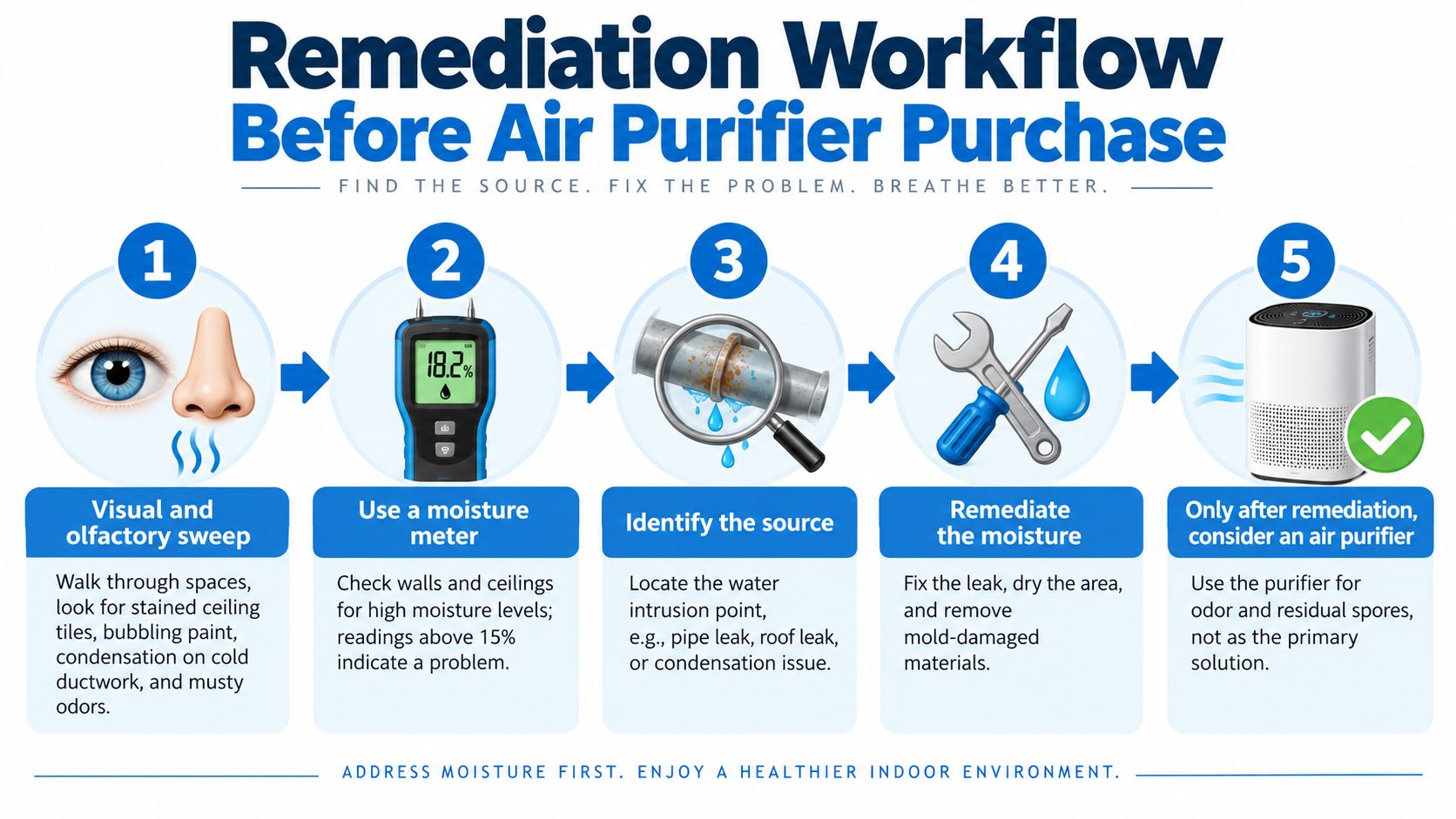
Check the building in an economical order
Use moisture meters on drywall, ceiling materials, and baseboards early in the investigation. Pin and pinless meters can help separate a localized wet area from a broader pattern, but material type and surface conditions affect interpretation. The supplied remediation workflow identifies readings above 15% as a problem. Treat that threshold as a field warning, not as a complete diagnosis from one reading.
Thermal imaging can expose cold bridges, concealed plumbing leaks, and temperature patterns linked to condensation. Pair those scans with hygrometer logging. Relative humidity should remain under 60% during investigation and drying, since persistent humidity allows moisture problems to return. The same moisture-first process and figures are summarized in this guide to air purifiers for mold.
Sampling can support an investigation, but sampling without a source hypothesis wastes budget. A spore count records what was airborne at a particular location and time. It cannot identify whether a roof drain, condensate pan, plumbing chase, or porous wall assembly is feeding the growth.
Contain, dry, then filter
Seal the affected zone before disturbing contaminated materials. Repair the leak or condensation pathway, remove materials that cannot be cleaned, and dry the structure. The supplied workflow uses under 16% moisture content in wood as the drying target before filtration becomes the next discussion.
For older EcoQuest, Alpine, Living Air, Vollara, Healthy Living, Spring Air, Lightning Air, or Natures Air equipment, the Standard Ozone Plate is listed as fitting models including Fresh Air, Classic, XL-15, Breeze, Flair, 880, Ozone Blaster, Eagle 2500, Eagle 5000, and Salon Air. That catalog detail does not change the remediation decision. Parts compatibility and mold control require separate checks.
Matching the Technology to the Job
Facilities buyers often compare labels instead of mechanisms. For mold, the practical distinction is whether a device captures airborne spores and fragments, treats only the air that passes through a reaction zone, or releases an active substance into occupied space.
A sealed true HEPA system should be the default for airborne mold control. H13 and H14 filters are commonly specified around the 0.3-micron test size, while mold spores are typically larger than that test particle. Correct sizing and sealed airflow matter more than a dramatic claim on the front of the cabinet. A filter that air bypasses through a poor gasket isn't doing the job its label suggests.
UV-C can inactivate microorganisms that pass close enough to the lamp for a sufficient exposure, but it doesn't treat air that never reaches the chamber. RCI, photocatalytic oxidation, and bipolar ionization may suit particular designs, yet their performance depends heavily on chamber design, maintenance, airflow, and byproduct control. Ozone and active-oxygen devices are the wrong choice for occupied offices, schools, clinics, and similar settings because ozone can irritate the respiratory system. Review any commercial ozone generator information as a separate, unoccupied-space application, not as a routine occupied-room mold strategy.
| Technology | Mechanism on spores and microbes | Evidence for mold | Key caution |
|---|---|---|---|
| True HEPA | Mechanically captures airborne particles | Strongest practical support for aerosol removal | Requires verified airflow, sealing, and filter maintenance |
| UV-C | Treats microorganisms that pass through the lamp chamber | Useful as a complement in suitable designs | Exposure depends on airflow, lamp condition, and contact time |
| RCI or photocatalytic oxidation | Uses a coated reaction surface to modify contaminants | Design-specific and harder to generalize | Maintenance and byproduct chemistry require scrutiny |
| Bipolar ionization | Charges particles and may affect airborne contaminants | Evidence varies by product and installation | Demand clear emissions and performance documentation |
| Ozone or active oxygen | Reacts chemically with odors and contaminants | Not a routine occupied-space mold control method | Avoid in occupied commercial areas |
The Living Air Classic XL-15 Air Purifier is described as a filterless unit using ionization and activated oxygen technology for airborne particles, odors, and stale indoor air in homes, offices, and other indoor environments. That description identifies its technology. It doesn't make it equivalent to a sealed HEPA unit for a mold remediation program.
My decision rule is simple: choose sealed HEPA first, add UV-C or another technology only when the use case and documentation justify the maintenance burden, and reject any proposal that leans on ozone for occupied-space mold control.
Sizing the Unit for a Real Commercial Room
Square footage alone produces bad purchases. Start with room volume:
Length × width × ceiling height = cubic feet
Then calculate the required continuous airflow:
Cubic feet × target air changes per hour ÷ 60 = required continuous CFM
For active mold concerns, plan around 4 to 6 air changes per hour, as described in the guidance on commercial mold purifier performance. A 1,000-square-foot room with 10-foot ceilings contains 10,000 cubic feet. Reaching 4.8 ACH requires roughly 8,000 cubic feet of clean air per hour, or about 133 CFM, before leakage, open doors, and connected spaces affect the result.
Open offices scale quickly. A 1,200-square-foot room with 9-foot ceilings contains 10,800 cubic feet. At 4 ACH, the required continuous delivery is 760 CFM. Request a unit or combination rated around 800 to 1,000 CFM on the intended operating setting, then confirm that occupants can tolerate the noise at that speed. A unit that reaches its advertised CADR only on high fan mode may be unsuitable if staff will keep it on low.
At standard 8-foot ceilings, industry guidance offers a faster check: select a smoke CADR roughly equal to two-thirds of the room's square footage, then size upward for mold because the source may continue releasing spores. The examples include about 200 CADR for a 300-square-foot room and about 267 CADR for a 400-square-foot basement, as explained in this CADR sizing guide. For equipment sized by CADR for offices, compare tested delivery with the actual operating setting instead of relying on coverage language.
| Room size, square feet at 8-foot ceiling | Target 4 ACH, CFM | Target 6 ACH, CFM | Minimum smoke CADR |
|---|---|---|---|
| 300 | 320 | 480 | 200 |
| 400 | 427 | 640 | 267 |
| 500 | 533 | 800 | 333 |
| 1,000 | 1,067 | 1,600 | 667 |
These are planning values from the ACH method. Check them against tested CADR, account for open-plan connections, and confirm filter access and electrical requirements. Several smaller units may distribute clean air better than one large unit parked beside a return grille.
Before requesting quotes, record room dimensions, ceiling height, connected areas, target ACH, required CFM, operating speed, noise limits, filter access, and electrical location. Review the commercial air purification range only after completing those calculations.
Verifying Performance After the Unit Is Running
A manufacturer's coverage claim is not a commissioning report. Request the unit's smoke, dust, and pollen CADR, then confirm whether an independent test used the AHAM CADR framework. CADR measures clean air delivery in cubic feet per minute, giving facilities teams a practical way to compare airflow between commercial rooms. The AHAM CADR framework and mold sizing context also explain why CADR is more useful than a special “mold” score.
Record baseline conditions before starting the unit. Use the same sampling method, location, and schedule for the follow-up sample after the purifier has operated for 72 hours. A published case study used that comparison period and reported average airborne mold reduction of 95.45%, with site-specific reductions of 90.83% and 99.35%. Treat those findings as evidence of what a well-designed system achieved in a controlled setting, not as a guarantee for every building.
Build a repeatable verification loop
Use a spore trap or Anderson sampler through a qualified laboratory, and keep collection conditions consistent. Pair laboratory results with straightforward field checks:
- Visual loading: Place a clean white sheet near the return and watch for changes in dust deposition.
- Supply inspection: Use sticky-slide tape at the supply to identify visible particulate loading.
- Humidity logging: Track relative humidity with a separate hygrometer, especially after rain or HVAC changes.
- Filter review: Photograph the pre-filter and inspect the gasket for bypass paths.
If airborne counts do not fall measurably after cleanup, buying another purifier is the wrong first response. Check the calculated CADR, fan setting, placement, filter condition, and whether moisture remains active. A Canadian commercial office evaluation used simultaneous indoor and outdoor 10-minute sampling following ASTM D7391. Indoor-to-outdoor concentration ratios did not increase after duct cleaning, showing why documented comparisons are more useful than visual assumptions. The Canadian evaluation provides methodological context.
Use an air quality monitor for ongoing operational visibility. Do not treat a consumer display as mold-clearance testing.
Placement, Runtime, and Maintenance Habits
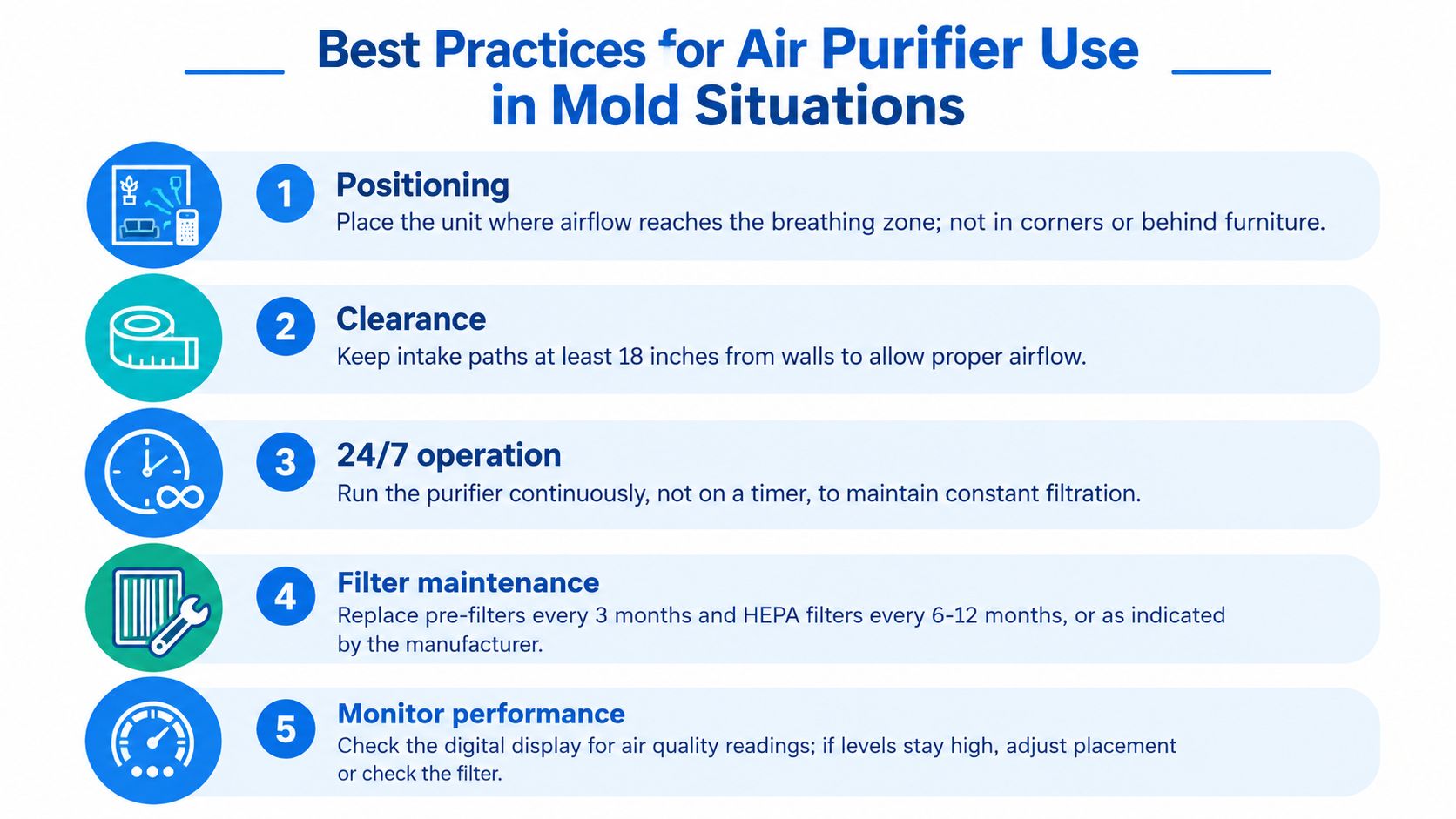
A correctly sized unit can still underperform if staff hide it behind furniture. Place the purifier where intake and discharge airflow can reach the breathing zone, not in a corner or directly against a wall. Keep intake paths at least 18 inches from walls, shelving, and other obstructions so the fan can deliver the air volume used in the CADR calculation.
Run filtration continuously during the control period. Mold release isn't limited to a predictable business-hour schedule. Occupants, maintenance activity, door movement, and HVAC cycling can disturb particles at different times, so turning the unit off on a timer allows the airborne load to rebound.
Humidity control belongs in the same operating plan. Keep indoor relative humidity between 30% and 50% where building conditions allow, and use a separate dehumidifier when the envelope or HVAC system can't maintain that range. Log readings weekly and investigate recurring excursions instead of merely increasing fan speed.
Maintain the equipment as part of the remediation plan
Filter changes should follow loading and runtime, not a forgotten calendar reminder. The supplied maintenance plan recommends pre-filter replacement every 30 to 60 days in dusty commercial spaces, HEPA replacement every 9 to 18 months at continuous operation, and carbon replacement every 12 months, or the manufacturer's stated interval when it differs. These are operational guideposts, not permission to leave a visibly loaded filter in service.
Assign ownership. At each inspection, staff should wipe the housing, check the filter gasket, confirm the fan reaches its expected setting, and document the filter change. A quarterly airflow check with a simple anemometer at the supply grille can reveal declining delivery before occupants report odor or irritation.
Maintenance reality: A bypassed HEPA filter is a HEPA filter that the room's air never passed through.
The Three Checks Before You Buy
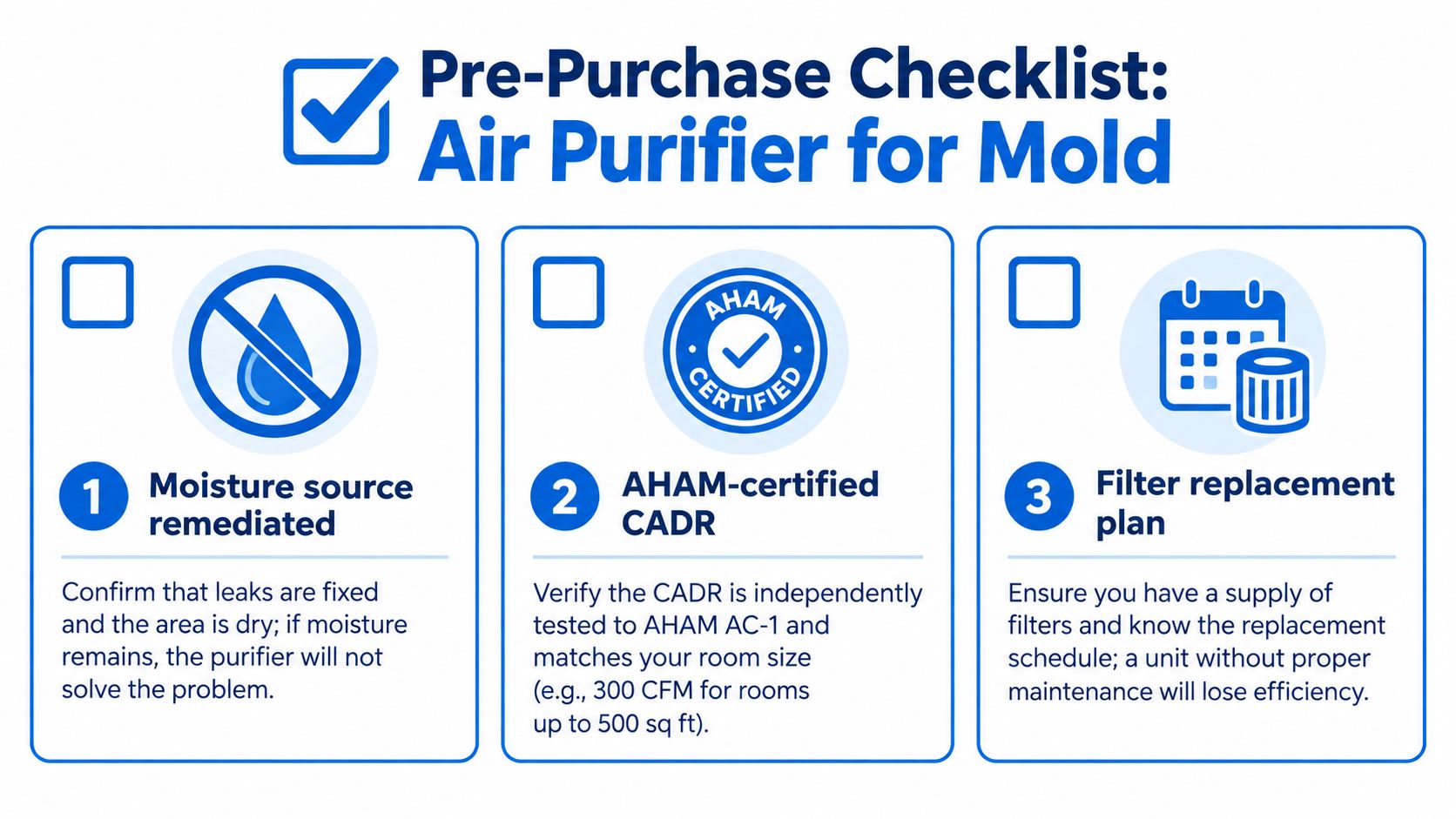
A responsible purchase should survive three checks before a supplier discusses price.
First, prove the moisture source is under control. Confirm that leaks, condensation pathways, roof defects, drain backups, or HVAC faults have been corrected. The affected materials must be dry, and contaminated porous materials must be cleaned or removed according to the remediation plan. If the building still has damp materials, postpone the purifier purchase or treat it only as temporary support during a controlled cleanup.
Second, prove the unit fits the room. Calculate volume, select the target between 4 and 6 ACH, convert that requirement into continuous CFM, and compare it with independently tested CADR. Open offices, gyms, corridors, and connected rooms may need multiple units or a ducted approach because one cabinet can't distribute clean air evenly through every connected zone.
Third, audit the specification sheet. Look for sealed HEPA construction, clear smoke and pollen CADR, documented operating noise at the required speed, accessible replacement filters, and a defined maintenance schedule. Ask how the manufacturer addresses ozone emissions and whether the product is appropriate for occupied commercial use. Don't accept “mold score” language in place of airflow, filtration, sealing, and service details.
Make the vendor prove it understands the building
A credible supplier will ask for room dimensions, ceiling height, occupancy, HVAC layout, moisture history, operating hours, and maintenance capacity. They'll discuss warranty support, service access, replacement-filter supply, and noise in the actual operating mode. A vendor who jumps straight to a model and a price without asking about the leak is giving you a sales answer to a facilities problem.
The commercial case-study data shows that high-capacity equipment can reach 231 CFM and 340 CFM CADR, with listed effective coverage of 403 square feet and 505 square feet at 4.8 ACH, respectively. Those figures reinforce the central buying lesson: commercial mold control often demands substantially more airflow than a typical consumer cabinet, and coverage claims must be checked against room volume. The reported high-capacity performance figures are useful comparison points, not universal guarantees.
A purifier earns its place after the source is fixed, the unit is sized, and performance is verified. Without those three conditions, it's an expensive distraction.

EcoQuest Purifiers offers commercial air-cleaning equipment, replacement parts, and multiple purification technologies for professional spaces, so use its catalog as a starting point after your moisture assessment and CADR worksheet are complete. Visit EcoQuest Purifiers to review available commercial options and support resources, then ask for a solution that matches your room volume, occupancy, maintenance plan, and remediation stage.