
Extra Large Room Air Purifier: How to Size One That Works
You've bought a purifier labeled for a huge room, set it beside the wall in your open-plan living space, and left it running. Yet cooking smells linger, dust keeps circulating, and the air doesn't feel as fresh as you expected. The problem may not be the machine's size. It may be that the coverage claim doesn't account for your ceiling height, connected rooms, or how much clean air the unit delivers.
That's why choosing an extra-large-room air purifier starts with the room, not the label. Compare the purifier's Clean Air Delivery Rate (CADR) with your room's area and layout, then consider where the unit will sit and whether you'll run it at a setting you can live with.
Table of Contents
- Why Most Large-Room Purifiers Fall Short
- Understanding CADR and Air Changes Per Hour
- HEPA vs RCI vs Ozone Technology Trade-Offs
- How to Size a Purifier for Your Specific Room
- Placement Strategies for Open and High-Ceiling Rooms
- Commercial-Grade Blaster Units and When to Use Them
- Maintenance and Replacement Parts for EcoQuest Models
- Your Final Checklist for Buying an Extra Large Room Purifier
Why Most Large-Room Purifiers Fall Short
A purifier marked for 1,000 square feet can sound like an easy match for a great room. But a square-footage label doesn't tell you how quickly the machine cleans the air, whether its rating assumes a standard ceiling, or how well air moves between a living room, dining area, and kitchen. Put one unit in a corner, and it may mainly circulate air nearby instead of drawing air evenly from the whole connected space.
The room's air volume and movement affect how much air the purifier needs to process. A high ceiling adds air without changing the floor-area number on the product label. Open doorways and archways can make the effective space larger still.
A coverage label isn't a cleaning guarantee
A purifier can capture particles when air passes through it, but the whole room benefits only if enough air reaches the unit and returns to the room clean. It functions like a pump: a good filter can trap particles, but low airflow limits how much room air gets treated over time. A physically large appliance doesn't necessarily have the airflow capacity to match an extra-large space.
The EPA reports that Americans spend approximately 90 percent of their time indoors, and concentrations of some pollutants inside buildings are commonly two to five times higher than typical outdoor concentrations. Those figures make indoor air worth paying attention to, but they don't mean that every purifier will solve every air-quality concern. The EPA's indoor air quality overview provides context for why choosing an appropriately sized cleaner matters.
The useful question is not, "How large a room does the package say this covers?" Ask instead: "How much clean air can this unit deliver in the space where I'll use it?" That shift makes it easier to compare products and avoid buying a unit that sounds powerful but can't keep up with your room.
Understanding CADR and Air Changes Per Hour
Clean Air Delivery Rate, or CADR, describes the volume of filtered air a purifier delivers. It's usually expressed in cubic feet per minute (CFM). A simple analogy is a pump moving water: the filter determines what the machine captures, while airflow determines how much air passes through that filter. Both matter.
The EPA advises choosing a portable cleaner with a CADR appropriate to the room. For rooms with ceilings up to 8 feet, the widely used AHAM sizing rule recommends a smoke CADR of at least two-thirds of the floor area in square feet. For example, a 600-square-foot room calls for at least 400 CFM, while a 1,000-square-foot room calls for approximately 667 CFM, according to the EPA guidance on air cleaners and respiratory viruses.
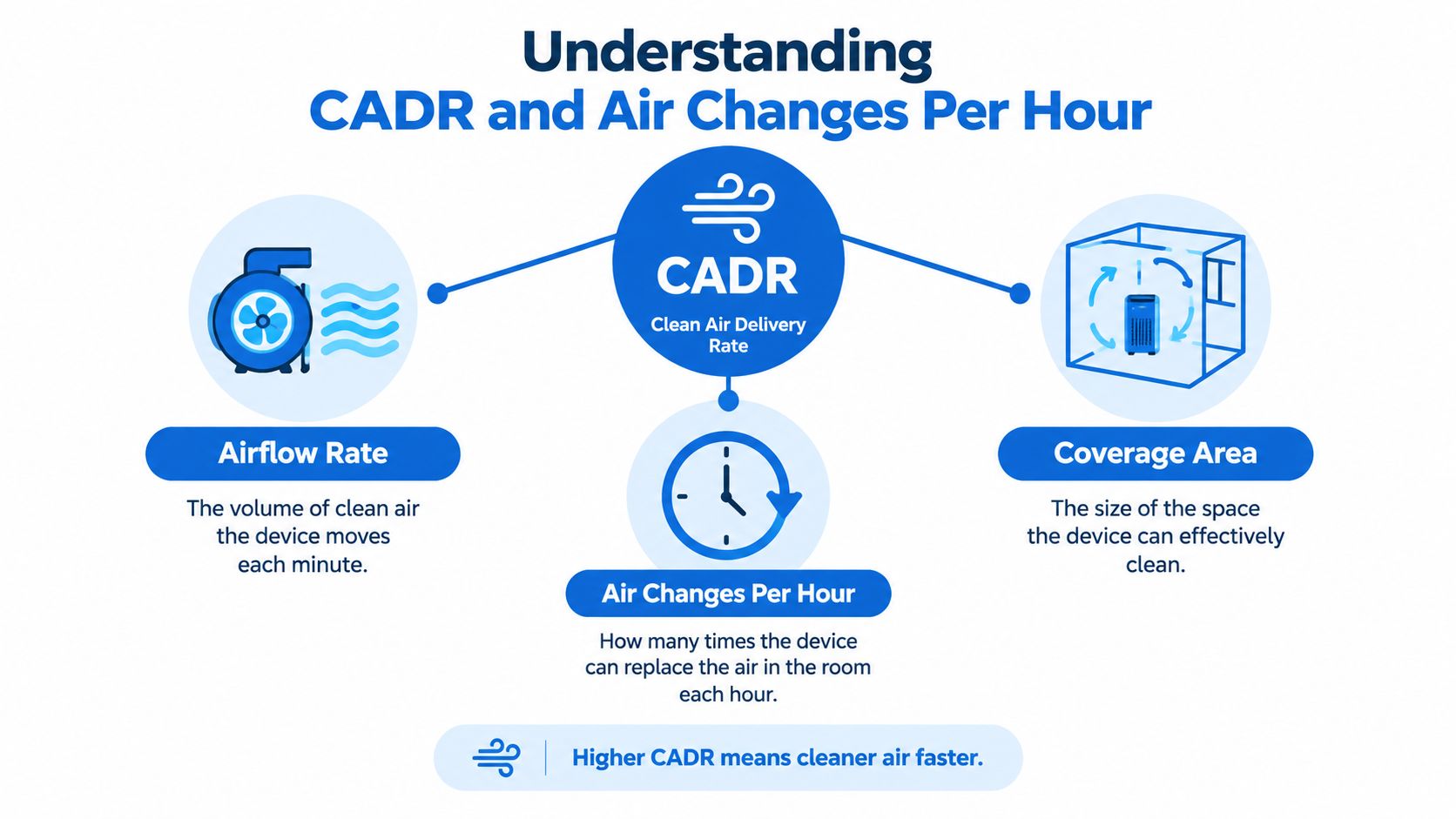
What smoke CADR tells you
Smoke CADR is useful when fine particles are a concern, including particles from tobacco smoke, wildfire smoke, and combustion. It gives you a practical way to compare a cleaner's particle-removal performance with the room it must serve. A marketing statement such as “covers a large room” isn't a substitute for checking the actual CADR.
Air changes per hour (ACH) describes how often the purifier's clean-air delivery corresponds to the room's total air volume. CADR is the amount of clean air delivered; ACH helps you understand what that means for the room over time. A larger or taller room contains more air, so the same CADR produces fewer air changes than it would in a smaller space.
Practical rule: If a purifier's CADR is too low for the room, an efficient filter can't make up for the missing airflow.
For a confident comparison, check the stated smoke CADR, the test conditions, and the room assumptions behind any coverage claim. CADR ratings are measured at the highest fan speed, so the number describes maximum airflow, not necessarily the quieter setting you'll choose for daily use. That distinction matters when you're deciding whether a unit will provide enough cleaning without becoming too loud.
HEPA vs RCI vs Ozone Technology Trade-Offs
Purification technologies don't all do the same job. HEPA filtration physically captures particles in air passing through the filter. RCI, or photocatalytic technology, is designed to address odors and some gases through a different process. Ozone-generating devices raise a separate safety concern: ozone is itself an indoor pollutant, so intentional ozone production isn't a substitute for particle filtration in occupied spaces.
A certified HEPA filter is commonly specified to remove 99.97% of 0.3-micrometer particles, but that figure describes filter performance under specified conditions, not guaranteed whole-room results. CADR, filter loading, leakage, and placement also influence what happens in a real room. The EPA advises avoiding portable cleaners that intentionally produce ozone; its guidance on air cleaners and COVID-19 explains that ozone doesn't replace mechanical particle removal.
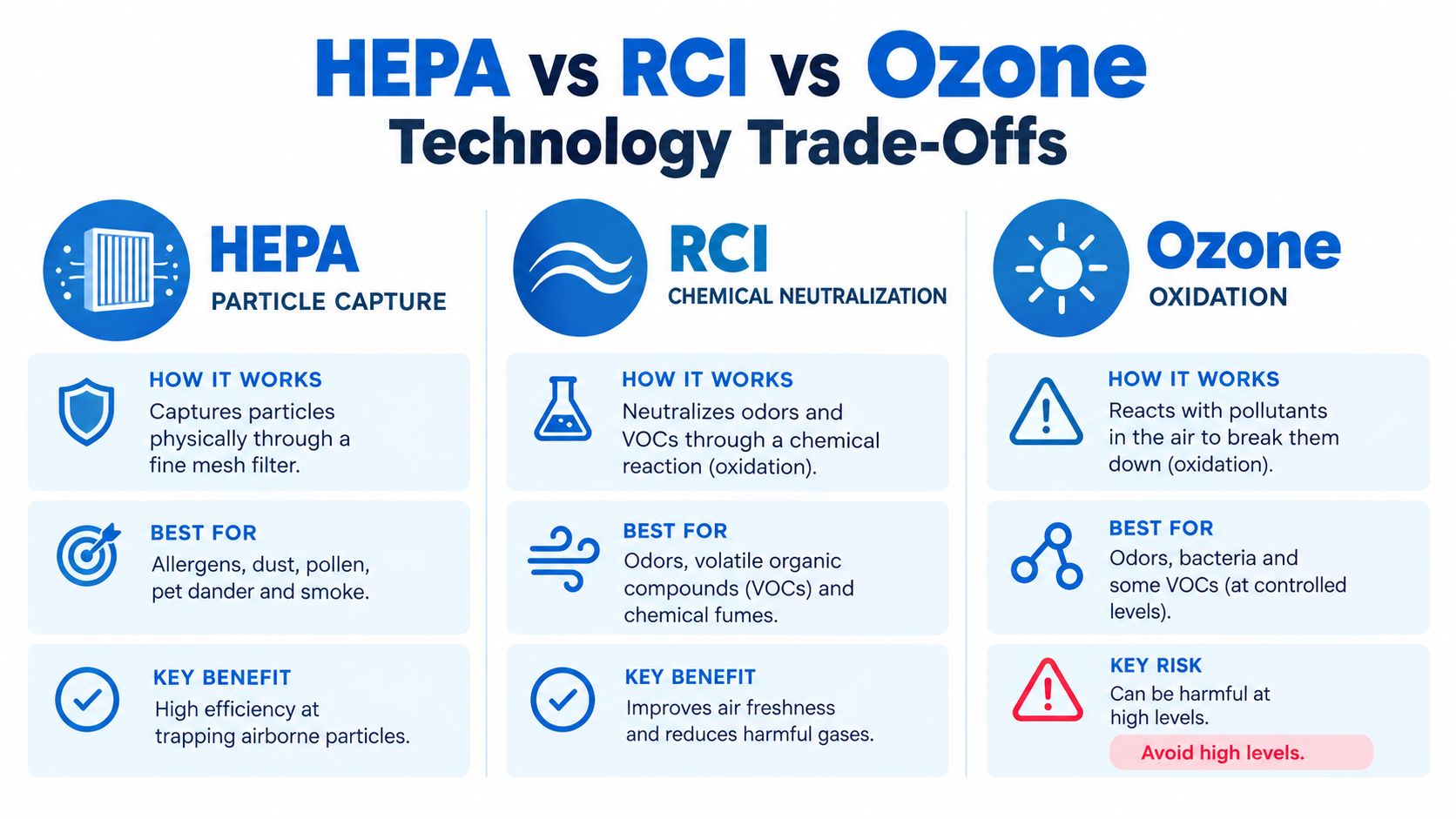
Match the technology to the concern
If smoke, dust, or allergens are the main concern, prioritize an appropriate smoke CADR and particle filtration. If odors matter, consider what a product's odor-control technology is designed to do, and don't assume it removes particles at the rate you need. When both particle and odor concerns matter, evaluate each function separately rather than treating one technology as a replacement for the other.
| Technology | What it does | What to check |
|---|---|---|
| HEPA filtration | Physically captures particles that pass through the filter | Smoke CADR, filter condition, and airflow |
| RCI or photocatalytic technology | Uses a different approach intended to address odors and some gases | Product-specific performance and whether particle filtration is also provided |
| Ozone generation | Produces ozone, which can be an indoor pollutant | Avoid intentional ozone generation in occupied spaces |
EcoQuest's HEPA air purifier selection is one place to compare filter-based options. The Living Air Classic XL-15 Air Purifier is described as a filterless model using ionization and activated oxygen technology to help reduce airborne particles, odors, and stale indoor air. That description doesn't establish a smoke CADR or show that the unit is suitable for every occupied-space use, so check the product details and safety guidance against your needs.
An odor-focused feature shouldn't distract from the central sizing question: whether the unit provides enough documented clean-air delivery for the room.
How to Size a Purifier for Your Specific Room
Start with measurements, not a shopping filter labeled “large room.” Floor area gives you an initial sizing benchmark. Ceiling height and layout tell you whether that benchmark covers the volume of air you need cleaned.
The EPA's home air-cleaner sizing guidance works out to approximately 65 CFM per 100 square feet of floor area, which translates to 325 CFM for a 500-square-foot room and 390 CFM for a 600-square-foot room. Washington State health guidance lands in the same range, recommending a smoke CADR of at least two-thirds of the room's floor area, and it advises adding capacity for ceilings above 8 feet and for open-plan spaces. Both rules point to the same lesson: the square footage printed on a purifier's box assumes conditions your room may not meet.
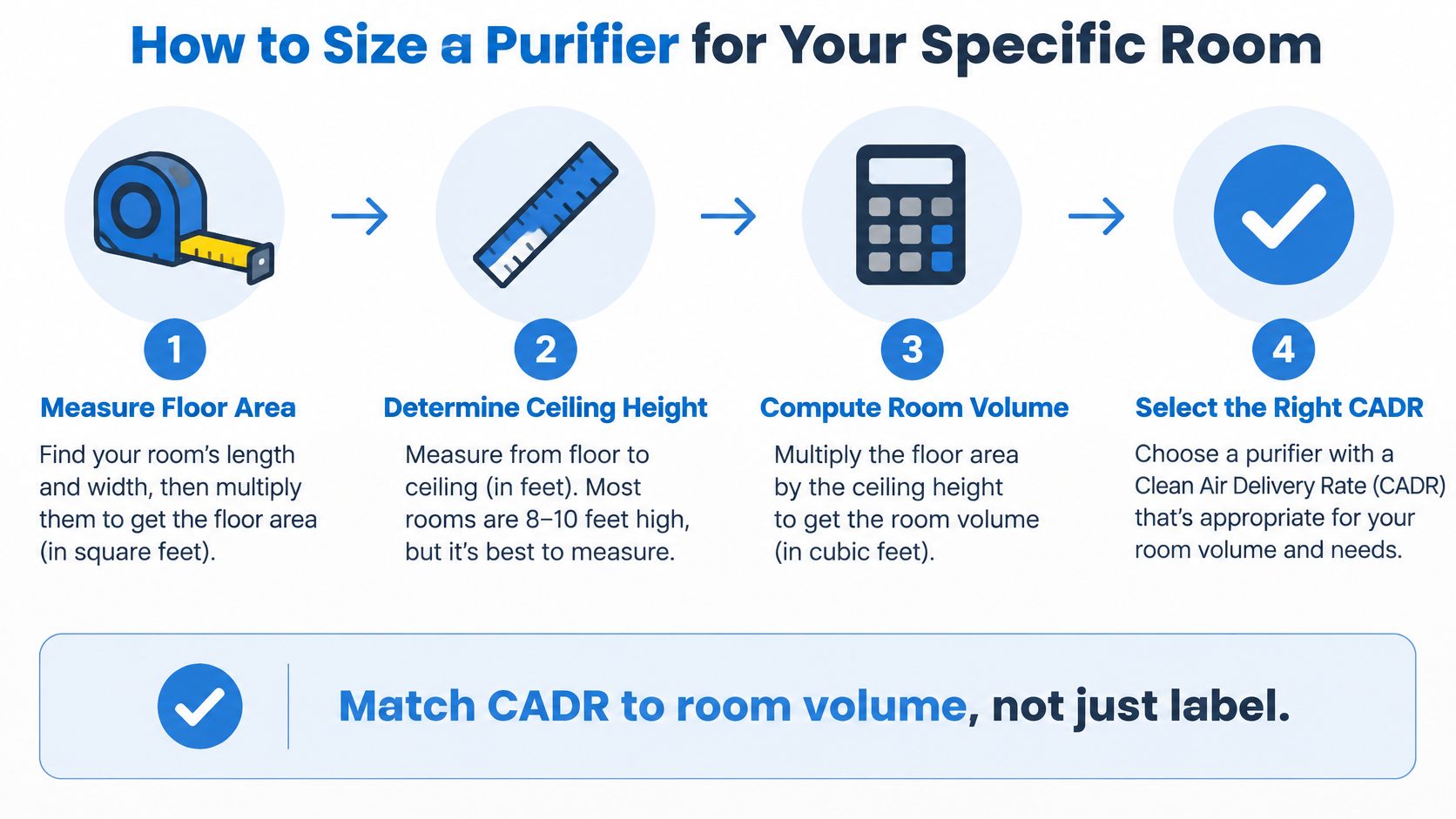
A practical sizing sequence
Measure the floor area. Multiply the room's length by its width. If your room isn't a simple rectangle, divide it into sections, estimate each section's area, then add them together.
Check the ceiling height. The sizing rules above assume ceilings up to 8 feet. Every extra foot adds air volume the purifier has to cycle through, so plan for more capacity rather than treating the same floor area as equivalent.
Account for connected spaces. Air that moves freely through an open doorway or across a combined living and dining area expands the volume the unit must serve. A purifier selected for one enclosed room may not clean a larger shared volume at the same rate.
Compare the smoke CADR. Treat the area benchmark as a floor, then aim higher when ceilings are tall or the layout is open. For help thinking through dust control in a larger setting, see the Purified Air Duct Cleaning dust purifier guide.
A concrete example shows why the ceiling step matters. A 600-square-foot room with a 10-foot ceiling holds 25% more air volume than the same floor area with an 8-foot ceiling. A unit chosen only against the standard assumption will cycle that air fewer times per hour than its label suggests. When a room is unusually tall or connected to other spaces, match the purifier's documented CADR to the air volume you have.
Placement Strategies for Open and High-Ceiling Rooms
Where you put a purifier affects how well it serves the space. In an open-plan room, a powerful unit tucked into a corner may have trouble drawing air from distant areas. Two units positioned apart can distribute clean-air delivery more evenly, especially when the space has distinct zones or circulation is limited.
Think about where particles enter and where people spend time. If cooking odors and particles are a concern, a unit placed near the kitchen side of a shared living area may help capture air from that zone. If outdoor dust comes in through an entryway, placing a unit where it can draw in room air without being blocked by furniture may make more sense.
Let the room breathe around the unit
Avoid wedging a purifier behind a sofa, inside a tight alcove, or beside objects that obstruct its air intake or outlet. A unit needs room to circulate air. In a high-ceiling room, place it where people gather and where airflow can mix through the occupied part of the space, rather than assuming that one corner position will clean every area uniformly.
Door position matters too. Keeping doors open can connect the purifier to more space, but it also increases the volume it must serve. Closing doors can make it easier to focus cleaning on one room, such as a bedroom, while an open doorway may let air move between spaces without guaranteeing even coverage.
Balance capacity with noise
CADR ratings are measured at the highest fan speed, which may be louder than the setting you'll want during conversation or sleep. Choosing extra capacity can give you the option to run a unit at a lower setting while still delivering useful airflow. In some layouts, two quieter units placed apart may be more practical than one powerful machine that people turn off because it's disruptive.
A purifier only cleans air while it's running. Favor a placement and operating setting you can maintain.
Commercial-Grade Blaster Units and When to Use Them
Commercial blaster ozone generators aren't interchangeable with ordinary occupied-room particle purifiers. They're intended for specialized odor-treatment situations, and ozone use requires a clear safety distinction: don't operate an ozone-generating device in a room while people or pets are present. The EPA advises avoiding portable cleaners that intentionally produce ozone in occupied spaces because ozone is itself an indoor pollutant.
For a business owner, the decision starts with the job. If the goal is regular particle filtration in an occupied office, waiting room, or shared work area, look for a cleaner with documented smoke CADR and an appropriate particle-filtration approach. An ozone treatment for a vacant space is a different task, with different operating precautions. Don't treat a high-output label as proof that a device is appropriate for continuous use around staff or customers.
Choose the tool for the environment
Before considering a commercial blaster, identify the source of the odor and whether the space can be kept unoccupied during treatment. Follow the manufacturer's instructions and applicable safety guidance. If the area can't be vacated and kept clear of people and pets, don't use an ozone generator there.
EcoQuest lists commercial air purification products for business settings. Compare the intended use, operating requirements, and maintenance needs with the job you need done. For routine cleaning in occupied spaces, multiple appropriately sized particle purifiers may be a more relevant comparison than a device designed for vacant-space odor treatment.
The safest purchase decision is the one that matches both the air-quality problem and how the room is used. A device's commercial positioning doesn't remove the need to verify its technology, room suitability, and operating precautions.
Maintenance and Replacement Parts for EcoQuest Models
Maintenance affects the amount of clean air a purifier can deliver. As dust loads a filter, resistance to airflow can rise, which may reduce the air moving through the unit. A purifier that once seemed properly sized can become less effective if its filtration components aren't cared for.
The right maintenance depends on the model and its technology. A washable pre-filter may need cleaning, while a disposable HEPA filter requires replacement according to the manufacturer's guidance. Models that use components such as RCI cells, UV lamps, or ozone plates have different upkeep needs. Don't assume that all EcoQuest models, including Fresh Air, Breeze 2, Living Air Classic, and EcoRoom, share the same parts or schedule.
Make maintenance part of the purchase
Before choosing a model, check what components it uses, how you'll monitor their condition, and whether replacement parts are available. A filter that's easy to replace but hard to source can complicate ownership. Conversely, a washable component still needs regular attention to avoid obstructing airflow.
Use the product manual for model-specific instructions rather than following a generic schedule. Keep a simple checklist:
- Identify the components: Confirm whether the unit uses a pre-filter, HEPA filter, RCI cell, UV lamp, ozone plate, or another part.
- Check condition regularly: Look for visible dust buildup or signs that the unit's airflow has changed.
- Follow model guidance: Clean or replace parts as directed by the manufacturer.
- Confirm fit: Match replacement parts to the exact model before ordering.
EcoQuest's replacement parts catalog is a resource for checking parts for its product range. Include replacement availability and required maintenance in your comparison, alongside CADR and placement. An extra-large-room purifier needs to keep delivering air over time, not just meet a rating when it's new.
Your Final Checklist for Buying an Extra Large Room Purifier
Walk into this purchase with your own numbers, not the manufacturer's. Measure the room, note the ceiling height, and decide whether open doorways hand the purifier a bigger job than the floor plan suggests. A unit labeled for a large room may handle your living area comfortably yet lose ground once it has to pull air from an adjoining kitchen or hallway.
From there, work through four checks:
- Compare smoke CADR to your actual room size, not the square footage printed on the box.
- Match the technology to your main concern, whether that is particles, odors, or microbes.
- Judge whether one unit can move air across your layout, or whether two units would cover separate zones more evenly.
- Add capacity for tall ceilings and open floor plans, since both raise the actual volume of air the purifier must clean.
Use the figures below as a starting point for rooms with ceilings up to 8 feet. The 500- and 600-square-foot values follow the EPA sizing table; the larger-area figures apply the AHAM rule of at least two-thirds of floor area as smoke CADR. For taller ceilings or open layouts, plan for additional capacity rather than treating these as guarantees.
| Room size (sq ft) | Minimum smoke CADR (CFM) |
|---|---|
| 500 | 325 |
| 600 | 400 |
| 1,000 | About 667 |
| 1,500 | 1,000 |
The EPA sizing table gives 390 CFM for 600 square feet, while the AHAM two-thirds rule gives 400 CFM for that area. These sizing-table figures come from the EPA home air-cleaner guidance cited earlier. When two benchmarks disagree, take the stricter one and adjust upward for your conditions.
Check filter or component upkeep, replacement availability, and the noise level you can tolerate. The best match is the unit, or combination of units, you can place sensibly and keep running.
EcoQuest Purifiers offers indoor air-quality products, replacement parts, and repair services, including HEPA and other purification technologies for home and professional settings. Visit EcoQuest Purifiers to compare options and check which approach fits your room, layout, and maintenance preferences.