
HEPA Air Purifier Whole House: Guide for Homeowners
A whole-house HEPA system can capture at least 99.97% of 0.3-micrometer particles, but only when the filter, housing, ductwork, and HVAC blower can move air through it safely. The right solution isn't the highest MERV rating you can buy, it's a properly sized filtration system that matches your home's airflow capacity.
You may be considering a HEPA air purifier for the whole house because dust keeps returning, a family member reacts to pollen or pet dander, or wildfire smoke has made outdoor air unsafe to bring indoors. The filter label seems like the easy answer. Yet a dense filter installed in an unsuitable furnace cabinet can restrict airflow, increase fan resistance, and leave you with less cleaned air than before.
A whole-house approach treats the HVAC system as part of the purifier. Air must pass through a sealed filter rack, the blower must deliver enough airflow, and the system must operate often enough to circulate air through occupied rooms. That makes this an engineering decision, not a simple filter-shopping exercise.
Table of Contents
- Why Whole-House Air Quality Matters More Than You Think
- Understanding HEPA Filtration Science and Real-World Performance
- Comparing HEPA Against Alternative Air Purification Technologies
- Sizing Your Whole-House HEPA System for Optimal Air Changes
- Installation Pathways for Whole-House HEPA Filtration
- When Whole-House HEPA Makes the Most Sense for Your Home
- Maintaining Your Whole-House HEPA System for Lasting Performance
- Choosing EcoQuest Purifiers Solutions for Your Home
Why Whole-House Air Quality Matters More Than You Think
A family can clean the floors, wash bedding, and vacuum the sofa, yet still breathe particles that remain suspended or circulate through return ducts. A pet may bring in pollen, cooking can create fine particles, and smoke can enter through small openings even when windows are closed. The rooms may look clean while the air moves contaminants from one space to another.
That matters most in homes with connected living areas. A portable purifier beside the sofa may improve the air immediately around it, but it can't automatically treat a closed bedroom, hallway, or upstairs landing. Central filtration has a wider reach because it works within the home's existing air-distribution network, provided the blower actually circulates air through the filter.
What the HEPA label really tells you
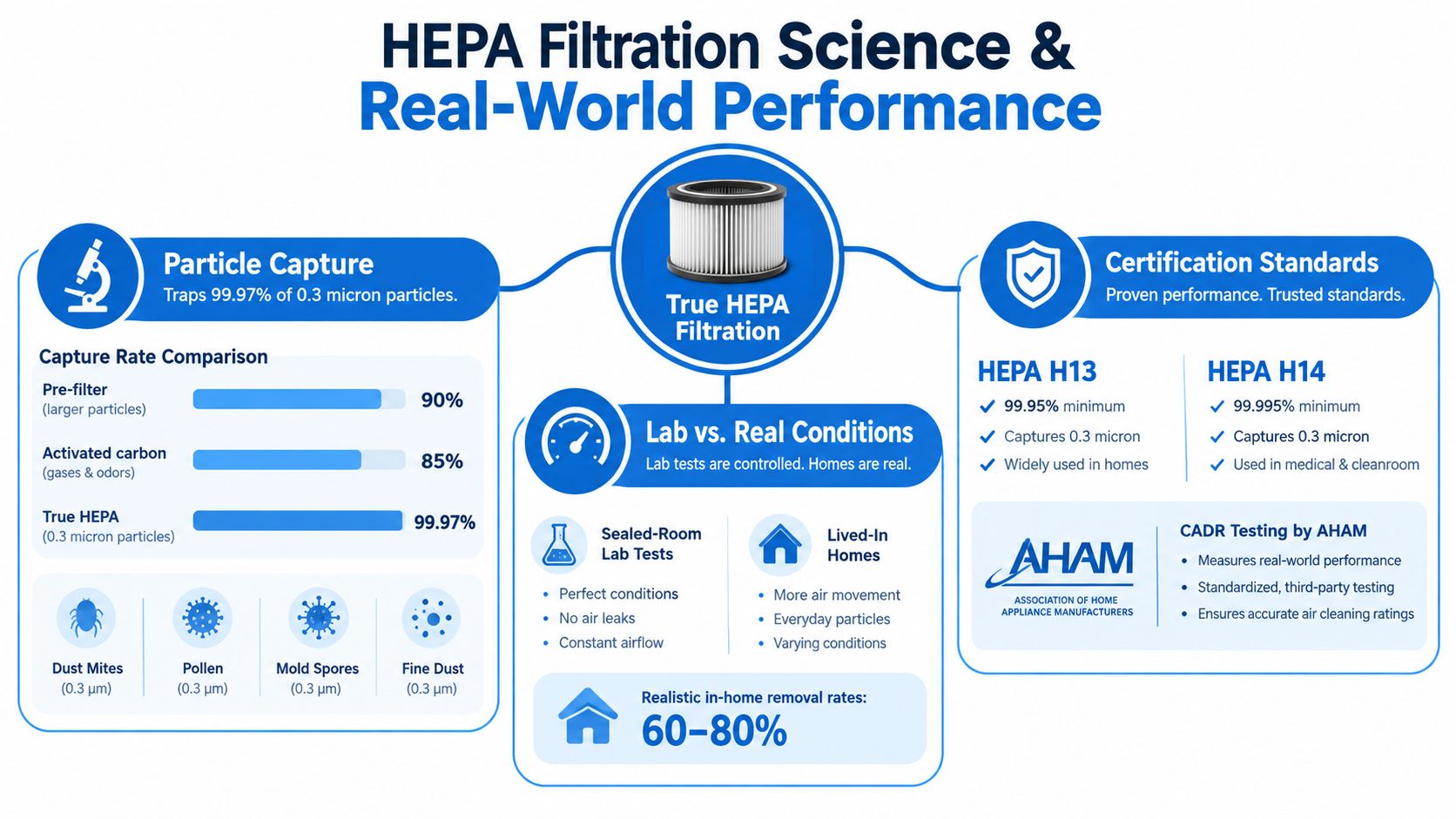
The CDC guidance on HEPA filtration defines a High-Efficiency Particulate Air filter as one that captures at least 99.97% of particles measuring 0.3 micrometers under the relevant test conditions. That test size is important because it is commonly treated as the most penetrating particle size for mechanical filters. Larger particles are generally captured more readily through interception and impaction, while smaller particles can be captured through diffusion.
The label describes media performance, not the performance of your entire home. Air that slips around a loose frame isn't filtered, and a blower that can't overcome resistance won't deliver enough cleaned air. The U.S. Environmental Protection Agency also cautions that filtration can't guarantee good indoor air quality when pollutant sources remain substantial or ventilation is inadequate.
A whole-home system needs supporting controls
Think of filtration as one layer in a larger indoor-air strategy. Source control, outdoor-air ventilation, humidity management, and regular maintenance still matter. If you want to understand how dust and debris can affect the wider air-distribution system, this guide to 2026 AC duct cleaning costs can help you evaluate cleaning as a separate maintenance question rather than confusing it with filtration.
An indoor particle monitor can also show whether pollution rises during cooking, cleaning, or smoke events. A dedicated indoor air quality monitor gives you a way to compare readings before and after changes, though the monitor doesn't replace professional airflow testing or source investigation.
Understanding HEPA Filtration Science and Real-World Performance
HEPA media doesn't work like a simple kitchen sieve with holes that are all the same size. Fibers create a tortuous path through the filter, and particles are captured through several mechanisms. Large particles can strike fibers directly, medium particles can be intercepted as air bends around fibers, and very small particles can be affected by diffusion.
That combination explains why the 0.3-micrometer test point matters without implying that particles smaller or larger than it automatically pass through. The result is a laboratory capture rating for air that travels through the media. Your home's result also depends on how much air reaches the media and whether the filter remains sealed.
Why efficiency can reduce useful performance
ASHRAE describes HEPA as at least 99.97% efficient for 0.3 micrometer particles under standard test conditions, but it also warns that retrofitting conventional residential HVAC equipment can be impractical. Dense media creates a high pressure drop, so a whole-house installation needs a properly sealed, dedicated rack rather than a tightly packed cartridge forced into a standard slot. See the ASHRAE mechanical filtration guidance for the engineering context.
A useful analogy is a doorway. A highly efficient filter may be a very fine screen, but if the doorway is too small, people can't pass through it comfortably. A deeper or wider cabinet gives the same media more surface area, reducing the speed of air through each part of the filter and helping preserve airflow.
Practical rule: A higher efficiency rating isn't automatically a better whole-house choice if the HVAC system can't maintain required airflow through the filter.
Installers should check blower capacity, total external static pressure, filter-face area, duct leakage, and the condition of the furnace or air handler. If the system can't support HEPA resistance, EPA and ASHRAE guidance identify MERV 13 or higher as a more practical central-HVAC target when the equipment can maintain required airflow.
For homeowners considering a non-ducted option, the Living Air Classic XL-15 Air Purifier is described as a filterless unit using ionization and activated oxygen technology to help reduce airborne particles, odors, and stale indoor air. That is a different operating approach from a sealed, HVAC-integrated HEPA module, so it shouldn't be evaluated by the HEPA capture benchmark alone.
Comparing HEPA Against Alternative Air Purification Technologies
HEPA is highly relevant when the problem is airborne particles. It isn't a universal treatment for every pollutant, and comparing technologies starts with identifying what you want to remove.
| Technology | Main role | Important limitation |
|---|---|---|
| HEPA filtration | Captures airborne particles when air passes through the media | Doesn't provide outdoor-air exchange or automatically remove gases |
| Activated carbon | Adsorbs some odors and gaseous compounds | Performance depends on carbon amount and design, not the label alone |
| UV systems | Can support microbial-control strategies in suitable HVAC installations | Doesn't replace particle filtration or source control |
| Ionization | Charges particles so they may attach to surfaces or be collected | Requires careful evaluation of the specific device and operating conditions |
| Ozone-generating equipment | Used in some specialized odor-treatment contexts | Ozone raises safety concerns in occupied spaces |
A HEPA filter is like a net for particles. Activated carbon is more like a chemical sponge for some gases and odors. Those functions can complement each other, but carbon doesn't turn a filter into a HEPA unit, and HEPA doesn't automatically solve cooking odors or volatile organic compounds.
UV belongs to a different category. It may support microbial treatment when the lamp, exposure time, airflow, and installation are appropriate, but ultraviolet light doesn't capture dust, pollen, or pet dander. Ionization also works differently from mechanical filtration, so a product using ionization shouldn't be compared with a HEPA filter using one number.
Placement and delivered clean air matter
A CDC-published experiment found that adding two HEPA air cleaners meeting EPA-recommended CADR criteria reduced simulated aerosol exposure by as much as 65% without universal masking, with the strongest performance when the units were close to the aerosol source. Those findings come from a specific indoor experiment, not a guarantee for every home or HVAC layout. The CDC experiment report shows why airflow patterns and placement matter as much as the label.
For a central system, ask whether the blower runs during the periods when pollution is generated. A house can have a good filter but limited filtration if the HVAC fan rarely operates. California guidance recommends at least 5 equivalent clean-air changes per hour, or 30 cubic feet per minute per occupant, whichever is greater, in occupied indoor environments. Treat those values as planning references, then have a professional determine what your home's equipment can deliver.
Sizing Your Whole-House HEPA System for Optimal Air Changes
Sizing starts with air volume, not the filter's marketing description. A system must deliver enough cleaned air for the rooms you occupy, and it must do so at the resistance created by the installed filter, cabinet, coils, and ducts.
A practical sizing sequence
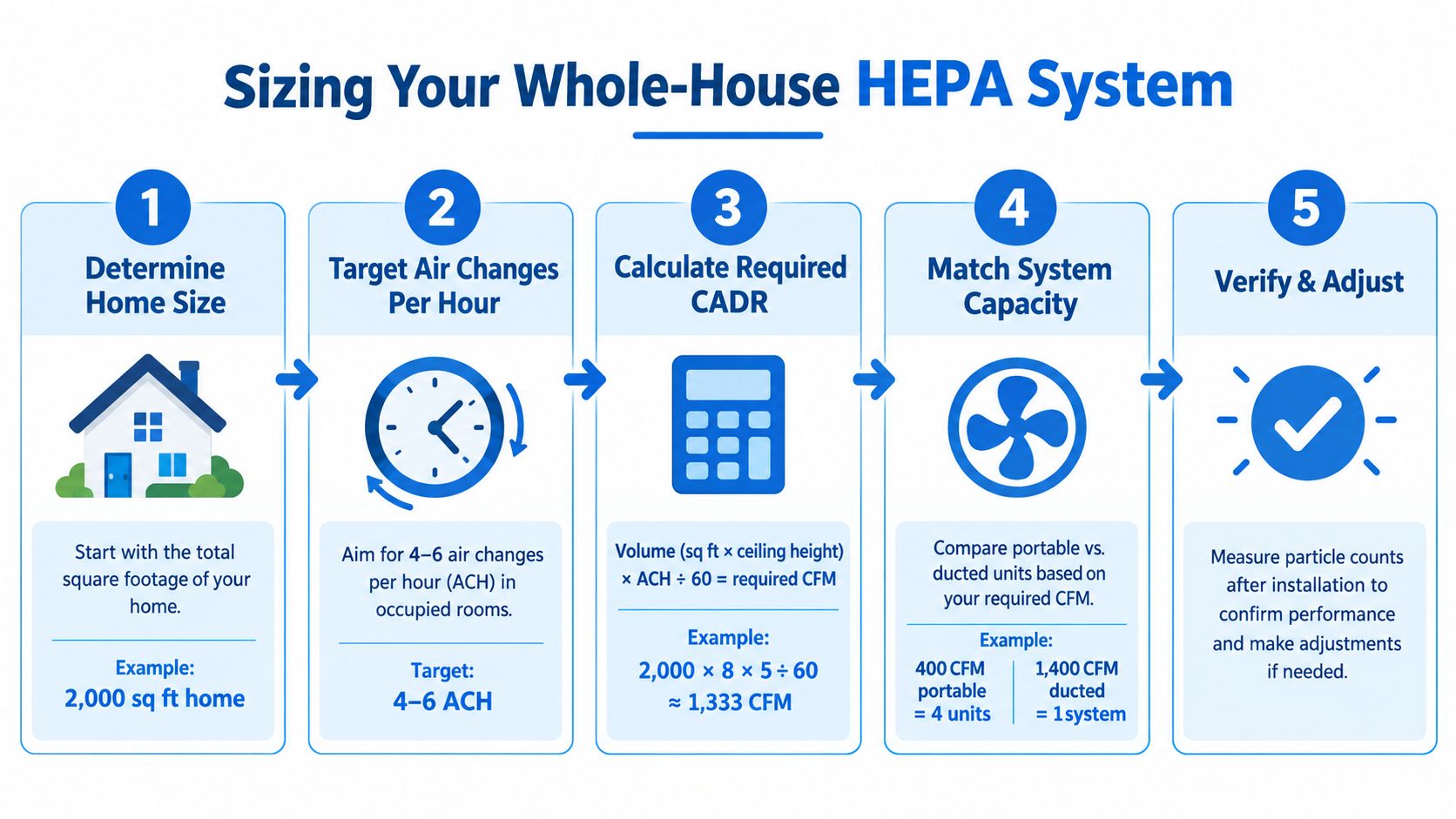
Measure the treated volume. Add the floor areas served by the HVAC system and multiply by the average ceiling height. Don't count a room that stays isolated if supply and return air don't reach it.
Choose a clean-air target. Public-health guidance commonly uses air changes per hour to express how quickly room air is replaced with equivalent cleaned air. Occupancy, smoke exposure, room isolation, and the home's ventilation strategy should influence the target.
Convert the target into airflow. The planning formula is:
home volume × target air changes per hour ÷ 60 = required cubic feet per minuteFor example, an illustrative 2,000-square-foot home with 8-foot ceilings and a target of 5 air changes per hour would require approximately 1,333 cubic feet per minute of equivalent clean airflow. This is a planning example, not a promise that an existing HVAC blower can deliver that amount through HEPA media.
Check installed resistance. EPA and ASHRAE guidance emphasizes CADR or delivered clean-air volume, not efficiency alone. Obtain pressure-drop information from an ASHRAE Standard 52.2 test report where available, and compare initial and loaded resistance with the equipment's allowable pressure budget.
Confirm the result after installation. Measure static pressure, confirm supply airflow, inspect bypass seals, and use particle readings as a supplemental check. If the central system can't provide the required clean-air volume, room units can address isolated bedrooms or high-occupancy spaces.
Residential central HVAC systems may have only about 0.5 inches water column, or 125 Pa, of total fan pressure capacity for the filter, coils, and ductwork, according to the ASHRAE Journal guidance on residential air cleaners. That limited budget is why a larger media surface and deeper pleats can be more useful than a small, extremely dense cartridge.
For a bedroom, bathroom, or office that doesn't receive enough central circulation, the EcoRoom Plug-In Air Purifier for Small Rooms is described as a compact wall-plug air cleaner for small spaces. It can fit a targeted-room strategy, while a ducted module serves a different purpose.
Installation Pathways for Whole-House HEPA Filtration
There are two practical ways to pursue whole-home particle control. You can integrate a high-efficiency module into the central HVAC return path, or you can use independent room units where the existing system can't safely support the added resistance.
The integrated HVAC route
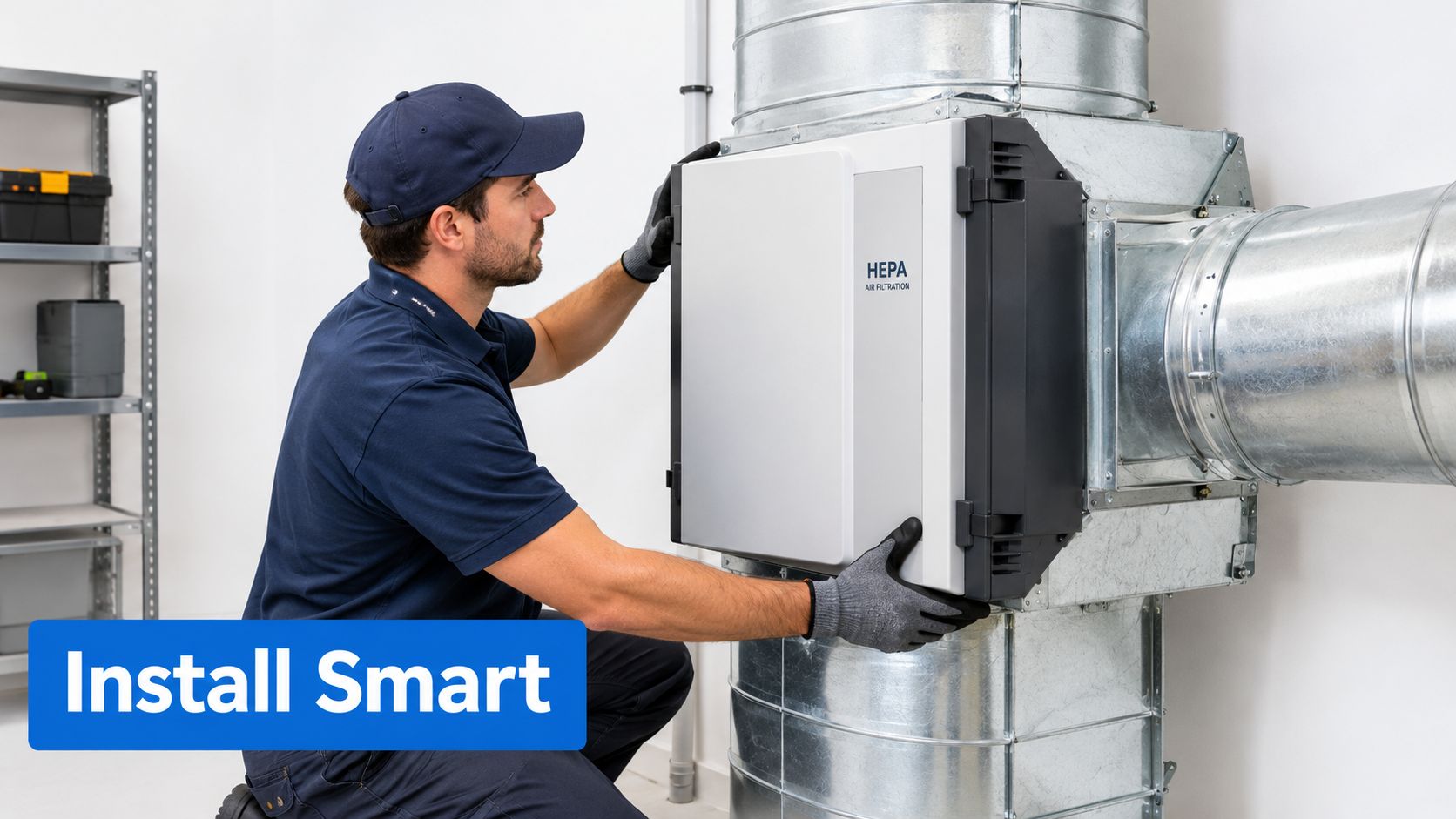
A duct-mounted HEPA module can provide broad filtration across connected rooms when the blower operates and the duct design distributes air effectively. The installer should create a dedicated rack with adequate face area, gasket compression, and a sealed transition. The filter must sit in the airstream, not merely near it.
Before approving the work, request these checks:
- Static pressure: Measure the system before and after the proposed module.
- Blower capacity: Confirm that the motor and controls can maintain the required airflow.
- Filter dimensions: Use a cabinet that provides enough media area instead of forcing a dense filter into a narrow slot.
- Bypass leakage: Inspect the frame, rack, gaskets, and duct transitions for paths around the media.
- Equipment operation: Verify that heating and cooling capacity won't be impaired by restricted airflow.
High-efficiency filters can raise fan energy use or reduce delivered airflow if the furnace, air handler, filter rack, and ductwork weren't designed for them. Guidance from Singapore's building ventilation and indoor-air-quality recommendations emphasizes evaluating filtration alongside airflow and system operation. A MERV 14, F8, or ePM1 70 to 80% option may be more appropriate than HEPA when the equipment's measured resistance limits the design.
The independent-room route
Room units avoid modifying the furnace and let you place clean-air capacity near a bedroom, nursery, office, or smoke entry point. Their weakness is coverage. Doors, walls, floor levels, and low HVAC runtime can leave untreated pockets, so a room-based plan needs deliberate placement and operation.
This HVAC air purifier collection can be considered alongside the ducted installation route, but product selection should follow measured airflow and contaminant goals. A qualified HVAC professional can tell you whether a dedicated high-static-pressure system, a central media cabinet, or separate room units make the most sense.
The video below offers visual context for an installation, but it shouldn't replace a site-specific pressure and airflow assessment.
When Whole-House HEPA Makes the Most Sense for Your Home
Whole-house HEPA is most useful when contaminants move through several connected rooms and the HVAC system runs often enough to distribute cleaned air. A family with persistent pet dander across bedrooms and living areas may benefit from central treatment more than from moving one portable unit from room to room. The same logic applies during wildfire smoke events, when a sealed central return system can repeatedly treat recirculated particles.
It can also make sense when the home has occupants who are particularly sensitive to airborne particles, or when bedrooms and living areas are connected to the same duct network. But the decision should follow the pollution pattern, not a blanket assumption that every home needs the most aggressive filter.
Match the remedy to the pollutant
- Particles: HEPA or another appropriately rated mechanical filter can capture particles that pass through the media. Use source control for dust, smoke entry, and cooking emissions as well.
- Odors and gases: HEPA isn't a gas filter. Activated carbon may help, but its effectiveness depends on the amount and design of the carbon.
- Outdoor-air exchange: Filtration recirculates and cleans indoor air. It doesn't replace ventilation or provide fresh outdoor air.
- Continuous sources: Cooking, candles, cleaning products, pets, and occupants can generate pollutants while the HVAC blower is off. A continuously operating room unit or local exhaust may be necessary.
EPA guidance on air cleaners, HVAC filters, and indoor air quality warns that air cleaners alone can't ensure adequate indoor air quality when pollutant sources remain or ventilation is insufficient. It also advises against devices that intentionally generate ozone in occupied spaces.
Use indoor PM2.5 readings, HVAC runtime, room isolation, and outdoor air conditions to make the choice. If readings rise sharply during cooking, a range hood and source control may matter more than upgrading the central filter. If smoke enters across the entire home, central filtration plus sealed windows and doors may provide broader support than one unit in a single room.
Maintaining Your Whole-House HEPA System for Lasting Performance
A HEPA installation doesn't remain at its rated performance by itself. Dust loads the media, pressure drop rises, seals age, and coils or blower compartments can collect debris. Maintenance protects both filtration and the HVAC equipment that moves air through the home.
Use measurements instead of a calendar alone
The correct replacement interval depends on dust, pets, construction, smoke, occupancy, and system runtime. Monitor differential pressure across the filter and follow the manufacturer's limit. A visual inspection helps, but a filter can become restrictive before it looks dramatically dirty.
Check the filter rack and gaskets whenever the filter is serviced. Look for crushed edges, gaps, loose fasteners, and signs of air movement around the frame. The HEPA rating applies only to air moving through the media, so bypass leakage can undermine the installation even when the filter itself is intact.
A maintenance checklist
- Filter condition: Record differential pressure and replace the media at the manufacturer's limit.
- Cabinet sealing: Inspect gasket compression and the filter's seating surface.
- Airflow: Watch for weak supply airflow, unusual noise, or comfort changes.
- Blower and coil: Have the motor, coil, drain pan, and heat exchanger inspected as appropriate for the equipment.
- Ductwork: Investigate visible leakage, loose transitions, and contamination concerns separately from filter replacement.
- Indoor readings: Compare PM2.5 trends during cooking, smoke events, and normal HVAC operation.
The filters, screens, and HEPA replacement collection can help you identify replacement components, but the correct part still needs to match the installed unit. Don't substitute a denser filter just because it fits physically. Confirm the manufacturer's approved resistance and the HVAC system's measured operating range.
Choosing EcoQuest Purifiers Solutions for Your Home
Choose the technology after defining the contaminant and the space. If airborne particles are the primary concern and the HVAC system can support the resistance, a sealed mechanical filter deserves the closest attention. If odors or gases dominate, investigate carbon capacity and source control. If microbial treatment is part of the goal, evaluate UV or other technologies according to their installation conditions rather than treating them as direct HEPA equivalents.
A simple decision path helps:
- Do you need connected-room coverage? Start with the central HVAC design and determine whether the blower, filter cabinet, and ductwork can support the required clean-air volume.
- Does the system fail the pressure test? Use a less restrictive central filter approved by the equipment manufacturer, or add independent room units.
- Are only certain rooms affected? Target bedrooms, offices, bathrooms, or other occupied spaces with appropriately sized standalone equipment.
- Are odors the main problem? Pair particle control with source removal and a suitable gas-treatment approach. Don't expect HEPA alone to remove odors.
- Is ozone being considered? Treat occupied-space safety as a decisive requirement and avoid devices that intentionally generate ozone where people are present.
EcoQuest Purifiers offers products spanning whole-house and single-room air cleaning, replacement parts, repair services, and technologies including HEPA, charcoal, UV, RCI photocatalysis, bi-polar ionization, and active oxygen or ozone. Its catalog includes both HVAC-related and portable options, so the useful comparison is between the product's operating method, your contaminant profile, and the measured capacity of your home.
The Fresh Air Double Plus is listed as a system combining ozone generation, germicidal UV light, charcoal, HEPA, and ionization. Because ozone-generating equipment raises safety questions in occupied spaces, review the operating instructions and intended use carefully rather than treating every listed technology as interchangeable with mechanical whole-house filtration.
Ask an HVAC professional for a static-pressure test, filter-resistance data, airflow measurement, and a bypass inspection before purchasing a duct-mounted HEPA system. Then compare that result with the clean-air capacity you need, using room units where central filtration can't safely deliver enough circulation.
EcoQuest Purifiers provides whole-house and room-level air-quality products, replacement parts, and repair support across several purification technologies. Visit EcoQuest Purifiers to compare options by pollutant type and installation pathway, then confirm HVAC compatibility and operating requirements before you buy.