
HEPA Filter for Car Selection and Installation Guide
You're halfway through a traffic jam when the car ahead releases a cloud of exhaust, the road surface turns dusty, and the vents start blowing a stale smell into the cabin. Closing the windows helps, but it also leaves you depending on the vehicle's HVAC system and its cabin filter. For drivers who spend long commutes in traffic, construction areas, or high-pollen conditions, a HEPA filter for car use can be a meaningful upgrade, provided it fits the HVAC system without restricting it too severely.
Table of Contents
- Introduction to HEPA Filtration in Your Vehicle
- Choosing Between Cabin HEPA Filters and Portable Purifiers
- Understanding Compatibility Filter Sizes and Standards
- How to Replace and Install Your Car HEPA Solution
- Maintenance Intervals and Tips for Cleaner In Car Air
- Final Checklist for Choosing and Enjoying Better Air
Introduction to HEPA Filtration in Your Vehicle
A conventional cabin filter mainly catches larger dust, pollen, and debris before they reach the blower and vents. A HEPA-grade element uses denser media to capture much finer airborne particles. The commonly cited benchmark is removal of 99.97% of particles larger than 0.3 microns, as described in this engineering reference on HEPA filtration standards.
That specification applies to the filter under defined test conditions. It does not guarantee the same result after installation in a vehicle. Automotive HVAC housings have limited space, seals may leak around the frame, and dense media increases pressure drop. If the blower cannot move enough air, cabin clearance, defrost performance, and fresh-air exchange can suffer. HEPA-level capture only works well when the filter, housing, and blower operate as one system.
Controlled vehicle-cabin testing explains the interest in higher-efficiency filtration. One study reported that high-efficiency cabin filters reduced in-cabin ultrafine particle concentration by 93% on average, compared with 41% to 65% for in-use OEM filters, according to the CDC-hosted vehicle cabin filtration study. Treat those results as a reference point, not a promise for every vehicle. Check the frame seal, blower output, defrost airflow, and ventilation settings after installation.
There are two workable paths: a compatible HEPA-grade replacement for the factory cabin filter, or a separate purifier in the cabin. A car air purifier option may suit vehicles whose filter housing cannot accept dense media. The right choice preserves particle capture without choking airflow or leaving the cabin dependent on recirculation alone.
Choosing Between Cabin HEPA Filters and Portable Purifiers
The strongest option depends on how your vehicle moves air. A cabin HEPA filter sits in the factory HVAC path, so it can treat incoming air before it reaches the vents. A portable purifier works independently and can continue filtering cabin air while the vehicle operates on recirculation. A standard cabin filter remains the simplest choice when the main priority is basic debris protection and unrestricted blower performance.
A factory replacement usually looks cleaner and more integrated. It doesn't occupy a cup holder, require a separate mounting solution, or add another cable to the dashboard. The catch is fitment. A filter can match the advertised vehicle application and still perform poorly if its frame is too thin, its seal doesn't meet the housing, or its media creates excessive resistance.
A portable unit is easier to move between vehicles and doesn't require opening the glovebox or cowl. It needs a stable location, a suitable power connection, and enough clearance around its intake and outlet. Portable systems also treat the air already inside the cabin rather than replacing the vehicle's factory filtration path.
| Option | Best For | Installation Effort | Tradeoff to Watch |
|---|---|---|---|
| Cabin HEPA filter | Drivers with a verified compatible HVAC housing | Moderate, depending on vehicle access | Dense media can reduce airflow or affect defrost performance |
| Portable HEPA purifier | Older cars, incompatible filter housings, or shared vehicles | Low, but placement and power routing matter | It occupies cabin space and may add noise |
| Standard cabin filter | Basic HVAC protection and maximum airflow | Low to moderate | It may capture fewer fine particles than a HEPA-grade solution |
Match the solution to the driver
A daily commuter in heavy traffic will usually benefit most from filtration that addresses fine particles at the HVAC intake, but only if the housing seals properly. An allergy-sensitive driver may prefer the same integrated approach, with a portable unit as a fallback when replacement fitment is uncertain.
Rideshare drivers have a different concern. Frequent door opening introduces new air repeatedly, so purifier placement and continuous operation matter more than installing a dense filter and forgetting about it. Families should also consider whether the solution leaves adequate legroom, protects the cable from feet, and avoids loose equipment during hard braking.
For general cabin maintenance guidance, this resource on how to improve cabin air quality offers useful background on the cabin filter's role. If you choose an independent purifier, the smart car air purifier category is a relevant place to compare vehicle-oriented options. The Living Air Classic XL-15 Air Purifier is a filterless unit intended for homes, offices, and other indoor environments, using ionization and activated oxygen technology to help reduce airborne particles, odors, and stale indoor air. It isn't a substitute for verifying automotive fitment, but it illustrates why portable and room-focused purification systems should be evaluated separately from cabin-filter replacements.
Understanding Compatibility Filter Sizes and Standards
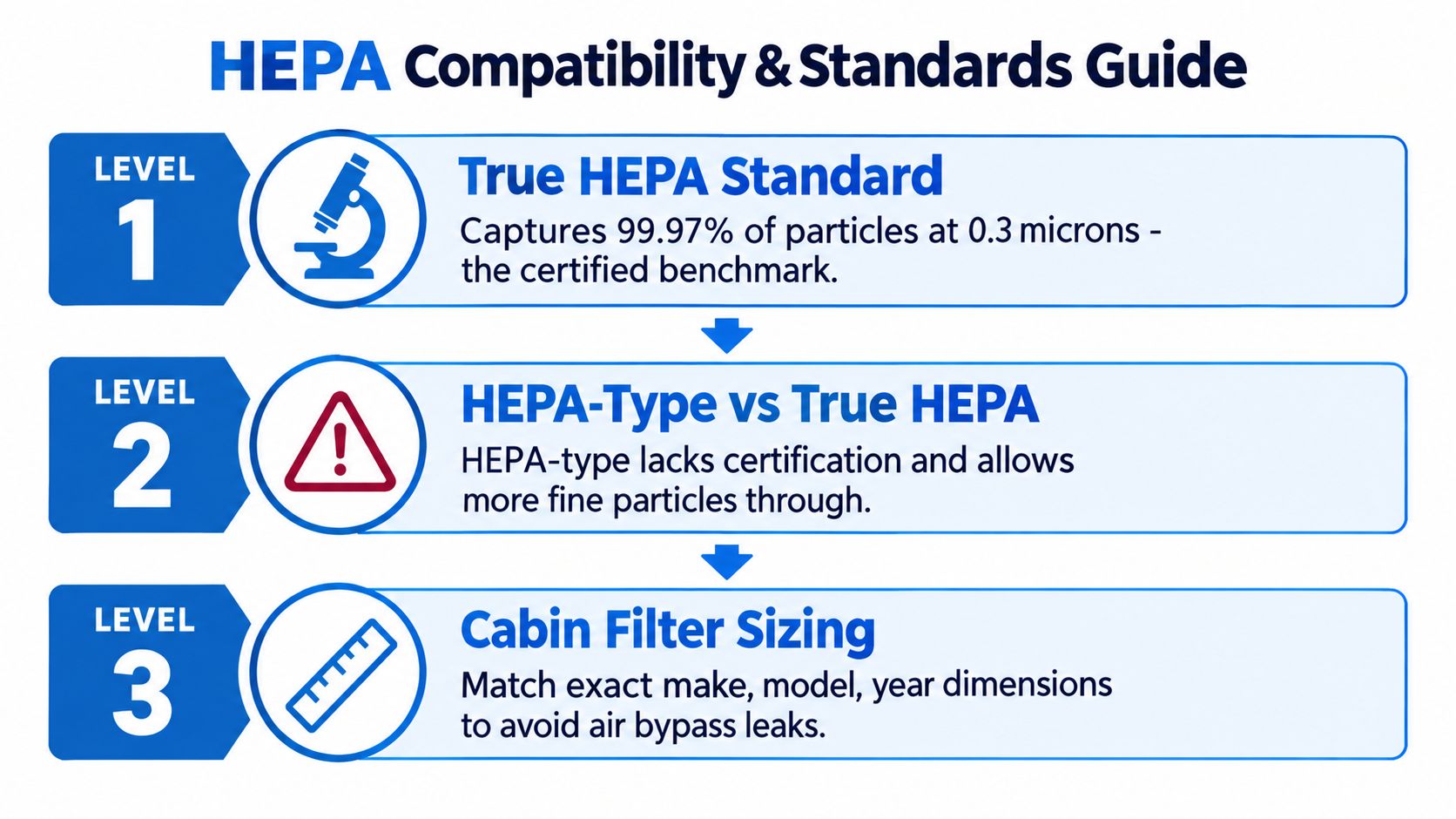
A filter can meet a HEPA performance claim and still be wrong for your vehicle. Confirm the exact make, model, year, engine configuration, and HVAC layout through the owner's manual or a reliable part-number lookup. Compare that number with the installed filter and housing before buying.
Fitment controls real-world performance. Measure length, width, and thickness if the application is uncertain, then inspect the frame, gasket, folded-media depth, airflow arrow, and locating tabs. A filter that slides into place but leaves an edge gap lets air bypass the media. That defeats much of the benefit of finer filtration and can make the blower work harder without improving cabin air.
True HEPA is not the same as HEPA-type
True HEPA identifies a defined performance benchmark. The standard describes removal of 99.97% of particles larger than 0.3 microns. Labels such as “HEPA-type” and “HEPA-style” may indicate denser media, but the wording alone does not confirm that benchmark. Compare the manufacturer's documentation rather than relying on the label.
Vehicle use requires more than a media rating. Look for application-specific airflow or pressure-drop information. A filter that captures more particles but restricts the blower can weaken ventilation, slow defrosting, and make recirculation less comfortable. In a sealed cabin, reduced fresh-air delivery can also work against CO2 control, so filtration must be matched to the HVAC system rather than chosen by efficiency wording alone.
Pressure drop determines whether the upgrade works
Pressure drop is the resistance the HVAC fan faces as air crosses the filter. Excess resistance can reduce vent output, slow windshield clearing, increase blower noise, and expose weaknesses in older fan systems. Vehicle filtration research has reported airflow reductions with higher-efficiency filters, while added protection layers also increase resistance, as described in this REHVA vehicle filtration analysis.
A precise seal and correct depth usually matter more than a large marketing claim. A staged design, with a pre-filter catching larger debris before the finer layer, can slow loading and preserve airflow. Universal filters are risky when the housing has a shaped gasket, support ribs, or limited depth. If the element fits loosely or sits too thick, it can compromise both bypass control and defrost performance.
For replacement media and related components, review the HEPA filters and screens collection, then verify that the selected item matches the specific vehicle or purifier system.
How to Replace and Install Your Car HEPA Solution
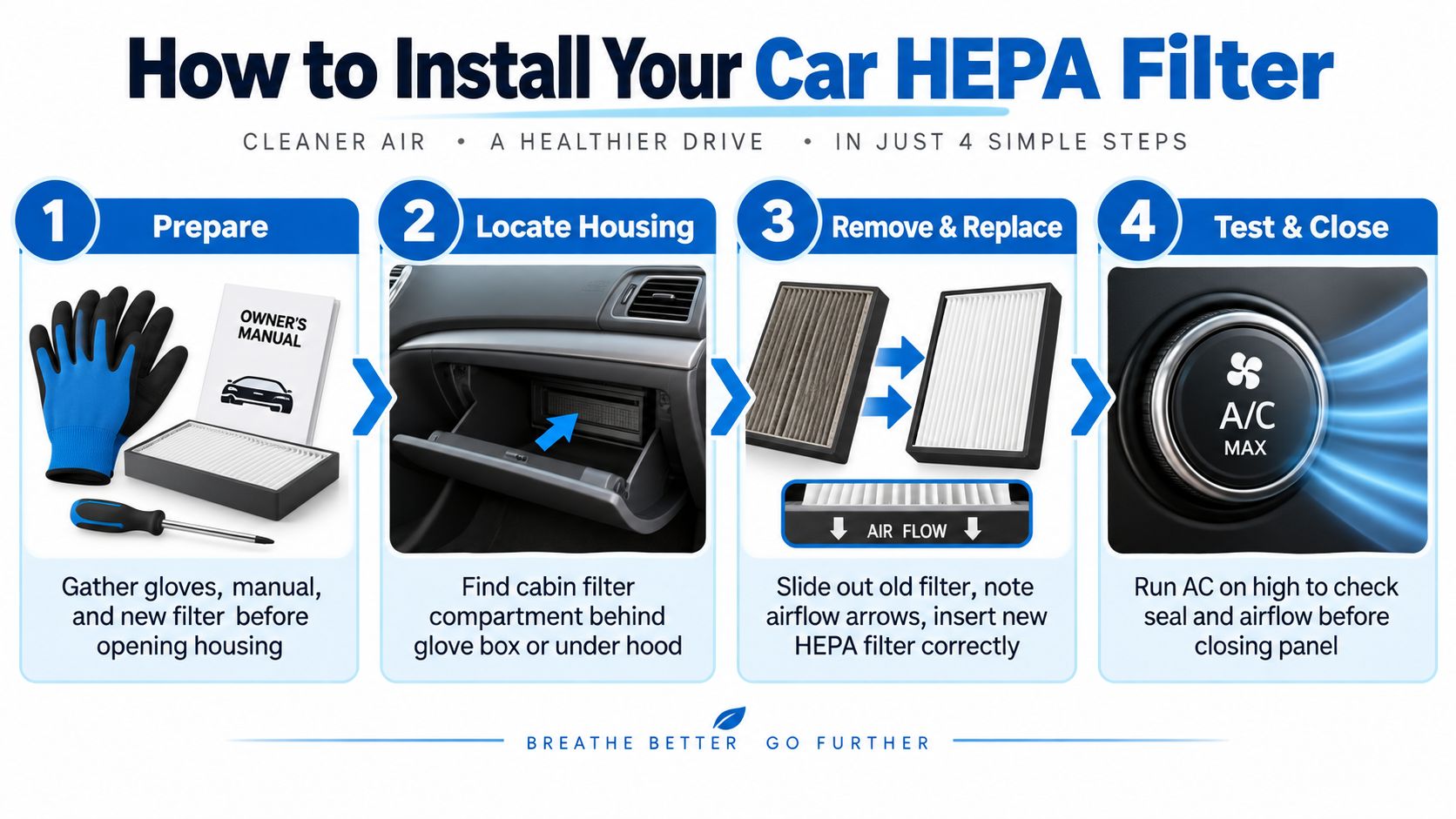
A filter can capture finer particles and still make the cabin harder to ventilate. Before installation, check the vehicle manual, the filter part number, the housing depth, and the airflow direction. Gather the new filter, disposable gloves, and a small vacuum. Cabin filters commonly sit behind the glovebox, under the windshield cowl, or inside a less accessible HVAC compartment. Park level, switch off the ignition, and use enough light to inspect the arrows, gasket, and housing edges.
Open the housing without damaging the seal
Empty the glovebox before releasing its stops or damper. For cowl-mounted filters, remove only the panels listed in the manual. Older plastic clips can become brittle, and forcing a panel can damage the cover or leave the housing unable to seal.
Pull the old filter out slowly and keep it level if it contains loose leaves or dust. Inspect the slot for folded media, broken plastic, rodent debris, and moisture. Vacuum the housing rather than blowing contamination deeper into the HVAC case. Wipe accessible sealing surfaces with a dry or lightly damp cloth, then let them dry fully.
Practical rule: A perfect filter cannot compensate for a damaged housing seal. Check the perimeter before closing the panel.
Photograph the old filter or note its airflow arrow before removal. Install the replacement in the same direction unless the manual specifies otherwise. Pleats should sit evenly, the frame should remain straight, and the cover should close without force. Significant compression usually indicates the wrong part, excessive thickness, or a distorted housing.
Position a portable purifier for circulation
A portable purifier needs clear intake and outlet paths. Do not bury it behind a seat, wedge it against the console, or aim its discharge directly at a passenger. Secure it with a suitable strap or non-slip mount. Keep USB or 12V cables away from pedals, shifter movement, airbags, and door hinges.
After installation, run the HVAC fan through several speeds. Listen for a whistle at the filter door and unusual blower noise. Check vent output, especially at the defrost outlets, and watch for warning lights. Test windshield clearing, outside-air mode, recirculation, and the highest fan setting during a short drive. If defrost becomes slower or airflow drops sharply, verify the filter dimensions and seal before accepting the trade-off.
The demonstration below shows the general access and replacement sequence. Vehicle layouts and retaining clips vary, so follow the manual for the specific model.
Independent testing found that HEPA-level upgrades can raise UFP removal from 41% to 65% with in-use OEM filters to about 93% on average. The result still depends on airflow resistance, filter fit, and how the HVAC system operates in real driving. Check those conditions together. Higher capture is useful only if the fan can maintain practical airflow for ventilation and defrosting.
Maintenance Intervals and Tips for Cleaner In Car Air
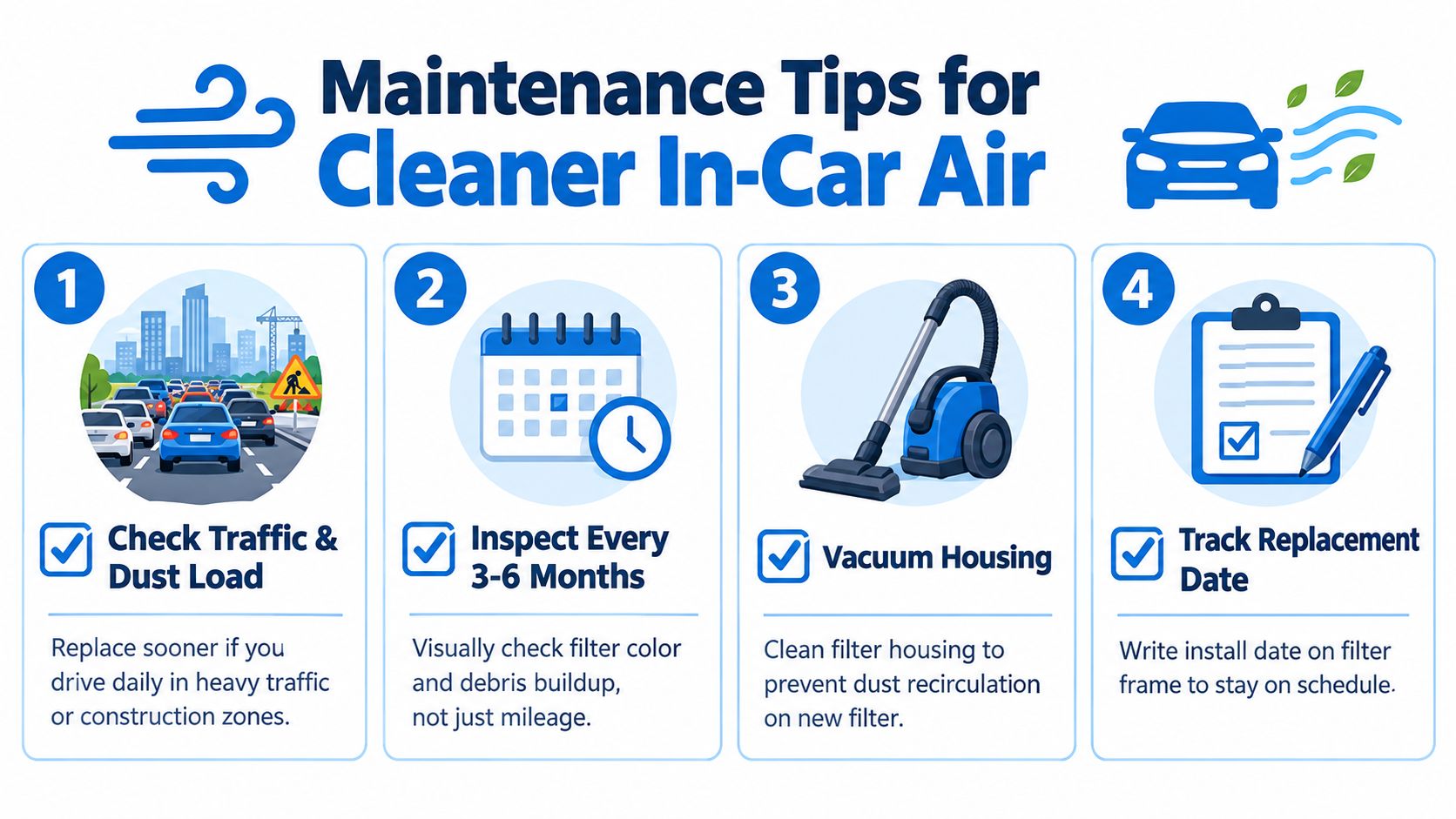
Filter life depends more on dust load, traffic exposure, construction, pollen, and parking conditions than on a mileage estimate alone. A vehicle used every day beside congested roads can load its filter faster than one driven occasionally on clean suburban routes.
Set a recurring inspection habit instead of waiting for a smell. Look for darkened media, leaves, grit, dampness, deformation, and a collapsed gasket. Vacuum the empty housing during replacement, but don't aggressively brush or wash a disposable HEPA element. Once the media is loaded, cleaning it rarely restores its original resistance and capture behavior.
Use the cabin environment as a maintenance signal
Inspect the filter periodically during dusty or high-pollen seasons, and mark the installation date on the frame. Move the inspection earlier if you notice any of these changes:
- Weak vent output: Reduced airflow at the same fan setting can indicate loading or a collapsed filter.
- New whistling: A whistle may point to a poor seal, a warped cover, or excessive resistance.
- Persistent odor: Musty air can come from a saturated filter or contamination elsewhere in the HVAC case.
- Slow defrosting: Poor windshield clearing is a safety concern, not merely a comfort issue.
Traffic conditions create measurable differences in resistance. One vehicle study found pressure drop rose to 45 Pa after 10 months in heavy traffic, compared with 20 Pa in moderate traffic and 6 Pa in light traffic, while filtration efficiency fell below 20% around 300 nm, the particle size with the greatest penetration in that test. These findings from the real-world cabin-filter durability study support a condition-based replacement approach.
Keep windows closed when passing through dense traffic or dusty work zones, then use recirculation briefly to reduce the immediate intake load. Don't leave recirculation on indefinitely if the cabin becomes stuffy. Use outside air when appropriate, especially when ventilation and occupant comfort require it, and vacuum carpets and seat fabric so the HVAC system isn't repeatedly disturbed by settled dust.
A filter is one part of cabin air management. Clean surfaces, sensible ventilation, and a functioning HVAC system protect the investment.
Final Checklist for Choosing and Enjoying Better Air
The best car HEPA solution is the one your vehicle can sustain. Before buying, confirm the exact filter dimensions and seal, check whether the manufacturer provides resistance information, and decide whether the factory HVAC path or a portable purifier better suits the cabin.
Use this quick decision check:
- Heavy-traffic commuter: Prioritize verified high-efficiency media and monitor airflow after installation.
- Allergy-sensitive family: Choose a sealed cabin solution when compatible, then keep carpets, vents, and the filter housing clean.
- Rideshare driver: Favor secure equipment, accessible power, and a setup that tolerates frequent door opening.
- Older vehicle owner: Consider a portable unit if the factory housing can't accept the required filter thickness.
HEPA cabin prototypes have reported PM2.5 removal from 87% to 99% and UFP removal from 76% to above 96%. In the same research, CO2 remained at 626 to 816 ppm with HEPA use, compared with 2500 to 4000 ppm in recirculation mode, according to this REHVA assessment of filtration and cabin ventilation. The practical lesson is simple: don't trade particle capture for poor ventilation, failed defrosting, or an overworked blower.
EcoQuest Purifiers offers portable car air-purification options, HEPA-related filters and screens, and other indoor air-quality equipment for drivers who need an alternative to HVAC-integrated filtration. Review the available solutions at EcoQuest Purifiers, then choose a unit or replacement component that matches your vehicle, installation space, and ventilation needs.