
How Often to Replace Car Air Filter and When to Do It
You're driving home after work when the vents seem weaker than usual. There's a faint dusty smell across the dashboard, or the engine feels a little slow when you press the accelerator. Nothing appears serious, so you start wondering: how often should you replace your car air filter?
The short answer is that there isn't one mileage figure that fits every vehicle or driver. Most independent automotive guidance points to a routine baseline, but the right replacement time also depends on elapsed time, mileage, road conditions, climate, and what you can see or feel. A car used on clean highways may follow a different schedule from one driven through construction dust or heavy city traffic.
There's another detail many owners miss. Your car usually has two separate air filters, and they protect different systems. The engine filter and cabin filter shouldn't be inspected, diagnosed, or replaced by treating them as the same part.
Table of Contents
- The Moment You Realize Something Is Off
- Why Your Car Has Two Air Filters and What They Do
- The Standard Replacement Ranges Most Drivers Follow
- How Driving Conditions Change the Schedule
- Engine Filter Versus Cabin Filter at a Glance
- Warning Signs That the Filter Is Past Its Prime
- Inspecting and Replacing a Filter at Home
- Building Your Personal Replacement Checklist
The Moment You Realize Something Is Off
A driver usually notices a cabin filter problem before opening the hood. The fan is running, but the air coming through the vents feels disappointing. The windshield takes longer to clear, the dashboard collects a film of dust, or the cabin develops a stale smell when the climate control starts.
Engine air filter symptoms can be less obvious. You might feel hesitation during acceleration, notice a rougher idle, or sense that the car isn't responding as crisply as it used to. These signs don't prove the filter is responsible, but they're good reasons to inspect it rather than waiting for a calendar reminder.

Why the simple answer falls short
Most owners want a rule such as “replace it every year” or “change it every 15,000 miles.” Those rules can be useful starting points, but they don't account for how quickly a filter loads with dust, pollen, soot, or other particles.
A car that travels mostly on paved roads in a relatively clean area may reach the normal service interval without trouble. A vehicle driven on gravel roads, around construction, or in severe pollution can build restriction much sooner. Time matters too, particularly for drivers who cover fewer miles but still expose the filter to moisture, dust, and seasonal air changes.
Practical rule: Use the owner's manual as the starting point, then let inspection and driving conditions move the replacement earlier when needed.
The useful question isn't just “How many miles has it been?” Ask four questions instead:
- When was each filter installed?
- How many miles has the vehicle covered since then?
- What kind of air does the car regularly travel through?
- Are there visible, airflow, odor, or performance changes?
That combination gives you a much more reliable answer than mileage alone.
Why Your Car Has Two Air Filters and What They Do
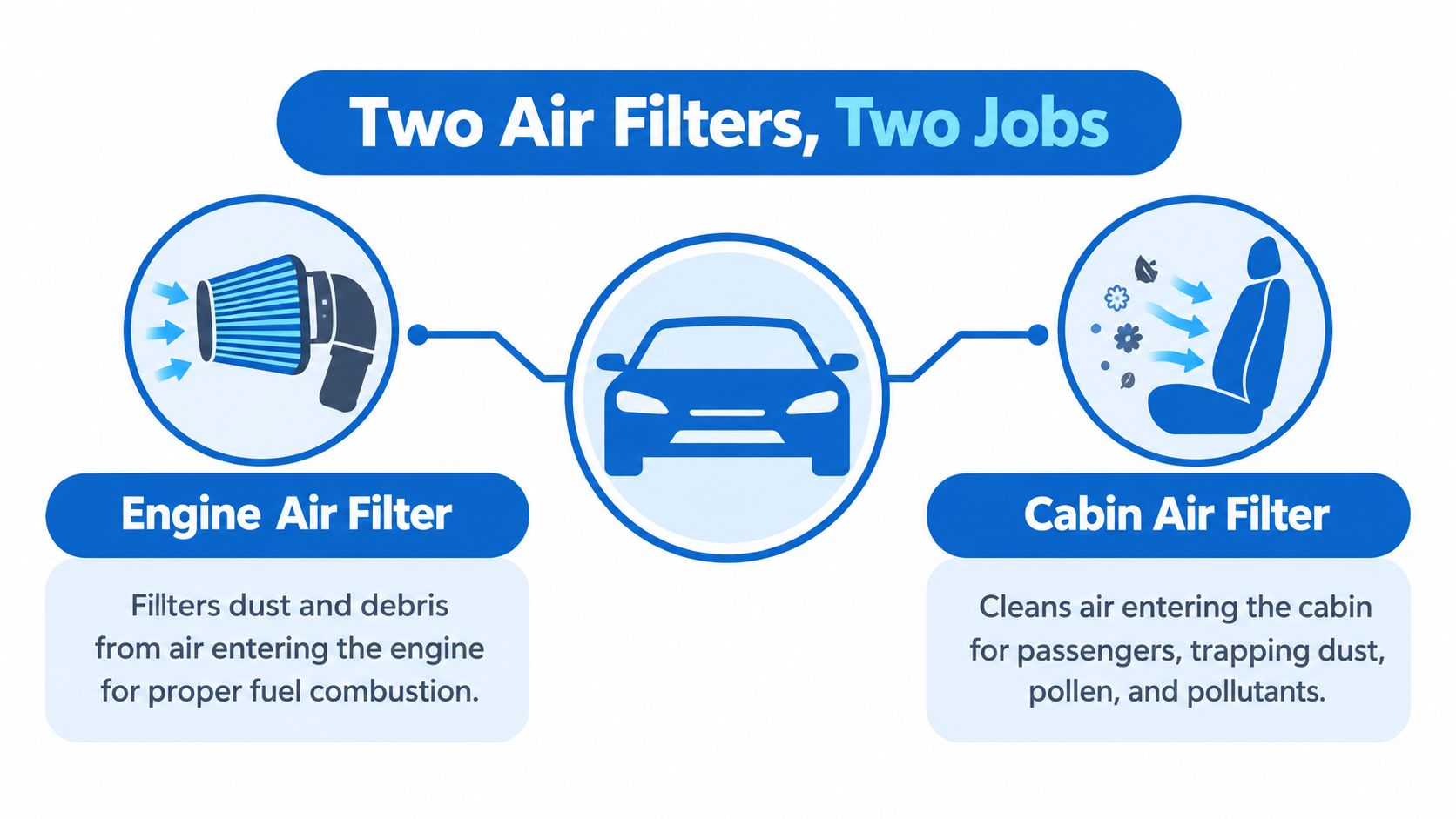
When the vents feel weak or the engine seems less responsive, the filter involved depends on which airflow path has a problem. Your car has two filters because the engine and passengers need different kinds of protection.
The engine air filter sits in the intake path before air reaches the engine. It catches dust, dirt, and debris while allowing enough air through for combustion. Its job resembles a gatekeeper for the engine: block abrasive particles without restricting the air supply more than necessary.
The cabin air filter protects the passenger compartment instead. It filters air entering through the heating, ventilation, and air-conditioning system. Depending on its design, it can trap dust, pollen, and other airborne pollutants. Some versions also contain activated carbon to help manage odors.
Two different airflow paths
As an engine filter collects particles, resistance in the intake can increase. Engineering guidance commonly defines permissible filter pressure drop around 2.5 to 4.0 kPa. One technical study reports that a 1 kPa increase in pressure drop can reduce engine power by about 1% to 1.5% and increase specific fuel consumption by about 0.7% (technical research on air-filter pressure drop). The practical result is a filter that may affect engine breathing before it looks completely blocked.
A loaded cabin filter affects the ventilation side. It may reduce blower airflow, make the windows harder to defog, or contribute to stale and musty odors. Pollen seasons, urban pollution, humidity, and frequent use of outside-air mode can all change how quickly it becomes restricted.
Location and construction differ as well. Engine filters are commonly under the hood inside a sealed housing. Cabin filters are often behind the glovebox, beneath a dash panel, or under the cowl near the windshield. For a model-specific example, T1A Auto's Altima filter installation advice shows the type of access and removal steps a cabin-filter replacement may involve.
Vehicle filters serve the car, not an entire room. For indoor air quality beyond the vehicle, products like the Living Air Classic XL-15 Air Purifier use ionization technology.
The distinction guides diagnosis. Replacing a cabin filter will not correct an engine-intake restriction, and replacing an engine filter will not improve air coming from the vents. Each filter needs its own inspection and replacement decision.
The Standard Replacement Ranges Most Drivers Follow
A driver who checks the service schedule may find two different answers in the same car. That is normal. The engine filter and cabin filter serve separate airflow systems, so their replacement timing should be tracked separately. General automotive guidance places engine-filter replacement around 12,000 to 15,000 miles or once a year. Cabin-filter guidance commonly falls around 15,000 to 30,000 miles or 12 months, with conditions affecting the decision (car air-filter replacement guidance).
| Filter Type | Mileage Range | Time Range | Typical Conditions |
|---|---|---|---|
| Engine air filter | About 12,000 to 15,000 miles as a common baseline | Once a year | Moderate driving and ordinary road exposure |
| Cabin air filter | Commonly 15,000 to 30,000 miles | About 12 months | Normal use, adjusted for dust, pollution, and pollen |
Use these baseline ranges, not guarantees. Vehicle design, engine size, intake layout, filter material, and the manufacturer's maintenance schedule can all change the recommendation. Some manuals distinguish normal use from severe use, so the owner's manual should set the starting point for your checklist.
Why the odometer can't decide alone
Mileage measures how far the car travels, not how much material the filter captures. Two cars can cover the same distance while breathing very different air. A vehicle used on clean suburban roads may load its filter more slowly than one driven near roadworks or on unpaved roads.
Time adds a second checkpoint. Once a year is a practical default for many drivers, including those with low annual mileage. A filter can collect contamination during ordinary trips even when the odometer has not reached the mileage range.
A government study found that newer fuel-injected, closed-loop engines can tolerate moderate intake restriction with little measurable change in fuel economy. On the tested vehicle, replacing a severely clogged filter improved fuel economy by as much as 14%, because the restriction had become serious enough to affect drivability (government study on clogged engine air filters).
The useful lesson is to combine the calendar, mileage, driving environment, and what you see during inspection. A clean filter does not need replacement solely because a generic interval has arrived. A visibly loaded or highly restricted filter deserves attention even if the mileage window has not.
For service-planning ideas beyond a personal vehicle, this fleet maintenance guide for Lincoln offers another way to organize recurring checks. DIY replacement is reasonable when the housing is accessible and the manual provides clear instructions. A professional is the safer choice when access is difficult, the housing is damaged, or the filter's condition is uncertain.
How Driving Conditions Change the Schedule
The same filter can last very differently in different environments. Dusty roads, construction zones, gravel, heavy pollution, and high pollen all increase the amount of material the filter must capture. Technical guidance describes a broad default around 10,000 to 15,000 km or 12 months, while severe-use conditions can shorten replacement to 5,000 to 8,000 km or 3 to 6 months (condition-based air-filter guidance).
| Driving Condition | Engine Filter Adjustment | Cabin Filter Adjustment |
|---|---|---|
| Dust, gravel, or off-road driving | Inspect early and replace toward the shorter end of the schedule | Inspect early because dust can load the media quickly |
| Construction areas or heavy pollution | Use restriction and visible loading as early warning signs | Shorten the interval if airflow or odor changes |
| High pollen seasons | Usually less affected unless roads are dusty | Consider earlier inspection during persistent pollen exposure |
| Humid coastal conditions | Watch for moisture and filter deterioration | Inspect for moisture, mold-related odor, and damp media |
| Wildfire smoke or severe haze | Inspect after sustained exposure | Check sooner, especially if odor and airflow change |
| Mostly clean highway driving | The normal interval may be reasonable | The normal interval may be reasonable, subject to the manual |
Match the filter to the exposure
A dusty-region driver shouldn't wait for the same trigger as a highway commuter. Engine restriction can build faster when the intake receives large amounts of fine dust, while the cabin filter may become unpleasant sooner during pollen, haze, or smoke events.
Urban stop-and-go driving also changes the cabin picture. Traffic exposes the HVAC system to roadside exhaust and concentrated pollution, particularly when the system frequently draws outside air. Recirculation can reduce outside-air intake for a period, but it doesn't eliminate the need to inspect the filter.
Humidity deserves its own check. Damp conditions can make a cabin filter smell stale, especially if moisture remains trapped in the media. Desert heat and dry air often bring more airborne dust, so the engine filter may need attention earlier even when the cabin still seems comfortable.
Vehicle design matters as well. Turbocharged engines can be especially sensitive to intake-air restriction because their intake systems move air under demanding operating conditions. Hybrids and electric vehicles don't use engine air filters in the same way as combustion vehicles, but their HVAC systems still use cabin filters that can load with dust, pollen, and pollution.
For additional in-car air-treatment options, EcoQuest Purifiers' car and home ozone generator is a separate product category from a replacement cabin filter. It shouldn't be treated as a substitute for maintaining the vehicle's HVAC filter.
Engine Filter Versus Cabin Filter at a Glance
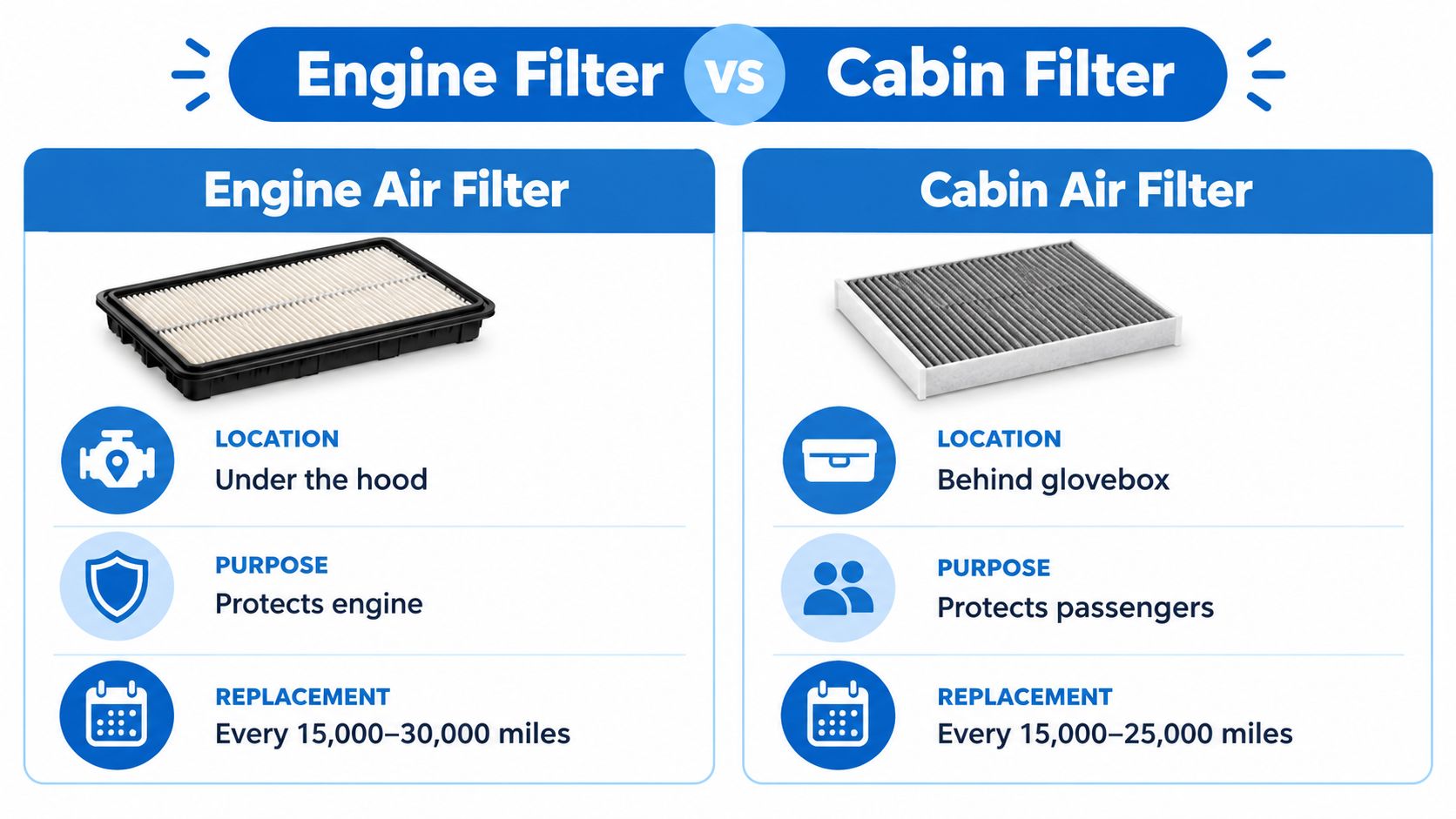
The easiest way to keep the two systems straight is to follow the air path. The engine filter is normally under the hood, before air reaches the engine. The cabin filter is commonly behind the glovebox, beneath the dashboard, or near the cowl, where it protects the HVAC airflow entering the passenger area.
Their warning signs differ too. A cabin filter usually announces trouble through weak vents, slow window clearing, or a musty smell. An engine filter may show up as restricted response, rough running, or a visible layer of dust and debris when you inspect the intake housing.
| Feature | Engine Air Filter | Cabin Air Filter |
|---|---|---|
| Location | Under the hood | Behind the glovebox, under the dash, or near the cowl |
| Main purpose | Protects the engine from dust and debris | Filters air entering the passenger compartment |
| Common media | Pleated paper or synthetic material | Filter media, sometimes with activated carbon |
| Main clues | Hesitation, rough running, visible loading | Weak airflow, odors, fogging, dusty interior |
| Inspection focus | Restriction, debris, pleat condition, housing seal | Dirt, dampness, odor, and airflow |
| Schedule | Vehicle-specific and condition-based | Vehicle-specific and condition-based |
Why the materials and intervals differ
Engine filters prioritize clean airflow into the intake while maintaining the flow the engine needs. Cabin filters prioritize passenger-air filtration, and some include carbon layers intended to help with odors. Neither design is automatically better. Each is built for a separate route and separate consequence.
A cabin filter can load heavily in a polluted city or during a high-pollen season even when the engine intake remains relatively clean. Conversely, a vehicle travelling dusty unpaved roads can build engine-filter restriction while the cabin still seems normal.
If you're deciding whether to handle the work yourself or ask a technician, Carmedics Autowerks' explanation of labour and parts for an air-filter swap gives useful context about why access and vehicle design can affect the service.
For drivers who want an additional in-car purification device alongside a maintained cabin filter, EcoQuest Purifiers' Smart Car Air Purifier is a separate option. It doesn't replace the vehicle's cabin-filter service.
Warning Signs That the Filter Is Past Its Prime
On a rainy commute, you may notice the windshield clearing slowly, the vents pushing less air, or a dusty dashboard returning soon after cleaning. Those clues can point to a loaded cabin filter, but they can also come from blocked vents, a weak blower, or another HVAC fault. Treat them as prompts to inspect, not automatic diagnoses.
A musty smell that appears when the fan starts deserves attention. Moisture and trapped debris can collect in a damp cabin filter and produce stale odors. Replacing the filter may help. If the smell remains, contamination may be deeper inside the HVAC housing.

What to watch for under the hood
Engine-filter symptoms usually show up in the way the vehicle runs:
- Sluggish acceleration: Restricted intake airflow can make the engine feel slower to respond.
- Rough idle or hesitation: A heavily loaded filter may contribute, although ignition, fuel, and sensor problems can cause similar behavior.
- A warning light: A check engine light may involve intake or airflow readings. Diagnose the fault before assuming the filter is responsible.
- Visible contamination: Dust, leaves, insects, or dark material spread across the pleats justify a closer inspection.
A missing fuel-economy complaint does not prove the filter is clean. Moderate restriction may have little noticeable effect in some newer vehicles, while severe loading can still limit airflow. Physical condition and the vehicle's symptoms provide better guidance than fuel use alone.
A separate device, such as EcoQuest Purifiers' small car air purifier, belongs to the purification category rather than the replacement-filter category. It can sit alongside a maintained cabin filter, not substitute for one.
A simple visual check
With the engine cool and the vehicle safely parked, inspect the engine filter under indirect light. Heavily dust-packed pleats, damaged media, or a collapsed element indicate replacement. Cleaning and reusing a damaged or saturated filter can leave the intake poorly protected.
Check the sealing edge as well. A torn gasket or housing that fails to close evenly creates a bypass path, allowing unfiltered debris into the intake. If the filter looks reasonably clean but the vehicle still runs poorly, investigate other causes instead of replacing parts by guesswork.
Inspecting and Replacing a Filter at Home
A home inspection is often straightforward, but the vehicle's service manual should guide the exact location and removal method. Park on level ground, switch the engine off, allow it to cool, and keep loose clothing and tools away from moving components.
Under the hood, look for the rectangular engine air-filter housing connected to the intake duct. Release the clips or fasteners carefully, lift the cover without pulling on the duct, and note the filter's orientation before sliding it out.
Check before you buy
The cabin filter may be hidden behind the glovebox, under a passenger-side panel, or below the windshield cowl. Don't force the glovebox or pry at trim until you know how the panel is retained. Some vehicles use clips, while others use screws or bolts.
Compare the replacement with the old part before installation:
- Part number: Match the vehicle-specific part number or the exact application listed by the manufacturer.
- Direction: Follow any airflow arrow printed on the cabin filter.
- Seal: Make sure the gasket or edge sits evenly in its channel.
- Housing: Refit the cover and clips so the box closes fully without gaps.
For the engine filter, look for collapsed pleats, torn media, or a distorted rubber edge. If dust has entered the clean side of the housing, stop and have the intake inspected rather than brushing debris deeper into the duct.
Before closing the housing: Confirm that the filter sits flat and that every latch has engaged. A new filter installed crookedly can allow unfiltered air around its edge.
DIY replacement makes sense when access is clear, the fasteners are familiar, and no warning lights or intake contamination are involved. A professional is the safer choice when clips are difficult to release, mounting bolts are unfamiliar, the housing is damaged, or the dashboard continues to show an error after replacement. A technician can also check pressure drop, sensor readings, and the rest of the intake system when symptoms don't match a simple dirty filter.
A clean cabin filter works as part of the vehicle's HVAC system. A separate in-cabin purifier may provide another layer of air treatment, but it doesn't remove the need to fit the correct filter and seal the housing properly.
Building Your Personal Replacement Checklist
A useful filter schedule should live with the vehicle, not in memory. Record the installation date and odometer reading for both filters, then add a short note describing your normal driving environment.
Use this compact checklist:
- Record the baseline: Write down when each filter was installed and its mileage.
- Describe exposure: Note gravel, construction dust, traffic pollution, pollen, humidity, smoke, or mostly clean highway driving.
- Check the manual: Compare your observations with the manufacturer's normal and severe-service schedules.
- Inspect before symptoms grow: Look at the engine filter and monitor cabin airflow and odor.
- React to unusual events: Inspect after sustained smoke, haze, dust, or another major change in air quality.
- Confirm the hidden location: Find the cabin-filter access point before you need to replace it.
- Order the right part early: Match the vehicle application and airflow direction before the next service visit.
This is a living record, not a rigid rule. Your commute, climate, and road exposure can change from year to year, so the answer to how often to replace your car air filter should change with them.
A quality cabin filter and a separate purifier can serve different roles. The filter belongs to the vehicle's HVAC maintenance, while a purifier is an additional air-treatment tool for the cabin or other indoor spaces.
EcoQuest Purifiers offers air-quality products for homes and vehicles, including portable car units, replacement parts, repair services, and purifier systems using technologies such as ionization, UV, RCI photocatalysis, ozone, HEPA, and charcoal filtration. Review the available options at EcoQuest Purifiers, then keep your vehicle's cabin-filter inspection and replacement schedule current.