
Nail Salon Ventilation Requirements: What Owners Should Know
Indoor air quality in nail salons is no longer just a comfort issue. It is directly tied to workplace safety, employee retention, and regulatory expectations.
From acrylic fumes and acetone vapors to fine nail dust and volatile organic compounds (VOCs), salons generate airborne contaminants throughout the workday. While many owners rely on basic HVAC systems or open windows, modern ventilation requirements demand a more structured approach.
This guide explains what nail salon owners should know about ventilation requirements in 2026 — and how to build a safer, more professional environment.
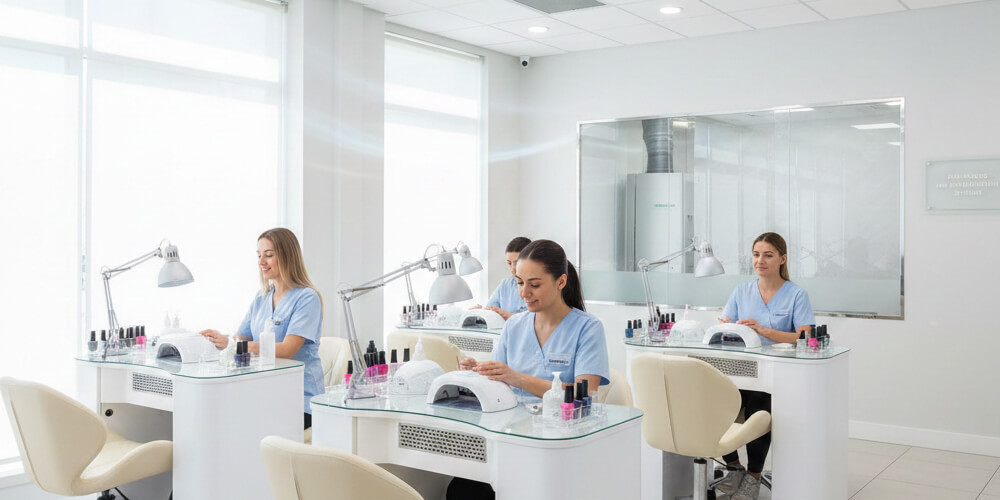
Why Ventilation Matters in Nail Salons
Ventilation serves two critical purposes: contaminant removal and fresh air exchange. Without proper airflow management, chemical vapors accumulate, increasing exposure time for both technicians and clients.
Poor ventilation can lead to persistent odors, employee complaints, and difficulty meeting health department expectations.
For a broader overview of improving salon air quality strategies, see: How to improve air quality in nail salons
Understanding OSHA and Local Ventilation Expectations
While OSHA does not publish nail-salon-specific ventilation blueprints, it does regulate workplace exposure to hazardous substances.
General Duty Clause
Employers must provide a workplace free from recognized hazards. Persistent chemical fumes may fall under this category if they affect worker health.
Airborne Chemical Exposure
Products used in nail services may release formaldehyde, toluene, and other VOCs. Even when individual products comply with regulations, cumulative exposure in poorly ventilated spaces can be problematic.
To better understand how VOCs behave in salon environments, see: What are VOCs in nail salons and how to remove them
Types of Ventilation Systems Used in Nail Salons
Natural Ventilation
Opening windows or doors provides temporary airflow but lacks consistency. Outdoor pollution and seasonal limitations reduce effectiveness.
Mechanical HVAC Ventilation
Standard HVAC systems circulate air but often recirculate contaminants rather than remove them. Many salon owners assume HVAC equals purification — this is not always true.
Local Exhaust Ventilation
Table-mounted dust collectors capture larger particles during filing. These systems are effective at the source but do not address room-wide chemical vapors.
Ventilation alone does not neutralize odors or fully remove suspended particles. That is where commercial air purification becomes relevant.
For business owners evaluating complete solutions, explore: Commercial air purification solutions for nail salons
Air Exchange Rates and Practical Standards
Most commercial spaces are expected to maintain adequate air changes per hour (ACH). While exact requirements vary by state and building code, beauty environments generally benefit from higher-than-average air turnover due to chemical use.
Increasing ACH alone, however, does not eliminate VOCs. It dilutes them.
Professional environments increasingly combine ventilation with filtration technology to create cleaner, more stable air conditions.
The Role of Commercial Air Purifiers in Modern Salons
Ventilation moves air. Filtration cleans air.
Commercial air purifiers designed for beauty environments can help reduce acrylic fumes, neutralize odors, and capture fine nail dust that escapes local collectors.
Owners looking for systems built specifically for nail salon environments can browse: Nail salon air purifiers
Common Ventilation Mistakes Salon Owners Make
Many salons assume that if odor is not overwhelming, ventilation is sufficient. However, odor perception does not equal safe exposure levels.
Another common mistake is relying solely on consumer-grade air purifiers. These units are often underpowered for commercial square footage and chemical load.
Designing a Balanced Air Quality Strategy
The most effective salons combine:
- Local dust capture
- Adequate air exchange
- Commercial-grade air purification
This layered strategy improves indoor air stability and creates a more professional environment for staff and clients.
In 2026, clients increasingly expect visible signs of safety and environmental responsibility. Clean air is becoming part of brand positioning.
Understanding nail salon ventilation requirements is about more than compliance. It is about protecting your team, enhancing client experience, and future-proofing your business.
While ventilation systems provide airflow, advanced air purification systems help address the unique chemical environment of nail salons. Owners who invest in both create safer, more competitive spaces.