
UV Air Filter for HVAC: How It Works, Limits and Safety
The most common advice about a UV air filter for HVAC is to buy the highest-wattage lamp, or the one that says it sterilizes the air. That advice treats the label as the result. Wattage is only the electrical power the lamp draws. It does not tell you how much ultraviolet energy the moving air receives.
Performance is delivered dose: intensity multiplied by the time air spends in the light, at the airflow your duct really runs. A bright lamp in a fast, short section can underperform a smaller lamp in a slower, longer one. Sterilization slogans skip that product and treat any glow as finished work.
If you own a house or look after a small building, judge the unit by dose at your airflow, by how the lamp is enclosed, and by whether ozone emissions are labeled. A particle filter, outdoor air, and coil cleaning still do jobs ultraviolet cannot do.
Table of Contents
- What a UV Air Filter for HVAC Does in the Airstream
- Dose Numbers and Why Identical Lamps Differ
- Checking Compatibility With Your HVAC System
- Safety Rules for UV-C, Ozone and Access Panels
- UV Air Filters Compared with HEPA and Charcoal
- How to Maintain and Replace an In-Duct UV Lamp
- Confirm Dose, Safety and Fit Before You Buy
What a UV Air Filter for HVAC Does in the Airstream
An in-duct UV system adds a supplemental disinfection layer to HVAC treatment. The CDC's germicidal ultraviolet guidance explains that germicidal ultraviolet (GUV), also called ultraviolet germicidal irradiation (UVGI), can inactivate airborne pathogens as they pass through ductwork. Since air moves past the UV source briefly, effective systems generally need more powerful lamps, multiple lamps, or both. UV works alongside particle filtration, outdoor-air ventilation, and routine cleaning, each of which addresses a different part of indoor air quality.
Dose works like sun exposure. Mild sunlight over a long afternoon and intense sunlight for a few minutes deliver different exposures. Exposure dose is UV intensity multiplied by contact time. A lamp installed in an air handler does not, by itself, establish the dose reaching moving air.
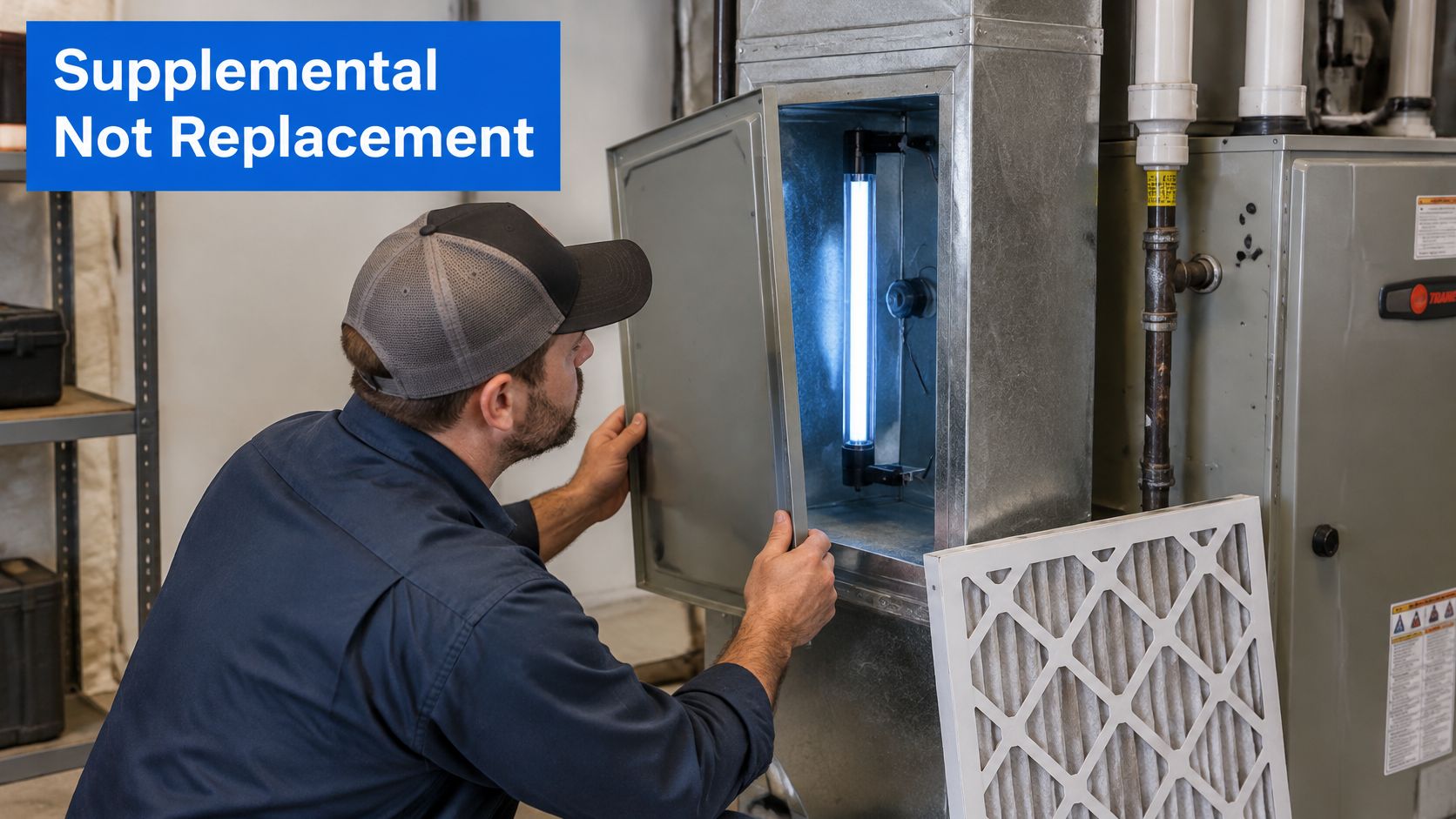
The installation's target determines what the lamp treats:
- Airstream treatment places lamps where moving air crosses the light in the duct.
- Surface irradiation, often called coil treatment, aims lamps at cooling coils, drain pans, and duct walls. Moisture on those surfaces can support mold growth that a particle filter does not capture.
These are different jobs. The CDC explains that coil devices target microbial growth on HVAC surfaces; they are not designed to disinfect moving air. A coil lamp may help limit surface growth while leaving fast-moving air with little UV exposure.
For homes, offices, schools, and clinics, the CDC places ultraviolet within a broader approach that includes code-compliant ventilation, filtration, maintenance, and safe installation. It also advises checking performance and safety evidence under real-world, as-used conditions rather than relying on laboratory claims alone. Airflow, lamp output, exposure time, geometry, cleanliness, and upkeep all affect results.
Ask what the concern is: airborne microbes, growth on a wet coil, or dust and pollen. UV can be directed at the first two; filtration handles particles such as dust and pollen.
An in-duct air scrubber can fit into this layered approach alongside the HVAC filter rack.
Dose Numbers and Why Identical Lamps Differ
Lamp wattage alone cannot show how much ultraviolet energy reaches moving air. Compare the delivered dose under stated operating conditions instead. Useful reference values include a target dose of about 1,500 µJ/cm², airflow of 500 fpm or slower, an irradiated zone of at least two feet, and exposure of at least 0.25 seconds, as described alongside EPA guidance for air cleaners in the home.
| Parameter | Reference value | Why it matters |
|---|---|---|
| Target UV dose | About 1,500 µJ/cm² | Dose, not wattage, indicates energy delivered to the airstream |
| Airflow through irradiated zone | 500 fpm or slower | Faster air receives less exposure time |
| Irradiated zone length | At least 2 ft | A shorter zone provides less time under the light |
| Exposure time | At least 0.25 s | Shorter exposure delivers less dose |
| Airstream lamp position | Downstream of filter, upstream of cooling coil | The filter helps keep dust from coating the lamp |
| Surface lamp position | Near coils, drain pans and duct walls | Directs light at growth on moist surfaces |
| Test standard, airstream | ANSI/ASHRAE 185.1 | Provides a method for testing airstream performance claims |
| Test standard, surface | ANSI/ASHRAE 185.2 | Provides a method for testing surface irradiation claims |
How to read the sheet against the duct
Begin with the dose specification. If a product sheet does not state delivered dose at a stated airflow, its performance cannot be compared directly with another product's. The number on a lamp's label describes its power, not the ultraviolet energy that microorganisms receive while passing through the duct.
Exposure time helps explain the difference. Calculate transit time by dividing the length of the irradiated zone by air speed. A two-foot zone at 500 feet per minute gives only a fraction of a second of exposure, so dose depends on the lamp's intensity throughout that brief passage.
Position also changes the treatment target. The EPA summary of residential air cleaners describes two principal HVAC UVGI applications: airstream disinfection and surface irradiation. In typical installations, airstream lamps sit downstream of the conventional filter and upstream of the cooling coil. A lamp placed after the coil treats air that has already been cooled and may have passed through a wet area. Surface lamps, by contrast, are placed near cooling coils, drain pans, and ductwork where moisture can support growth. The filter goes first because dust on the lamp or its quartz surface can reduce the light reaching the target.
The EPA summary identifies test standards to ask about when reviewing performance claims. In-duct airstream systems are tested under ANSI/ASHRAE Standard 185.1. In-duct surface systems are tested under ANSI/ASHRAE Standard 185.2. The summary reports no single standard measurement for the effectiveness of residential UVGI cleaners, and describes typical household units as having limited effectiveness against bacteria and mold. Some viruses and most mold and bacterial spores generally require higher exposure. A residential unit may deliver too little dose to deactivate many airborne microorganisms when exposure time is short, lamp intensity is low, or both.
Why the same wattage splits
Consider two proposals with the same 30-watt lamp. In the first, the irradiated length is 3 feet and air moves at 300 feet per minute, about 5 feet per second. Transit time is about 0.6 seconds. In the second, the lamp covers 1 foot while air moves at 900 feet per minute, about 15 feet per second. Transit time is about 0.07 seconds, roughly nine times less. The nameplate wattage matches, but the time available for exposure does not. The actual dose also depends on how far the lamp sits from the air path.
A lower-powered lamp in a slow, correctly placed zone can deliver more exposure than a higher-powered lamp in a fast, short airstream.
Lamp age can widen the difference. Germicidal output declines over the rated life, sometimes before the lamp appears to have failed. The useful wavelength is invisible, so a visible violet glow is not a measure of dose. Dust or film on a lamp or reflector blocks light, much as a dirty window dims a room. Debris on a coil can also obstruct a surface lamp's treatment of the underlying surface.
UV equipment works alongside filtration, ventilation, and cleaning. When comparing products, look for documented dose and airflow, the stated target organism, installation position, maintenance requirements, and the applicable test standard. Without those details, wattage alone cannot tell you how the system will perform.
Checking Compatibility With Your HVAC System
A catalog drawing cannot show whether a lamp will fit your actual duct, filter rack, coil, and service access. Measure the installation space first, then compare it with the device's required position and the system's airflow.
Measure airflow at the proposed location. With the system running, use an anemometer in the duct section where the lamp would sit. Record the airflow reading and where you took it; a blower nameplate value does not describe conditions at the lamp.
Record the available space. Measure the duct's inside width and height, the clear distance between the filter and coil, and the space needed to reach the filter. Note obstructions, seams, and nearby panels. For example, a 14-inch return trunk with only a 12-inch gap before the coil may leave too little straight duct for a particular lamp arrangement.
Check filter and coil access. Keep the conventional filter upstream, with its rack reachable for replacement. For a surface-treatment lamp, check whether its position can illuminate the coil face and drain pan. A dry heating-only trunk presents a different installation condition from a damp cooling coil.
Check the fan and filter combination. A lamp housing and a tighter filter can add resistance. Confirm that the blower can maintain the airflow the system needs; reduced airflow can affect room delivery as well as the lamp's operating conditions.
Coil condition is part of the fit assessment. Bender's Oil Service home cooling advice can help you consider whether the evaporator and drain are wet, dirty, or difficult to reach.
If fitting the lamp requires a new access panel, the panel should be interlocked so opening it cuts power to the lamp.
For product options, see HVAC air purifiers, then have a licensed technician assess any required sheet-metal changes and confirm the installation.
Safety Rules for UV-C, Ozone and Access Panels
Ultraviolet is not automatically safe, and it is not automatically unsafe. The difference is enclosure, interlocks, labeling, and what else the device emits.
UV-C is invisible. Occupants cannot look at a duct and know whether the lamp is on. Eye and skin exposure is the hazard, not a visible beam you can dodge.
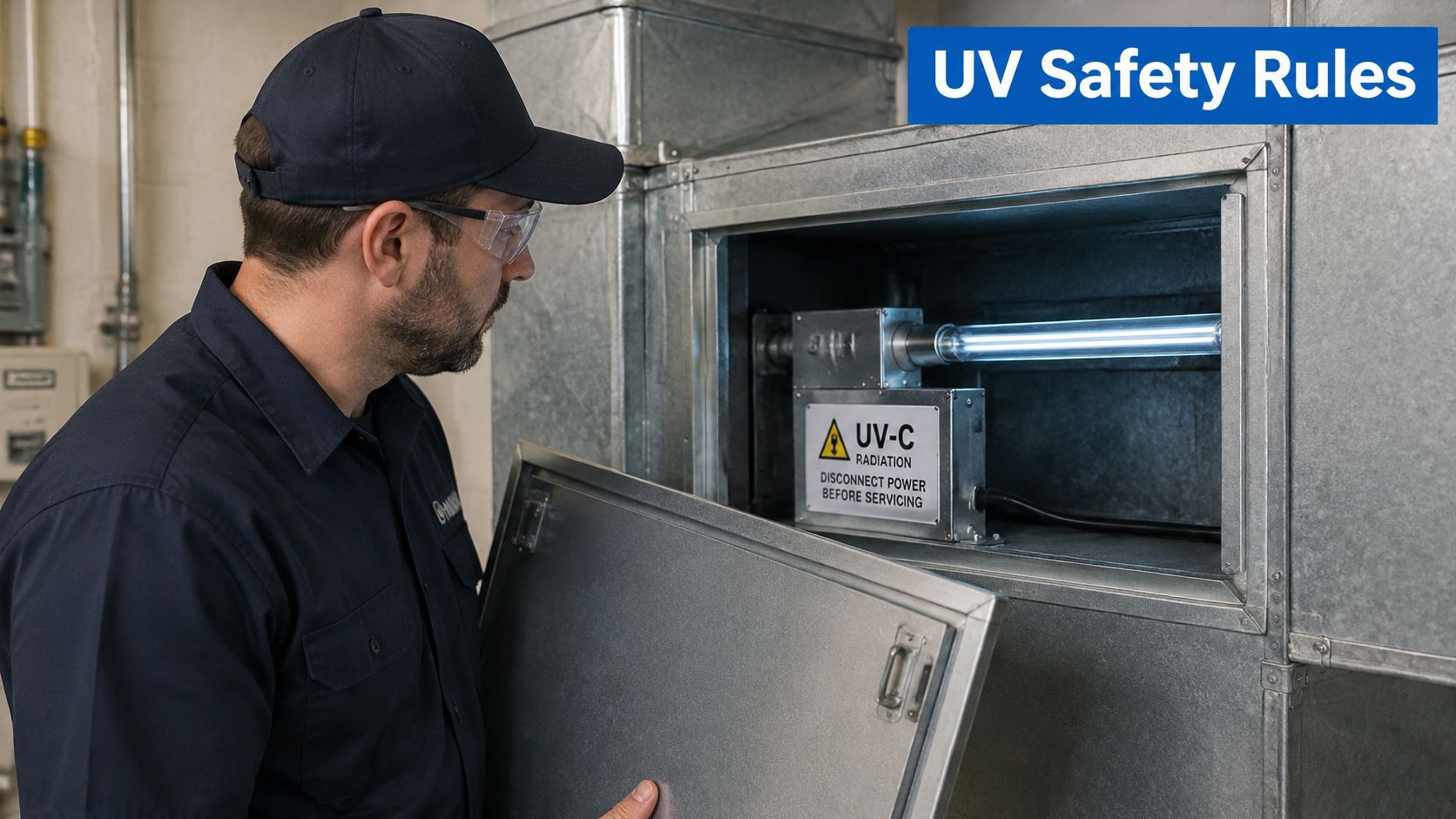
ASHRAE's filtration and disinfection guidance advises turning UV-C systems off before maintenance, training the people who open the equipment, and using protective equipment wherever eye or skin exposure could exceed safe levels. Its upkeep list is practical: check status indicators and fault alarms, inspect lamps for end of life or malfunction, clean them as the manufacturer instructs, and replace them on schedule or after failure.
An enclosed, interlocked installation cuts lamp power when the access panel opens. An exposed lamp, or a panel you can open while the lamp stays lit, does the opposite. That is the difference between a controlled air-handler install and a lamp someone can walk into during a filter change.
Ozone is a separate question
Some devices sold near ultraviolet also make ozone, on purpose or as a byproduct. ASHRAE states that electrically powered air-cleaning devices should be tested and labeled for ozone emissions under UL 2998 or an equivalent standard. It warns that ozone-producing cleaners should not be used for infectious-aerosol control.
Read both labels. A UV claim does not answer the ozone question, and an ozone claim does not answer the dose question. Families, daycares, clinics, and small offices matter here because people may be in the treated air for the whole day, not for a short visit.
Put three questions to any seller:
- Who may replace the lamp? If the answer is the homeowner, ask what lockout and eye protection the manual requires.
- What happens when a door opens? Power should drop through an interlock, not rely on someone remembering a switch.
- How do you know it is running? UV-C gives you nothing to see. Indicator lights and fault alarms are the check, not a glance into the duct.
Wattage charts skip this ownership risk. Safety hardware is part of the purchase, not a footnote after the sale.
UV Air Filters Compared with HEPA and Charcoal
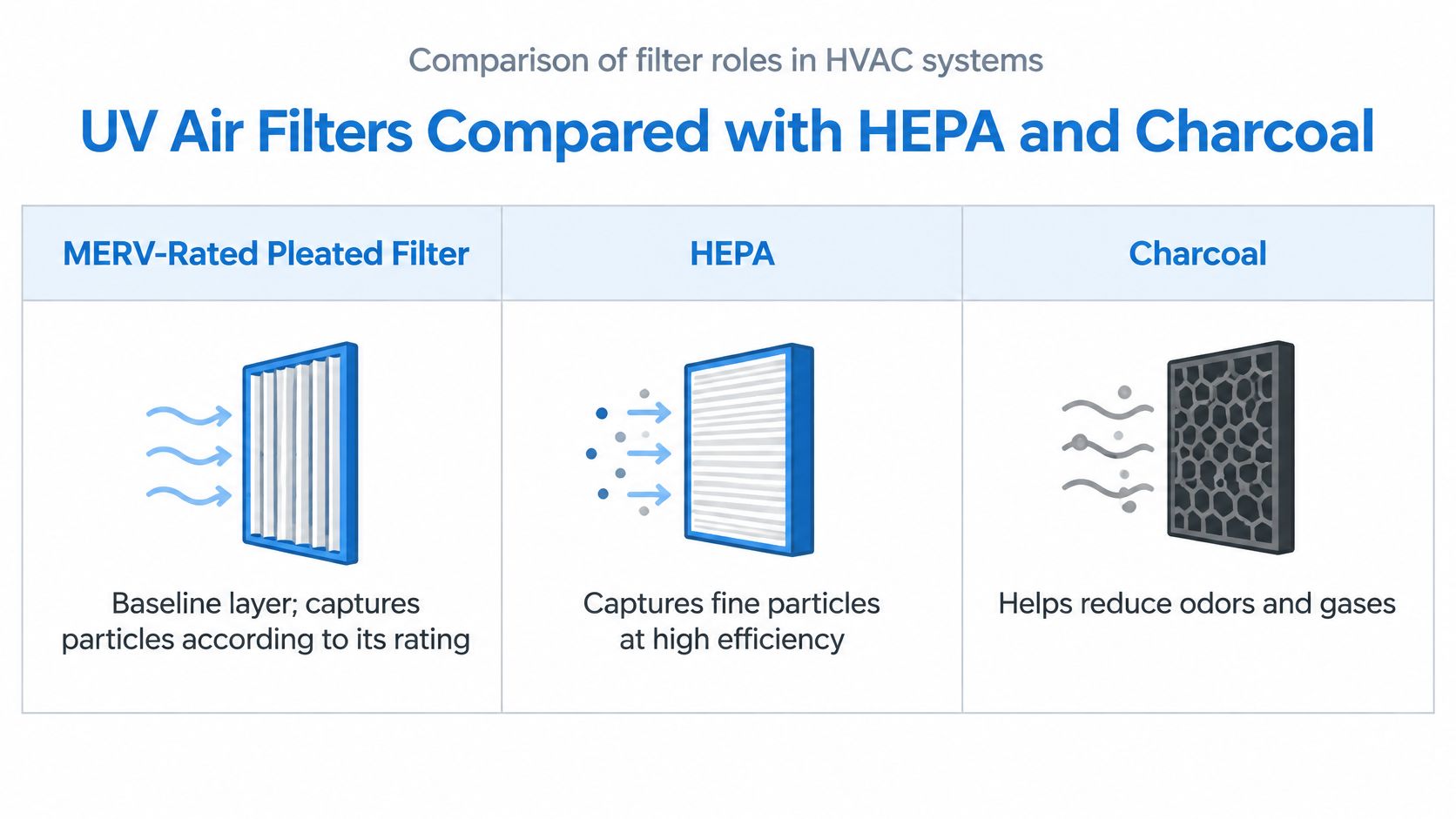
Each technology removes a different thing. None of them covers the whole list.
| Technology | Captures particles | Inactivates microbes | Removes odors and gases | Main upkeep |
|---|---|---|---|---|
| Pleated MERV-rated filter | Yes, by MERV rating | No | No | Replace on manufacturer schedule |
| HEPA filter | Yes, high efficiency for fine particles | No | No | Replace when airflow drops |
| Activated charcoal | Limited | No | Yes, until saturated | Replace when saturated |
| In-duct UV lamp | No | Partly, dose-dependent | No | Clean and replace lamp on schedule |
Match the complaint, not the brochure
Smoke, pollen, and fine dust point to a high-MERV pleated filter or to HEPA. A MERV-rated filter is the baseline layer in a central system. It captures particles according to its rating and keeps the coil and any downstream lamp cleaner. HEPA captures fine particles at high efficiency. It also adds resistance, so the fan and ducts have to be able to move the air. If the blower cannot, you trade particle capture for weak rooms and a frozen coil.
Cooking smells, pets, and many gases point to activated charcoal. Charcoal adsorbs odors until the media is saturated, then it stops. It does not inactivate microbes, and particle capture is limited. Plan the replacement by smell return and by the maker's interval, not by how clean the pad still looks.
Microbial growth in the air handler or concern about organisms in the airstream is the case for in-duct ultraviolet, added to the filter, not swapped for it. Results track dose and whether you bought coil treatment or airstream treatment. The lamp captures no dust. Organisms that the light inactivates, and the particles they rode on, stay in the air until a filter takes them out. Dead material is still material.
A short walk-through of how mechanical filters and ultraviolet sit in the same air handler makes the split easier to see before you price hardware.
Packages that combine a MERV 13 filter, ultraviolet, and photocatalysis are sold as one box. Treat them as three claims. Verify particle capture from the filter data, microbial performance from the ultraviolet test standard and dose, and any gas or odor claim from the photocatalytic data. One logo on the carton does not make the layers equal.
A portable room HEPA purifier solves a different problem again. It cleans one space. It does not treat the coil or the supply duct.
How to Maintain and Replace an In-Duct UV Lamp
A lamp can still glow while delivering less UV-C than intended. Maintenance protects its output and keeps skin and eyes away from the beam, but a clean lamp alone cannot prove that the system delivers an effective dose at the actual airflow.
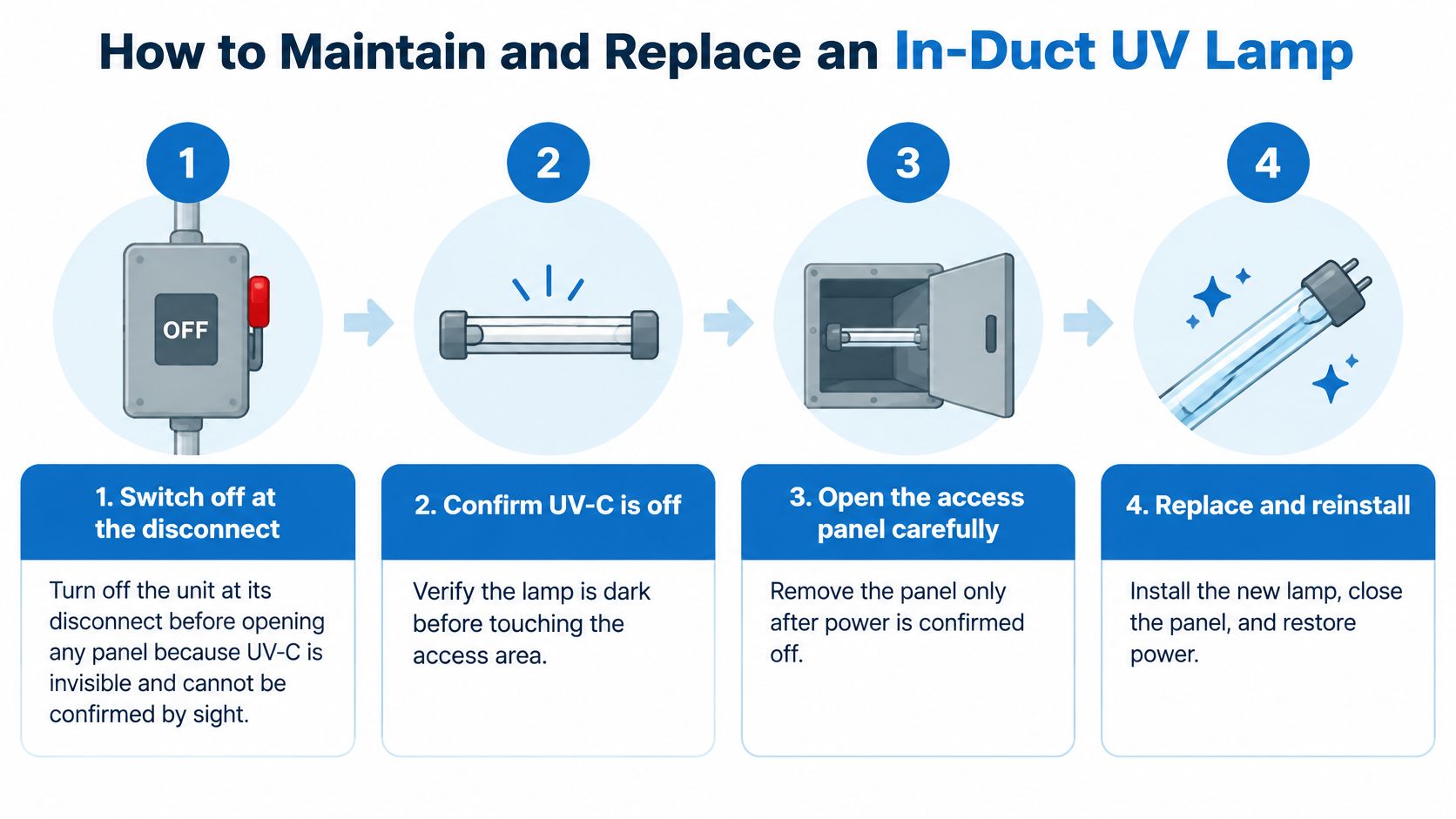
Kill power first. UV-C is not reliably visible to the eye. Switch the unit off at its disconnect and confirm the circuit is dead before removing a panel screw.
Check indicators before handling the lamp. Status lights and fault history can signal a problem even when the tube looks intact. Record what the panel reports.
Use rated life, not visible glow, to judge output. Check for blackening, cracks, or a failed filament, then compare the installation record with the hours on the manufacturer's label. Germicidal output can decline before the lamp visibly fails.
Remove anything shading the lamp. Wipe the lamp and reflector with a dry cloth, or use only what the manual approves. Dust blocks UV and reduces the dose reaching the target. Keep fingerprints off quartz by handling the glass at its ends, and do not use water unless the manual permits it.
Check the coil and drain pan for visible growth. Debris between the lamp and coil can block the light. Slime in the pan also calls for attention to the drain, not just the lamp.
Replace the lamp with the same model and part number. Follow the manufacturer's replacement schedule or replace it if it fails. A different tube can change the dose because the housing and lamp are designed to work together. Keep this step focused on the UV lamp, rather than replacing a separate photocatalytic cell as part of the lamp change.
Restore power, check the indicator, and log the replacement. Reset the lamp-hours counter if the unit has one. A clear record helps prevent the next replacement from being delayed.
Common errors are straightforward to avoid: working while the lamp is powered, fitting a longer or supposedly equivalent tube that was not tested with the ballast and housing, and forgetting to reset the counter. Each can compromise safety or make it harder to track lamp life. If the manual reserves replacement for a technician, follow that instruction. Access panels and line voltage require care, not guesswork.
Confirm Dose, Safety and Fit Before You Buy
A purchase decision should resolve more than whether a lamp fits in the duct. Ask the seller questions that connect the product's documentation to your installation and ongoing costs.
- Dose evidence: Can the seller provide a dose figure for the airflow in your system, rather than lamp wattage alone?
- Test details: Can they identify the applicable test standard and provide its reference?
- Installation drawing: Does the documentation show the unit in a configuration that matches your duct and equipment?
- Filter compatibility: Will your existing filter remain accessible for routine service?
- Safety provisions: What prevents operation when an access panel is open, and how will you know if the lamp fails?
- Ozone emissions: What does the product's ozone labeling establish?
- Replacement planning: What is the correct lamp part number, and what will replacement cost?
EcoDuct 2000 Ozone Free is an HVAC air scrubber that covers up to 2000 ft² and costs $299.99. A low price does not substitute for a dose figure on the spec sheet. Most air purifiers have a one-, two-, or three-year warranty, but replacement parts such as filters, screens, PCO cells, and UV bulbs are excluded. Include those parts in your ownership-cost comparison.
If the dose, airflow conditions, or test reference is missing, you cannot determine delivered performance from the available information. Request the specification sheet, compare its conditions with your duct measurements, and ask a licensed HVAC technician to confirm that the proposed placement suits your system.
EcoQuest Purifiers supplies HVAC-integrated purifiers, room units, and replacement parts, including UV lamps, filters, and cells. Compare options by their specifications, fit, and replacement requirements, not by sterilization claims alone. Visit EcoQuest Purifiers to review in-duct and room options.