
UV Air Purifier for HVAC System: What It Actually Does
You've had a UV lamp installed inside your HVAC system, and it's still glowing whenever the blower runs. Yet the house has a musty smell, dust settles on the furniture, or allergy symptoms haven't changed. You start wondering whether the purifier is faulty, the lamp is too weak, or UV technology itself is mostly marketing.
Often, the lamp is working exactly as designed. The problem is that a powered lamp isn't the same as an effective air-disinfection system. An in-duct UV air purifier for an HVAC system must deliver enough germicidal energy to moving air, at the actual speed and conditions of the equipment. That hidden variable is called delivered dose.
Table of Contents
- Why Your UV Light May Not Be Purifying Air
- Understanding Germicidal Dose and Airflow
- What UV Removes and What It Leaves Behind
- Verifying Your UV System Delivers Proper Dose
- Integrating UV into a Layered Air Quality Strategy
- Common Misconceptions About UV Air Purifiers
- Making the Right Decision for Your Space
Why Your UV Light May Not Be Purifying Air
A homeowner might look through the HVAC access panel and see a bright blue-white glow. The installer may have described the product as a whole-home air purifier, so it's reasonable to assume the air leaving the vents has been purified. But visible light only confirms that the lamp is receiving power. It doesn't confirm the UV intensity at the air path, the time air spends in the treatment zone, or the condition of the lamp and reflector.
Consider a lamp placed in a fast-moving return duct. Air may pass the emitter quickly, with limited exposure. If the lamp sits too far from the air stream, if the chamber is too short, or if dust coats the lamp, the delivered germicidal dose can fall below the level needed for meaningful microbial inactivation. The system can remain illuminated while its air-treatment performance is weak.
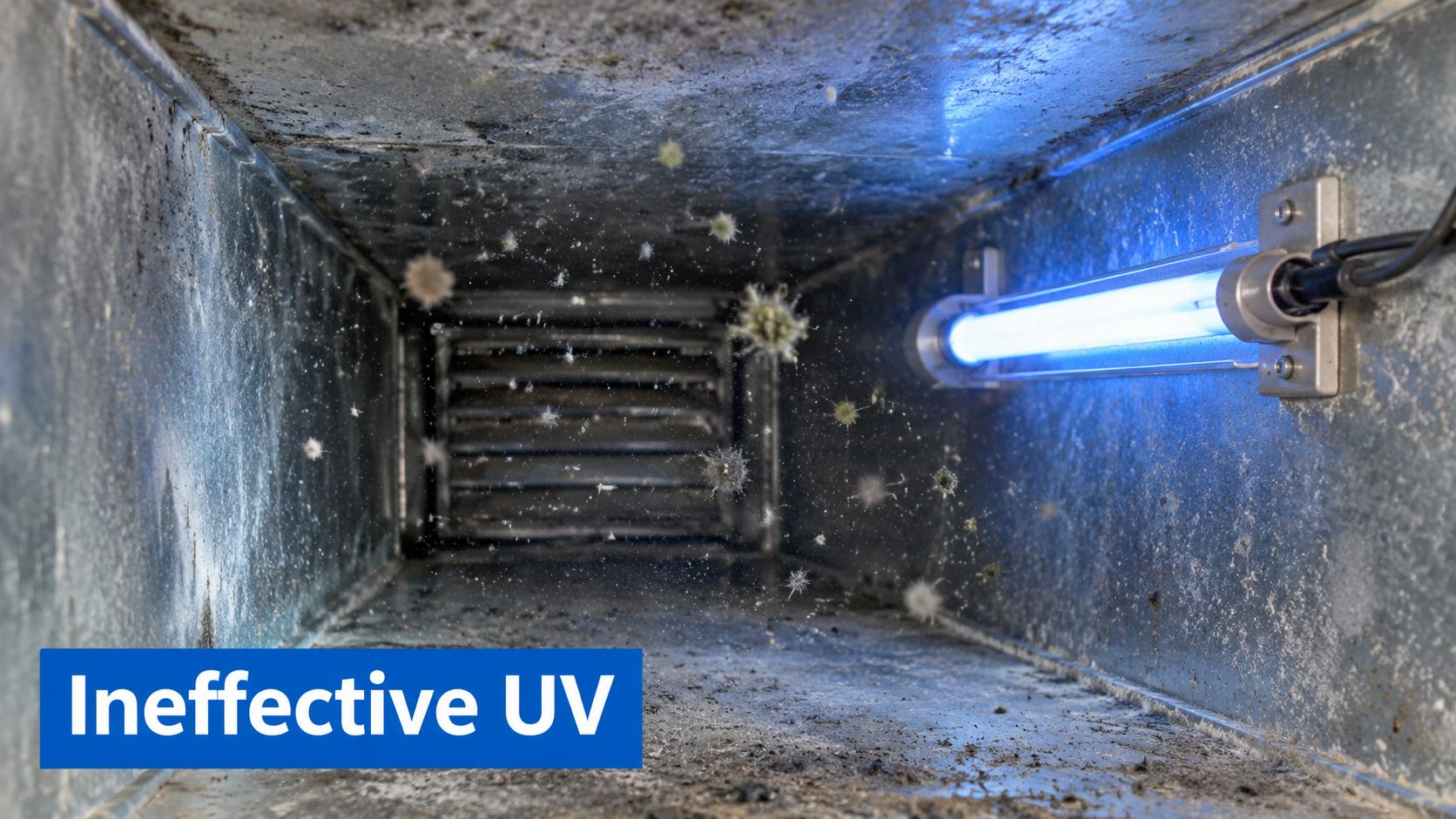
The difference between a lamp and a treatment system
The CDC and NIOSH guidance on HVAC ventilation describes UV air purification as a supplementary microbial-control technology, not a replacement for outdoor-air ventilation or mechanical filtration. Correctly designed, installed, and operated germicidal ultraviolet systems can inactivate airborne pathogens as they pass through an HVAC duct.
That qualification matters. Performance depends on UV dose, airflow speed, lamp placement, microorganism type, and maintenance. A lamp designed to treat a coil surface has a different job from a dedicated air-disinfection system. Coil-treatment devices primarily limit microbial growth on HVAC surfaces. Air-treatment systems need enough energy to affect air during its brief passage through the duct, which may require stronger or multiple lamps.
A useful first step is to stop asking whether the lamp is on and start asking whether the system has a documented treatment design. An indoor air quality monitor can help you observe changes in certain indoor conditions, but it can't independently prove that an in-duct UV system is delivering its specified germicidal dose. For that, you need HVAC measurements and equipment documentation.
Practical rule: If an installer can tell you only the lamp wattage, but not the expected irradiance, airflow, exposure time, or delivered dose, you haven't yet been given enough information to judge air-treatment performance.
Understanding Germicidal Dose and Airflow
Germicidal dose equals UV-C irradiance multiplied by exposure time. Irradiance is the intensity of UV-C energy reaching the microorganisms. Exposure time is how long those microorganisms remain within the effective treatment zone. Both variables matter, and one can't always compensate for a serious weakness in the other.
A longer chamber can give air more exposure time. Greater irradiance can provide more energy during a shorter passage. Multiple lamps can increase the available energy, but only if their placement, shielding, reflectivity, and operating conditions support the intended design.
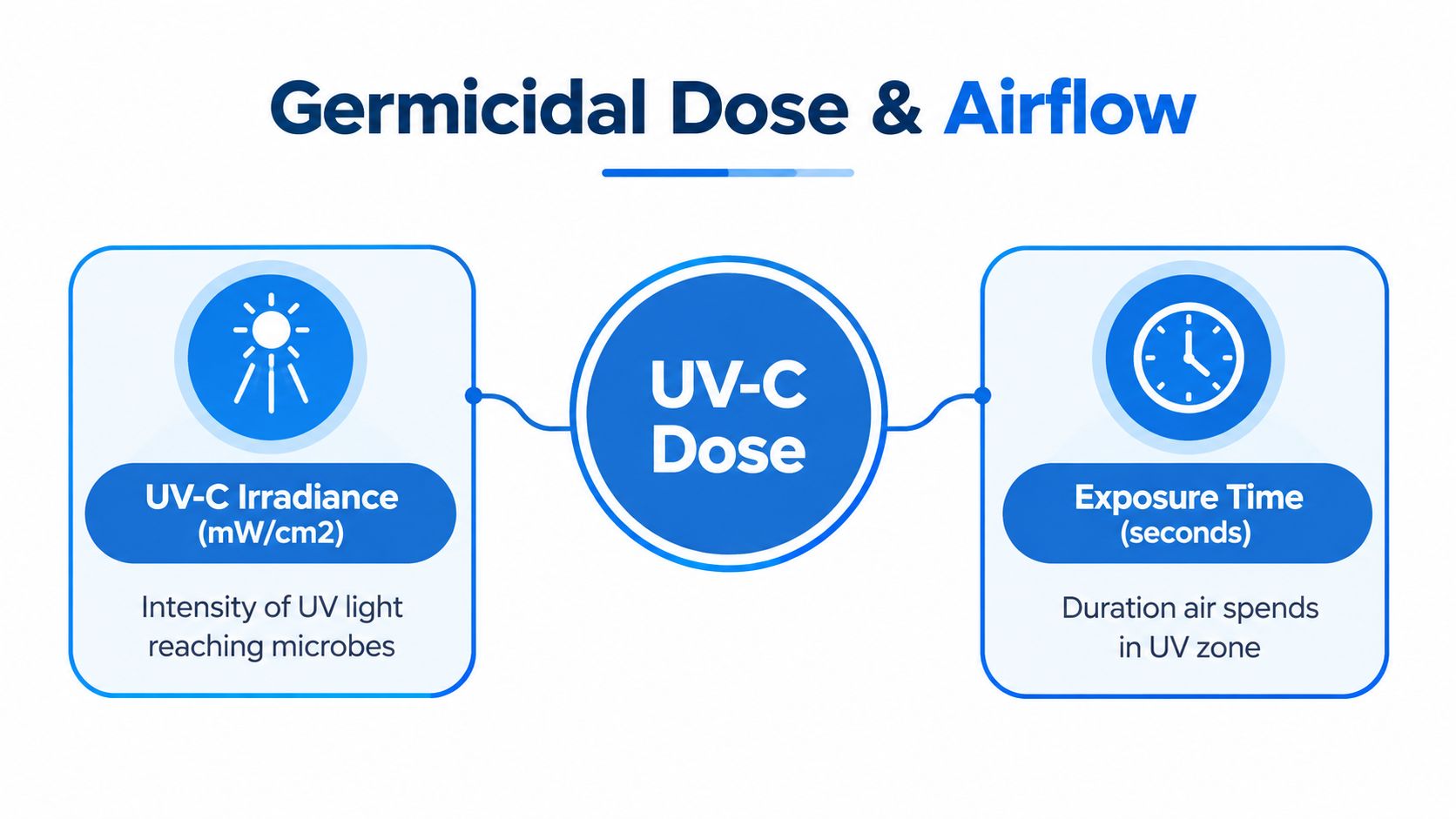
Why fan speed changes the result
When airflow increases, air spends less time in the UV zone. Unless the system adds irradiance, increases chamber length, or uses additional lamps, the delivered dose decreases. A system that reaches its intended performance at a low fan speed may underperform when the blower runs at a higher heating or cooling airflow.
ASHRAE guidance on filtration and disinfection identifies 1,500 µJ/cm² at approximately 254 nanometers as a conservative design target for 99% inactivation of SARS-CoV-2 in air, with a minimum exposure zone of about 0.25 seconds and design conditions of 500 feet per minute or less. These are design benchmarks, not universal guarantees. Microorganisms vary in susceptibility, and a target for one organism doesn't establish the same reduction for every contaminant.
The calculation must reflect the actual HVAC operating point. A contractor should consider measured duct airflow, treatment-chamber dimensions, lamp output, lamp age, temperature, humidity, fouling, and airflow variation. Nominal wattage by itself can't tell you how much UV energy reaches the air.
That's also why the mechanical filter deserves attention. A helpful explanation of why ducted AC filters matter can clarify a point that UV marketing often obscures: filters and UV perform different jobs. A filter physically captures particles, while UV can inactivate susceptible biological contaminants that receive sufficient exposure.
A compact room purifier follows a different design logic because it treats air locally rather than relying on a high-speed duct passage. The EcoRoom Plug-In Air Purifier for Small Rooms is described as a wall-plug air cleaner for small rooms, bedrooms, bathrooms, and offices, with a compact form that doesn't occupy shelf or desk space. It should be evaluated as a room-level product, not assumed to deliver the same function as an engineered in-duct UV chamber.
The video below provides a visual explanation of how UV-C treatment is incorporated into air-cleaning systems.
What UV Removes and What It Leaves Behind
UV-C is not a general-purpose particle filter. It can inactivate microorganisms when they receive sufficient energy, but the particle carrying that microorganism may remain in the air. The air can therefore contain a particle that is no longer infectious while still containing dust, pollen, smoke, or other material that a filter would need to capture.
This distinction explains many disappointing installations. A family may install UV to address pet dander or visible dust, but those are particle problems. Someone concerned about cooking fumes or chemical odors may expect UV to remove gases, even though gas removal requires a different control method. A musty smell may come from biological growth, moisture, trapped debris, or another source, so the lamp alone can't identify or solve the cause.
Match the contaminant to the control
The EPA technical guidance on residential air cleaners notes that UVGI may affect biological pollutants on HVAC components such as coils, drain pans, and ductwork. It also explains that typical residential units have limited effectiveness against bacteria and mold, while higher UV exposure is generally needed for reliable destruction of viruses and spores. EPA recommends using UVGI with filtration rather than treating it as a substitute.
| Contaminant type | Removal or control method | UV effective? |
|---|---|---|
| Dust and visible airborne particles | Mechanical filtration | No, UV doesn't capture the particle |
| Pollen and pet dander | Mechanical filtration and source control | No, not as a particle-removal method |
| Smoke particles | Mechanical filtration and ventilation | No |
| Airborne microorganisms | UV-C, filtration, and ventilation used in combination | Sometimes, when dose and exposure are adequate |
| Microbial growth on coils or drain pans | Coil treatment, cleaning, moisture control, and maintenance | Potentially, depending on exposure and installation |
| Chemical gases and non-biological odors | Source control, ventilation, and suitable gas-phase media | No |
| Musty odors from moisture or growth | Moisture correction, cleaning, ventilation, and appropriate air treatment | Not reliably by a lamp alone |
The table also shows why “purification” can be an imprecise product label. Inactivation is not the same as removal, and surface treatment is not the same as whole-air disinfection. A UV lamp aimed at a coil can help manage microbial growth on that coil without delivering sufficient energy to disinfect air moving through the duct.
A separate room-level technology may target different concerns. The Living Air Classic XL-15 Air Purifier is described as a filterless purifier using ionization and activated oxygen technology to help reduce airborne particles, odors, and stale indoor air in homes, offices, and other indoor environments. That function is distinct from the dose-dependent UV treatment of air inside an HVAC duct.
Verifying Your UV System Delivers Proper Dose
The most useful maintenance question isn't “Is the lamp still glowing?” It's “Does the installed system still deliver its intended dose at the current airflow?” Lamp output can decline with age, and dust on the lamp or reflector can reduce the energy reaching the treatment zone. A blower setting can also change the exposure conditions without changing the lamp's appearance.
Start by collecting the original installation information. Record the lamp model, installation date, intended operating conditions, chamber location, and any available irradiance or dose calculation. Keep that information with the HVAC service records so a technician can compare future measurements with the original design.
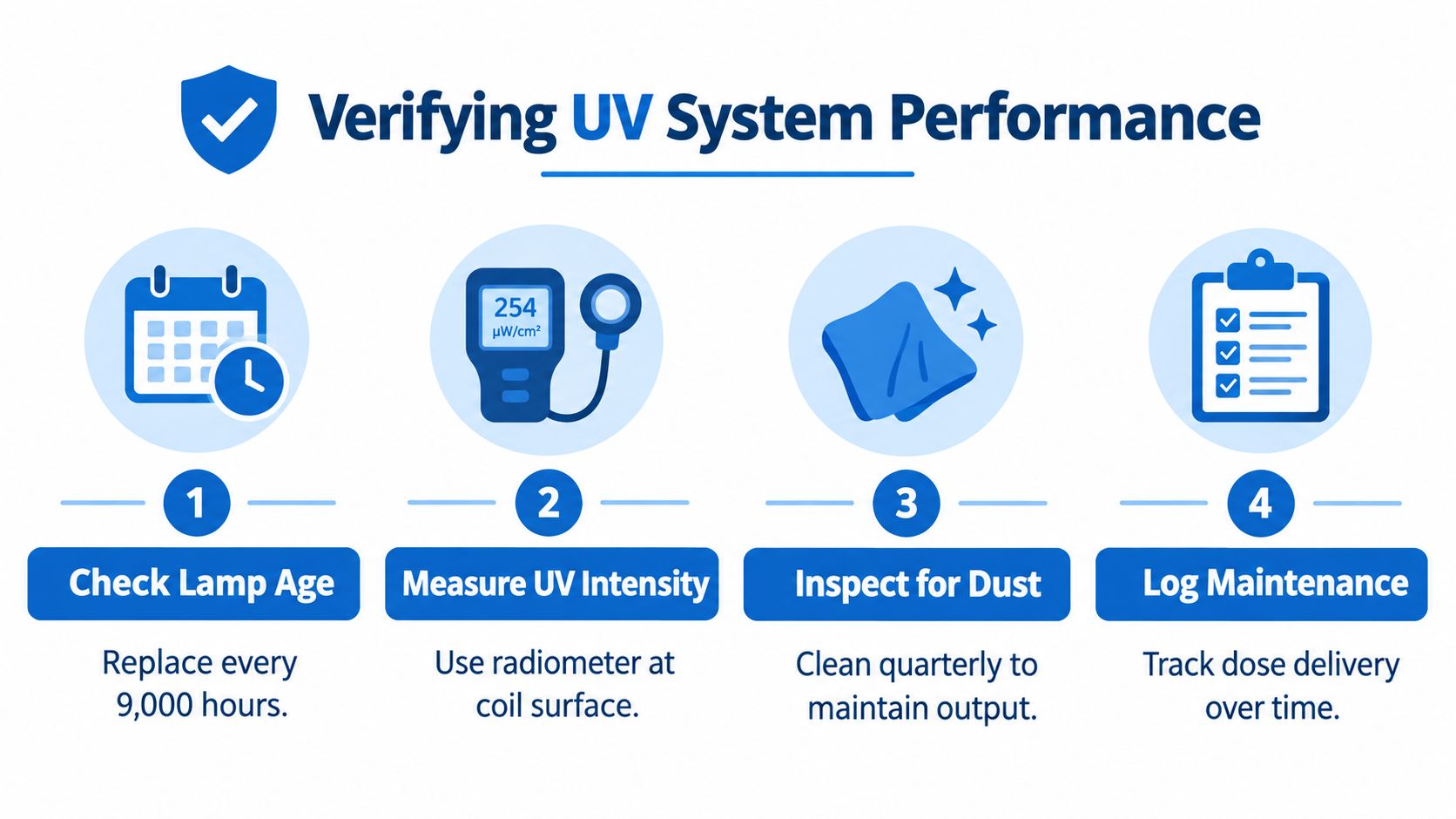
A practical verification workflow
Inspect the lamp and chamber. Dust, deposits, and fouling can block or scatter UV-C energy. A technician should inspect the lamp, reflector, chamber surfaces, wiring, and mounting position.
Confirm the operating airflow. The dose calculation must use the airflow the equipment delivers, including relevant heating, cooling, and high-speed fan settings. Don't rely on a calculation made for a slower operating condition if the system regularly runs faster.
Measure output with suitable equipment. A qualified professional can check UV intensity with an appropriate radiometer and compare the result with the design documentation. The lamp can remain visibly bright while its measured output has fallen below the intended level.
Check access safety and interlocks. The UV section should be enclosed and shielded. Service doors and switches should prevent direct exposure, and workers should know how to shut down the system before opening the equipment.
Clean and replace according to the service plan. EPA technical guidance on residential air-cleaner maintenance states that regular UVGI maintenance generally involves cleaning dust from lamps and replacing aging lamps. It also emphasizes following safety, exposure, maintenance, and monitoring instructions.
Safety is part of performance
A lamp that disinfects effectively but exposes occupants or service personnel to UV-C is not a successful installation. Direct or reflected UV-C can cause temporary eye and skin injury, so the section must be sealed and technicians must receive appropriate training. Systems should be shut off before maintenance, and access should be controlled.
Replacement parts need to match the equipment design rather than being selected by appearance alone. For example, replacement UV lamps and RCI cells should be checked against the relevant manufacturer and model requirements. A physically compatible lamp may still have different output characteristics, dimensions, or electrical requirements.
The EcoSpace, also called EcoZone, is described as a small-space air purifier for areas such as bathrooms, closets, kitchens, pantries, garages, and other compact spaces. Its listed coverage is 1 to 15 m², and its adjustable ozone output is part of its product design, so it should not be confused with an in-duct UV dose-verification procedure.
Integrating UV into a Layered Air Quality Strategy
A sound HVAC air-quality plan assigns each control a specific job. Ventilation brings in outdoor air and dilutes contaminants. Filtration captures particles. UV adds microbial inactivation when the air receives a suitable dose. None of these functions makes the others unnecessary.
The CDC and NIOSH guidance on germicidal ultraviolet systems explains that airborne particles must pass through the UV zone and receive sufficient energy. The particles may remain physically present after they have been rendered noninfectious, which is why UV doesn't replace a properly selected filter.
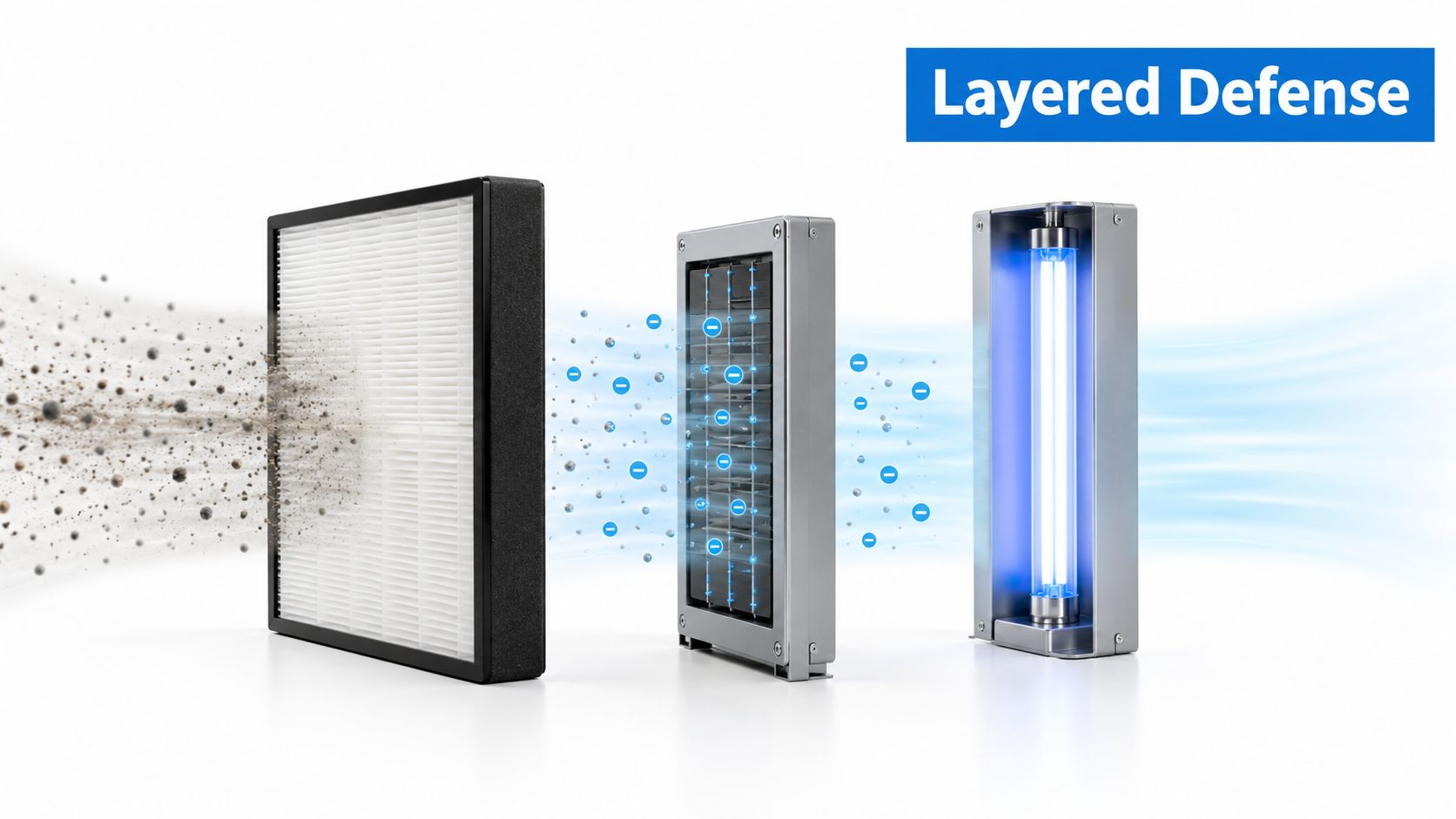
Build the layers around the actual problem
Start with the contaminant that concerns you most. If dust, pollen, smoke, or pet dander dominates, filtration and source control deserve attention before adding UV. If the building has inadequate outdoor-air delivery, correct ventilation remains fundamental. If moisture is creating microbial growth on coils or inside components, cleaning, drainage, humidity control, and equipment maintenance matter alongside any UV treatment.
In a home, the strategy may involve a correctly fitted filter, regular filter replacement, moisture correction, and an in-duct UV system with documented dose. In a school, office, healthcare facility, restaurant, or daycare setting, the design may also involve occupancy, airflow distribution, maintenance access, and professional commissioning.
Indoor comfort affects how people experience a building, but comfort and air cleanliness aren't identical. Guidance discussing temperature and employee performance in Ireland provides useful context for separating thermal conditions from broader indoor-environment decisions. A comfortable room can still have poor filtration or inadequate ventilation, while a well-treated air stream doesn't automatically correct an uncomfortable temperature.
An HVAC-integrated product category can be explored through whole-home HVAC air purifiers, but product selection should follow the system assessment, not replace it. Ask for airflow data, installation details, shielding information, maintenance requirements, and the expected dose at the operating condition that matters.
A layered strategy creates fewer false assumptions because each technology has a defined responsibility.
Common Misconceptions About UV Air Purifiers
A brighter lamp is not automatically a better purifier. Raw wattage doesn't reveal how much germicidal energy reaches the moving air. The chamber geometry, distance from the air path, exposure time, airflow, reflector condition, temperature, humidity, and lamp age all influence delivered dose.
UV doesn't replace filtration. A filter captures particles. UV can inactivate susceptible microorganisms that pass through the treatment zone and receive sufficient energy. Using one technology as a reason to remove or neglect the other leaves an important part of the air-quality problem untreated.
All UV systems don't perform equally. A lamp aimed at a coil may help limit microbial growth on that surface, while a dedicated air-disinfection system needs a different design. Residential units may also have limited effectiveness against bacteria and mold when exposure is insufficient, as the EPA guidance discussed earlier explains.
A glowing lamp doesn't prove effective purification. It proves that the lamp is powered. It doesn't prove that the lamp has adequate output, that air spends enough time in the chamber, or that dust hasn't reduced the energy reaching the air.
UV doesn't eliminate every odor. It may contribute to biological control in an appropriate application, but chemical odors, combustion smells, smoke, and gases require source control, ventilation, filtration, or gas-phase treatment. A musty smell also demands investigation of moisture and material contamination.
UV doesn't make particles disappear. An airborne particle can remain physically present after a microorganism on or within it has been inactivated. Anyone expecting cleaner-looking air, less dust on surfaces, or relief from particle-triggered allergies should evaluate filtration separately.
The reliable way to compare products is to ask for engineering information rather than visual reassurance. Look for the intended airflow, measured or calculated irradiance, exposure zone, maintenance procedure, shielding design, and the conditions under which the stated performance applies.
Making the Right Decision for Your Space
An in-duct UV purifier can make sense when microbial control is a defined part of the building's air-quality plan. It may be relevant where equipment surfaces need microbial-growth control, where a facility wants an additional air-disinfection layer, or where a professional assessment shows that the HVAC layout can provide the required exposure conditions.
It's a weaker first choice when the main complaint is dust, pet dander, smoke, or chemical odor. Those concerns point toward filtration, ventilation, source control, moisture correction, or suitable gas-phase treatment. Adding a glowing lamp without addressing the dominant contaminant can create confidence without solving the problem.
Questions to ask before purchase
Ask the installer to answer these questions in writing:
- What is the actual airflow? Request the operating airflow used in the design, not a generic HVAC rating.
- What dose reaches the air? Ask for irradiance, exposure time, and delivered-dose calculations for the relevant fan setting.
- Is this coil treatment or air treatment? The two applications have different goals and design requirements.
- How will the system remain safe? Confirm enclosure, shielding, service access, and shutdown interlocks.
- How is performance maintained? Request the lamp-replacement, cleaning, inspection, and measurement schedule.
- What problem will UV not solve? A credible recommendation should identify the limits of the technology.
The foundational purchasing question is not whether a lamp is present. It's whether the HVAC installation supplies a documented germicidal dose at its actual airflow and remains safe and effective over its service life. A qualified HVAC professional should be able to assess duct airflow, lamp placement, chamber conditions, shielding, maintenance access, and compatibility with the existing filtration and ventilation strategy.
If you're comparing indoor-air products for a home, office, or specialized space, EcoQuest Purifiers offers HVAC-integrated and room-level air-quality equipment, replacement parts, and related purification technologies. Visit the catalog with your contaminant priorities and HVAC details ready, then ask for product documentation that helps you compare dose, maintenance, safety, and the role each device plays in a layered air-quality plan.