
UV Air Purifier Whole House: What It Does and Doesn't
The most common advice about a whole-house UV air purifier is to buy a powerful lamp and let the HVAC system do the rest. That's the wrong buying test. Delivered UV dose, actual airflow, and maintenance determine performance, not the wattage printed on the box.
If you're searching for “UV air purifier whole house” options, ask a harder question: what microbial treatment will this installation deliver while your air handler is running? A credible answer requires measured airflow, relevant performance testing, and a service plan. A germ-kill claim without those conditions isn't enough to choose equipment.
Table of Contents
- How Whole-House UV Purification Works
- Where UV Fits Beside Filters and Ventilation
- Sizing Dose and Verifying the Installation
- Why Airflow and Recirculation Change Results
- Maintaining Lamps and Following Safety Rules
- Who Should Buy Whole-House UV and Next Steps
How Whole-House UV Purification Works
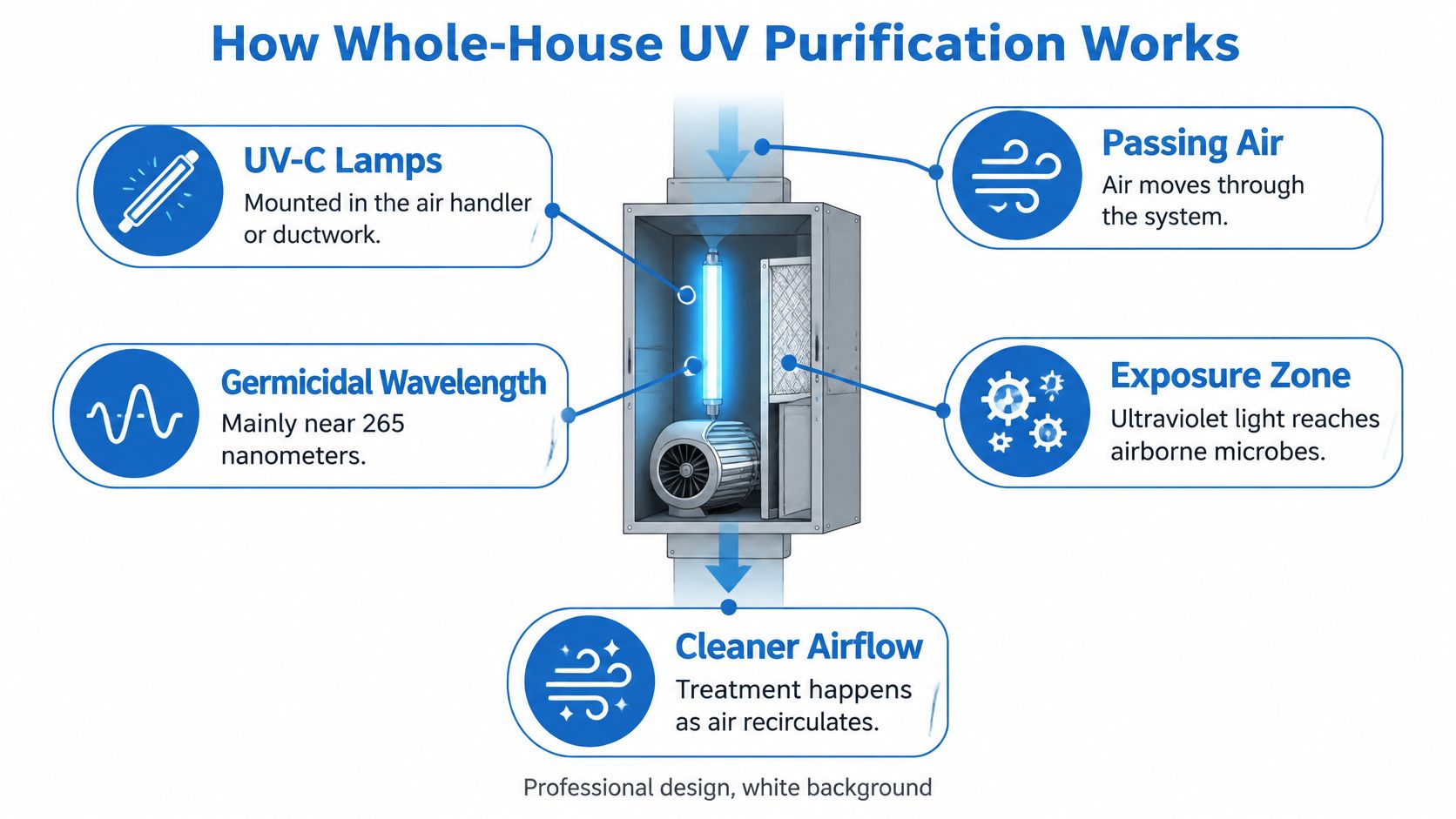
UV-C lamps mounted in the air handler or ductwork expose passing air to germicidal ultraviolet light, with peak germicidal effectiveness near 265 nanometers, according to the ASHRAE handbook on ultraviolet air and surface treatment. The light damages microbial genetic material, preventing adequately exposed organisms from reproducing.
Think of the air stream as a conveyor belt traveling beneath a lamp. The belt carries microorganisms through an illuminated zone, but each organism receives only the exposure available during that trip. Speed up the belt without changing the lighting or treatment-zone length, and exposure falls.
The central distinction: Installing a UV lamp creates an opportunity for disinfection. Delivering an adequate dose makes that opportunity useful.
Say a contractor mounts a lamp beside an HVAC coil. The coil surface can remain illuminated while the lamp operates, whereas airborne microbes pass through quickly. Evidence of surface treatment therefore doesn't automatically establish effective treatment of moving air.
ASHRAE distinguishes these applications through separate test methods. Its airborne-device standard evaluates UV-C equipment in air-handling units and ducts; its surface standard evaluates microbial inactivation on irradiated surfaces. Buyers should ask which application a manufacturer tested rather than accepting a general claim of household sterilization.
The diagram shows where treatment happens within the recirculating air path.
Disinfection isn't particle capture
A UV lamp doesn't physically collect dust, pollen, or smoke particles. Nor should buyers assume that direct UV treatment removes odors. Inactivation and removal are different jobs: a microorganism can lose its ability to reproduce without its carrier particle disappearing from the air.
That distinction changes how to evaluate the installation. A whole-house UV system is an HVAC disinfection stage, not a universal air cleaner. Its usefulness depends on what receives irradiation, how much exposure it receives, and whether the equipment maintains that exposure during operation.
Where UV Fits Beside Filters and Ventilation
A whole-house UV system earns its place by treating the target in the air handler, while other controls address particles, dilution, or emissions at their source. These jobs are distinct, so the first intervention should match the complaint.
| Control | Main function | Limitation | Role in the plan |
|---|---|---|---|
| In-duct UV-C | Treats viable airborne microbes and microbial growth on irradiated surfaces | Performance depends on exposure in the installed system | Supplemental microbial stage |
| MERV 13 filter | Captures airborne particles, including many that carry microbes | Does not inactivate captured microbes | Particle capture |
| Ventilation | Dilutes indoor contaminants with outdoor air | Indoor sources can continue emitting | Dilution baseline |
| Source removal | Stops a contaminant at its origin | Does not address contaminants already airborne | Primary control |
The table separates treating an organism, capturing a particle, diluting a concentration, and stopping an emission. A homeowner dealing with smoke entering a living space needs a different first intervention from someone seeking microbial treatment inside an air handler.
The EPA's residential air-cleaner guidance reports no standard method for rating and comparing residential UVGI cleaners. It describes limited effectiveness against bacteria and molds in typical home units, and says UVGI did not appear effective as a sole control device. Some viruses and most mold and bacterial spores, the guidance cautions, require substantially more exposure than typical residential equipment provides. These limits make installation conditions central to assessing a UV system.
Match the control to the complaint
For dust and pollen, start with particle filtration and check that the filter fits correctly. A bypass gap lets air avoid the filter media, while the filter's particle-capture rating says nothing about microbial inactivation.
For recurring mold, address moisture and remove the affected source appropriately. Illuminating an HVAC component cannot repair a leak or dry damp materials outside the treated area.
Ventilation dilutes indoor contaminants, but it cannot stop an indoor source from continuing to emit them. Source removal addresses that origin; filtration and ventilation can then help manage what remains airborne.
- Particle complaint: Check filter compatibility, sealing, and airflow.
- Persistent odor or smoke: Identify and control the source before adding equipment.
- Microbial-treatment objective: Consider UV as an additional, specifically engineered stage.
When comparing HVAC-integrated air purification options, ask whether the vendor states which organisms the UV stage was tested against and at what airflow. A product category or combination of technologies does not show that a particular installation will solve a particular air-quality problem. The relevant evidence is tied to the organisms and operating conditions the system is designed to treat.
Sizing Dose and Verifying the Installation
Design reference values for an in-duct UV-C system
| Parameter | Reference value | Why it matters |
|---|---|---|
| Minimum UV-C dose | 1,500 µJ/cm² | Sets the design dose target for microbial treatment |
| Air velocity | 500 ft/min or less | Faster air shortens exposure time |
| Irradiated zone length | At least 2 ft | Provides distance over which irradiation occurs |
| Exposure time | About 0.25 seconds | Describes residence time during a pass |
| Filtration pairing | MERV 13 where fan pressure allows | Captures particles UV doesn't remove |
These are design inputs, not a universal promise of pathogen elimination. The contractor must determine the required treatment for the intended organism and the conditions of the actual installation.
Dose is irradiance multiplied by exposure time, under a simplified uniform-exposure model. Irradiance describes the ultraviolet energy reaching an area; exposure time describes how long an organism receives it. Lamp wattage alone establishes neither.
A useful comparison starts with the energy reaching the moving air, not the electricity consumed by the lamp. A powerful lamp mounted poorly can leave parts of the air stream inadequately treated.
Consider a fan switching from a lower to a higher operating setting while the illuminated zone stays the same. Faster-moving air spends less time inside that zone. The design must account for the operating condition that produces the shortest relevant exposure.
The treatment-zone length is the illuminated path, not the lamp's physical length. Air needs to pass through a useful irradiation field; fitting a long lamp inside a cabinet does not establish that such a path exists.
Residence time should be calculated from measured airflow and chamber geometry. An estimate based only on floor area cannot describe how air moves through the installed duct.
Why nominal wattage is a weak comparison
Lamp aging, accumulated dust, temperature, humidity, and duct geometry can reduce delivered treatment. Installation design must account for these conditions rather than assume laboratory output will remain unchanged.
The ASHRAE handbook on ultraviolet treatment design supports evaluating dose through engineering analysis and modeling rather than choosing equipment by wattage alone. It also distinguishes performance during a single passage from reductions accumulated through repeated recirculation.
The practical buying conclusion is that a lower-wattage system with adequate residence time and a validated chamber can outperform a brighter lamp in a fast, poorly configured duct. Electrical input is not useful exposure.
Request evidence of treatment at your operating airflow, not merely proof that the bulb turns on.
The commissioning checklist buyers should request
Commissioning verifies that installed equipment performs as intended. Ask the contractor to include these items in the handover documents.
Record measured airflow. Obtain the air-handler airflow in cubic feet per minute or cubic meters per hour. Record which fan settings were checked, especially if airflow changes between operating modes.
Match testing to that airflow. Request the manufacturer's dose or inactivation results under comparable conditions. Identify the organism tested, chamber arrangement, lamp condition, and applicable ASHRAE airborne-device test method. A percentage without those details is incomplete evidence.
Verify enclosure and access protection. Confirm that the treatment chamber prevents UV leakage into occupied areas. Have the technician explain how access switches, warning labels, and the electrical disconnect protect service personnel.
Document the irradiation path. Request chamber dimensions, lamp orientation, and calculated residence time. If the available duct space is unsuitable, the installer should explain the engineered alternative rather than place a lamp wherever it fits.
Separate single-pass from cumulative performance. Label each claim clearly. Treatment measured during passage through a device is not the same outcome as a concentration reduction throughout an occupied house.
Check the filter and fan together. Confirm the upstream filter arrangement, available fan capacity, and pressure drop. More restrictive media can change airflow, which may affect the conditions used to select the UV system.
Assign maintenance responsibility. Record how lamp hours will be tracked, who will inspect and clean the lamps, and who will replace them at the end of useful life. Include replacement-part identification in the handover package.
An indoor air-quality monitor may inform a broader assessment, but its readings do not verify UV dose. Check what it measures. Room readings cannot substitute for airflow measurement, relevant irradiance verification, and device performance documentation.
Keep the commissioning record with the HVAC service paperwork. A tidy installation and paid invoice show that equipment was installed, not that it delivered an appropriate microbial dose.
Why Airflow and Recirculation Change Results
In an experiment summarized by a systematic review of UV-C air disinfection, increasing air changes per hour from 2 to 6 improved effectiveness by 7% without a mixing fan and 24% with one. The useful lesson isn't a transferable household performance number. It's that air movement and mixing materially changed the treatment outcome.
The review found reductions in viable airborne respiratory bacteria in every included study, but results differed with organism type, airflow, mixing, ultraviolet intensity, and exposure conditions. A successful apparatus test establishes what happened under that test's conditions, not what will happen in every room connected to an HVAC system.
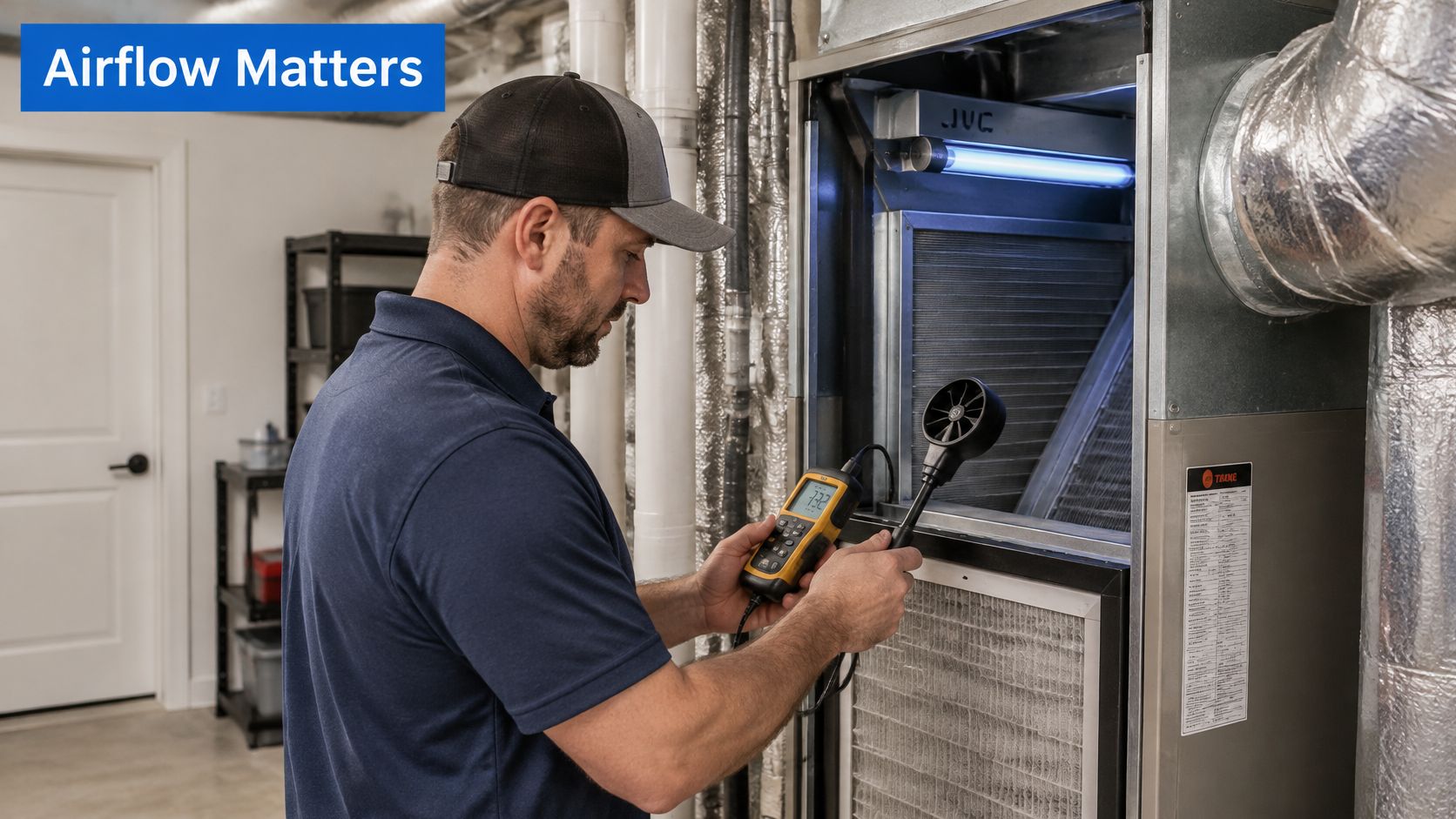
Airflow measurement is therefore part of evaluating treatment, not merely a comfort check.
Device performance isn't room performance
Consider a home office where a person releases respiratory particles while the air handler is off. Those particles don't immediately reach the UV chamber. Even after the fan starts, room mixing and the return-air path affect when contaminated air reaches treatment.
A laboratory test can control flow through an apparatus. A house adds closed doors, leakage paths, uneven mixing, intermittent fan operation, and continuing indoor emissions. These conditions separate inactivation inside the device from exposure reduction where people breathe.
Repeated recirculation can provide cumulative treatment, often described as multiple dosing. But repeatedly treating some air doesn't prove that air from every occupied location reaches the chamber equally well.
Whole-house describes the HVAC connection. It doesn't establish uniform treatment throughout the building.
When evaluating an in-duct air-treatment unit, ask how its tested operating conditions compare with your fan schedule and return-air arrangement. Product placement within the duct system is only part of that assessment.
For virus concerns, request virus-specific dose and inactivation evidence rather than extrapolating from bacterial testing. Don't assume ordinary residential exposure is sufficient.
Finally, ask whether the system runs long enough to recirculate air from the occupied rooms. An installer should answer using airflow, operating schedules, and distribution conditions, not the thermostat's fan setting.
Maintaining Lamps and Following Safety Rules
Maintenance and safety schedule for an in-duct UV-C system
| Task | Interval or trigger | Reason |
|---|---|---|
| Lamp replacement | End of rated useful life; consider annual replacement for continuous operation | Germicidal output declines with age |
| Lamp inspection and cleaning | Each HVAC service visit, with additional checks based on fouling | Dust or film reduces output |
| Failing lamp replacement | Promptly when failure is identified | Intended treatment is no longer maintained |
| Lamp access | Only with the lamp de-energized | Prevents worker exposure to UV |
| Ozone-producing lamp shutdown | Switch off lamps first, ventilate the chamber, then stop the air handler before access | Reduces ozone exposure during service |
The ASHRAE guidance on ultraviolet equipment maintenance and safety advises replacing lamps at the end of useful life and notes that annual replacement may be prudent for continuous operation, approximately 8,760 operating hours. The rated service interval and operating record should guide the maintenance calendar.
A glowing lamp isn't proof of adequate germicidal output. Aging and surface deposits can reduce useful irradiation before a homeowner notices an obvious failure. Have the service technician record installation dates, operating hours where available, cleaning, and replacement.
Make inspection safe and repeatable
The inspection-and-cleaning entry is a practical service checkpoint, not permission to open energized equipment. A trained technician should de-energize the lamp before accessing the chamber and follow the equipment's cleaning procedure.
Ask the technician to check the enclosure, access interlocks, electrical connections, and lamp condition during service. Workers need appropriate protective eyewear, clothing, gloves, and training. Protective equipment doesn't replace shutdown and isolation.
- Dirty lamp: Arrange cleaning and inspection before assuming the design output is available.
- Expired or failing lamp: Replace it with the specified compatible part rather than judging it by visible brightness.
- Broken lamp or damaged enclosure: Keep the equipment out of service until a qualified technician assesses it and follows the lamp-specific handling procedure.
- Unexpected energized access: Stop work and isolate the equipment; don't continue an inspection with the lamp exposed.
Service access matters when comparing quotations. A lamp installed where a technician cannot conveniently inspect, clean, or replace it creates a foreseeable maintenance problem. Request replacement-lamp costs, labor arrangements, and part availability before purchase.
Keep room products and duct maintenance separate
The EcoRoom Plug-In Air Purifier for Small Rooms is a compact wall-plug air cleaner intended for spaces such as bedrooms, bathrooms, and offices. That room-level format serves a different installation context and doesn't replace maintenance of an existing HVAC UV system.
For any proposed lamp, ask whether it produces ozone. If ozone-producing equipment is present, the shutdown order matters: switch off the lamps while the air handler continues ventilating the chamber, then shut down and isolate the air handler before opening it. Have the contractor document the equipment-specific ventilation procedure rather than improvising a waiting period.
Who Should Buy Whole-House UV and Next Steps
Whole-house UV suits buildings with usable ductwork, a defined microbial-control objective, and an owner prepared to maintain the equipment. It is a poor first purchase when the problem is an uncontrolled pollutant source, unresolved moisture, or inadequate particle filtration. UV treatment does not address those underlying conditions.
Homeowners should distinguish a goal of reducing airborne allergens from one of microbial inactivation. Households with immunocompromised members should seek clinical advice about protective measures, rather than relying on a residential purifier as a guarantee against infection.
Offices, daycare centers, gyms, and restaurants may consider supplemental microbial treatment in shared-air systems. Occupancy alone does not establish suitability. The operator must account for ventilation, air distribution, operating schedules, and who will handle service.
Use a documentation-based buying rule
If the installer cannot state the airflow, provide performance evidence for treatment at that airflow, and describe the maintenance plan, the proposal is not ready for purchase. Use the commissioning checklist in the sizing section to review installation details, then compare proposals on the evidence and responsibilities they document.
Request installed-cost and energy estimates in writing. The quote should identify electrical work, commissioning, replacement lamps, cleaning access, and expected service obligations. These details make it possible to compare the ongoing ownership requirements, not just the initial equipment choice.
Ask for performance evidence suited to the intended target, including virus-specific results if viruses are the concern. For households with immunocompromised members, discuss how the proposed system fits into clinical guidance and other protective measures before committing to a purchase.
A whole-house UV system is a reasonable candidate when the building's needs, operating conditions, and maintenance capacity align. If the proposal leaves those assumptions unclear, wait for written documentation before buying.
EcoQuest Purifiers offers HVAC-integrated and room air-quality products, replacement parts, and repair services. Visit EcoQuest Purifiers to explore the available options, then request the airflow, performance, and maintenance documentation needed to assess a whole-house installation.