
What Causes Poor Indoor Air Quality: Sources and Fixes
In poorly ventilated dwellings, indoor smoke can reach fine-particle levels about 100 times higher than acceptable, according to the World Health Organization household air pollution fact sheet. That gap reframes what causes poor indoor air quality. It's rarely one bad product or one dusty room. It's a sequence where a source emits, moisture helps other pollutants grow or off-gas, and ventilation fails to remove what people keep producing.
Table of Contents
- Main Causes of Poor Indoor Air at a Glance
- How Combustion and Cooking Load the Air
- Moisture, Mold and Biological Particles
- How Sealed Buildings Trap Pollutants
- Why Opening Windows Does Not Always Help
- Diagnosing Which Problem Your Space Has
- Choose Your First Fix This Week
Main Causes of Poor Indoor Air at a Glance
Poor indoor air comes from pollutant sources inside the building combined with too little ventilation to dilute and remove them. Either side can tip the balance. A modest source in a sealed bedroom can matter more than a stronger source beside an exhaust fan that vents outdoors.
The U.S. Environmental Protection Agency guide to indoor air quality identifies fuel-burning appliances, tobacco smoke, cleaning and personal-care products, pesticides, paints, pressed-wood furniture, carpets, and other building materials as common indoor sources. Those sources can emit particulate matter, carbon monoxide, volatile organic compounds, and other chemicals. The same guide notes increased use of synthetic materials and products has contributed to higher concentrations of some indoor pollutants in recent decades.
Sorting Sources by How They Behave
| Source family | Common examples | Pollutants released | Usual control |
|---|---|---|---|
| Combustion | Gas stoves, fireplaces, wood stoves, tobacco smoke, attached garages | Fine particles, carbon monoxide, nitrogen oxides | Vent outdoors, service appliances, install CO alarms |
| Chemical emissions | Paints, cleaners, air fresheners, pressed-wood furniture, new carpet | Volatile organic compounds, formaldehyde | Ventilate during use, choose low-emission products, store solvents outdoors |
| Biological | Mold on damp surfaces, dust mites, pet dander, pollen | Mold spores, allergens | Fix leaks, control humidity, clean and vacuum with HEPA filtration |
| Particulate | Cooking, cleaning, dust, outdoor infiltration | PM2.5, PM10 | Local exhaust at the source, filtration, sealing entry points |
| Building and HVAC | Poorly maintained HVAC, low outdoor air supply, soil gas | Radon, carbon dioxide, mixed pollutants | Mechanical ventilation, radon testing and mitigation |
Not every pollutant starts indoors. Outdoor pollution enters through doors, windows, cracks, and ventilation systems, and radon can migrate from soil into buildings. That's why a room can stay polluted after you remove a cleaner or candle. The building may be importing the problem.
Moisture creates a separate route. Damp materials and poorly maintained heating, ventilation, and air-conditioning systems can support mold, while dust mites and pet dander add biological particles. A wet wall isn't just a building defect. It's a continuous source.
Rule of thumb: Indoor air gets worse when emissions rise, moisture supports growth, or ventilation fails to remove what's produced.
Use that test room by room. Ask what's emitted there, whether water collects there, and where the air goes next. If you can't name the exit path, dilution is probably guesswork.
How Combustion and Cooking Load the Air
A gas burner exhausts combustion gases whether or not you see smoke, and without an outdoor path that exhaust becomes room air. Fireplaces, wood stoves, and tobacco smoke follow the same sequence: the source emits, ventilation must carry the output outside, and anything missed remains in the room.
The cooking setup below shows why distance matters. The cook stands closest to the plume, often before a hood has captured it.

Air cleaning can reduce particles after a plume escapes. Outdoor discharge remains the removal step that keeps exhaust from becoming room air.
The exposure is substantial worldwide. The U.S. National Institute of Environmental Health Sciences indoor air page summarizes World Health Organization findings that household air pollution is caused largely by burning wood, animal dung, charcoal, agricultural waste, and kerosene in or around homes, causes more than 3 million premature deaths each year, and has a reported disease distribution of 32% from ischaemic heart disease, 23% from stroke, 21% from lower respiratory infections, 19% from chronic obstructive pulmonary disease, and 6% from lung cancer.
From Open Fires to a Modern Kitchen
A modern kitchen uses different fuels. The source sequence stays the same. Gas ranges, fireplaces, wood stoves, tobacco smoke, attached garages, and improperly vented heating equipment still load indoor air. Incomplete combustion produces fine particles and toxic gases that can penetrate deep into lungs and enter the bloodstream.
Sear food at high heat on a gas range and two sources run at once. The flame adds combustion gases, including nitrogen oxides and carbon monoxide from incomplete combustion. Hot oil adds fine particles at the same time. If the hood recirculates, is undersized, or starts after the pan is smoking, you breathe the first and strongest part of the plume.
Grease makes capture worse over time, so regular degreasing matters. A practical routine to clean kitchen vents and grout can keep vents and surrounding surfaces from holding residue that reheats and smells during the next cooking session.
The video below connects the kitchen source to the exhaust path, where most home fixes succeed or fail.
Run two checks this week. First, confirm whether your range hood vents outdoors by checking for an exterior cap and feeling for discharge while it runs. Second, confirm a working carbon monoxide alarm sits near sleeping areas. A recirculating hood and a missing alarm leave you without capture or warning.
Moisture, Mold and Biological Particles
A bathroom with no exhaust fan tells the story quickly. A shower fills the room with steam, mirrors stay fogged, and dark spots appear on caulk. Days later, a musty smell reaches the hallway even though the shower looks clean.
Mold needs moisture and organic material, and homes supply both. Leaks, window condensation, damp basements, and wet carpets feed growth on drywall, wood, dust, and grout. Once colonies form, disturbing the surface or running air across it can release spores into rooms you use more often.
How HVAC Spreads a Local Problem
Drain pans, ducts, cooling coils, and humidifiers stay wet by design or by neglect. If mold grows there, the blower can distribute spores through the whole house. Changing a filter helps capture particles, but it won't correct standing water or a slimy drain pan.
- Dust mites: They thrive in bedding, upholstered furniture, and carpet when humidity stays high.
- Pet dander and pollen: People and pets carry them in on skin, hair, clothing, and shoes, then furniture releases them back during use.
- Bacteria and mold fragments: Damp HVAC parts and wet building materials can keep supplying them after the original leak stops.
Humidity does more than support biology. It can also raise emissions from furnishings and products, so moisture multiplies chemical sources rather than acting alone. A damp room with new furniture can therefore produce both allergens and stronger chemical odors.
Homeowners comparing a mold-focused air purifier should still fix the water source first. Filtration can reduce airborne particles after drying and cleaning, but active growth behind a wall keeps replacing them. For a small bathroom or bedroom after moisture control, the EcoRoom Plug-In Air Purifier for Small Rooms is a compact wall-plug cleaner designed for small rooms, bedrooms, bathrooms, and office spaces without taking shelf or desk space.
Keep relative humidity between about 30% and 50%, fix leaks within days rather than weeks, and dry any area that stayed wet for more than 24 hours.
Those three targets work together. Low humidity slows mites and mold, fast repairs limit the food and water supply, and rapid drying prevents a one-time spill from becoming a hidden source.
How Sealed Buildings Trap Pollutants
A newly renovated apartment gets new flooring, fresh paint, and pressed-wood cabinets in the same month. Each material may meet its own product standard, but together they emit into a tight unit with low air exchange. Occupants notice odors and irritation for weeks because the combined output exceeds what the building removes.
Indoor concentration is set by two rates: what enters the air and what leaves it. Poor indoor air usually involves a failure in sequence, a source that emits, an envelope too tight to release the output, and, in damp buildings, moisture feeding further sources. The diagram below sets out the source-versus-removal balance before the contaminant groups make it more specific.
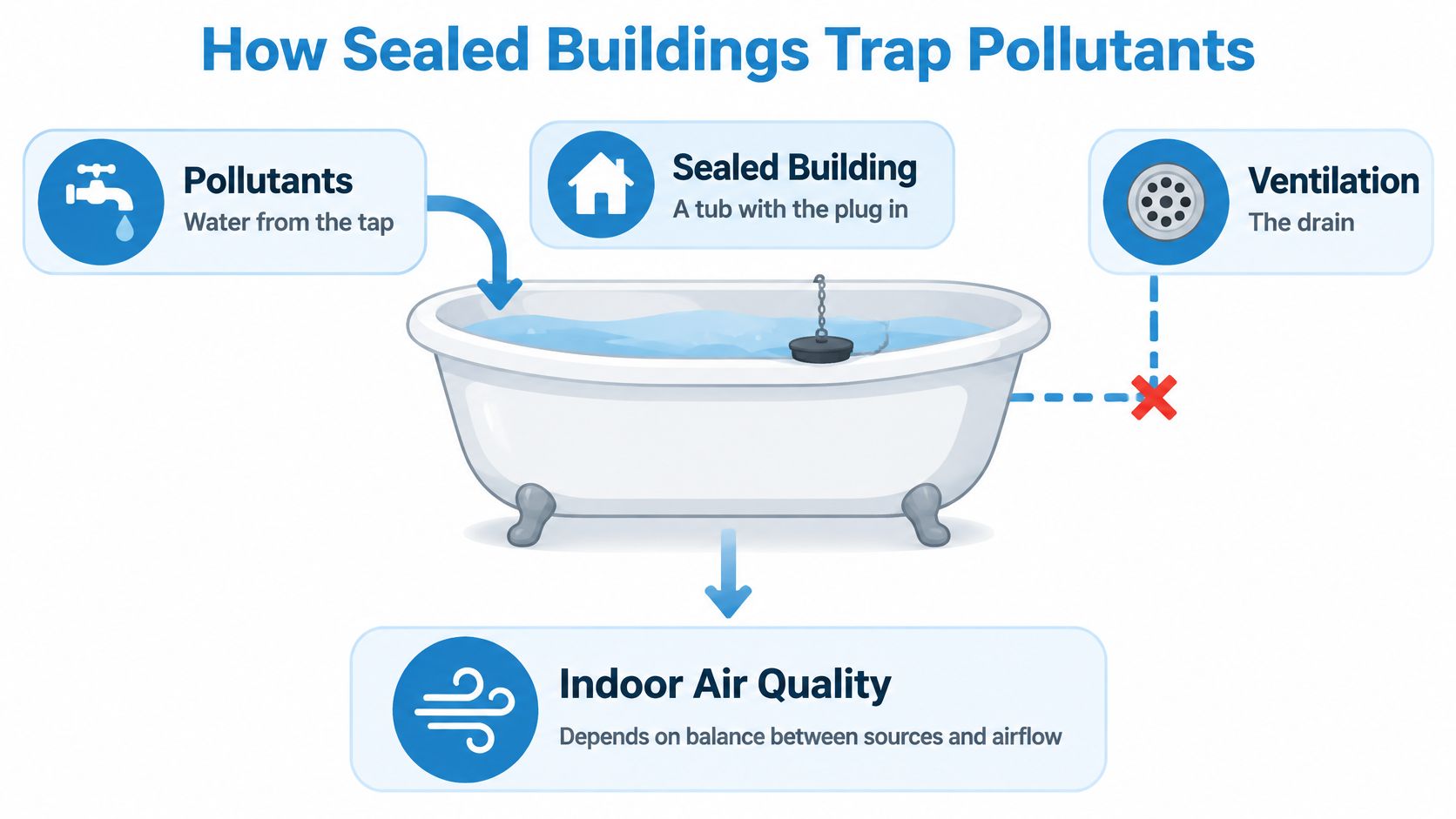
The ASHRAE position document on indoor air quality classifies major contaminants as particulate matter, organic gases such as volatile and semivolatile compounds, and inorganic gases including carbon monoxide, ozone, and nitrogen oxides. That split matters because one control rarely handles all three equally well. A particle filter doesn't remove carbon monoxide, and outdoor air that dilutes VOCs can bring in ozone or smoke.
When Efficiency Removes the Safety Margin
Energy-efficient envelopes reduce uncontrolled leakage. Without correctly designed outdoor-air supply and source-local exhaust, they can increase exposure to volatile organic compounds, particulate matter, carbon monoxide, and biological aerosols. Older leaky buildings wasted energy, but their cracks sometimes diluted emissions by accident.
Modern construction removes that accidental dilution. When leakage drops and no designed ventilation replaces it, indoor concentration depends almost entirely on how much the sources emit. That is why two homes with identical materials can have very different air: the tighter one accumulates what the leakier one vented.
Radon follows a quieter path from soil through foundation cracks and openings. You can't smell it, and ventilation guesses won't tell you whether it's present. A short-term test kit on the lowest lived-in level for at least 48 hours gives a starting result. Readings at or above the EPA action level of 4 pCi/L call for mitigation by a certified radon contractor, usually a sub-slab depressurization system that vents soil gas outdoors.
The stakes justify the test. The EPA estimates radon exposure is associated with approximately 21,000 U.S. lung-cancer deaths annually.
Control order: Remove or isolate the source first, then design ventilation, then add filtration.
Reversing that order asks equipment to chase emissions you could have stopped. Source control reduces the load every hour, including when a fan is off or a filter is overdue for replacement. Ventilation and filtration still matter. They perform best as the second and third steps in the sequence.
Why Opening Windows Does Not Always Help
Many people believe an open window solves indoor pollution. It helps only when outdoor air is cleaner than indoor air and when the airflow reaches the polluted room.
Traffic exhaust, construction dust, wildfire smoke, and industrial emissions can enter through the same opening that's supposed to provide relief. Meanwhile, cooking, cleaning, smoking, pets, and building materials keep generating pollutants indoors. You're diluting a source that hasn't stopped.
A 2026 study of patients with chronic respiratory disease found that 89% relied on opening windows for ventilation, while participants also identified cooking, dampness, condensation, and bathrooms as important pollution-related concerns. That combination exposes the gap. The most common response doesn't directly capture stove exhaust, dry a bathroom, or fix condensation.
Dilution Is Not Source Capture
Dilution lowers the concentration of airborne pollutants by mixing room air with cleaner air. Source control prevents or captures emissions before they spread. An open window across the apartment can't pull a frying plume into a hood, remove compounds absorbed by carpet and upholstery, or stop a cabinet from off-gassing.
Surface reservoirs complicate the picture. Chemicals and particles deposit on fabrics and hard surfaces, then re-enter air during activity or react with other compounds. Air can smell fresher for an hour while the underlying source remains ready to reload the room.
- Open windows: Choose times when outdoor air is clearly cleaner, such as after traffic eases and no smoke or construction plume is visible.
- Keep windows closed: Avoid natural ventilation during wildfire smoke, heavy traffic peaks, and nearby industrial or construction emissions.
- Pair the opening: Run kitchen and bathroom exhaust during the activity, so the window supplies replacement air instead of doing all the work.
Use one test before you open up. If outdoor air isn't clearly cleaner than indoor air, don't treat the window as purification.
Diagnosing Which Problem Your Space Has
Start with what you notice, then test the most likely explanation. A musty hallway, irritation after cleaning, and drowsiness in a crowded meeting room point to different pollutants. Treating them as one generic air problem leads to the wrong purchase.
Recent childcare evidence shows why timing matters. The 2026 childcare study in Environmental Science Processes and Impacts found pollutant peaks varied by pollutant and time of day, and total VOCs exceeded reference ranges at every facility examined. A single midday reading could miss the cooking peak, cleaning peak, or occupied-room ventilation problem entirely.
Match the Clue to the First Check
| Symptom or reading | Likely cause | First check |
|---|---|---|
| Stuffy air, drowsiness, high carbon dioxide | Insufficient ventilation | Measure carbon dioxide; sustained readings above about 1,000 ppm suggest too little fresh air |
| Musty smell, dark spots, condensation on glass | Moisture and mold | Check humidity with a hygrometer and inspect for leaks, window condensation, and damp materials |
| Headaches, dizziness, carbon monoxide alarm | Combustion appliances or attached garage | Inspect and service appliances; test the alarm and check exhaust routes |
| Eye or throat irritation after painting or cleaning | Volatile organic compounds | Ventilate during use and check product labels for solvents |
| Sneezing, itchy eyes, visible dust | Dust mites, pet dander, pollen | Clean filters, vacuum with HEPA, and reduce humidity |
| Low particle reading but persistent odors | Gases or volatile compounds not captured by a particle sensor | Add volatile compound or carbon monoxide monitoring |
Cooking and cleaning can produce PM2.5, nitrogen oxides, carbon monoxide, VOCs, and secondary organic aerosols through indoor chemical reactions. That's why a low particle reading doesn't prove healthy air if VOCs, carbon monoxide, humidity, or mold remain uncontrolled. Your sensor may be accurate and still be measuring the wrong problem.
Build a small monitoring set around the risks you have. Use a carbon monoxide alarm where combustion or an attached garage is present, a hygrometer where condensation occurs, and a carbon dioxide monitor as a ventilation proxy in occupied rooms. Add a PM2.5 or VOC sensor for trends, especially if you're evaluating an air quality monitor to compare rooms or activities over time.
Log readings for one week instead of reacting to one number. Record morning conditions, readings after cooking or cleaning, and readings during normal occupancy. Note open windows, fan use, outdoor smoke, and symptoms beside each entry. Peaks tied to an activity identify the source more reliably than a daily average.
Identify the likely pollutant and its source before choosing any intervention.
That sequence prevents a common error. People buy particle filtration for a gas problem, add fragrance for a moisture odor, or open windows during smoke because the room feels stale. Diagnosis turns a vague complaint into a testable cause.
Choose Your First Fix This Week
Start with the source, because every later step inherits whatever it leaves behind. Name the largest source your symptoms, odors, moisture, or week of readings confirmed, and fix that before you size any equipment. If the log produced several candidates, the one tied to the highest or most frequent peaks goes first.
Five moves cover the work: three remove or dilute the pollutant, one filters what remains, and the last tells you whether it all worked.
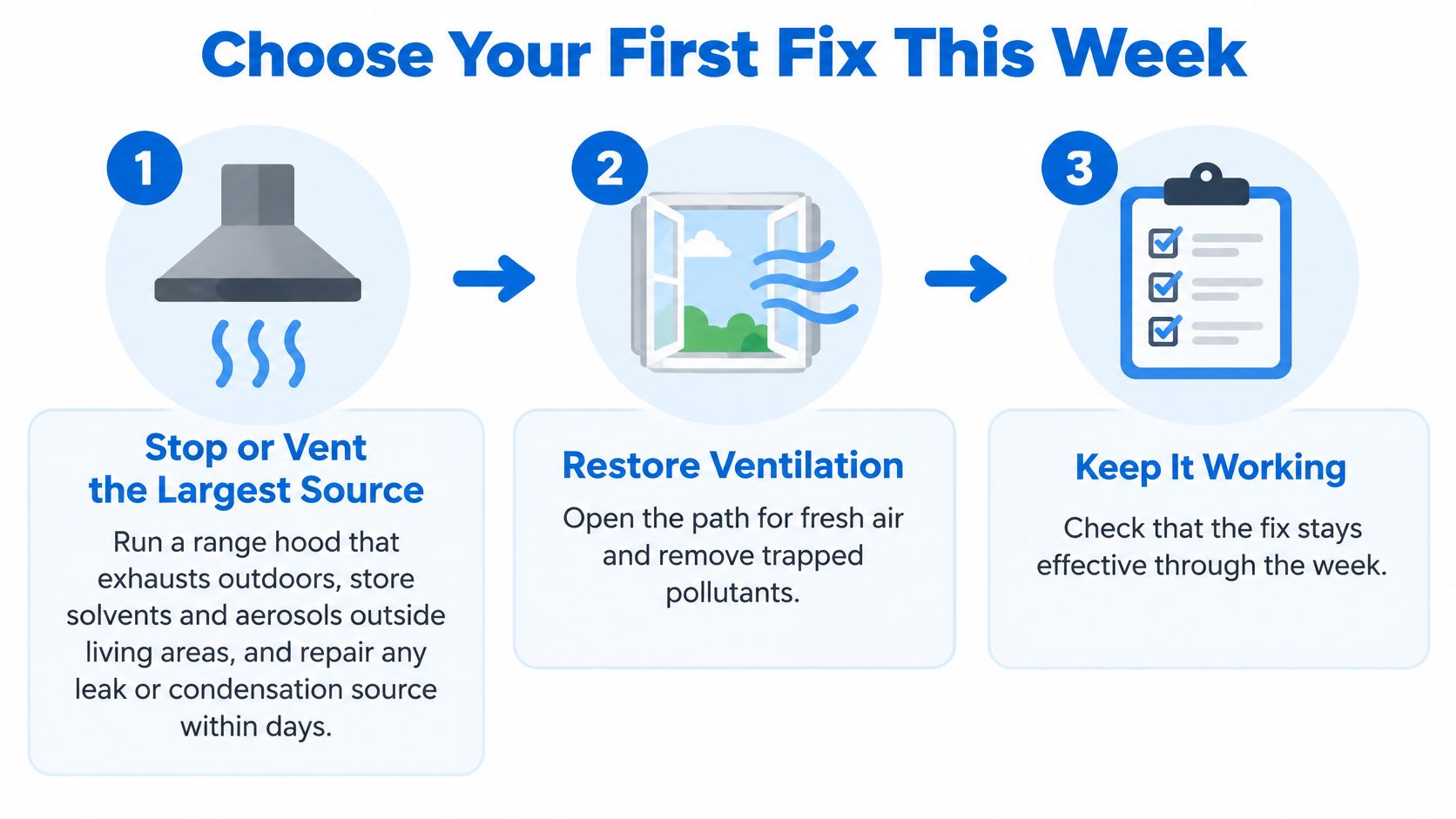
Five Moves in the Right Sequence
Stop or vent the largest source. Run a range hood that exhausts outdoors from the moment burners or pans heat up. Store solvents and aerosols outside living areas, and repair any leak or condensation source within days. Pollutants that never reach the room need no downstream equipment at all.
Restore ventilation where pollutants are made. Run bathroom and kitchen fans during use and for about 20 minutes after. Use mechanical ventilation where it exists, and confirm dampers and exterior caps open freely. Where outdoor air is cleaner, open windows as a supply path while the local exhaust fan does the removal.
Control moisture and biological reservoirs. Keep relative humidity between 30% and 50% with exhaust, air conditioning, or a dehumidifier matched to the space. Clean HVAC drain pans and replace filters on schedule, because wet components can reseed clean rooms. Vacuum carpets, upholstery, and bedding areas with a HEPA-filter vacuum so collected dust stays collected.
Add filtration for whatever remains. A purifier earns its place when readings still peak after the steps above. Choose and operate a unit with attention to its low ozone emission rating, since ozone is itself an indoor pollutant. Lowering the square footage setting reduces the amount of ozone a purifier produces, so keep the setting below the actual square footage of the space. Place the unit as close to the ceiling as possible, or at least five feet from the floor, next to an incoming air vent so natural airflow distributes the output.
Homeowners comparing system types can review HVAC-integrated air purifiers against single-room and portable options once they know which rooms still show peaks. The catalog covers whole house, one room, car and portable, wearable, commercial, and HVAC units, so the match follows room size and the pollutant you confirmed. A room unit such as the Breeze 2 performs to spec only when its placement and settings fit the space it serves.
- Recheck after one week. Repeat the same morning, activity, and occupancy log for one week. Judge the results by peak height and recovery time across the week rather than a single afternoon's smell test. Faster recovery after cooking or cleaning tells you exhaust and dilution are working. A peak that starts lower tells you source control worked.
Name your largest source today and pick one fix you can finish this week: switching the hood on before the pan heats, moving solvents to detached storage, drying a cabinet leak, or replacing an overdue HVAC filter. One completed source fix does more than three devices compensating for a problem that is still running.
If a gap remains after you've controlled the source, restored exhaust, and dried the space, match whole-house, single-room, portable, and HVAC options to the pollutant and room size you confirmed. Rated coverage figures assume conditions your room may not meet. Visit EcoQuest Purifiers to review purifier types, monitors, replacement parts, and support resources that fit the specific problem in your home or workplace.