
What Is UV Sterilization and How Does It Actually Work
UV sterilization is the use of short-wavelength ultraviolet light, primarily UV-C, to damage the DNA or RNA of microorganisms so they can no longer reproduce. Its effectiveness depends on the delivered dose, not on whether a device contains a UV lamp.
You're comparing air purifiers for a bedroom, and one product page highlights a germicidal light. Another emphasizes filtration. The UV-equipped model sounds reassuring, especially if someone at home is vulnerable to illness, but the specifications don't explain how much light reaches the passing air.
That missing detail matters more than the glowing lamp. A useful purchase starts with understanding what the device treats, under what conditions, and with what safeguards.
Table of Contents
- The Short Answer Most Articles Skip
- How UV-C Light Damages Microbes
- Why Dose Decides Everything
- Where UV Sterilization Works Best
- Safety Questions Every Buyer Should Ask
- Common Myths That Lead to Bad Purchases
- A Buyer's Checklist for UV Indoor Air Products
- Questions Readers Still Ask After the Basics
The Short Answer Most Articles Skip
A parent comparing air purifiers may ask whether a UV model kills germs. The answer depends on which microorganisms the device targets, where they encounter the light, and how long they are exposed. A lamp rating is like a speaker's wattage: it describes the source, not what reaches the listener. For UV, placement, airflow, and exposure time determine what reaches the microbes.
The lamp must deliver enough germicidal light to the organisms the product is meant to treat. Fitting a lamp inside the housing does not show that this happens.
A process, not a promise
UV sterilization is common consumer language, but it can suggest a complete result. For a homeowner, microbial inactivation under specified conditions is a more precise way to understand the claim.
A product may be tested against a particular organism in a controlled chamber. That result applies to the arrangement tested, not automatically to every microorganism in every room. It also does not establish that using the product will reduce household illness.
A UV lamp is a component. Effective treatment depends on the whole system.
Before comparing models, ask what the product is designed to treat:
- Passing air: Was the actual device tested while air flowed through it?
- Stationary objects: Do the instructions specify how to position the object and which surfaces must be exposed?
Those questions help separate a lamp's presence from the treatment a product can deliver. The useful buying question is not whether UV light can affect microbes. It is whether the device's tested conditions match the air or object you want to treat.
How UV-C Light Damages Microbes
A sunburn shows that light can affect biological material without scraping it away. UV-C acts on susceptible microorganisms in a related way, though the comparison is only an analogy. It does not mean people should be exposed to germicidal UV-C.
UV-C damages the DNA or RNA a microorganism needs to reproduce. When that genetic material is damaged enough to stop reproduction, the microorganism is inactivated, even though the treatment has not physically collected or removed it.
That distinction separates UV treatment from filtration. A filter captures particles carried by air. UV treatment affects microorganisms that receive sufficient exposure.
The diagram shows how ultraviolet light can damage microbial genetic material.
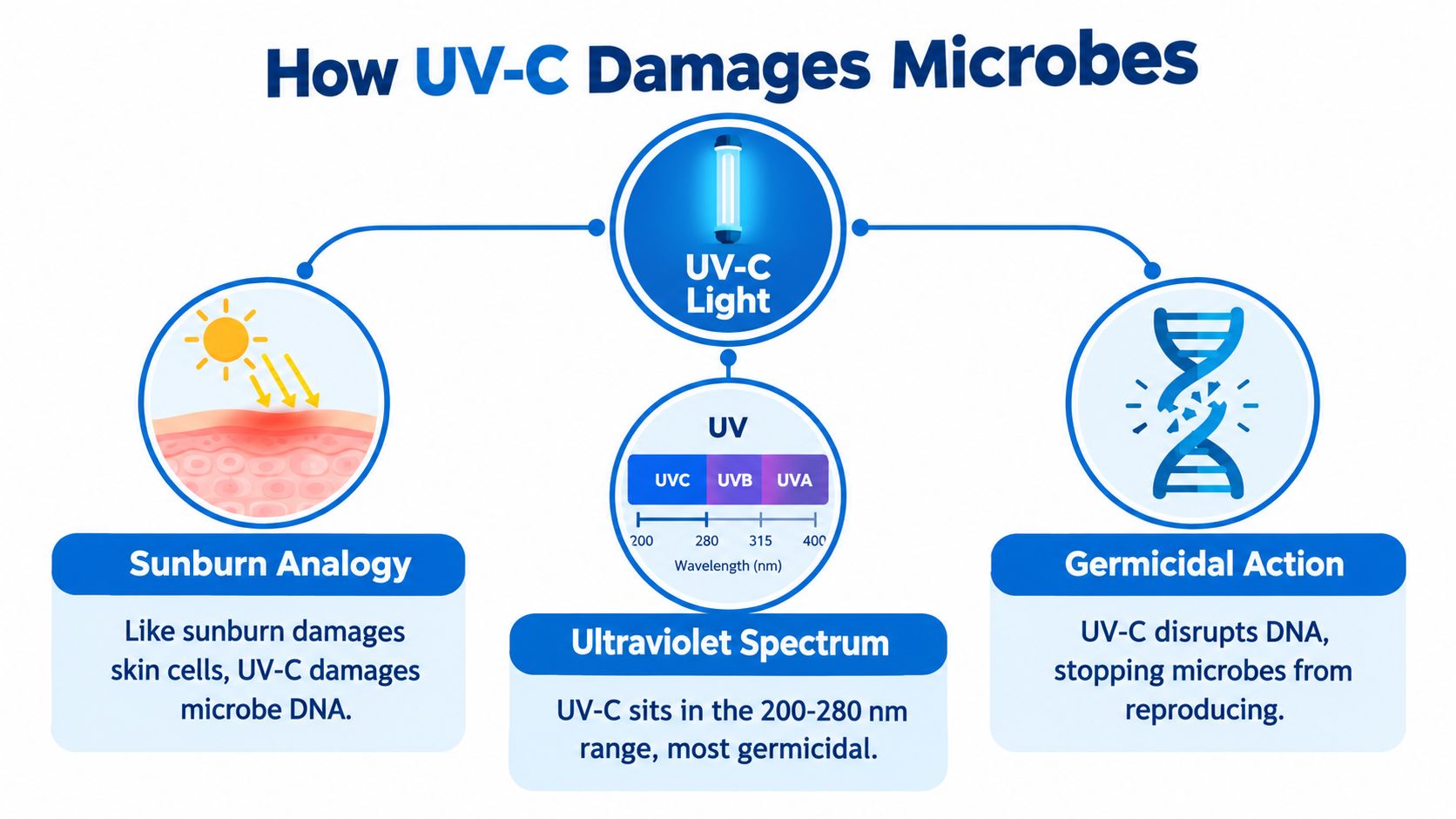
Damage to genetic material, not removal of the organism
Ultraviolet germicidal irradiation, usually shortened to UVGI, is treatment with germicidal ultraviolet radiation. The explanation of germicidal UV treatment and microbial DNA describes how damage to DNA can prevent microorganisms from multiplying.
A bright indicator on a purifier does not show whether this treatment is working. The relevant question is whether germicidal radiation reaches the treatment area, not whether the device looks active.
Inactivation also does not clear every unwanted substance from the air. A claim about microbial treatment does not, by itself, establish that a product removes odors, dust, or allergens.
UV treatment affects a microorganism's ability to reproduce. It does not act like a vacuum cleaner.
Why the tested organism matters
Microorganisms can respond differently to ultraviolet exposure. A test involving bacteria, for example, does not establish performance against every virus, mold, or other microbial target.
Ask the seller to identify the organism, test conditions, and measured outcome. A report that names what researchers tested gives you a specific result to assess. A general claim that a lamp attacks germs does not tell you which organisms were tested or under what conditions.
The basic mechanism is clear: germicidal ultraviolet light can damage microbial genetic material enough to prevent reproduction. Whether a particular device achieves that result depends on its design and the exposure delivered to the target.
Why Dose Decides Everything
Standing beside a campfire for an hour and walking past it in seconds won't leave you equally warm. In both cases, the energy reaching you depends on intensity and time. UV treatment follows the same principle.
Dose = irradiance × exposure time.
Irradiance is the intensity of UV radiation reaching a target. Exposure time is how long the target receives it. A lamp's wattage alone cannot tell you the dose a microorganism receives.
This visual shows the two parts of the calculation.
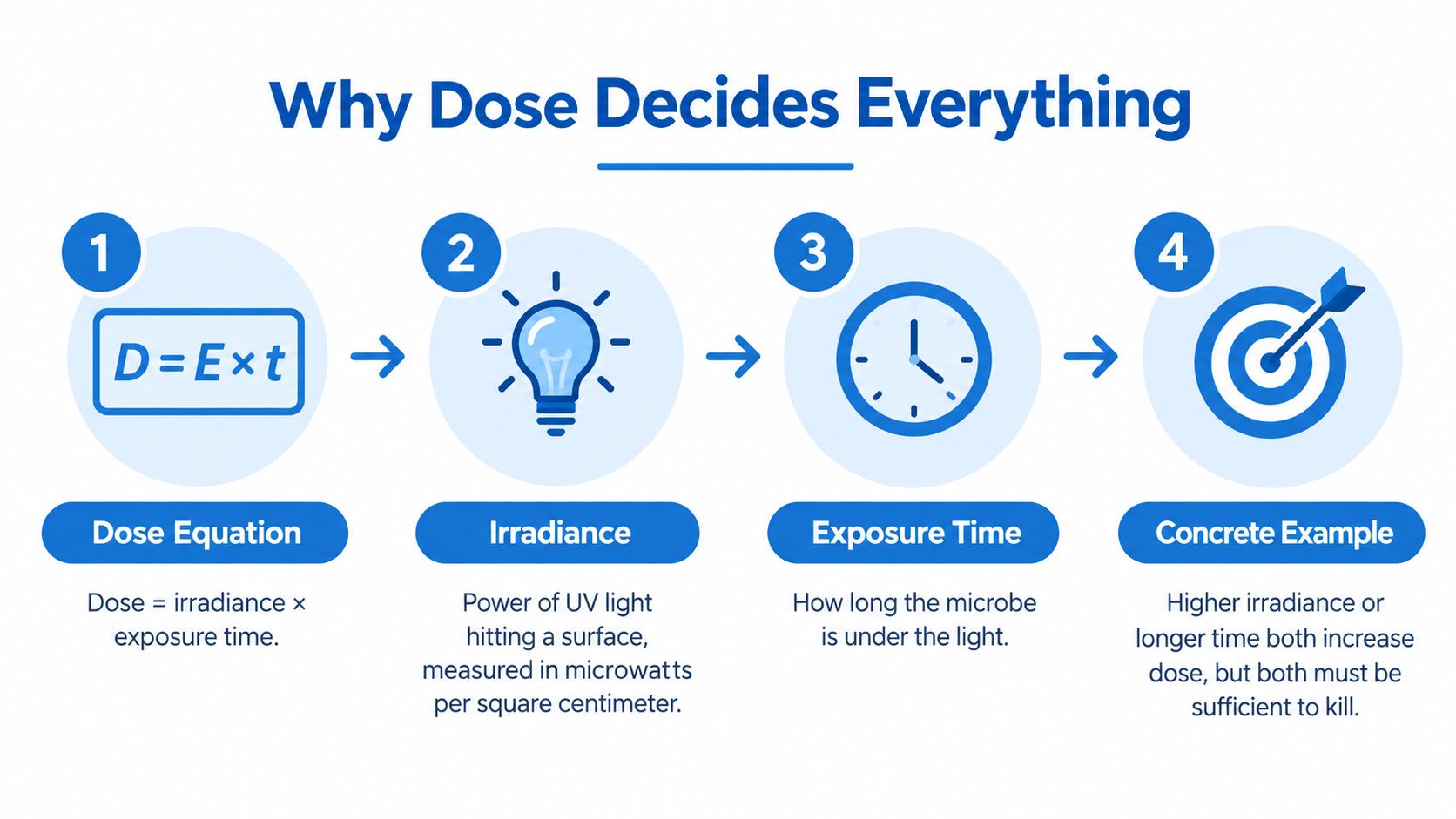
Airflow changes the treatment opportunity
Consider a chamber running at different fan settings. Air moving faster spends less time in the treatment zone. Slowing the fan may give each passing portion of air more exposure, but the device also processes less air over time. For room cleaning, both factors matter.
Ask how the manufacturer balances air throughput and germicidal exposure. A chamber test that allows long exposure may not represent the fan setting you would use at home. Air also follows a path through the device, so ask whether the test accounts for the full treatment route rather than a single measurement point.
The Lawrence Berkeley National Laboratory review of UV air cleaning identifies intensity, exposure duration, humidity, airflow speed, particle size, organism type, placement, and lamp aging as relevant variables. It describes surface reductions approaching 99%, while results in moving air are less predictable. The review also covers 66 HVAC-related publications, with relatively few studies clearly reporting irradiance or dose.
Ask what happens outside the ideal test
Aging lamps, humidity changes, and altered airflow can make an installed system behave differently from its original test setup. Check whether the report describes those conditions and whether the maintenance instructions explain how to preserve the intended performance.
Use these questions to assess a product's specifications:
- Where was irradiance measured? A reading near the lamp may not represent exposure throughout the treatment path.
- What operating setting was tested? Compare the test conditions with the fan mode you expect to use.
- What maintenance assumptions apply? Look for a lamp-replacement schedule and cleaning procedure.
For a separate household application, Good Boy Plumbing's guide for Florida homeowners on UV covers water treatment. Keep evidence about water systems separate from evidence about an air purifier.
For another visual explanation of UV treatment, watch this video.
Where UV Sterilization Works Best
A photograph of a clean countertop doesn't tell you whether a vacuum cleans carpet well. In the same way, a UV result from a stationary surface doesn't establish performance in moving air. The application determines what evidence you should request.
The useful comparison isn't which category has the most impressive headline. It's how closely the tested exposure conditions resemble your intended use.
Match the report to the application
A surface-treatment enclosure holds an object in a defined position for a treatment cycle. That makes positioning and cycle duration central questions. Ask which surfaces researchers tested and how the instructions ensure that those surfaces receive exposure.
A water-treatment chamber has a different operating environment. Water-system evidence needs to address the conditions of that system, rather than serve as indirect proof that a room air purifier works. Don't transfer confidence between applications just because both contain ultraviolet lamps.
For air treatment, distinguish an enclosed room appliance from upper-room equipment or an HVAC installation. The earlier airflow discussion becomes especially relevant: researchers must describe how air reaches and passes through the treatment region.
How UV Sterilization Performs Across Common Applications
| Application | Dose Control | Typical Contact Time | Reliability of Lab Claims |
|---|---|---|---|
| Surface enclosure | Depends on object position and exposure coverage | Defined by the treatment cycle | Relevant to the tested surfaces and arrangement |
| Water-treatment chamber | Depends on the chamber and operating conditions | Determined by passage through the system | Requires water-specific evidence |
| Room air purifier | Depends on the internal treatment path and fan operation | Determined by time inside the treatment zone | Stronger when the actual appliance is tested |
| In-duct or upper-room system | Depends on installation, placement, and airflow | Varies with the air's movement through irradiated areas | Requires evidence applicable to the installed arrangement |
Room appliances and HVAC products solve different installation problems
When browsing HVAC-integrated air purifier options, ask what the proposed installation treats. A lamp positioned to irradiate an HVAC surface shouldn't be assumed to provide the same treatment as a system evaluated for moving air.
A plug-in appliance presents another set of practical considerations. The EcoRoom Plug-In Air Purifier for Small Rooms is a compact air cleaner intended for small rooms, bedrooms, bathrooms, and offices, with a wall-plug design that avoids occupying a shelf or desk. Those are placement and form-factor facts, not evidence of a particular germicidal dose.
For a living room, vehicle cabin, office, or daycare space, describe your use before choosing the hardware. Where will it operate? What problem are you addressing? Can the seller produce a report relevant to that application?
A well-matched report is more valuable than a stronger-looking claim borrowed from a different environment.
Safety Questions Every Buyer Should Ask
You wouldn't buy a space heater without checking whether its design suits the place you'll use it. Apply the same discipline to UV equipment. Safe operation depends on the device and installation, not just the technology name on the box.
Conventional germicidal UV-C presents skin and eye exposure hazards. Ask how the product prevents people from encountering the treatment radiation during operation, inspection, and servicing.
The safety checklist highlights the physical protections and documentation to request.
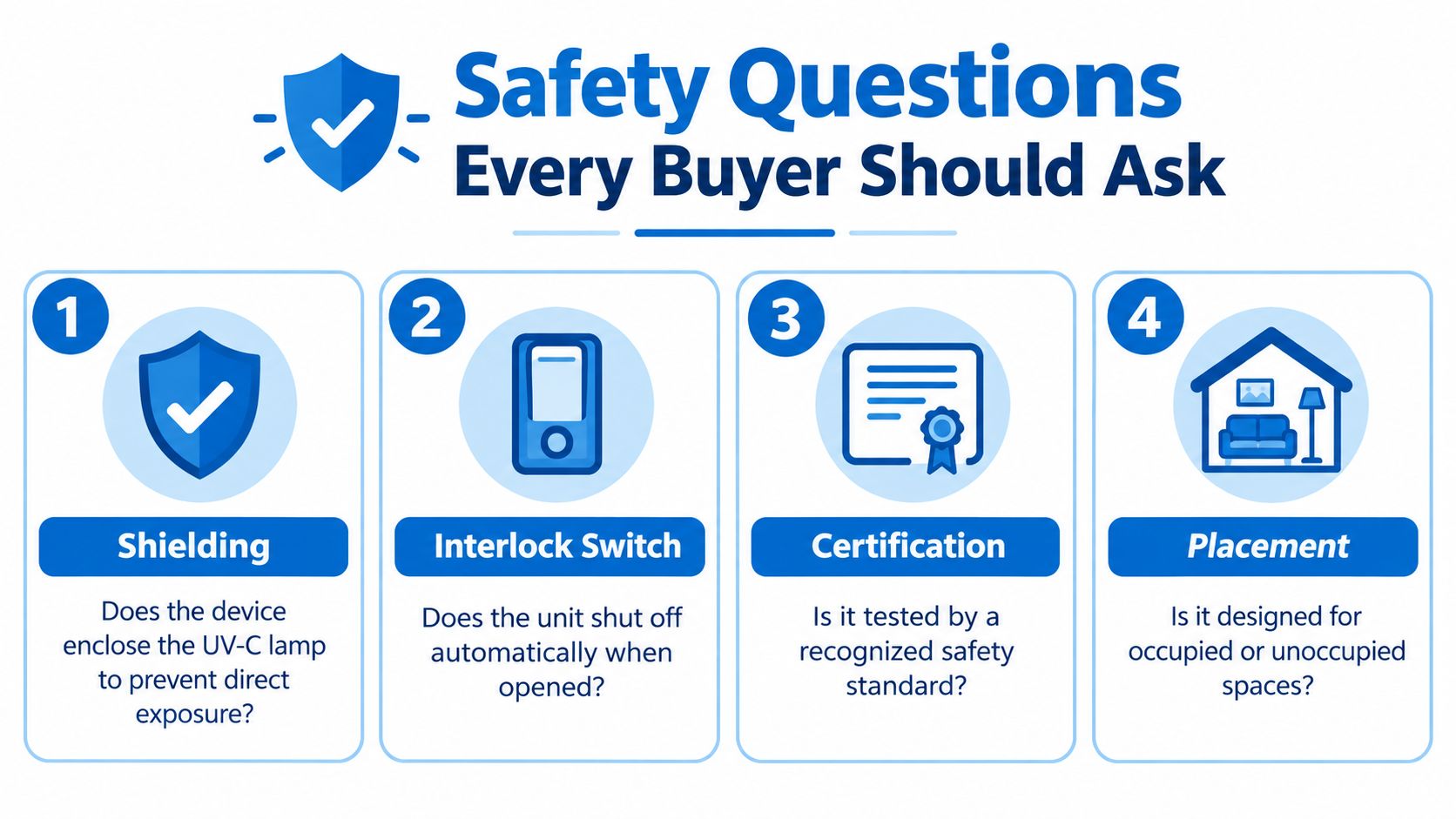
Occupancy and access need explicit answers
Don't infer that a room can remain occupied because the product is sold for home use. Get a clear answer in the operating instructions, including restrictions during maintenance.
- Shielding: Does the housing or fixture prevent direct exposure under intended operating conditions?
- Interlocks: Does opening an access panel shut down the lamp, and how should you verify that protection?
- Installation: Are there positioning requirements that an installer must follow?
- Safety documentation: What testing covers the complete device rather than only an internal component?
For a family home, add practical access questions. Could a child open the unit? Could someone move it into an unsuitable position? The instructions should explain how to preserve the intended protections.
Far-UVC isn't a blanket safety label
Far-UVC systems around 222 nanometers are being investigated for occupied spaces, but wavelength doesn't settle every safety or performance question. A 2025 Drexel UV-disinfection modeling report found that distributing more low-power fixtures outperformed fewer high-power fixtures under otherwise equivalent conditions, and cautioned about small amounts of ozone and other chemical byproducts.
That finding concerns a modeled arrangement, not a universal endorsement of consumer products. It makes placement, airflow, and ventilation relevant purchasing questions alongside lamp specifications.
Ask whether the device generates ozone or other byproducts and request the applicable test documentation. Don't accept an occupied-space claim without instructions that address the actual device and intended installation.
Safety documentation and microbial-performance testing answer different questions. A buyer needs both, especially for continuous use in a bedroom, classroom, salon, or office.
Common Myths That Lead to Bad Purchases
Shopping pages can turn a legitimate treatment method into an all-purpose promise. The most useful corrections separate microbial treatment from the other jobs involved in maintaining a clean indoor environment.
Myth one treats UV as automatic housekeeping
Adding UV means the purifier no longer needs cleaning or filter maintenance.
That conclusion confuses inactivation with physical removal. A germicidal component doesn't establish that the appliance can dispose of collected dust or maintain every other component without attention.
Follow the maintenance instructions for the complete product. If it contains a washable pre-filter, a replaceable filter, or a serviceable lamp assembly, ask what each component requires.
The filter shown below illustrates the kind of maintenance question buyers shouldn't overlook.
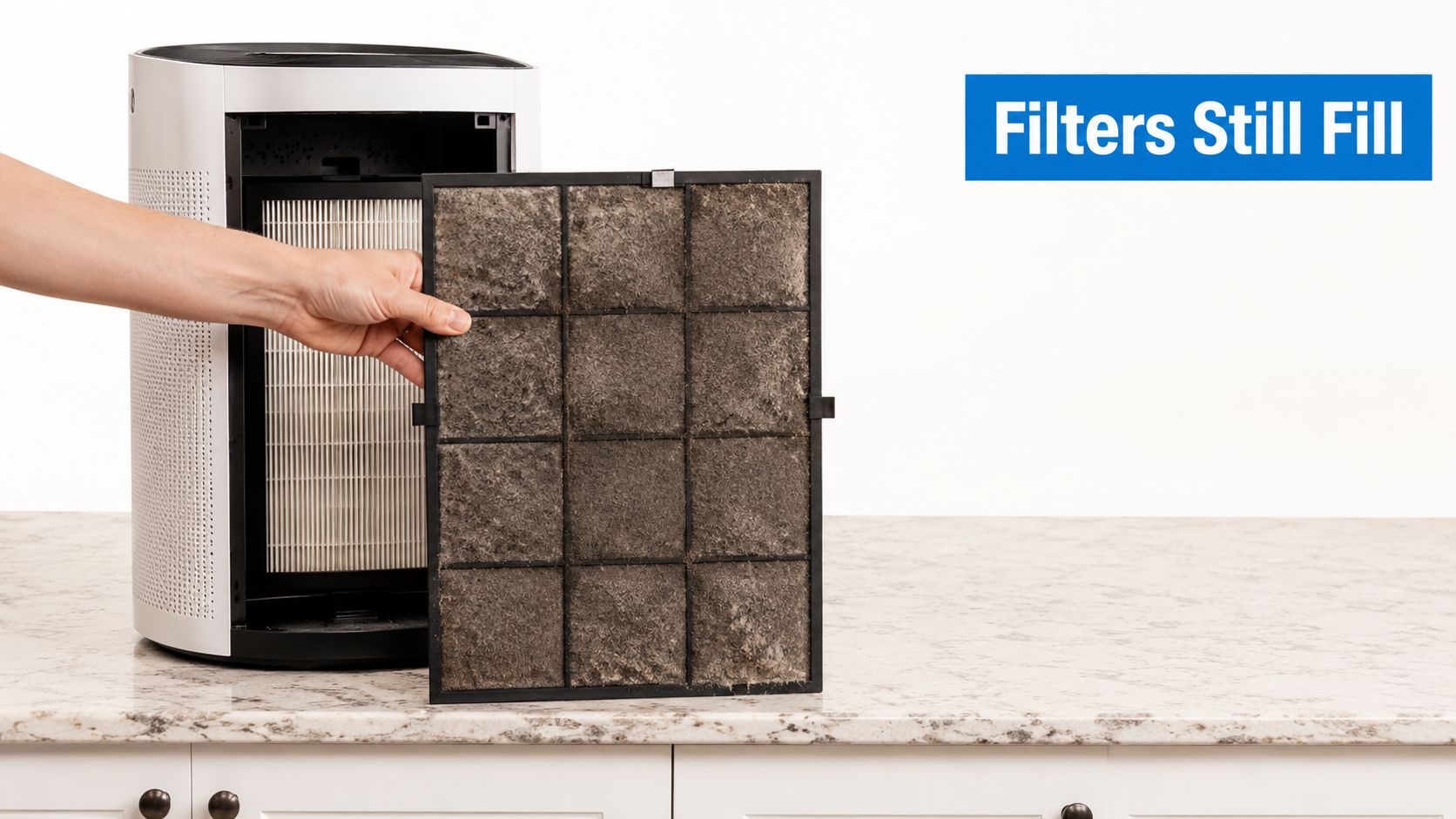
Myth two treats every test as interchangeable
A result from a UV box proves that a room purifier will perform the same way.
The application comparison explains why that transfer isn't justified. Different exposure arrangements require different evidence.
The same caution applies to organisms. A named test organism provides a defined result, not permission to claim equivalent performance against every microbial target. Ask whether the report directly supports the claim on the product page.
Myth three treats UV as the entire cleaning plan
UV replaces ventilation, filtration, and routine cleaning.
The building-science review discussed earlier characterizes UV as a supplemental control, with inconsistent evidence for actual health outcomes and limited research outside healthcare settings. Healthcare literature likewise treats it as an adjunct to established practices.
Keep surface housekeeping separate from an air-treatment purchase. For that task, Gmaids' resource on choosing the right disinfectant offers a separate cleaning reference.
You don't need to reject UV to reject exaggerated claims. You need to preserve the other controls and demand evidence for the additional job the UV component is supposed to perform.
A Buyer's Checklist for UV Indoor Air Products
Treat a product page like a used-car listing: it can help you identify candidates, but you still need the specifications and records. Before buying, collect the manual, relevant test report, and replacement-part information.
When reviewing air purifiers marketed for viruses and bacteria, evaluate the individual model rather than assuming every product in the category uses the same method.
Verify the evidence before the features
- Stated wavelength: Identify the treatment technology. A generic UV label is not a complete specification.
- Irradiance and dose: Request exposure information, not just electrical wattage.
- Relevant airflow: Confirm that the test conditions match the intended operating mode and explain any room-size recommendation.
- Named organisms: Check which microbial targets were tested and what the report measured.
- Independent testing: Ask who performed the evaluation and whether it covered the complete appliance.
- Safety protections: Verify shielding, access controls, occupancy instructions, and installation requirements.
- Byproduct disclosures: Request documentation addressing ozone and other chemical byproducts where applicable.
- Service requirements: Get the lamp-replacement interval, replacement cost, cleaning procedure, and compatible part identification.
A missing answer isn't proof that a device fails. It means you don't yet have enough information to judge that claim. Ask the seller to fill the gap before you commit.
Plan for ownership, not just installation
Choose a product you can maintain according to its instructions. A retailer offering replacement lamps, cells, filters, and accessories can make parts sourcing more straightforward, but verify compatibility with your exact model.
Also distinguish an appliance's microbial-treatment role from your filtration and ventilation needs. Don't let an optional UV feature distract you from the primary reason you're buying an air cleaner.
The practical decision is whether the documented treatment, safe placement, and ongoing upkeep fit your space. If they don't, a different product or a simpler indoor-air strategy may be the more sensible purchase.
Questions Readers Still Ask After the Basics
What about odors and allergens? Don't infer removal from a microbial-inactivation claim. Look for separate evidence addressing your concern.
How long should it run? There's no universal runtime. Follow the tested operating conditions and manufacturer's instructions.
Occupancy and upkeep
Is far-UVC appropriate around children and pets? Don't decide from wavelength alone. Request device-specific safety documentation.
What maintenance is required? Follow the complete appliance manual. The Living Water replacement UV lamp listing illustrates why replacement parts must be matched to the intended system, not selected merely because they're UV lamps.
EcoQuest Purifiers offers indoor air products, replacement parts, and repair services, including options using UV and filtration technologies. Visit EcoQuest Purifiers to compare products, then request the operating manual, relevant test documentation, and maintenance requirements for the model you're considering.