
Whole House Air Purifier for Smoke: What Works
Closing every window feels like it should solve wildfire smoke. It doesn't, and that gap between feeling protected and being protected is where most whole-house plans go wrong. A whole house air purifier for smoke helps only when your blower can move enough air through the right filter, for long enough, without letting dirty air slip around it.
Table of Contents
- Why Closed Windows Still Let Smoke In
- Smoke Technologies Compared by Contaminant
- How to Run HVAC Filtration During Smoke
- Particles and Odors Are Separate Jobs
- Sizing Airflow for a Clean Room
- Filter Changes for Wildfire and Indoor Smoke
- Check Results With an Indoor PM2.5 Reading
- Pick the Setup Your Blower Can Run
Why Closed Windows Still Let Smoke In
On a smoky afternoon, the doors are shut and the windows are closed, yet indoor PM2.5 can still rise. During wildfire events, indoor concentrations are generally about 55% to 60% of outdoor concentrations when windows and doors are closed and no portable air cleaner is operating. A closed house slows smoke entry, but small leaks and HVAC air intakes still let some particles in.
PM2.5 is the principal smoke pollutant of health concern. These fine particles can penetrate deep into the respiratory system, so a room that looks clear can still irritate the lungs, eyes, and throat.
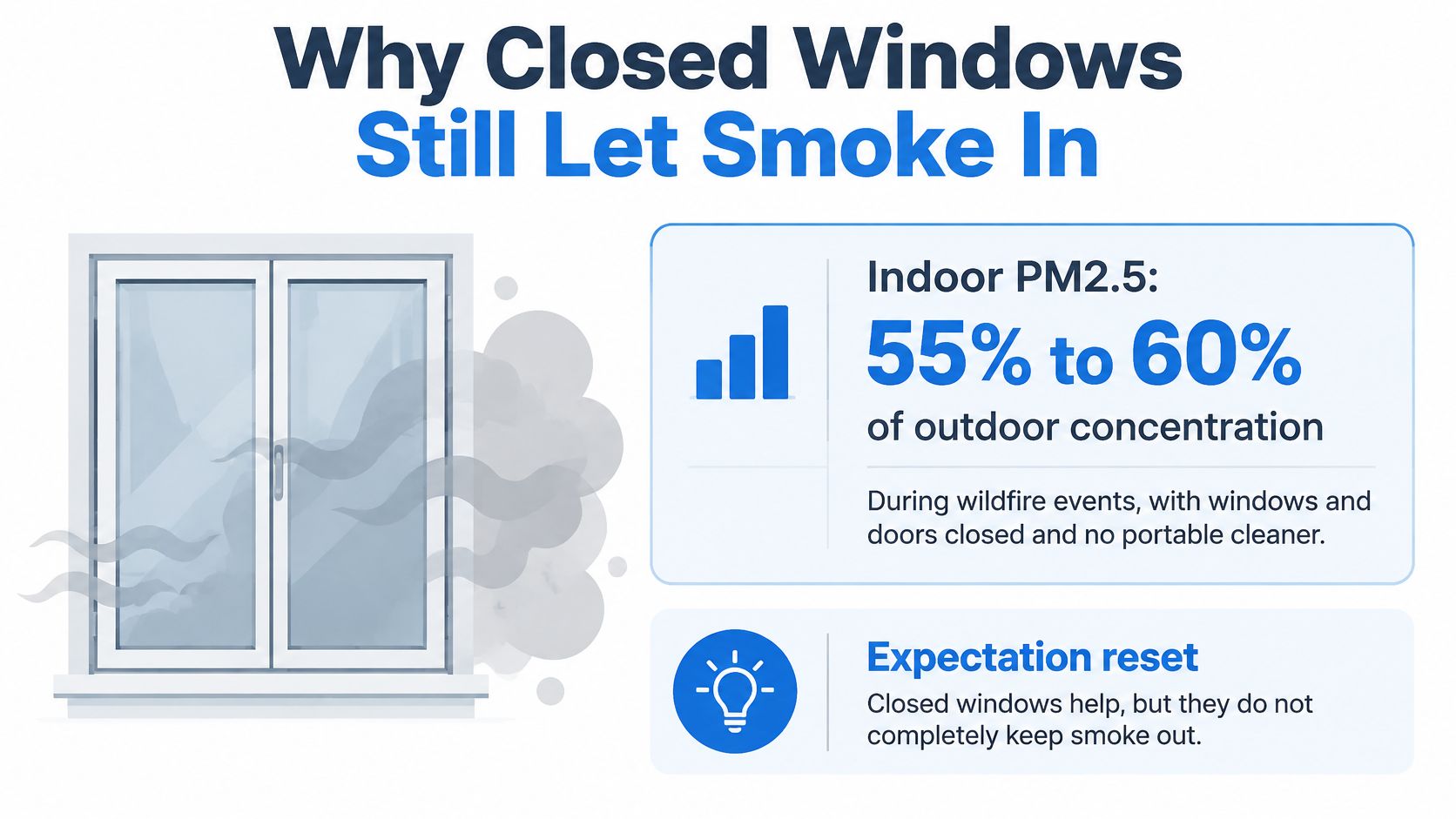
A House Is a Leaky Bag, Not a Sealed Jar
A house works more like a bag with small openings than a jar with a tight lid. Smoke can enter through gaps around doors, plumbing and wiring penetrations, attic hatches, and outdoor-air intakes connected to the HVAC system. Opening a door briefly can also let in smoky air.
Once indoors, smoke particles can linger when air is still. Without the furnace fan running, particles that entered earlier may remain suspended in bedrooms later in the day. The indoor baseline varies with how much outdoor air leaks in and how quickly indoor air is filtered.
Central filtration can clean air across several rooms, provided air passes through a well-fitted filter. A high filter rating alone cannot tell you how much air the furnace blower can push through the media or how often it will run.
What Moves the Result Up or Down
Three factors shape how well filtration works:
- Fan runtime: A filter cleans only the air that passes through it.
- Filter fit: Gaps around the frame let unfiltered air bypass the media.
- Building leakage: A drafty house keeps drawing in outdoor smoke while filtration is running.
The CDC recommends MERV 13 or the highest-efficiency filter the HVAC system can safely support. For a hot, dusty climate, a home air purification guide for Tucson homeowners shows how installers frame whole-house choices around existing equipment.
Without active cleaning, indoor smoke can remain a substantial share of outdoor levels. A central filter can lower particle exposure across rooms, but it cannot guarantee clear air.
Smoke Technologies Compared by Contaminant
A filter rating describes what the media captures when air passes through it. The whole-house result also depends on airflow, fit, and how much smoke enters the home. The table compares what each technology does, and where its limits matter.
| Technology | Main target | Measured limit | Whole-house fit | Occupied use |
|---|---|---|---|---|
| MERV 13 pleated filter | Fine particles, including smoke PM2.5 | At least 50% of 0.3 to 1.0 µm particles and 85% of 1 to 3 µm particles | A practical choice if the blower and cabinet allow it | Mechanical filtration; no ozone |
| MERV 16 filter | PM2.5, black carbon, and ultrafine particles | About 95% in one evaluation; MERV 13 to 16 filters can reach up to 95% under appropriate conditions | Use only if static pressure stays within range | Mechanical filtration; no ozone |
| HEPA | Particles at the 0.3 µm test size | At least 99.97% of 0.3 µm particles | Usually needs a dedicated cabinet, bypass, or separate cleaner; many furnaces cannot handle its pressure drop | Mechanical filtration; no ozone |
| Activated carbon | Some smoke gases and odors | Performance depends on carbon mass, contact time, airflow, humidity, and saturation | An add-on or deep bed; a thin coating has limited capacity | Sorbs some gases; does not replace particle filtration |
| UV or photocatalysis | Some microbes and some gases | No particle-capture rating | A supplement, not a smoke particle filter | Check for byproducts; it is not HEPA filtration |
| Ozone or active oxygen | Odors in an empty space | Does not remove PM2.5; ozone is itself a harmful pollutant | Avoid as an occupied whole-house approach | Do not run while people or pets are present |
Lab Capture Is Not Whole-House Removal
The CDC ventilation FAQ defines HEPA as capturing at least 99.97% of particles measuring 0.3 micrometers. It also reports that MERV 13 filters capture at least 50% of particles in the 0.3 to 1.0 micrometer range and 85% of particles in the 1 to 3 micrometer range. These size bands overlap important components of wildfire smoke.
Those ratings describe air that reaches the filter media. A gap around the filter lets some air bypass it, while low fan runtime reduces the volume of air that gets cleaned. New smoke entering the home also works against removal. A high rating helps only when the system moves air through a well-sealed filter.
Under appropriate conditions, MERV 13 to 16 filters can reduce indoor particles by as much as 95%, according to EPA materials. Results in homes vary: an EPA summary of tested homes reported average PM2.5 reductions of 51% from portable air cleaners and 37% from central-system filters. A separate evaluation found approximately 95% reductions in PM2.5, black carbon, and ultrafine particles with MERV 16 systems.
Reading rule: Treat a filter rating as a capture measure for air passing through the media, not a promise about room air.
Three Choices That Shape the Setup
Consider a MERV 13 filter as a practical example. Its stated capture rates apply to air passing through the filter, but the whole-house benefit still depends on whether the blower can move enough air through it. A denser HEPA filter captures more at the 0.3 µm test size, yet many residential furnaces cannot accommodate its pressure drop in a standard slot. A dedicated cabinet, bypass setup, or separate cleaner may be a better fit.
Carbon handles a different part of smoke. A thin carbon coating has little material and brief contact with passing air, while a deep bed provides more carbon for some gases and odors to contact. Neither replaces a particle filter.
Ozone devices are different again: they do not capture PM2.5, and ozone itself can harm lungs. Avoid using them as an occupied whole-house solution. Choose particle filtration your blower can support, then consider carbon if odor remains.
How to Run HVAC Filtration During Smoke
A filter only cleans air that passes through it. Match the MERV rating to what your blower can push, then check that air still reaches the rooms. A tight fit matters too: gaps let air bypass the filter.
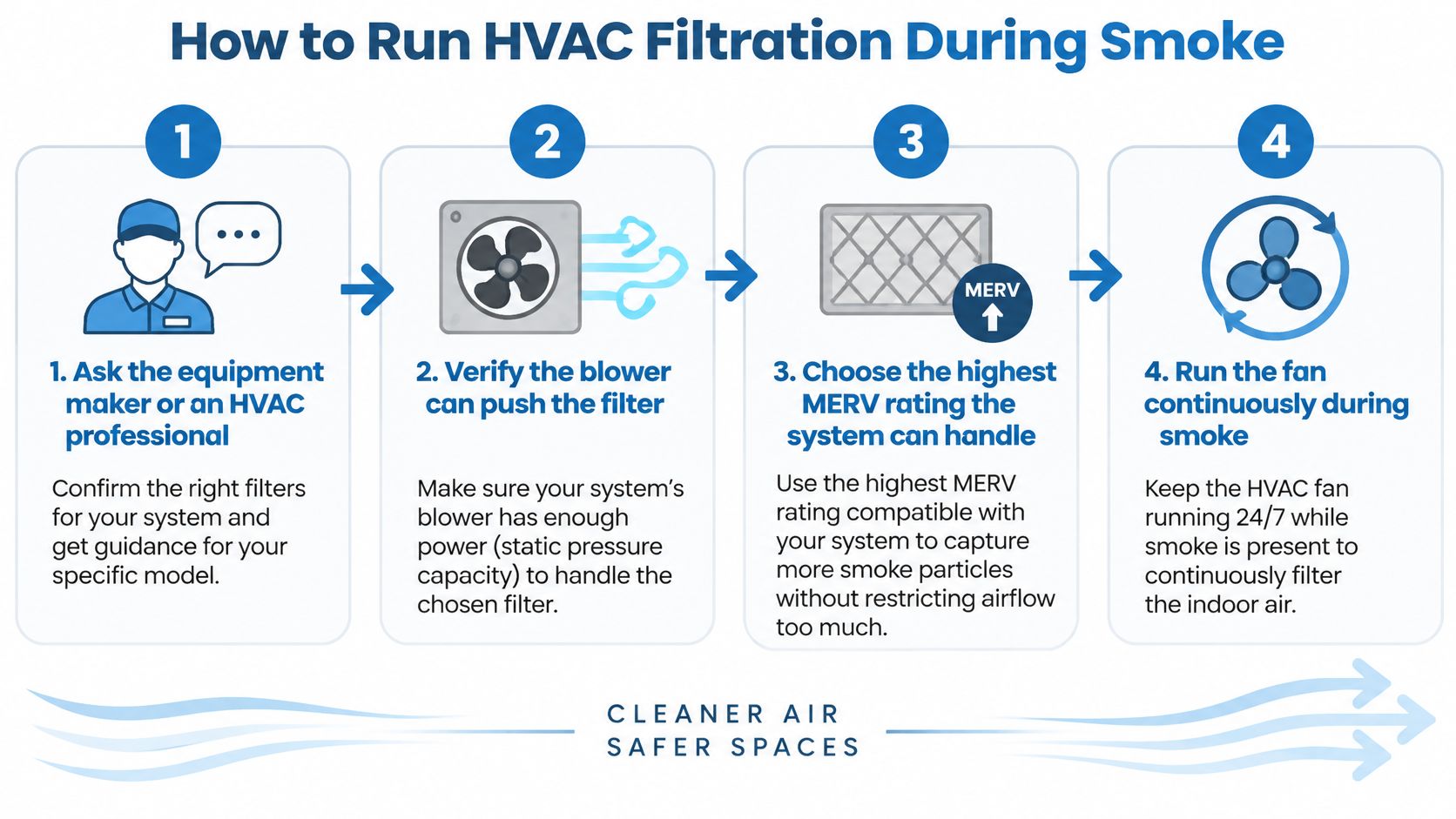
Six Actions Before and During a Smoke Event
- Ask about static pressure first. Contact the equipment maker or an HVAC professional about the air handler's allowable static-pressure range. This helps identify choosing HVAC filters without restricting airflow as a practical limit, not just a rating on the filter label.
- Choose the highest MERV rating the system can support. MERV 13 or higher is often used for smoke when the blower and filter cabinet can handle it. Confirm airflow after installation.
- Seat the filter snugly. Slide it fully into the slot, check that its frame is straight, and close the access panel. A gap gives unfiltered air a route around the media.
- Set the thermostat fan to On during smoke. California Smoke Ready guidance recommends switching from “Auto” to “On” so air passes through the filter more consistently. Continuous runtime can increase filtration, but it also means the blower must keep moving air through the filter.
- Close the outdoor-air intake or select recirculation during severe smoke. Consider ventilation needs and combustion-appliance safety first. If you have gas appliances and are unsure what to do, ask a technician before closing the intake.
- Check the system while it runs. Feel for supply air at registers, listen for a strained blower, and watch for heating or cooling performance to lag. If airflow drops, use a less restrictive filter.
The fan setting is a runtime choice, not a guarantee of clean air. A system set to On can filter air between heating or cooling calls, but only if the blower maintains adequate airflow.
Where Other Devices Fit
A true HEPA element usually needs a dedicated cabinet or a separate cleaner with its own fan. Many residential blowers cannot push air through HEPA media in a standard furnace slot without losing airflow.
The Living Air Classic XL-15 Air Purifier is listed as an air purifier. It is a separate device, so assess it apart from the HVAC filter's MERV rating.
If rooms are not getting supply air, the filter may be too restrictive for the system. A higher rating cannot make up for weak airflow: less air passes through the media, and room-to-room filtration becomes uneven.
Particles and Odors Are Separate Jobs
The haze has cleared after a smoky afternoon, but the couch still smells like a campfire. That's because smoke brings both fine particles, which stay in the air, and gases that can settle into paint, carpet, and upholstery. A particle filter captures airborne particles; it does not remove compounds already absorbed into furnishings.
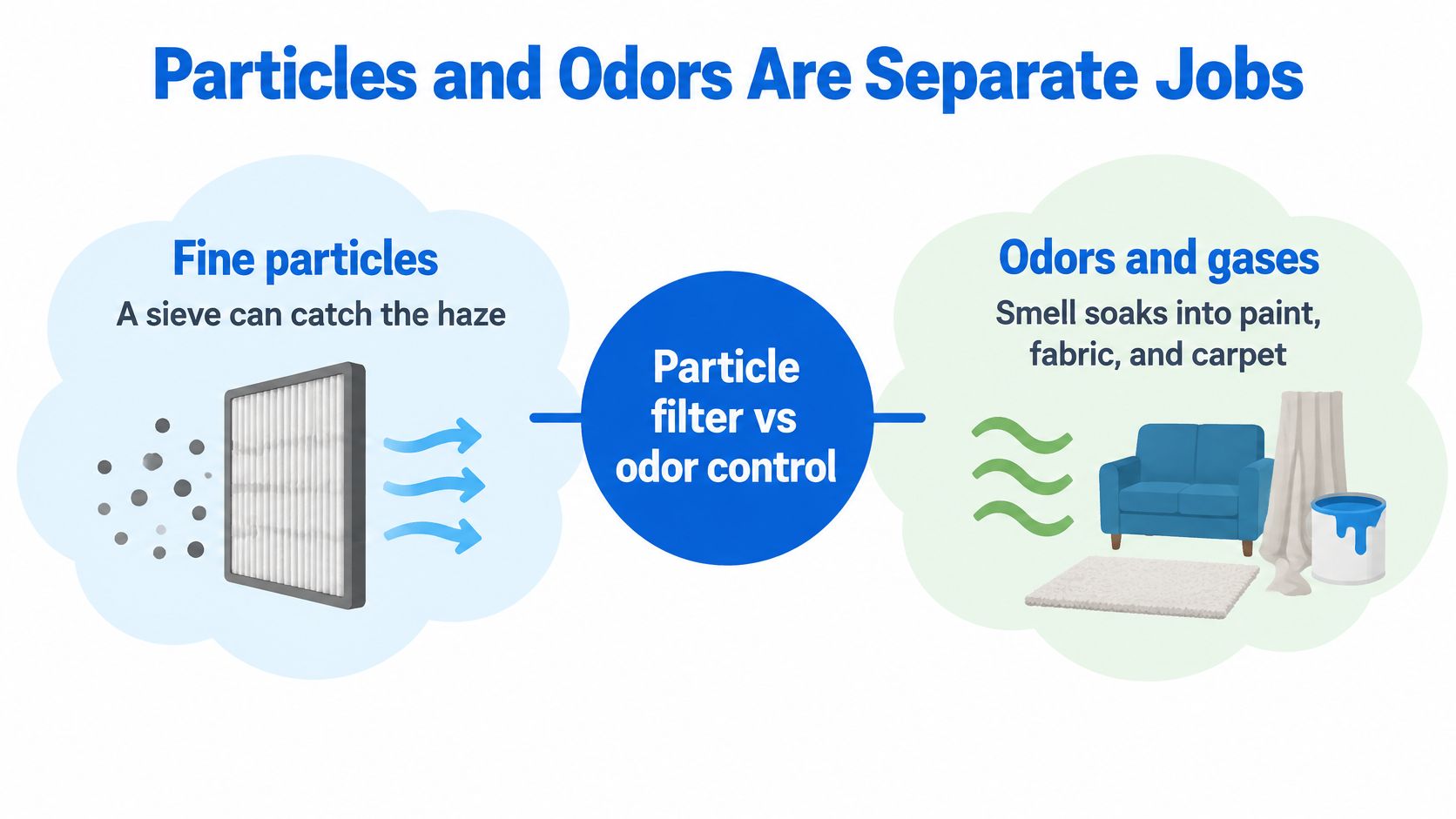
Particle Filters and Carbon Do Different Work
Pleated MERV filters and HEPA filters trap particles as air passes through their fibers. They do not create ozone. If haze irritates your eyes or an indoor monitor shows increased PM2.5, particle filtration addresses that part of the problem.
Activated carbon can adsorb some gases and odor molecules. Its useful capacity depends on the amount of carbon, how long air contacts it, and conditions such as humidity and saturation. A thin carbon coating may reduce a mild smell, but it has less capacity than a deep carbon bed.
UV and photocatalytic devices are different again. They do not trap PM2.5 like a particle filter. EPA recommends choosing air cleaners that produce little or no ozone; look for recognized low-ozone certification when considering an electronic device.
Why Smell Is the Wrong Scoreboard
The EPA wildfire guide for public health officials reports that portable air cleaners can reduce indoor wildfire PM2.5 by roughly 50% to 80%, averaging about 65%. That finding concerns particles, not equivalent odor removal. Smoke compounds absorbed into furnishings can remain after airborne particle levels fall.
Particle counts can fall while the house still smells, and a fresher smell can hide particles you cannot see.
For children, pets, and anyone with asthma, keep occupied-room air cleaning separate from odor treatment. Run mechanical filtration while people are home, and do not run an ozone treatment in an occupied room.
Use an indoor PM2.5 reading to assess particles, not a sniff test at the front door. Assess odor separately: soft furnishings can continue to smell after the haze clears.
Sizing Airflow for a Clean Room
A clean room sounds clinical, but at home it's just one bedroom where you control the door, the airflow, and the cleaner size. It's the backup plan that saves the whole-house plan when a blower is too weak or outdoor smoke peaks hard.
A correctly sized room unit can protect the place where you sleep, even when the rest of the house lags behind.
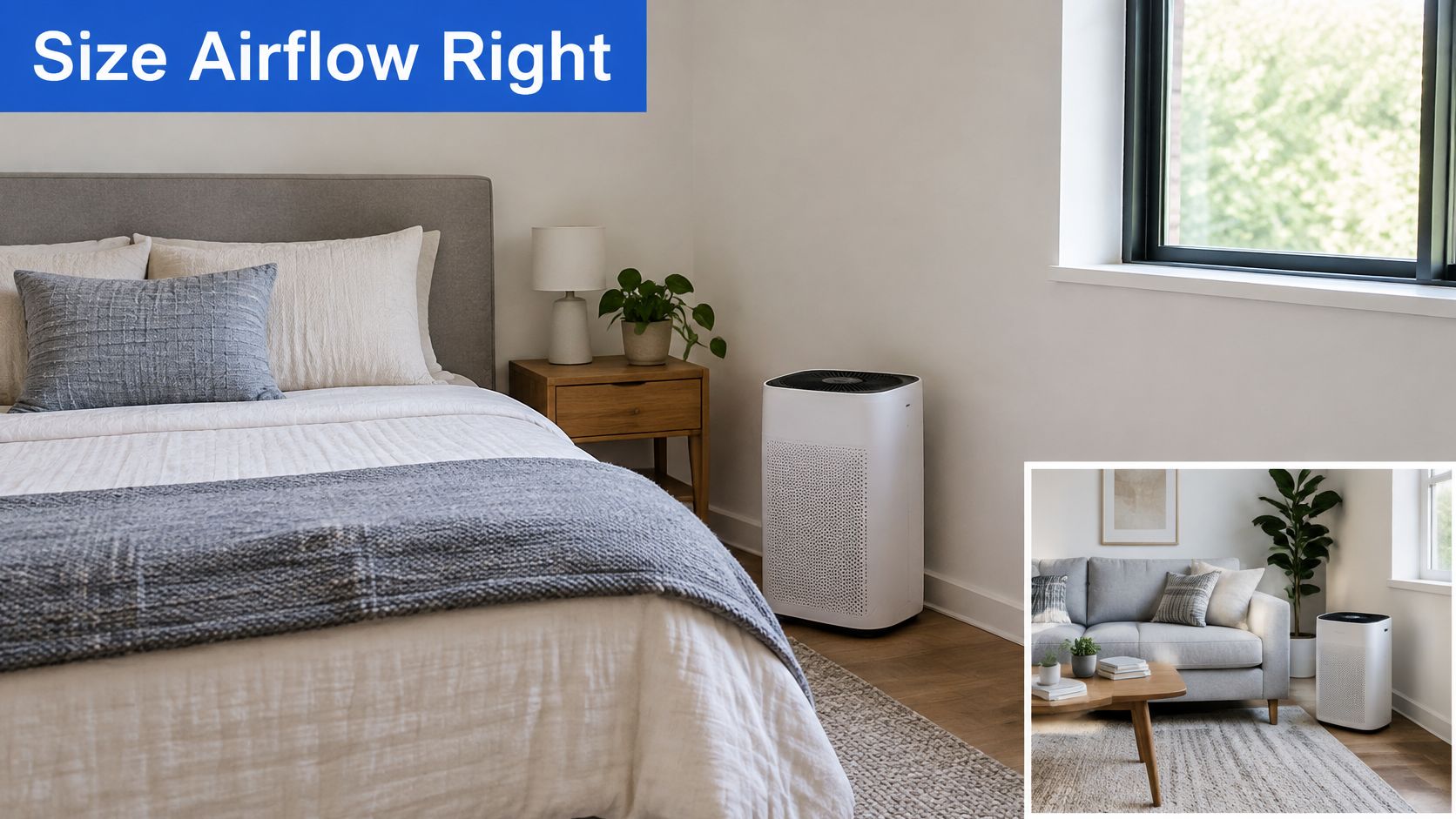
Example One, a 200 Square Foot Bedroom
The EPA indoor air filtration guidance recommends a tobacco-smoke CADR of at least two-thirds of the room area in square feet for portable units during wildfire smoke. For a 200 square foot bedroom, two-thirds of 200 is about 133, so look for a cleaner with a tobacco-smoke CADR of 133 or more.
CADR means clean air delivery rate. In plain terms, it's how much filtered air the unit delivers, not just how strong its fan sounds. A small desktop unit with a pretty design won't meet that target for a full bedroom.
Browsing a category of room HEPA purifiers sized for bedrooms and clean rooms is a practical way to compare CADR figures against your room math before you buy. Bring your target number with you, and ignore any model that won't state its smoke CADR clearly.
Example Two, an Older Blower in a Larger House
Say you have a roughly 1,800 square foot house and an older furnace. You try a dense filter and the supply registers go weak. Forcing that filter won't create a whole house air purifier for smoke, it'll create poor airflow and uneven cleaning.
Split the plan into two jobs instead. First, keep the highest safe central filter on the furnace for background particle reduction, and close the outdoor intake during the event if combustion safety allows. Second, turn one bedroom into the refuge: shut the door, run a HEPA cleaner that meets the room's CADR target, and sleep there when outdoor smoke peaks.
This video walks through the clean-room idea visually, so you can see how a single protected room fits into a larger house plan.
Why HEPA Usually Sits Outside the Furnace
HEPA gives very high particle-removal efficiency, but it usually requires a dedicated cabinet, a bypass arrangement, or a separately powered air cleaner. Ordinary residential blowers often can't tolerate the pressure drop, so the bedroom unit carries its own fan for a reason.
A tight new house with a variable-speed air handler is the edge case. Continuous low-speed fan plus a sealed high-rated filter may cover more rooms well, making the clean room a backup rather than the main plan.
Write down three numbers before smoke season: room area, required CADR, and whether the blower passed the pressure check. Those three lines tell you which plan you have.
Filter Changes for Wildfire and Indoor Smoke
After a week of continuous fan operation during heavy wildfire smoke, a pleated filter may need replacement even if it still looks fairly clean. Tobacco smoke or a frequently used fireplace can load the filter more gradually, while odor compounds continue settling on furnishings.
| Situation | Typical replacement timing or cue |
|---|---|
| Wildfire smoke with continuous fan operation | Check after several days of heavy smoke; replace sooner if airflow falls |
| Older or weak blower | Replace if supply airflow weakens |
| Ongoing tobacco or fireplace smoke | Replace the particle filter when airflow falls; assess the carbon separately if odor returns |
| After outdoor smoke clears | Replace pleated media that served through a heavy event; replace carbon if odor returns |
How to Read the Replacement Cues
Color is an incomplete signal. Fine smoke particles may load a filter without making it look obviously dirty. Falling airflow, longer heating or cooling cycles, and rising indoor particle readings offer more useful clues.
Carbon needs a separate check. A bed can look clean even after its odor-adsorbing capacity has declined, and humid conditions shorten its useful life. If the particle filter is fresh but stale smells return quickly, the carbon may need replacement.
A cleaner-smelling room does not show whether fine particles remain. Odor and particle readings answer different questions, so neither filter appearance nor smell alone provides the full picture.
After the Plume Passes
Replace pleated media that handled a heavy smoke event. If the filter still allows normal airflow and the event was brief, use airflow and indoor particle readings to guide the timing rather than relying on appearance alone.
Check carbon separately when odors persist or return. A bedroom HEPA cleaner may also need attention after a smoky period, especially if it ran through the worst hours. Inspect its filter according to its condition and the cleaner's replacement guidance.
Check Results With an Indoor PM2.5 Reading
You don't need a lab to know whether your setup works. You need paired readings, taken the same way, across a real smoke peak.
A Simple Ratio Test You Can Run at Home
- Place monitors in two rooms. Put one PM2.5 monitor in the refuge bedroom and a second in the main living area, both away from supply registers and exterior doors.
- Log outdoor PM2.5 at the same times. Use a nearby regional air-quality station so indoor and outdoor numbers line up by hour.
- Run the full setup. Keep doors closed, keep the fan On, and record readings across a full smoke peak rather than taking one snapshot.
- Express indoor air as a share of outdoor air. Divide each indoor reading by the outdoor reading from the same time. If that share stays near the closed-house baseline, your setup is adding little.
- Compare the two rooms. A refuge room that stays well below the living area shows the bedroom HEPA is earning its place, even when the central filter is limited.
If you're shopping for a monitor to run this test, an indoor air quality monitor for tracking PM2.5 at home gives you the paired readings this method depends on. One monitor moved room to room can work, but two fixed spots make comparisons cleaner.
Save the readings with your filter-change date. Next smoke season, you'll start from a record of what your house did, not from memory or marketing claims.
Pick the Setup Your Blower Can Run
A whole-house filter works only when the blower can move air through it. Choose the setup that matches your system, then add room filtration or odor control only where needed.
If your blower can carry MERV 13 or better, use a well-sealed filter and recirculate air during smoke events. Confirm the allowable static-pressure range with the furnace maker or an HVAC technician before choosing the filter. A whole-house HVAC-integrated air purifier is another option when the cabinet and blower support it.
If your blower cannot carry that filter, use the highest-rated filter the system can handle and add a CADR-sized HEPA cleaner in the bedroom. A restrictive cartridge can strain the furnace; a clean sleeping room gives you a separate place to reduce particles.
If particles fall but odors remain, consider a deep carbon bed. Keep ozone or active-oxygen treatment out of rooms occupied by people or pets. Odor control is a separate job from particle removal.
This Week, in Order
- Measure the refuge room. Use its square footage to determine the HEPA cleaner's CADR target.
- Choose the particle setup. Match the central filter to the blower's limit, then size the room cleaner for the bedroom.
- Decide whether odor control is needed. Add carbon only if smoke odors remain a problem.
The strongest filter label is not automatically the best choice. Air must pass through the filter, and the blower sets a practical limit; a bedroom cleaner can cover the gap without forcing the furnace to push through a filter it cannot handle.
Now that you know your blower limit, refuge-room CADR target, and whether carbon is needed, visit EcoQuest Purifiers to match those needs to HVAC-compatible filtration, replacement media, room HEPA units, and air quality monitors. Bring your filter size and room measurements when choosing equipment.