
Whole House Air Purifier No Ozone: A Safe Buyer's Guide
You're searching for a whole house air purifier with no ozone because someone in your home has asthma, young children, chemical sensitivity, or a respiratory condition. You may also be trying to protect your family from wildfire smoke, persistent odors, or air that feels worse after the HVAC system runs.
The concern is justified, but shopping labels make the decision harder than it should be. “No ozone” can describe a passive filter that never creates ozone, a device that emits a small measurable amount, or an ionizing system whose marketing language sounds safer than its engineering. My recommendation is straightforward: for a sensitive household, choose physical filtration first, verify the ozone test result, and treat active ozone generation as incompatible with occupied whole-home use.
Table of Contents
- What Buyers Really Mean by No Ozone
- How Ozone Became a Dealbreaker in Indoor Air
- Purification Technologies That Do and Don't Emit Ozone
- Why Whole House Changes the Stakes
- What to Look for in a Safe Whole House System
- Low Ozone vs Truly Ozone Free
- Sizing, Installation, and Ongoing Maintenance
- A Practical Shortlist for Sensitive Homes
What Buyers Really Mean by No Ozone
The phrase no ozone isn't a single technical promise. It can refer to three very different product categories.
The first is a genuinely non-generating system. A passive media cabinet, HEPA filter, MERV-rated filter, or activated carbon stage works by trapping particles or adsorbing gases. These components don't need an electrical discharge, ionizer, plasma field, or ozone generator to perform their basic function.
The second category is a low-ozone product. It may meet the California Air Resources Board requirement that covered air-cleaning devices emit less than 0.050 parts per million, or 50 ppb, of ozone. That is a meaningful regulatory ceiling, but it isn't the same as zero measurable ozone. California's consumer guidance on air cleaners is the right place to verify the applicable requirement rather than relying on a retailer's badge or product description.
The third category includes ionizers, plasma units, and products marketed with phrases such as “fresh air” or “activated oxygen.” Some may advertise ozone control while still producing ozone as part of their operating method. If the manufacturer doesn't publish a current third-party emissions report, you don't know which category the device belongs to.
A practical grading system
Use this order of preference:
- Passive and mechanical: HEPA, MERV media, and activated carbon with no ionization or discharge.
- Verified zero-ozone technology: An active component supported by a credible test report, with emissions at or below the stricter 5 ppb engineering target associated with UL's zero-ozone validation program.
- Low-ozone equipment: A device that stays below the California ceiling but still emits measurable ozone.
- Ozone-producing equipment: Any product designed to generate ozone or lacking evidence that it remains below a recognized limit.
That framework prevents a common buying mistake. A device can be legal to sell and still be the wrong choice for a child's bedroom, an asthma-sensitive home, or an HVAC system that operates for long periods.
How Ozone Became a Dealbreaker in Indoor Air
Ozone is a reactive form of oxygen made of three oxygen atoms. That reactivity is exactly why manufacturers use it to attack odors and certain contaminants, but it also makes ozone an airway irritant. The U.S. Environmental Protection Agency's guidance on ozone generators explains that ozone-generating cleaners can produce indoor concentrations from 0.20 to 0.80 ppm in real-world tests. The EPA compares those results with a cited public-health-relevant occupational limit of 0.10 ppm, meaning the tested concentrations were 2 to 10 times higher.
The same guidance states that ozone has little ability to remove indoor contaminants at concentrations that don't exceed public-health standards. That point matters because an air cleaner shouldn't solve one indoor-air problem by introducing another. The EPA also advises avoiding portable air cleaners and furnace or HVAC filters that intentionally produce ozone.
The two thresholds buyers should know
California's consumer air-cleaner regulation requires covered portable and in-duct devices sold in the state to emit less than 50 ppb of ozone. That threshold became a widely referenced benchmark for air-cleaning equipment in the United States, and it aligns with the 50 ppb ozone threshold used by Energy Star for qualifying room air cleaners. The California requirement is described in the state's air-cleaner information for consumers.
UL's zero-ozone validation program uses a much stricter engineering target of 5 ppb. That difference explains why “CARB compliant,” “low ozone,” and “zero ozone” shouldn't be treated as interchangeable language.
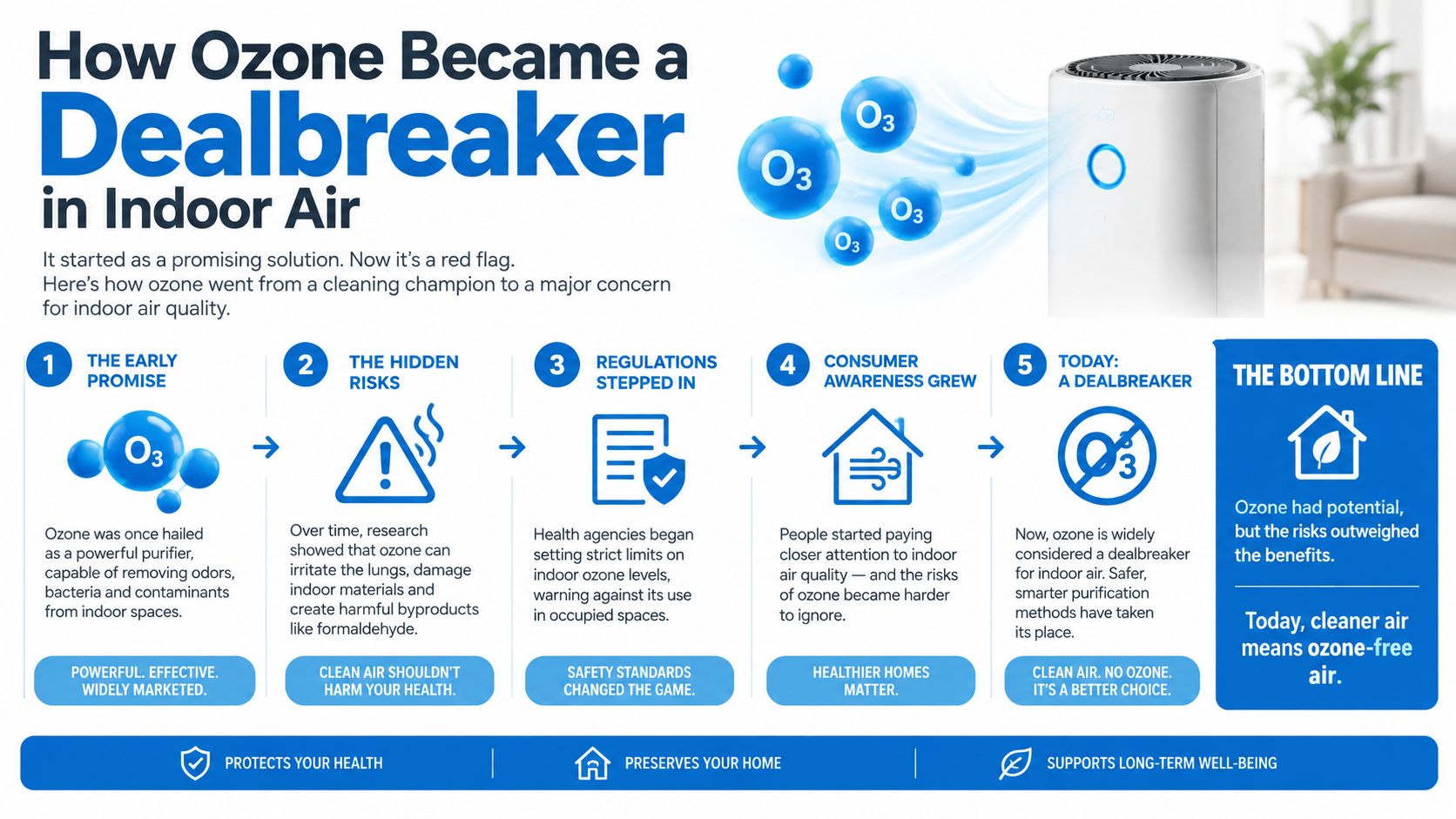
For households with children, older adults, asthma, COPD, or chemical sensitivity, I prefer the conservative option. Avoid intentional ozone generation and choose a system that doesn't depend on a reactive gas to clean occupied air.
Purification Technologies That Do and Don't Emit Ozone
The technology inside the cabinet matters more than the word “purifier” on the box. Start by identifying whether the device physically filters air, adsorbs gases, uses UV light, or creates an electrical discharge.
HEPA and pleated media are the safest defaults. They remove airborne particles through mechanical filtration and don't intentionally generate ozone. A deeper media cabinet can provide more filter surface area than a thin filter slot, which can make it easier for the HVAC system to move air without excessive restriction. Activated carbon adds gas-phase treatment, although its practical value depends on the amount and quality of carbon rather than the presence of a thin black coating.
Shielded UV-C can be acceptable. A properly enclosed in-duct UV-C lamp can support biological control without intentionally generating ozone. The lamp and housing must be specified correctly, because an open or poorly designed UV fixture can create unwanted byproducts. UV isn't a substitute for particle filtration or source control.
Photocatalytic and RCI systems require evidence. Some designs are engineered to avoid ozone, while other photocatalytic systems can create unwanted byproducts. Don't approve this category from a brochure alone. Ask for an emissions report that covers the complete installed configuration, not just an individual cell.
Ionization and plasma belong in the caution category. These technologies create charged particles or electrical discharge. Some products may test below a regulatory ceiling, but “bipolar,” “plasma,” or “ion cluster” language doesn't prove zero ozone. If the manufacturer can't show a credible report, move on.
Ozone generators are the wrong tool for occupied HVAC operation. A product such as Fresh Air Double Plus is described in its catalog snapshot as a digital ozone air purifier using ozone generation, germicidal UV light, charcoal, HEPA, and ionization, with coverage described across 3,500 square feet. That makes it an ozone-generating product, not a no-ozone recommendation for continuous occupied whole-house purification. For context, products in this category are also listed alongside air purifiers and ozone generators, so read the product type carefully.
| Technology | Ozone status | CARB 50 ppb | UL 2998 5 ppb | Notes |
|---|---|---|---|---|
| Passive HEPA or MERV media | Ozone-free by design | Verify the complete device if certified | Prefer a documented result | Mechanical filtration is the default choice |
| Activated carbon | Ozone-free by design | Verify the complete device if certified | Prefer a documented result | Adsorbs gases and odors |
| Shielded UV-C | Potentially ozone-free | Verify the lamp and housing | Ask for testing | Installation quality matters |
| Photocatalytic or RCI cell | Requires verification | Ask for a report | Prefer a documented result | Check for ozone and other byproducts |
| Ionization or plasma | Possible ozone generation | Must be tested | Prefer zero-ozone validation | Marketing language isn't proof |
| Active ozone generator | Ozone-producing | Not appropriate as a no-ozone choice | Does not fit the goal | Avoid in occupied HVAC systems |
Why Whole House Changes the Stakes
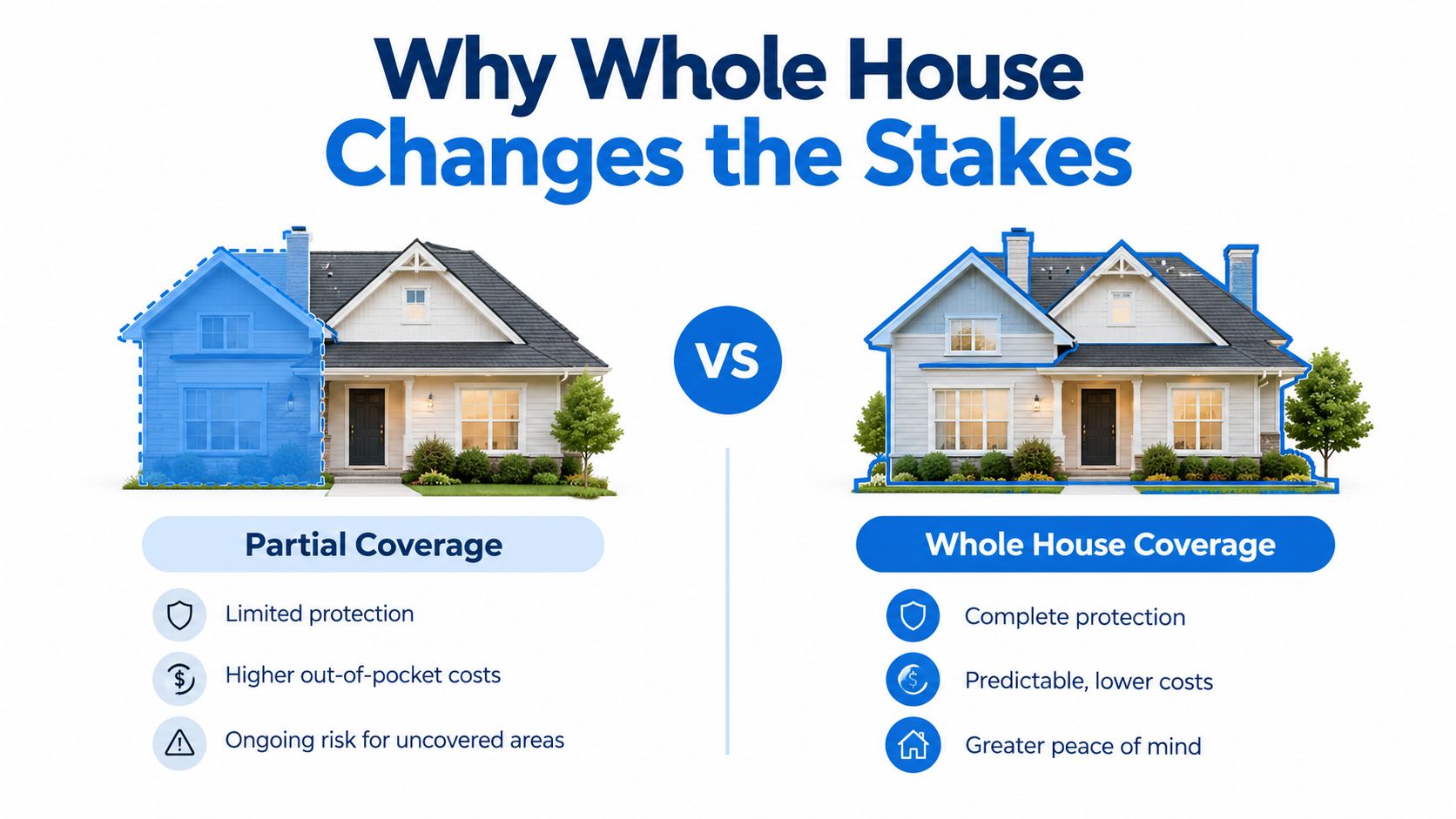
A portable purifier treats the room where it sits. An HVAC-integrated unit can affect air moving through the return, air handler, supply duct, or terminal branch. That broader reach is useful when the technology is safe, but it also distributes any emitted byproduct through the home.
The EPA's guidance on air cleaners and HVAC filters recognizes that HVAC filtration can deliver cleaner air throughout a home and notes that mechanical filters such as HEPA don't produce ozone. The same principle creates the central buying rule: don't install an intentionally ozone-producing device in a system that circulates air across living spaces.
Where installation changes exposure
An in-line unit at the air handler processes air near the central blower. A return-side device treats air before it reaches the equipment. A supply-side or terminal device treats air later in the distribution path. Each location has different service and airflow implications, but none changes the basic safety question. If the unit produces ozone, the duct system can carry it beyond the room where the device was installed.
Whole-house equipment also tends to operate whenever the HVAC blower runs, and some homeowners run the blower continuously for circulation. That makes a “low ozone” claim less reassuring than it might appear on a product page. Ozone can also react with indoor chemicals from cleaners, paints, and cooking, creating additional compounds that you don't want circulating through bedrooms and living areas.
The whole-house standard is not “probably low.” It is verified non-generation under the actual operating configuration.
For a broader discussion of practical household controls, improving indoor air quality in 2026 is a useful complementary resource. My own recommendation remains narrower: use the HVAC system to move air through physical media, not to distribute an active oxidant.
What to Look for in a Safe Whole House System
Treat the product page as an opening document, not proof. A safe purchase starts with the specification sheet, the installation requirements, and an emissions report for the complete unit.
Start with the emissions evidence
Ask whether the device has third-party ozone testing. A result associated with UL's 5 ppb zero-ozone target is a stronger signal than compliance with the California 50 ppb ceiling. Energy Star's air-cleaner ozone threshold also uses 50 ppb, so the badge doesn't automatically mean the product is ozone-free.
Next, inspect the airflow path. I prefer the blower and motor arranged so air passes through physical media without being exposed to an upstream ionization or plasma stage. Ask the installer to document the filter cabinet, airflow direction, and any active cell in the duct.
MERV and HEPA ratings describe particle filtration, not ozone safety. Choose the highest practical media efficiency your HVAC equipment can handle, and have static pressure checked after installation. A dense filter that starves the blower is a poor result, even if the filter itself is safe.
| Spec | Look for | Avoid |
|---|---|---|
| Ozone testing | Current third-party report for the complete unit | “No ozone” with no test document |
| Certification | A verifiable zero-ozone result, or clear California compliance | Unverifiable badges |
| Filter type | HEPA or substantial pleated media | Filterless claims replacing physical filtration |
| Airflow path | Media filtration with documented direction | Ionization before or around the occupied-air path |
| Carbon stage | Clearly stated carbon material and service instructions | Vague “odor technology” language |
| Maintenance | Accessible filters, cells, and testable components | Sealed components with no service procedure |
A retailer may list whole-house air purifiers across several technologies, so compare the mechanism rather than the category name. The Living Air Classic XL-15 Air Purifier is described in the catalog snapshot as a filterless unit using ionization and activated oxygen technology. Those features place it outside my passive, no-ozone default.
The product should also include a credible airflow rating and clear installation instructions. If the seller won't provide the report, the filter specifications, or the maintenance procedure, don't make your family the test environment.
Low Ozone vs Truly Ozone Free
“Low ozone” and “ozone-free” describe different outcomes. A product that stays below California's 50 ppb ceiling may still release measurable ozone, while a product validated to the 5 ppb zero-ozone target makes a much narrower claim.
That distinction matters most in households where someone already reacts to respiratory irritants. Parents of children with asthma, people with COPD, and those with chemical sensitivity don't need a device that merely stays under a ceiling if a passive alternative can avoid generation altogether.
Choose the least complicated safe method
A sealed media cabinet is the cleanest starting point. It can use HEPA or appropriately selected pleated media, with activated carbon added when odor or gas control matters. A shielded UV-C lamp can be considered for a specific biological-control objective, but it shouldn't replace physical filtration and should come with documentation for the exact lamp and housing.
I don't treat “low ozone” as a premium safety tier. I treat it as a regulatory or testing result that still requires interpretation. If the home includes a respiratory-risk occupant, select a system that has no ionizer, no plasma generator, and no active oxygen mode unless an independent report proves the complete operating system meets the stricter requirement.
Sizing, Installation, and Ongoing Maintenance
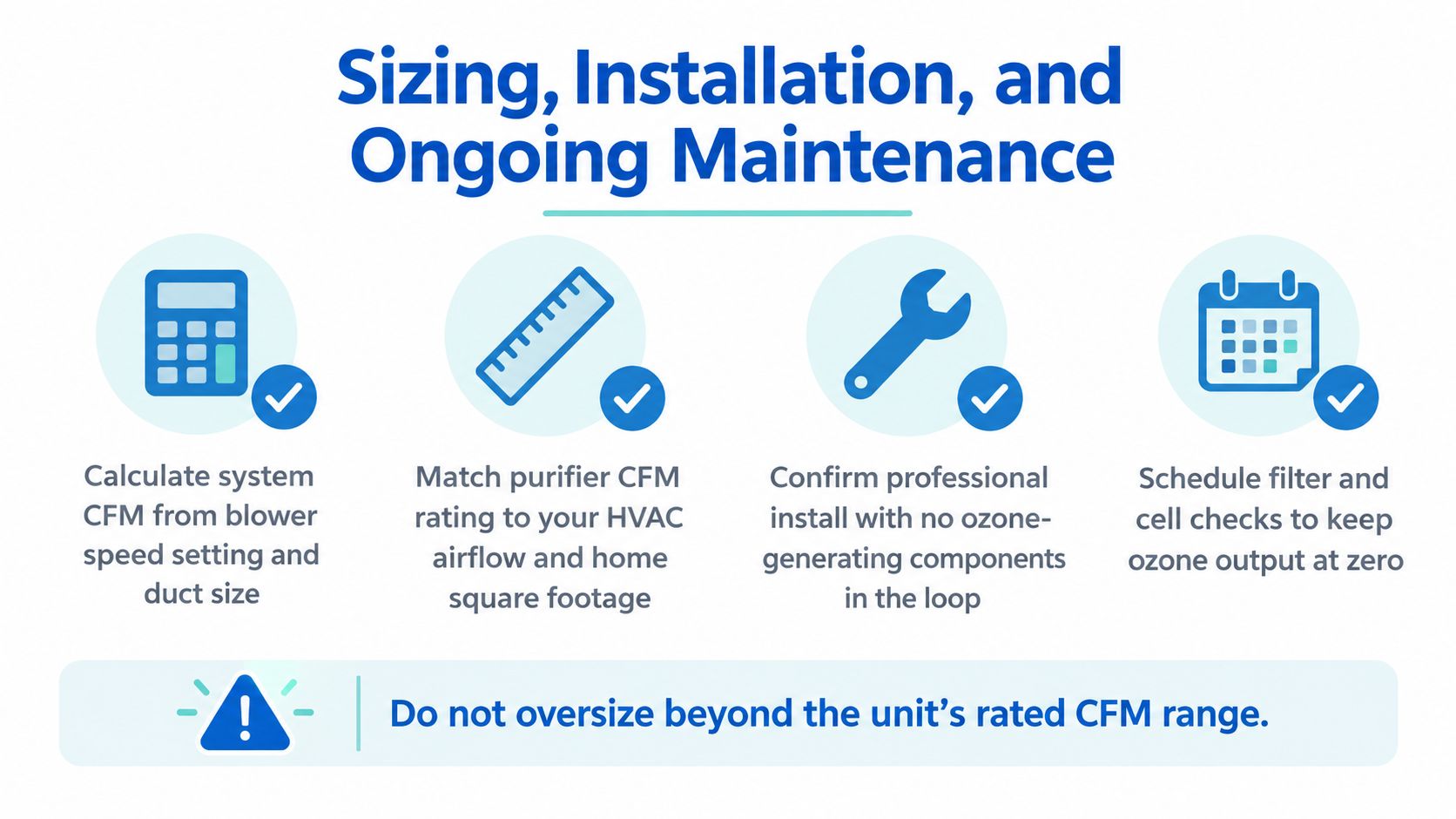
A no-ozone system still has to move air properly. Before buying, have an HVAC professional confirm the blower's operating capacity, the duct dimensions, the cabinet fit, and the pressure created by the selected media. The most protective filter is useless if the system can't circulate air through it reliably.
Place the media cabinet where the return-air design allows service and where the filter can be replaced without dismantling the equipment. The installer should record the airflow direction and verify that no ozone-generating component remains in the circulation loop. If the system includes UV or another active cell, request documentation for the installed configuration, not just the replacement part.
Maintenance is part of the safety claim
Filters load with dust, smoke, pet debris, and other particles. As loading increases, resistance can rise and airflow can fall. That affects comfort, equipment operation, and the amount of air the purifier processes.
Use a written maintenance schedule based on the manufacturer's instructions and the household's pollutant load. Homes exposed to wildfire smoke, construction dust, pets, or heavy cooking may need more frequent inspection than a clean, lightly occupied home.
- Inspect the filter: Look for visible loading and reduced airflow rather than waiting for a strong odor or equipment fault.
- Check the cabinet seal: Gaps around the frame let air bypass the media.
- Service active components: UV lamps and photocatalytic cells require inspection according to their specific instructions.
- Measure after replacement: Ask the technician to verify airflow and system operation after installing denser media.
- Keep source control active: Vent cooking, fix moisture problems, and remove pollution at the source instead of asking filtration to do everything.
A bypass around the filter defeats the purpose of a high-quality cabinet. So does an overdue filter that turns a well-designed system into a restricted one. For HVAC-integrated options, HVAC air purifiers should be evaluated by airflow path and maintenance requirements, not by the broad “whole house” label alone.
A Practical Shortlist for Sensitive Homes
For a sensitive household, my first choice is a passive media cabinet using substantial mechanical filtration, with activated carbon added when odors or gas-phase pollutants are a priority. Have the cabinet matched to the HVAC airflow and installed so air can't bypass the media.
Use UV-C only for a defined purpose and only when the lamp and enclosure have credible documentation. Don't select bipolar ionization, plasma, activated oxygen, or ozone generation just because the product promises freshness, sterilization, or odor removal.
| Home type | Primary filter | Secondary stage | Optional add-on | Certification to verify |
|---|---|---|---|---|
| Apartment or smaller home | Passive mechanical media | Activated carbon if needed | Bedroom portable HEPA | Third-party ozone report |
| Family home with asthma concerns | Sealed high-efficiency media cabinet | Substantial activated carbon | Shielded UV-C for a specific use | Zero-ozone validation preferred |
| Home exposed to wildfire smoke | HEPA-capable mechanical filtration | Deeper carbon stage | Portable HEPA in sleeping areas | Complete-system emissions test |
| Larger home with multiple HVAC zones | Separate media service at each suitable return | Carbon sized to the pollutant burden | Professional airflow assessment | Certification for each installed unit |
Before ordering, request the actual ozone test report, check whether it applies to the complete product, and confirm the return and service policies. A portable HEPA unit in the bedroom remains sensible even with a whole-house system, because the central blower may not run continuously and bedrooms need direct protection.
The clear buying decision is this: choose a passive or independently verified zero-ozone system, install it correctly, and maintain the media. Don't trade a vague promise of “fresh air” for an avoidable ozone source.
EcoQuest Purifiers offers whole-house and HVAC-integrated air-cleaning products alongside HEPA, charcoal, UV, ionization, RCI, and ozone-based technologies, so review each product's operating method carefully against your no-ozone requirements. Visit EcoQuest Purifiers to compare available options, replacement parts, and support resources before you buy.