
Why Change Car Air Filter for Engine and Cabin Health
You press the accelerator to merge into traffic, but the car responds with less urgency than usual. Later, you switch on the air conditioning and get a weak stream of air carrying a damp, stale smell. Nothing appears seriously broken, yet the vehicle feels uncomfortable and slightly sluggish.
Those symptoms can have different causes, but they share one possible source: an air filter that has become restricted. Your car uses two separate filters, one for the engine and one for the passenger cabin. Understanding why you change each filter will help you avoid an outdated fuel-economy myth, protect HVAC performance, and create a cleaner environment inside the vehicle.
Table of Contents
- The Hidden Lungs of Your Vehicle
- Engine Intake Versus Cabin Ventilation Filters
- Real Impacts on Acceleration and Fuel Economy
- Protecting Cabin Air Quality and HVAC Performance
- Recognizing Clogging Symptoms and Replacement Intervals
- Enhancing In-Car Air With Portable Purification
The Hidden Lungs of Your Vehicle
A vehicle needs air in two very different places. The engine draws outside air into the combustion system, while the HVAC system draws air through the cabin ventilation path and sends it through the dashboard vents. Each route has a filter, and each filter has a different job.
Think of the engine as the mechanical heart and the cabin as the space where people breathe. The engine air filter keeps abrasive dust and debris away from sensitive components while allowing enough air to support combustion. The cabin air filter stands between the outside environment and the blower, helping trap particles before they circulate around passengers.
When the engine filter becomes restricted, the driver may notice reduced throttle response, particularly when the engine needs a large volume of air. When the cabin filter loads with dust, pollen, or debris, the blower may deliver less air, and the interior may develop a musty odor. These signs don't prove that a filter is the cause, but they give you a practical reason to inspect it before assuming the vehicle needs a larger repair.
Practical rule: Treat engine and cabin filters as separate maintenance items. Changing one doesn't renew the other.
The question “why change car air filter” therefore has two answers. You change the engine filter to manage intake restriction and protect the engine's air path. You change the cabin filter to preserve ventilation, particle capture, and passenger comfort. A car can have a clean engine filter and a neglected cabin filter, or the reverse.
That dual-filtration view also explains why a replacement alone isn't always a complete air-quality strategy. A cabin filter only works while air passes through the HVAC intake. Open windows, outside leaks, traffic exposure, and odors already embedded in upholstery can still affect the interior. Good vehicle care starts with both filters, then adds other controls when driving conditions demand them.
Engine Intake Versus Cabin Ventilation Filters
The easiest way to distinguish the filters is to follow the air.
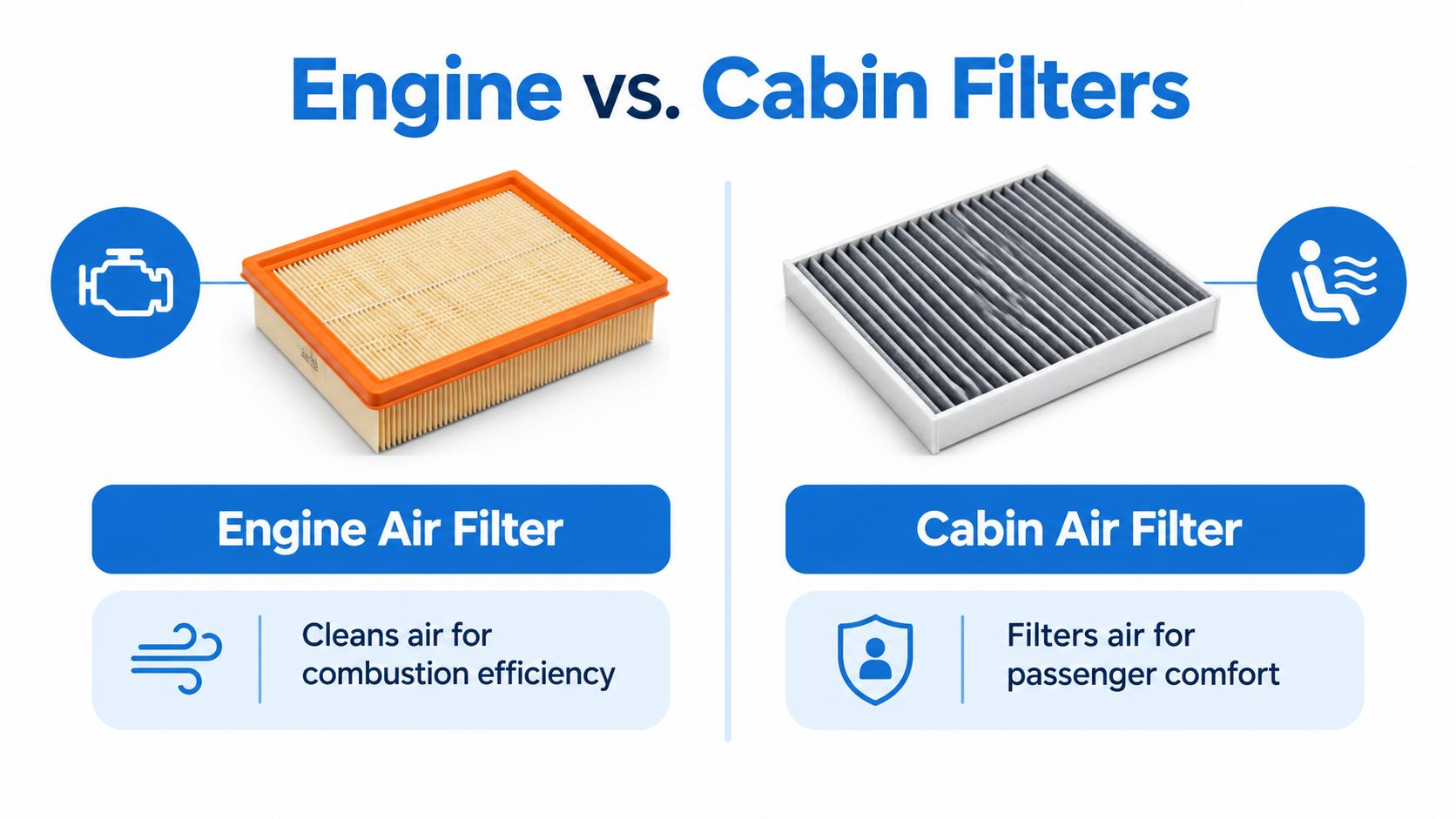
The engine air filter sits in the intake tract, usually inside a plastic airbox under the hood. Outside air passes through its pleated or panel-shaped media before reaching the engine. The filter catches dust and larger debris, reducing the chance that abrasive material will enter the intake and combustion path.
The cabin air filter is part of the HVAC intake system. Depending on the vehicle, it may sit behind the glovebox, below the windshield cowl, or in another housing near the blower assembly. It filters air before that air reaches the evaporator, heater core, blower, and passenger vents. Some designs filter outside air, recirculated cabin air, or both, depending on the vehicle's HVAC mode.
A useful analogy is a runner. The engine filter acts like the runner's nose, preparing the air before the body performs strenuous work. The cabin filter acts more like a protective mask, reducing the dust and pollen that reach the occupants. Neither filter performs the other's task.
Two filters, two failure patterns
A dirty engine filter affects the air supply available for combustion. Its most noticeable effect may appear during acceleration, climbing, towing, or other situations that demand high airflow. A cabin filter affects the resistance that the blower must overcome. Its symptoms usually appear at the vents, in the odor of the air, or in the comfort of the occupants.
| Filter | Main location | Main responsibility | Common clue |
|---|---|---|---|
| Engine air filter | Under the hood, inside the intake airbox | Keep intake air clean while maintaining airflow | Sluggish response under load |
| Cabin air filter | HVAC intake, often near the glovebox or cowl | Reduce particles before air reaches the cabin | Weak airflow or stale odor |
AAA explains that some vehicles use a pressure-drop indicator across the engine air-filter housing, and the same basic airflow principle applies to the cabin system. As debris loads filter media, air faces more resistance, so the system may no longer deliver its designed airflow as easily. You can also review vehicle filter and screen options when identifying the type of filtration used in a particular air-quality setup.
A home air cleaner isn't a substitute for either automotive filter, but it can illustrate how filtration technologies differ. For example, the Living Air Classic XL-15 Air Purifier is described as a filterless unit using ionization and activated oxygen technology for airborne particles, odors, and stale indoor air in homes, offices, and other indoor environments. That is a different application from a passive engine or cabin filter.
The video below offers another visual explanation of automotive air-filter placement and service considerations.
Real Impacts on Acceleration and Fuel Economy
A dirty engine air filter doesn't automatically cause a dramatic fuel-economy collapse in a modern car. That belief comes partly from older vehicles, whose carburetors responded differently to changing airflow.
The U.S. Department of Energy summary on vehicle maintenance and air filters says that replacing a clogged filter doesn't improve fuel economy in modern fuel-injected, computer-controlled gasoline and diesel engines, although it can improve acceleration. For older carbureted vehicles, the same source says fuel economy and acceleration can improve by a few percent. The advice changed because engine-control systems changed.
Modern fuel injection can adjust how fuel is delivered as operating conditions change. That doesn't make a restriction harmless. It means the first noticeable loss may be drivability rather than the large fuel saving many drivers expect from a new filter.
Pressure drop explains the sensation
Air doesn't move through a filter for free. The filter media creates resistance, and dust loading increases that resistance. The difference in air pressure before and after the filter is called pressure drop.
Under light cruising, the engine may need only a modest amount of air, so a partially restricted filter can seem normal. During a hard acceleration event, a hill climb, highway merging, or towing, the engine demands more airflow. At that point, the restriction becomes more important because the intake system has less ability to supply the air the engine needs.
The technical relationship is measurable. Engineering studies define passenger-car replacement thresholds at roughly 2.5 to 4.0 kPa of allowable pressure drop, associated with about a 3% engine power loss. Test data and reviews associate each 1 kPa increase in filter pressure drop with an average 1% to 1.5% drop in engine power and about a 0.7 increase in specific fuel consumption, because the engine takes in less air and fills its cylinders less effectively. These figures come from the diesel air-filter engineering report, so they shouldn't be treated as a universal prediction for every passenger car.
What you feel matters: A filter doesn't need to look completely blocked before restriction can affect torque and throttle response during high-flow driving.
What controlled testing found
A 2009 Oak Ridge National Laboratory report tested three modern vehicles from model years 2003 to 2007. Under severe restriction conditions, changing from a new filter to a clogged filter produced a 2.1% decrease in FTP fuel economy and a 2.5% decrease in HFET fuel economy, while the report found no significant overall fuel-economy change under those test conditions. The Oak Ridge air-filter report supports the broader conclusion that modern engines are less sensitive to routine filter clogging than older designs, even though restricted airflow can still hurt performance.
This distinction helps you make a sensible maintenance decision. Don't replace an engine filter because you expect a guaranteed mileage bonus. Replace it when inspection, the service schedule, or symptoms indicate that the filter is loaded and airflow may be compromised.
If acceleration feels poor, don't blame the filter automatically. A technician may also need to check the intake duct, throttle system, sensors, ignition, fuel delivery, and exhaust. The filter is an accessible first check, not a diagnosis for every performance problem.
Protecting Cabin Air Quality and HVAC Performance
The cabin filter controls more than whether the air smells fresh. It sits in the airflow path that supplies the blower and vents, so its condition affects both particle capture and ventilation resistance.
A clean, correctly specified filter can allow the HVAC system to move air while trapping particles from the outside environment. As the media fills with dust, pollen, and debris, resistance increases. The blower then has to work against a more obstructed path, and passengers may notice weaker airflow from the vents even when the fan setting hasn't changed.
A cabin filter can also become damp or contaminated with organic debris. That environment may contribute to the musty smell people often notice when turning on the air conditioning. Odor alone doesn't prove the filter is the only source, because moisture on HVAC components and debris in the airbox can contribute too. Still, the filter is a logical place to inspect.
Particle filtration and gas control aren't the same
Standard cabin filters are primarily designed to capture particles. A filter with an activated charcoal layer adds an adsorptive material that can help address some odors and gaseous contaminants, including compounds associated with traffic exhaust. It won't make every pollutant disappear, and it can't compensate for a damaged HVAC housing or open windows, but it can be useful in heavy traffic, polluted urban areas, and other environments where smell and exhaust exposure are persistent.
The health case deserves careful wording. Cabin filtration is a control for exposure and comfort, not a promise that a vehicle becomes pollution-free. Peer-reviewed research has found that cabin inlet filters can substantially reduce exhaust-derived particles, while combining particle filtration with activated charcoal reduced diesel-exhaust symptoms more than particle filtration alone. A review of cabin filtration also discusses its role in managing particulate matter, volatile organic compounds, gases, and microbial pathogens in vehicle interiors. Those findings are summarized in the peer-reviewed review of cabin air filtration.
A cabin filter is a first line of defense, not an airtight environmental barrier.
Drivers with allergies may notice the difference when the filter captures seasonal pollen before it reaches the vents. Commuters may care more about traffic exhaust and odors. Families traveling through dusty areas may value reduced particle circulation. The right filter depends on the vehicle, the filter housing, the climate, and the contaminants you encounter.
Know when filtration isn't enough
A filter can't remove contaminants that enter around the filter, through an open window, or from materials already inside the cabin. If smoke odor has soaked into seats, carpets, or the headliner, replacing the filter won't remove the source. A practical guide on how to remove smoke odor from car can help you address that separate problem.
An air-quality monitor can add useful context when you're trying to understand whether odors or irritation relate to outside conditions, HVAC operation, or the cabin itself. The Living Air air-quality monitor is one example of a device intended to help users observe indoor air conditions, although a reading should support, not replace, filter maintenance and sensible ventilation choices.
Check the owner's manual before choosing a higher-efficiency or charcoal filter. A filter that captures more contaminants may also create more airflow resistance if it isn't designed for the vehicle's HVAC system. Better filtration means the right balance between capture and airflow, not just the densest material available.
Recognizing Clogging Symptoms and Replacement Intervals
Filter schedules are useful, but driving conditions and inspection results matter just as much. Dusty roads, construction zones, high-pollen seasons, wildfire smoke, and heavy urban traffic can load a filter faster than ordinary commuting. Your owner's manual remains the starting point for the correct replacement guidance because filter shape, access, and service requirements vary by vehicle.
Inspect the engine filter safely
Turn the engine off and open the airbox according to the vehicle's service instructions. Avoid dropping dirt into the intake tract, and don't use compressed air aggressively if it could drive particles deeper into the filter material or intake.
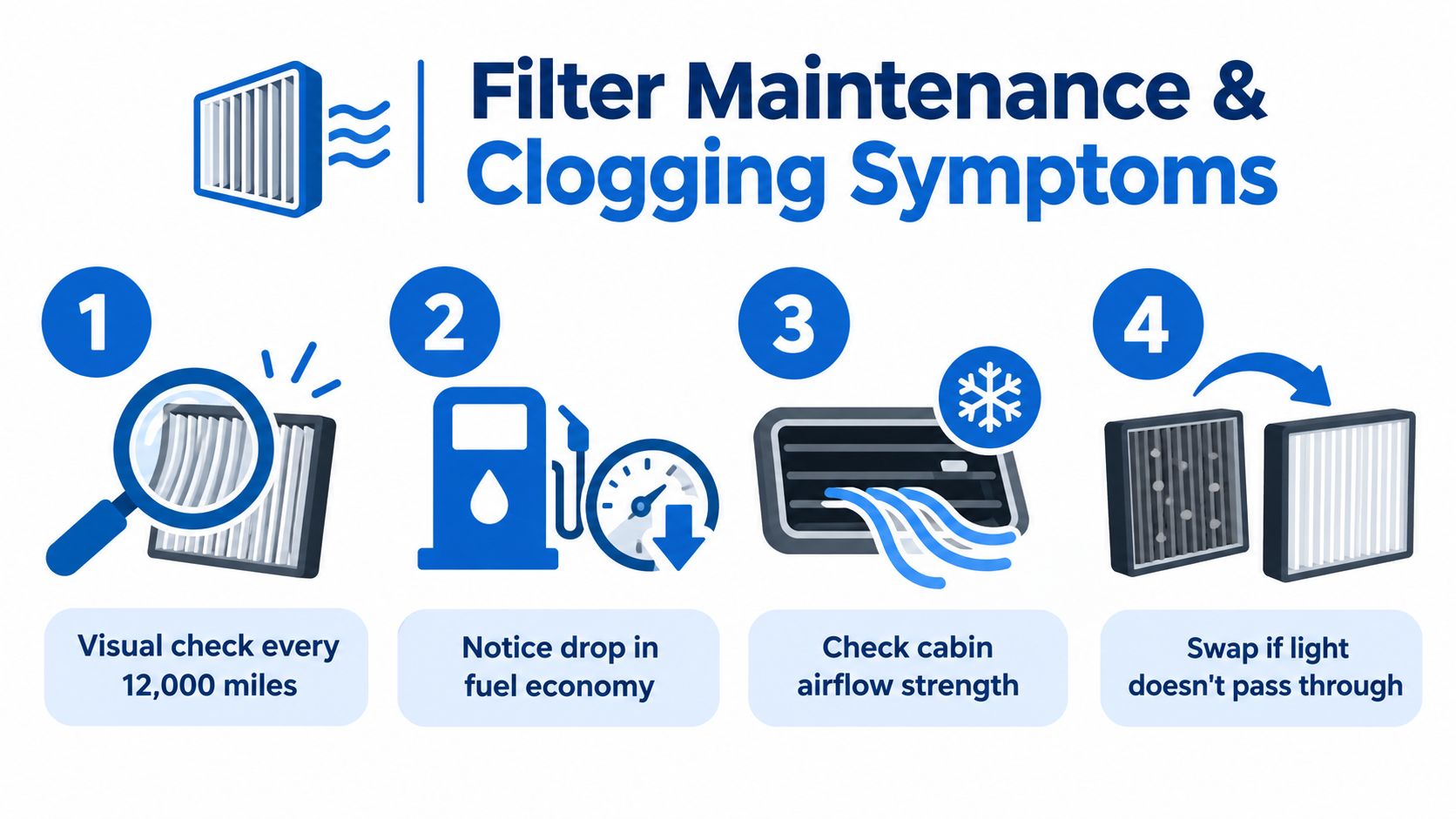
A basic light test can reveal heavy loading. Hold the filter toward a bright light and look for areas where the media is packed with dust, leaves, or dark deposits. The test isn't perfect because filter color varies by material, and a filter can look acceptable while developing pressure drop. Use the inspection alongside acceleration symptoms, the maintenance schedule, and any restriction indicator fitted to the vehicle.
Black soot at the exhaust isn't a reliable stand-alone reason to replace the engine filter. It may point to a combustion or emissions issue that needs diagnosis. Likewise, a whistle from the intake could result from a loose housing seal, a cracked duct, or air leakage rather than a dirty element.
Find the cabin filter and evaluate airflow
The cabin filter is often behind the glovebox, but some vehicles place it under the cowl or in another HVAC access panel. Follow the owner's manual rather than forcing a panel, because clips and damper cords can be easy to damage.
Look for a collapsed, wet, heavily dust-coated, or leaf-filled filter. Then run the fan through its settings and compare the airflow with what you normally feel. Weak output, a persistent damp smell, or debris emerging from the vents justifies a closer inspection. If airflow remains poor after a new filter, the blower, evaporator, ductwork, or control system may need attention.
Use a condition-based checklist
- Read the manual: Confirm the specified filter type, access procedure, and recommended service timing.
- Record the change: Note the date and mileage in your phone or maintenance log so you don't rely on memory.
- Match the environment: Inspect more often if you drive on unpaved roads, through dusty areas, in dense traffic, or during intense pollen and smoke events.
- Check both systems: An engine-filter inspection doesn't tell you anything about the cabin filter, and a strong fan doesn't prove that the cabin filter is clean.
- Investigate persistent symptoms: If replacement doesn't restore airflow or response, ask a technician to inspect the wider intake or HVAC system.
Don't judge a filter by color alone. Some new filters are dark, and some loaded filters retain a relatively light appearance. Restriction, damage, moisture, debris, and the vehicle's symptoms provide a better basis for action than appearance by itself.
Enhancing In-Car Air With Portable Purification
Replacing both filters gives the vehicle a sound baseline, but it doesn't control every exposure. A passive cabin filter works only when air moves through its housing. If you open the windows, use outside air in heavy traffic, or carry smoke and odors into the car on clothing, contaminants can still enter the passenger space.
That limitation makes portable in-car purification a useful additional layer for some drivers. Commuters who spend long periods in traffic, rideshare drivers, and families traveling through smoky or dusty conditions may want active treatment inside the cabin rather than relying only on the HVAC intake filter.
A portable unit should complement, not replace, the cabin filter. The filter manages the designed HVAC path, while a portable purifier can circulate and treat air within the passenger compartment. Product capabilities differ, so check the manufacturer's instructions for placement, power requirements, operating modes, and any safety limitations.
Build a layered vehicle strategy
Start with the basics:
- Maintain the engine filter so the intake system can supply air without unnecessary restriction.
- Replace the cabin filter when it is loaded, damaged, damp, or restricting ventilation.
- Use recirculation thoughtfully when outside traffic pollution is the concern, while following the vehicle's guidance for ventilation and window fogging.
- Keep the interior clean so settled dust and odor sources don't continually re-enter the air.
- Add portable purification when conditions justify it, especially when the cabin filter can't address pollutants entering through open windows or other routes.
The EcoTravel portable car air purifier can be considered as part of that supplemental approach. It belongs in the active-purification category, not the engine-maintenance category, so it shouldn't be presented as a replacement for either automotive filter.
A clean cabin filter protects the HVAC airflow path. A portable purifier addresses air circulating within the cabin. Together, they support a more complete plan for mechanical reliability, ventilation, odor control, and passenger comfort. The right combination depends on your vehicle and environment, but the principle is straightforward: maintain the two built-in filters first, then add active purification where ordinary filtration falls short.
EcoQuest Purifiers offers indoor, HVAC, and portable air-quality products that can complement routine vehicle filter maintenance and broader odor-control needs. Visit EcoQuest Purifiers to review the available purification technologies, replacement parts, and portable options for your home and car.