
Bipolar Ionization Cost and What Actually Drives It
Installed bipolar ionization typically costs $300–$1,500 for a residential in-duct unit and $2,000–$15,000 for commercial systems, depending on scope. Those prices don't capture the full five-year cost: electrical integration, emitter replacement, maintenance, and proving the equipment is suitable for occupied spaces can all add to the bill.
The counterintuitive part is that a low-power device can still be an expensive choice. Its electricity use may be modest, but a quote that omits controls, replacement parts, and safety verification isn't a reliable total. Treat the headline price as a starting point, not a buying decision.
Table of Contents
- Bipolar Ionization Cost Range Buyers Should Know
- How Bipolar Ionization Actually Works in an Air Stream
- What Actually Drives the Price You Pay
- Residential Versus Commercial Cost Scenarios
- Operating Costs, Electricity, and Maintenance Over Five Years
- Safety Standards and the Hidden Cost of Compliance
- Ionization Versus Better Filtration Over Five Years
- A Buyer Checklist and How EcoQuest Purifiers Fits In
Bipolar Ionization Cost Range Buyers Should Know
An installed price is too narrow a basis for choosing a system. Require a five-year cost schedule that separates equipment, labor, electricity, emitter replacement, and safety verification. That makes a higher bid with defined obligations easier to judge against a cheaper bid with missing work.
The residential and commercial cost estimate puts residential in-duct installation at $300–$1,500, averaging near $850, commercial equipment at $2,000–$10,000 per unit, and building-wide systems at $5,000–$15,000. These market estimates are useful boundaries, not project quotes. Commercial buyers must distinguish a unit price from a building-wide price before comparing proposals.
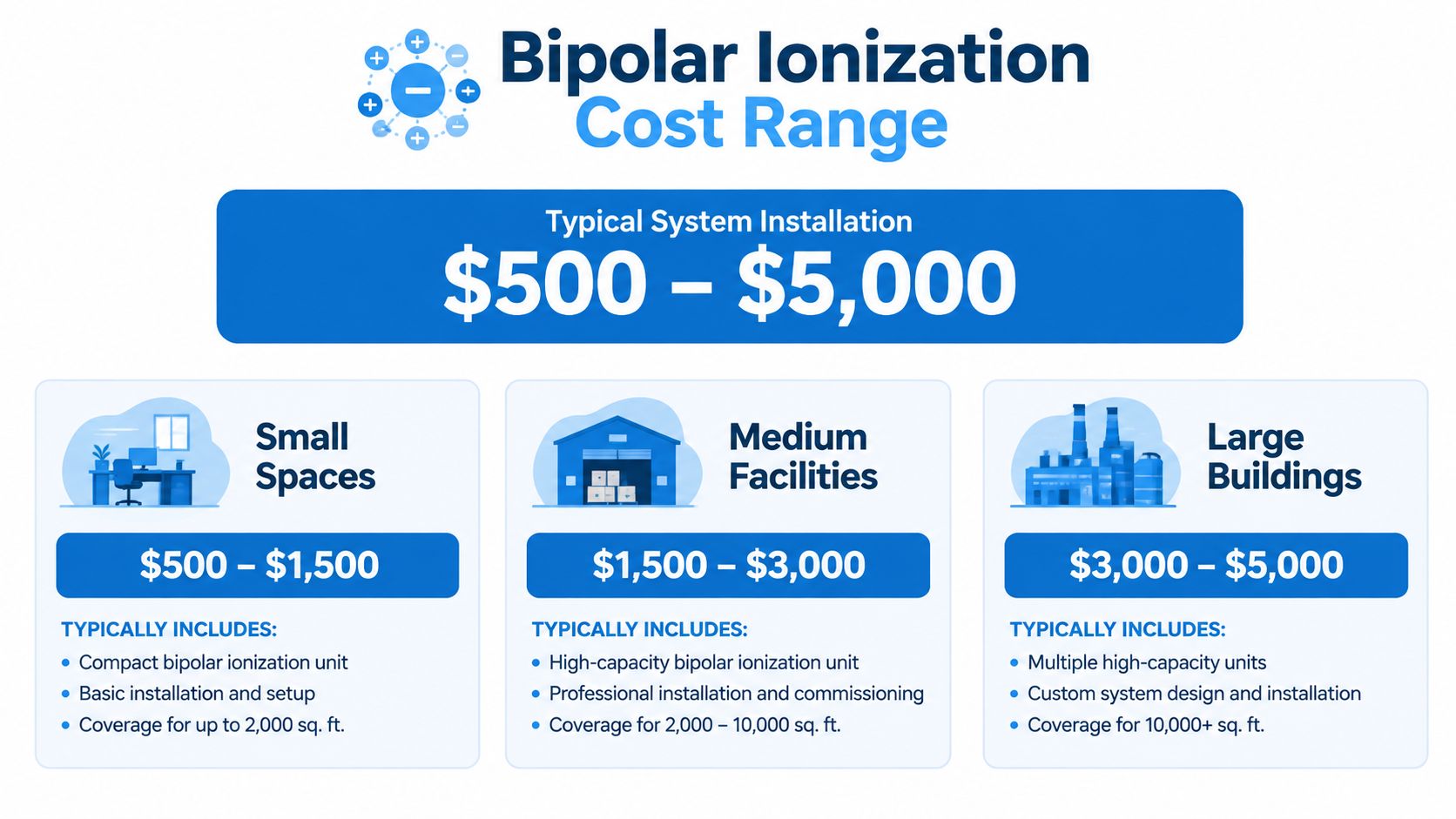
Wiring, duct modifications, controls integration, commissioning, and inspection can change the installed total. Ask which are included. Safety verification belongs in the quote, particularly documentation supporting the exact model's suitability for occupied spaces.
Read the quote as a cost schedule
Have the contractor itemize the obligations and assumptions:
- Initial installation: Separate equipment and mounting from labor, wiring, duct changes, and controls work.
- Recurring service: Specify required inspection and cleaning, plus electricity assumptions. Keep energy use separate from service charges.
- Replacement parts: Identify the emitter or electrode, its price, and the model-specific replacement schedule.
- Verification: Include commissioning, emissions documentation, and the operating conditions covered by that documentation.
Annual maintenance allowances and replacement-component estimates need a written model-specific check. Confirm which parts require replacement, what triggers replacement, and whether service labor is included. A generic interval leaves you carrying the uncertainty.
Practical rule: Compare bids only after they cover the same work, replacement assumptions, and safety documentation. Treat unspecified costs as unresolved budget risks, not savings.
How Bipolar Ionization Actually Works in an Air Stream
An in-duct ionizer charges particles; downstream filtration still matters. The device generates positively and negatively charged ions and releases them into moving air. Those ions attach to airborne particles and can encourage clustering or capture by a downstream filter. Keep filter type and airflow matching in the budget. The installed equipment usually appears as a powered module and wiring, rather than a separate room appliance.
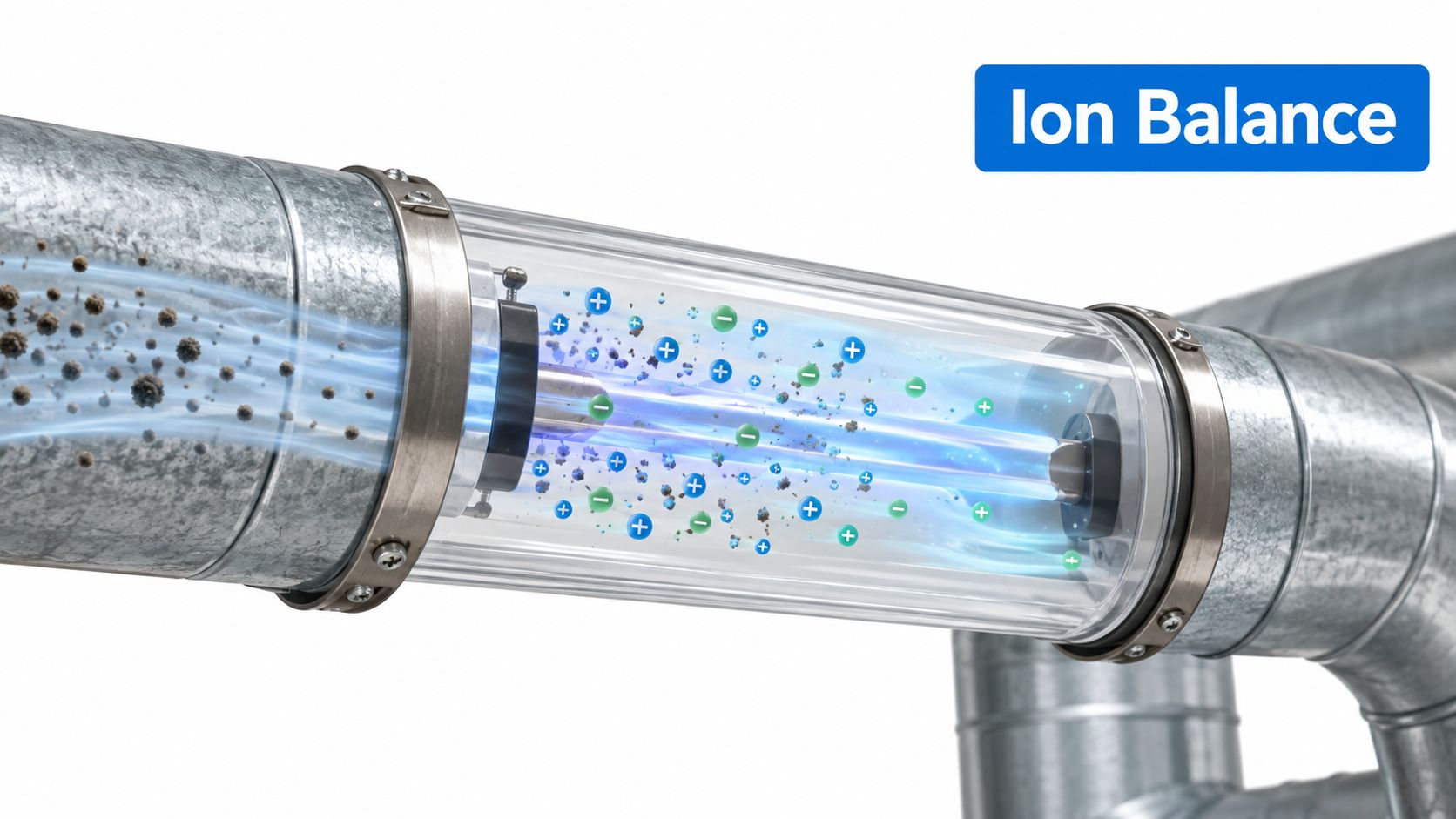
Ionization does not force air through a dense physical barrier, so it can add little airflow resistance. That characteristic does not establish contaminant-removal performance or justify removing existing filters. Filtration, ventilation, and source control must still meet the building's needs.
What the mechanism means for your budget
Low airflow resistance is a reason to consider ionization alongside filtration upgrades, not proof of headline savings.
The University of Illinois EnergySense Resilience Center reports approximately 2 watts per 1,000 CFM in its overview of ionization technologies. That figure provides an energy reference, not evidence that a particular device will deliver a health benefit or remove a particular contaminant.
Judge the mechanism against a five-year cost horizon. Keep equipment, installation labor, electricity, emitter replacement, and occupied-space safety verification separate. Low device wattage addresses only the electricity component; it leaves the other obligations unresolved.
Location and airflow determine whether the installation suits the air handler and spaces served. Require the installer to explain the intended result, how performance will be evaluated, and which complementary controls remain necessary. Accept no promise of whole-building cleaning based solely on placing an ionizer in a duct.
What Actually Drives the Price You Pay
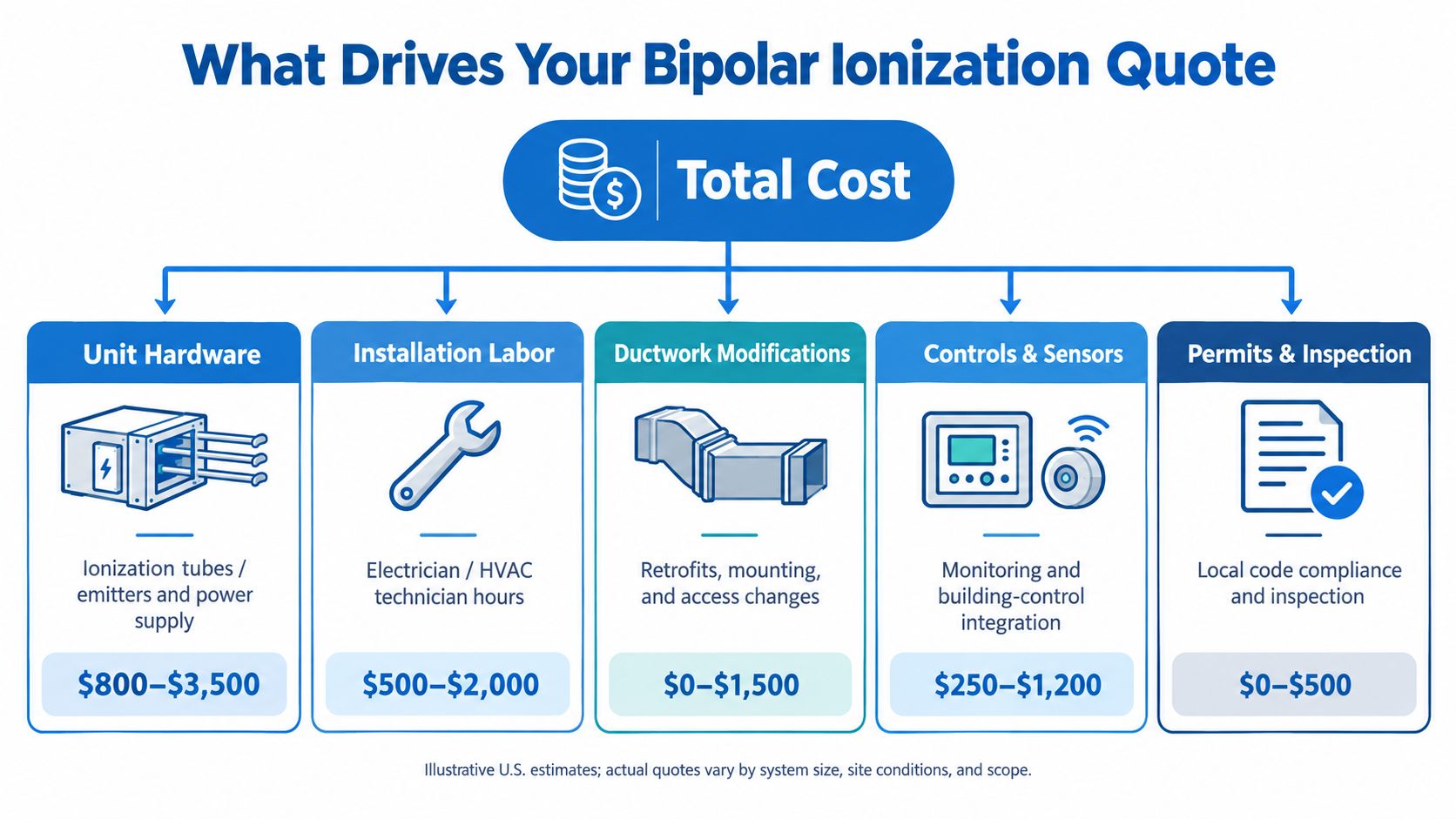
A cheap installation quote can leave you buying the missing work later. Compare bids on a five-year risk-adjusted total, with equipment, labor, electricity, emitter replacement, and occupied-space safety verification priced separately. A mount-and-connect job and a commissioned multi-air-handler installation carry different obligations.
Require a bid you can audit
Unit and emitter design: Require the exact model and replacement part numbers. Needlepoint and tube systems have different replacement schedules, so an equipment price without a parts-and-labor replacement allowance leaves your ownership budget incomplete.
Air handlers and capacity: Count the air handlers and identify the capacity each device will serve. The EnergySense cost and energy overview gives an installation estimate of $500–$5,000, depending on air-handler size and capacity. Use that range to question scope, rather than treating it as a quote for your building.
Labor and access: Separate routine servicing from retrofit work. The residential cost breakdown lists $100–$250 for routine service-visit labor and $75–$400 for extra wiring or mounting. Require the installer to identify access restrictions, electrical changes, and mounting work before accepting the labor allowance.
Controls and commissioning: Specify controls integration, operational checks, and the records delivered at handover. Without those details, you cannot tell whether competing bids include the same work.
Safety testing and documentation: Request certification and supporting documentation for the exact model, plus a separate allowance for any required independent testing or engineering review. Evidence supporting use in occupied spaces belongs in the purchasing decision. An unexplained omission is a budget risk.
Treat historical savings as a scope check
The ASHRAE Philadelphia cost example, published in 2022, compared installation at about $0.80 per CFM with conventional equipment at about $1,500 per ton, assuming approximately 400 CFM per ton. That comparison describes nominal capital costs under its assumptions. It establishes no five-year savings.
Use the historical figure to challenge the bid's scope: require air-handler count, wiring, controls, and commissioning as separate lines, then add electricity, emitter replacement, and safety-verification costs before comparing totals.
Keep duct cleaning separate, too. Florida air duct cleaning costs provides context for that service; require its scope and price outside the ionization retrofit allowance.
Residential Versus Commercial Cost Scenarios
Residential and commercial bids cover the same broad cost categories, but their scopes can look very different. A home quote may cover one in-duct unit and standard installation; a commercial project can include several devices, controls work, and a service plan. Compare the five-year cost, not just the installation total. Include equipment, labor, electricity, emitter replacements, and any cost to document safety for occupied spaces.
| Scenario | Installed Cost | Annual O&M | Emitter Replacement |
|---|---|---|---|
| Residential in-duct unit | $300–$1,500 | $50–$150 per unit, estimated | Depends on system design; confirm schedule in writing by model |
| Commercial unit | $2,000–$10,000 per unit | $50–$150 per unit, estimated | Needlepoint and tube intervals differ; confirm schedule in writing by model |
| Building-wide commercial system | Commonly $5,000–$15,000 | Depends on unit count and service scope | Price parts and labor by model; confirm schedule in writing by model |
These prices and maintenance estimates summarize the published cost ranges discussed earlier. Replacement intervals vary by system type, so don't assume one schedule or replacement cost applies to every building. Get the manufacturer's schedule in writing for each model.
Budget by system, not just building size
For your residential quote, list each air handler and its CFM, then confirm whether wiring, controls, and the first-year inspection are included. Add annual O&M at $50–$150 per unit to compare the five-year total, and include emitter replacement and safety documentation as separate costs. For offices and larger facilities, require an itemized count of units, controls work, commissioning, and recurring inspection. A low installation bid can become the expensive option if these costs are left out.
Facility managers can use EcoQuest's commercial air solutions as a catalog reference. Compare the proposed configuration, documentation, and service terms with the building's requirements before judging the price.
Operating Costs, Electricity, and Maintenance Over Five Years
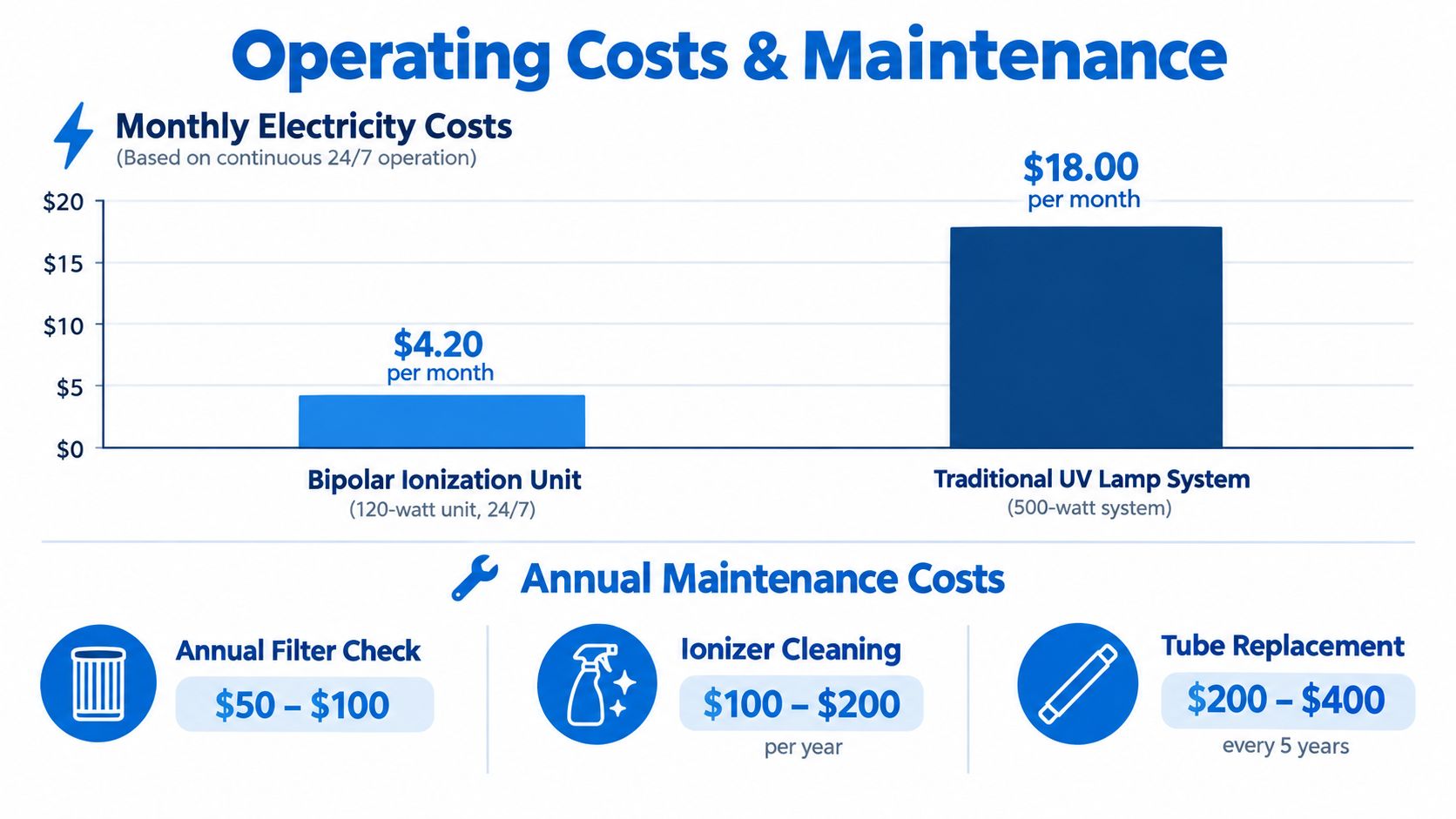
Electricity is a small part of the bill. At approximately 2 watts per 1,000 CFM, a 10,000-CFM air handler uses about 20 watts. At $0.15 per kWh and continuous operation, that works out to roughly $26 per year. The University of Illinois EnergySense overview provides the consumption estimate; the annual cost depends on the stated electricity rate and operating assumption.
Replacement parts can outweigh electricity
For a five-year comparison, list service, replacement parts, and electricity separately. Plan $50–$150 per unit per year for service and $200–$500 for components. Needlepoint emitters may need replacement every 12–18 months, while tube systems may run 24–36 months between replacements. Treat these as planning ranges, not guaranteed lifespans, and get the schedule for the quoted model in writing.
Electricity savings alone do not settle the comparison with filtration. Ionizers add little airflow resistance, but buildings may still need conventional filters for particulate control. If filters stay in place, include their replacement cost and any effect on fan energy. Ask the contractor to itemize the assumed filter type, pressure drop, fan operation, annual running hours, and electricity rate.
Don't count savings twice: A low-power ionizer does not prove that filters can be removed or fan energy reduced. Require calculations based on the actual HVAC setup.
A useful operating-cost estimate also includes service visits, emitter parts, retained filtration, and controls changes. A proposal that promises low maintenance without a parts schedule leaves a major five-year cost unanswered. Compare the full operating budget, not just the equipment's electricity use.
Safety Standards and the Hidden Cost of Compliance
The cheapest quote can become the expensive one if it leaves the buyer without evidence that the device is appropriate for occupied spaces. Certification labels aren't interchangeable, and a general claim about ionization doesn't tell you what the exact model emits under specified test conditions.
Ask which certification applies
The cost guidance distinguishes UL 867, which can permit ozone emissions up to 50 ppb, from UL 2998, which validates emissions below 5 ppb. The cost and compliance discussion presents this distinction as a buyer concern and recommends checking documentation for the exact model. Don't accept “zero ozone” as a generic technology attribute; request the certification record and relevant testing details.
A bid that excludes verification may appear cheaper because it doesn't include the work needed to document performance or address a compliance gap. If an owner later needs independent testing, replacement, or engineering review, the original price comparison no longer reflects the true cost.
Put the evidence request in writing
Ask the vendor to provide:
- Exact model documentation: Certification details and the test conditions that apply to the offered unit.
- Airflow rating: The capacity and installation conditions for which the system is specified.
- By-product information: Available data relevant to operation in occupied spaces.
- Commissioning scope: What the installer will verify, and what records you'll receive.
- Corrective-work terms: Who pays if the installed equipment doesn't meet the agreed specification.
Safety documentation belongs in the cost comparison, not in a footnote after purchase. If one bidder supplies it and another doesn't, their prices aren't directly comparable.
Ionization Versus Better Filtration Over Five Years
The sensible comparison isn't “ionizer versus nothing.” It's ionization added to a building's existing strategy versus a filtration upgrade that addresses the same air-quality goal. Over a five-year planning window, compare equipment, labor, service, replacement components, verification, filter purchases, and any change in fan energy. Don't assume ionization eliminates the need for HEPA or higher-efficiency HVAC filtration.
A technical article in ASHRAE Journal describes a project where bipolar ionization contributed to about $60,000 in initial savings by enabling HVAC equipment to be downsized. That was a design-specific result, not a standard retrofit payback. The article also discusses possible lifetime energy savings from reducing the need to condition ventilation air, but those savings require engineering validation against ventilation, occupancy, climate, humidity, and codes. The ASHRAE Journal technical discussion is evidence that project design can change the economics, not a promise that an existing building will save money.
Compare the right cost categories
- For a home: Compare the ionizer installation and replacement schedule with the filter or portable-purifier approach you'd otherwise use. A homeowner considering HEPA filtration for wood floors should still evaluate the filtration setup and its maintenance independently.
- For a small office: Keep existing filtration in the calculation unless an engineer confirms a change is appropriate. Include electricity, service visits, parts, and any required safety verification.
- For a commercial building: Ask for an air-handler-level model showing pressure drop, fan power, operating hours, replacement parts, and the baseline filtration plan. The cost case is stronger when the ionization system is evaluated during design or a major retrofit, rather than treated as a guaranteed energy-saving add-on.
If your goal is filtration rather than an in-duct ionization retrofit, compare the EcoQuest HEPA air purifier options against the building's needs and maintenance plan. For a different setting, the EcoTravel Voyager Portable Car Air Purifier is described as purifying car air from exhaust gases, unpleasant odors, and other contaminants entering from the roadway, and as providing protection against viruses and bacteria from the air-conditioning system.
A Buyer Checklist and How EcoQuest Purifiers Fits In
Before signing, get UL 2998 documentation, an emitter schedule, an air-handler-level airflow and pressure-drop calculation, and an itemized total for equipment, labor, controls, commissioning, service, replacement parts, and verification. Ask vendors to put each assumption in writing. EcoQuest Purifiers offers HVAC-integrated options; its Living Air Classic XL-15 Air Purifier is a filterless unit using ionization and activated oxygen. Compare products by documented features and intended use, not by a headline price.
EcoQuest Purifiers offers indoor air-quality products, replacement parts, and repair services across home, portable, HVAC-integrated, and commercial categories. If you're comparing bipolar ionization costs, visit EcoQuest Purifiers and request the product details and documentation you need to build a complete five-year cost comparison.