
UV Air Purifier in Duct Explained How It Works and When
That stale, slightly damp smell when the AC kicks on can send people down the same path. Change the filter. Vacuum the vents. Spray something near the return grille. Hope for the best. Then the smell comes back, or allergy symptoms keep flaring, and you start looking at a UV air purifier in duct systems as the next step.
That's usually the right moment to ask a better question.
Most buyers ask, “Does UV kill germs?” In a technical sense, yes, UV-C can damage microorganisms. But that isn't the whole buying decision. The core question is when a duct UV system meaningfully treats moving air, and when it mostly helps keep the HVAC coil cleaner. Those are not the same result, and many guides blur them together.
A good duct UV setup can be a useful add-on to filtration, not a replacement for it. It can support HVAC hygiene, reduce biological buildup on wet internal surfaces, and in some designs help treat air passing through the system. If you're comparing options for an HVAC-mounted solution, you can browse whole-home HVAC air purifier products to see how these systems are typically positioned.
Table of Contents
- Introduction to In Duct UV Air Purification
- How UV Air Purifiers Work Inside Your Ducts
- What In Duct UV Can and Cannot Do for Your Air
- Safety Ozone and Real World Performance Factors
- Installation Integration and Maintenance Essentials
- Costs ROI and Compliance Considerations for Homes and Businesses
- Choosing Troubleshooting and Getting Support for Your System
Introduction to In Duct UV Air Purification
A common home example looks like this. The house doesn't seem dirty, but the system has a musty note every time cooling starts. One family member wakes up congested. The filter gets changed on schedule, yet the air still feels “old” by late afternoon.
That's where in-duct UV gets attention. It promises help with the invisible part of the HVAC system, especially places that stay dark and damp. Those conditions matter because your evaporator coil and nearby surfaces can collect microbial growth over time, even when the home looks spotless.
Why people consider it after filters disappoint
A filter and a UV lamp solve different problems.
Filters are mechanical catchers. They trap particles moving through the system. A UV lamp is a light-based treatment device. It doesn't trap dust, and it doesn't pull pet hair out of the air. What it can do is expose microorganisms to germicidal light inside the HVAC path.
That difference is where buyers often get confused. If your main complaint is visible dust on furniture, UV probably won't solve the issue you care about most. If your concern is a damp-system smell, biological buildup near the coil, or adding another layer to an indoor air plan, then UV becomes more relevant.
Most disappointment with duct UV happens when someone buys it for a particle problem instead of a biological or HVAC hygiene problem.
The buying question that actually matters
The history here is longer than many people realize. Independent reviews note that UVGI was first used for air disinfection in 1935, and by the 1940s many hospitals had adopted UV-C for airborne infection control. Modern in-duct systems are designed to irradiate air as it passes through HVAC ducts, and guidance tied to ASHRAE notes a minimum UV exposure time of 0.25 seconds and a minimum dose of 1,500 µJ/cm2 for HVAC in-duct systems intended for high single-pass efficiency, when installed correctly, as described in ASHRAE-linked UVGI guidance.
That last part matters more than the marketing headline. Installed correctly means the lamp, airflow, exposure time, and placement all have to work together. A bulb in a duct isn't automatically a high-performing air cleaner.
How UV Air Purifiers Work Inside Your Ducts
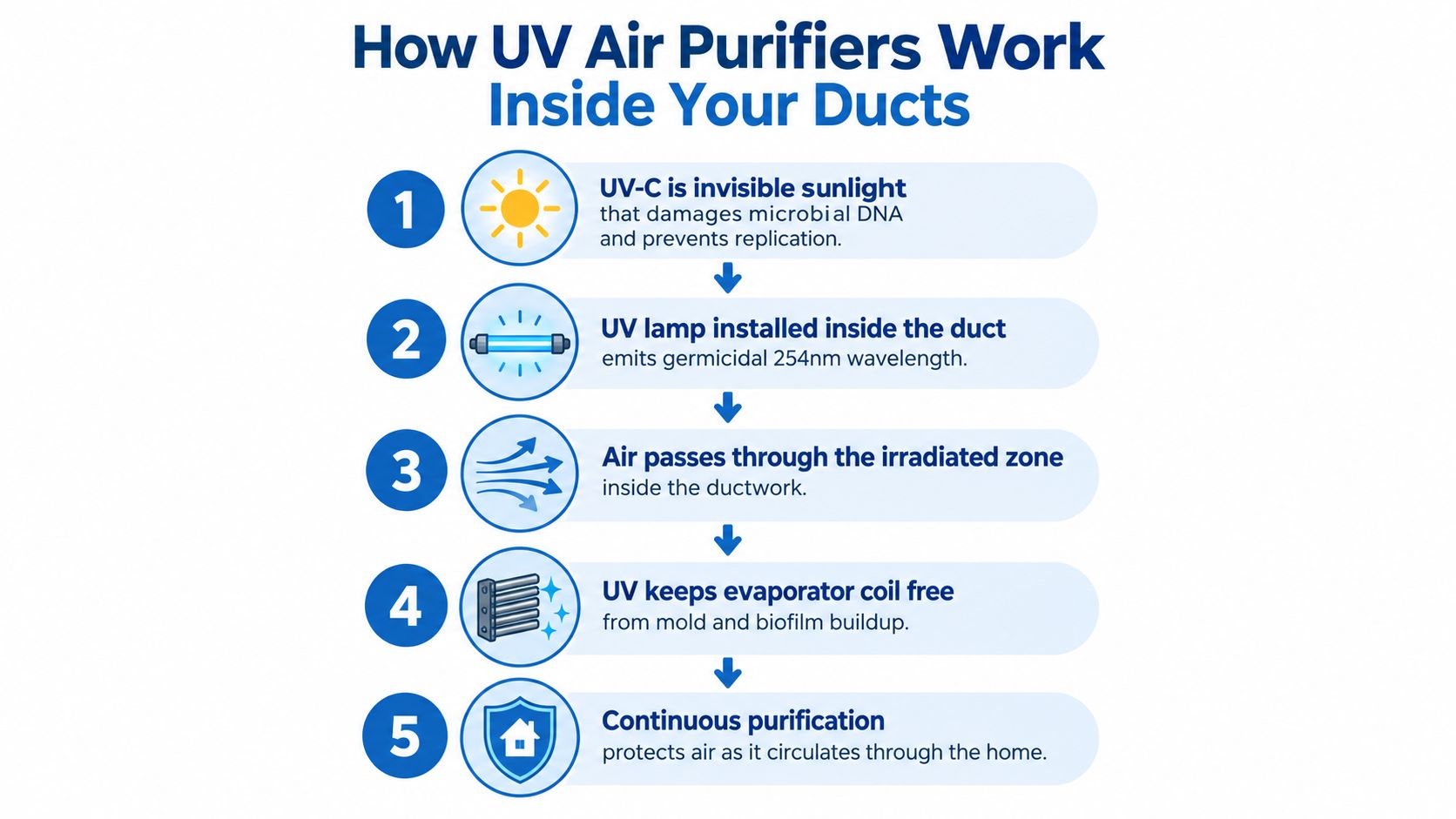
Think of UV-C as a very narrow, invisible kind of light energy. It isn't “cleaning” the way soap cleans. It works more like a key that jams the copying process inside microorganisms. When microbes pass through enough UV-C, the damage can keep them from reproducing.
Inside ductwork, that light is usually produced by a lamp designed for germicidal output at 253.7 nm, a wavelength noted in CDC-published technical material discussing HVAC&R use since the 1990s for coil and heat-exchange performance.
A simple visual helps:
Two placement styles that get lumped together
There are really two different jobs a UV lamp might do in an HVAC system.
Coil irradiation places the lamp so it shines on the evaporator coil and nearby drain-pan area. That's the wettest, most biofilm-prone part of many systems. This setup is often the most practical way to improve HVAC hygiene.
In-duct air-stream irradiation places the lamp so moving air passes through a UV zone. Here, the goal is single-pass treatment of airborne microbes. This is the version commonly imagined when one hears “UV air purifier in duct.”
Those two uses overlap, but they aren't interchangeable. A system can be good at keeping a coil cleaner without delivering dramatic single-pass air disinfection in fast-moving ducts.
For readers comparing installed HVAC devices, Air Scrubber Induct 2000 options show the kind of in-system products often evaluated alongside UV-based solutions.
Dose matters more than the mere presence of a bulb
The most helpful mental model is a tanning booth versus a camera flash. A quick flash of light is not the same as sustained exposure. UV systems depend on dose, which combines light intensity and time.
A few design details change that dose:
- Lamp placement: Closer target surfaces receive more effective irradiation.
- Air speed: Faster air spends less time in the treated zone.
- Duct geometry: A longer irradiated path can give air more exposure time.
- Reflective surfaces: Better reflectivity helps keep more UV energy in the treatment zone.
Practical rule: Don't ask only “How many bulbs does it have?” Ask where the lamp sits, how long air stays in the irradiated section, and whether the system was designed for moving air or mainly for coil treatment.
If you want a quick walk-through of the physical layout, this video gives useful visual context before you talk with an installer:
Some HVAC-integrated purification systems also use replaceable internal components alongside UV-related functions. For example, the ActiveOx RCI PCO Cell with ozone is described as an essential part of Any Air purifier. The RCI PCO Cell should be replaced when UV Light Bulb burns out.
What In Duct UV Can and Cannot Do for Your Air
A balanced way to judge duct UV is to compare it with the problem you're trying to solve. Many homeowners buy the right technology for the wrong contaminant.
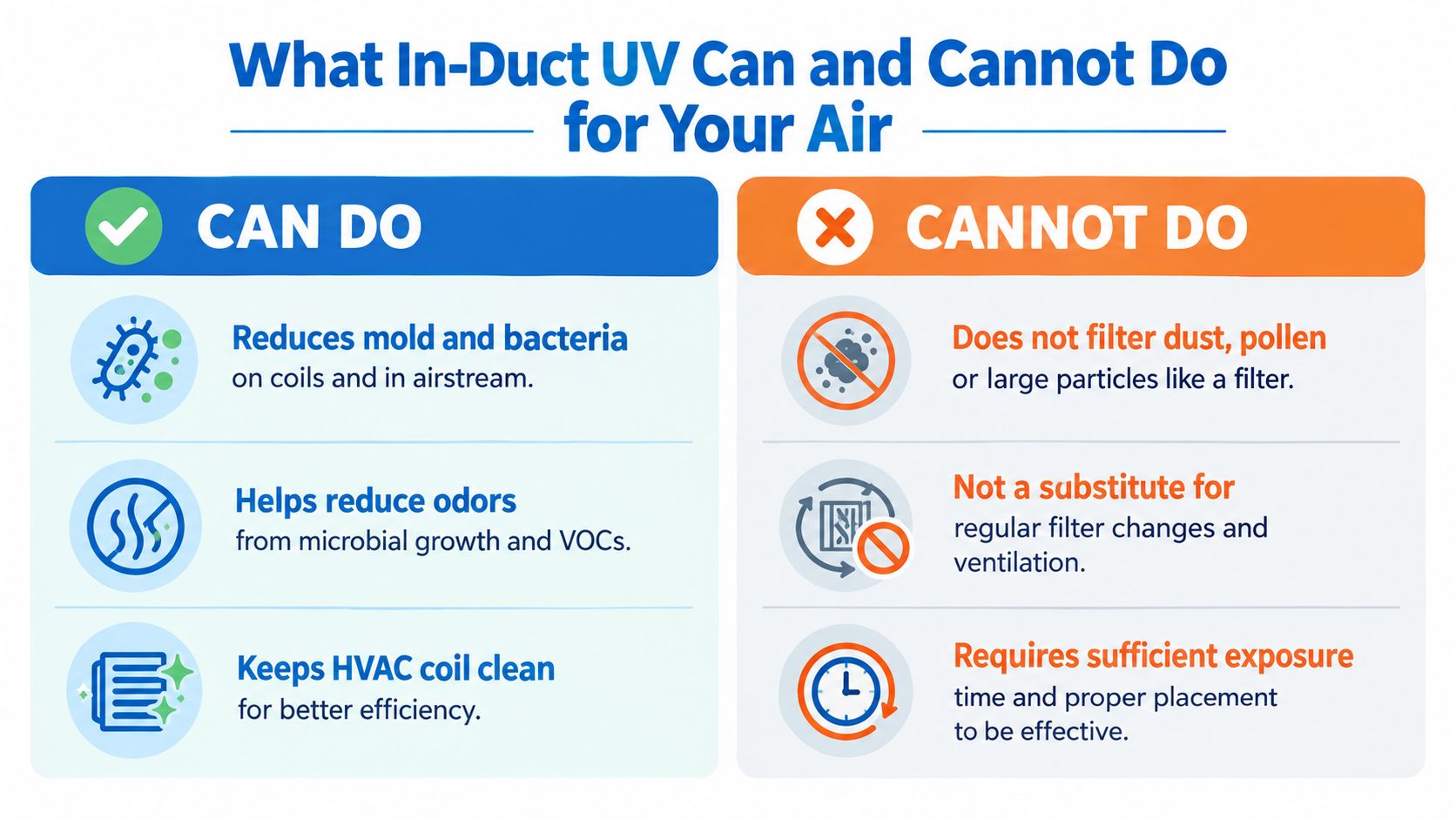
The split below keeps the claims grounded.
What it does well
If your HVAC system has a damp smell, UV often makes the most sense near the coil area. CDC-published technical literature also states that UV-C can kill 99% or more of microorganisms on HVAC air ducts and evaporator coils under appropriate intensity, exposure, placement, and lamp-life conditions, and it notes in-place testing can quantify performance in operating systems, as discussed in the CDC technical document on in-duct UVGI performance.
That tells you two practical things. First, UV can be very effective on surfaces when the setup is right. Second, “when the setup is right” does a lot of work in that sentence.
What it won't do
UV is not a dust solution. It doesn't replace your filter, duct sealing, source control, or fresh-air strategy. If your issue is pollen, lint, or construction dust, a lamp won't catch any of it.
A quick comparison helps:
| Problem in the home | UV in duct fit | Better primary tool |
|---|---|---|
| Musty AC smell from wet HVAC components | Strong fit | Coil-area UV plus maintenance |
| Visible dust on furniture | Weak fit | Better filtration and housekeeping |
| Pet hair and larger particles | Weak fit | Filter upgrade and cleaning |
| Concern about microbial growth inside system | Strong fit | UV plus routine service |
| Stale air in one room | Partial fit | Ventilation or room purifier |
Match the tool to the room problem
A family with recurring coil odors may benefit more from HVAC-mounted UV than from buying another portable device. But a family bothered by smoke residue, stale air, or room-specific airborne particles may compare that with a standalone option such as the Living Air Classic XL-15 Air Purifier. The EcoQuest Living Air Classic XL-15 air purifier is designed for homeowners who want cleaner indoor air without complicated systems or expensive maintenance. This filterless air purifier uses ionization and activated oxygen technology to help reduce airborne particles, odors, and stale indoor air in homes, offices, and other indoor environments.
That's why the smartest buyers stop asking whether UV is “good” in the abstract. They ask whether it fits the specific contaminant and location causing trouble.
Safety Ozone and Real World Performance Factors
The hardest truth about duct UV is that lab-friendly claims don't automatically survive real duct conditions. Air moves. Ducts bend. Some organisms are easier to inactivate than others. Maintenance access can be awkward. All of that changes results.
Why direct safety risk is lower in ducts, but not gone
A duct-contained lamp lowers the chance of accidental exposure during normal operation because the UV source is enclosed within the HVAC system. That's a real advantage compared with open-room UV concepts.
But maintenance is the danger point. AHRI notes that UV bulbs lose intensity over time and need periodic replacement, and service should be done with power disconnected because UV exposure can seriously irritate eyes and skin. NHS guidance adds that maintenance should include shut-down interlocks, hazard notices, electrical checks, runtime tracking, and lamp replacement when needed, as described in AHRI guidance on ultraviolet treatment and maintenance considerations.
Some buyers also ask about ozone. The safe answer is simple: check exactly what technology the unit uses and what the installer says it's designed to emit or avoid. Don't assume every UV-related product works the same way just because it includes a lamp.
If a contractor can't clearly explain the lamp type, its placement, and what safety shutoff protects service access, keep asking questions.
Why moving air is the real test
A recent review highlighted a problem with typical consumer content. It found 66 qualifying studies, but the evidence base was still heavily split between lab work and theory. That helps explain why many pages answer whether UV-C “kills germs” while skipping the more useful question of when it affects moving air versus mainly coil biofilm, as summarized in NHS guidance on UVC air-cleaning evidence and standards.
In plain language, many systems may deliver their strongest benefit by keeping HVAC internals cleaner, not by performing dramatic one-pass sterilization of fast-moving residential airflow.
How Airspeed and Organism Type Affect In Duct UV Effectiveness
| Condition | Inactivation Rate | Implication for System Design |
|---|---|---|
| Airborne E. coli in a full-scale study, residence time below 0.36 s | More than 99.5% | Common bacteria can respond well when exposure is sufficient |
| Fungal spores under the same conditions | 53% to 73% viable-count reduction | Spores are more resistant and may need much higher dose |
| Controlled HVAC-duct test at 2.2 m/s for vegetative bacteria | 87% single-pass efficiency | Moderate airflow can still allow useful performance |
| Controlled HVAC-duct test at 2.2 m/s for fungal spores | 75% single-pass efficiency | Even at workable airflow, spores remain tougher |
| Controlled HVAC-duct test at 5.1 m/s | Essentially no detected inactivation | Fast airflow can collapse performance unless the system increases output, exposure length, or reflector efficiency |
Those figures come from a full-scale and controlled-duct study summarized through Duke University.
The lesson isn't that duct UV doesn't work. The lesson is that air velocity and target organism decide a lot of the story. If a sales claim sounds absolute, the system details probably weren't discussed enough.
Installation Integration and Maintenance Essentials
Once you understand the physics, installation starts to look less like “add a bulb” and more like “build a controlled treatment zone.” That's why placement and upkeep matter so much.
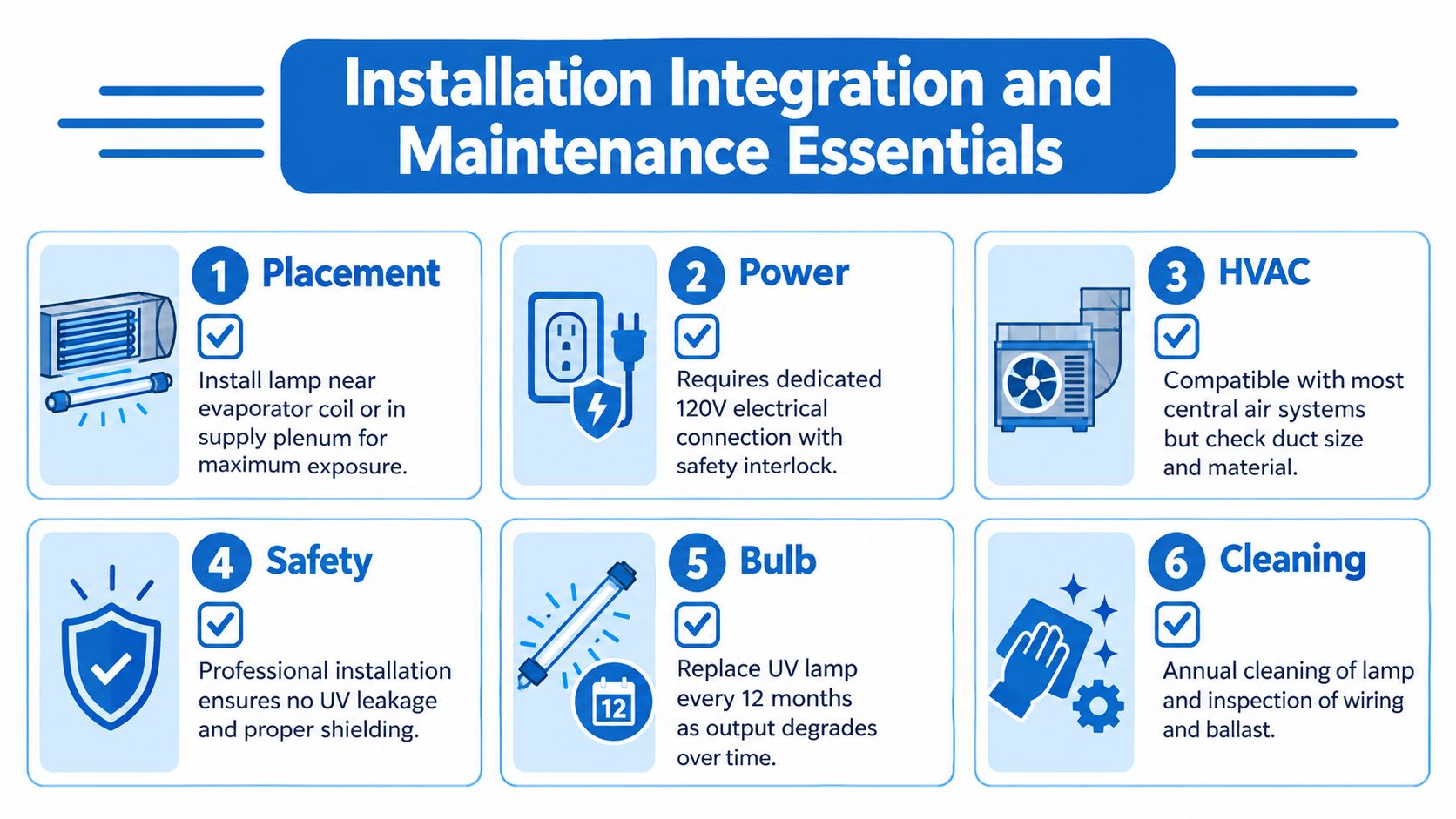
Where installers usually place the lamp
In many homes, the first decision is whether to target the evaporator coil area or the moving air stream farther into the duct or plenum.
Coil-area placement usually aims at the wettest part of the system. That's often the practical choice when the homeowner complains about musty startup odors or recurring internal buildup. Air-stream placement tries to treat passing air more directly, but it's much more sensitive to airflow and exposure geometry.
A few installation checkpoints matter every time:
- Access matters: The lamp has to be reachable for cleaning and replacement.
- Shielding matters: Light leakage into occupied space or service areas is unacceptable.
- Electrical integration matters: The unit needs proper power connection and safe shutoff during service.
- Material compatibility matters: The installer should account for duct construction and mounting location.
If you like keeping a home maintenance schedule, this DIY vent system upkeep guide from Bulls Eye Repair is a useful companion for the non-UV parts of airflow care, like vent cleanliness and general system attention.
Why maintenance is not optional
The biggest ownership mistake is assuming the lamp is working just because it still lights up. AHRI guidance warns that bulbs lose intensity over time. A weak lamp may look normal to the eye while delivering less useful germicidal output.
That creates a silent failure mode. The system can become less effective long before anyone notices a smell change or service issue.
“Set it and forget it” is the wrong mindset for duct UV. Runtime tracking, cleaning, and replacement are part of the product, not an extra chore.
A practical upkeep routine
You don't need to turn ownership into a science project, but you do need a routine.
- At filter-change time: Look for unusual odors, moisture issues, or signs that the service access area needs attention.
- During regular HVAC service: Ask the technician to inspect the UV assembly, wiring, ballast, and mounting condition.
- When lamp replacement is due: Replace the lamp even if it hasn't visibly failed.
- After service: Confirm safety interlocks and panel closure before restoring operation.
For replacement components used in these systems, UV lamps and RCI cell parts are the category most owners eventually need to check.
Costs ROI and Compliance Considerations for Homes and Businesses
A UV system is easier to justify when you stop treating it like a miracle purchase and start treating it like a maintenance-backed HVAC accessory. The value often comes from better coil hygiene, fewer odor complaints tied to biological growth, and support for overall indoor air quality strategy.
That doesn't mean every building gets the same payoff.
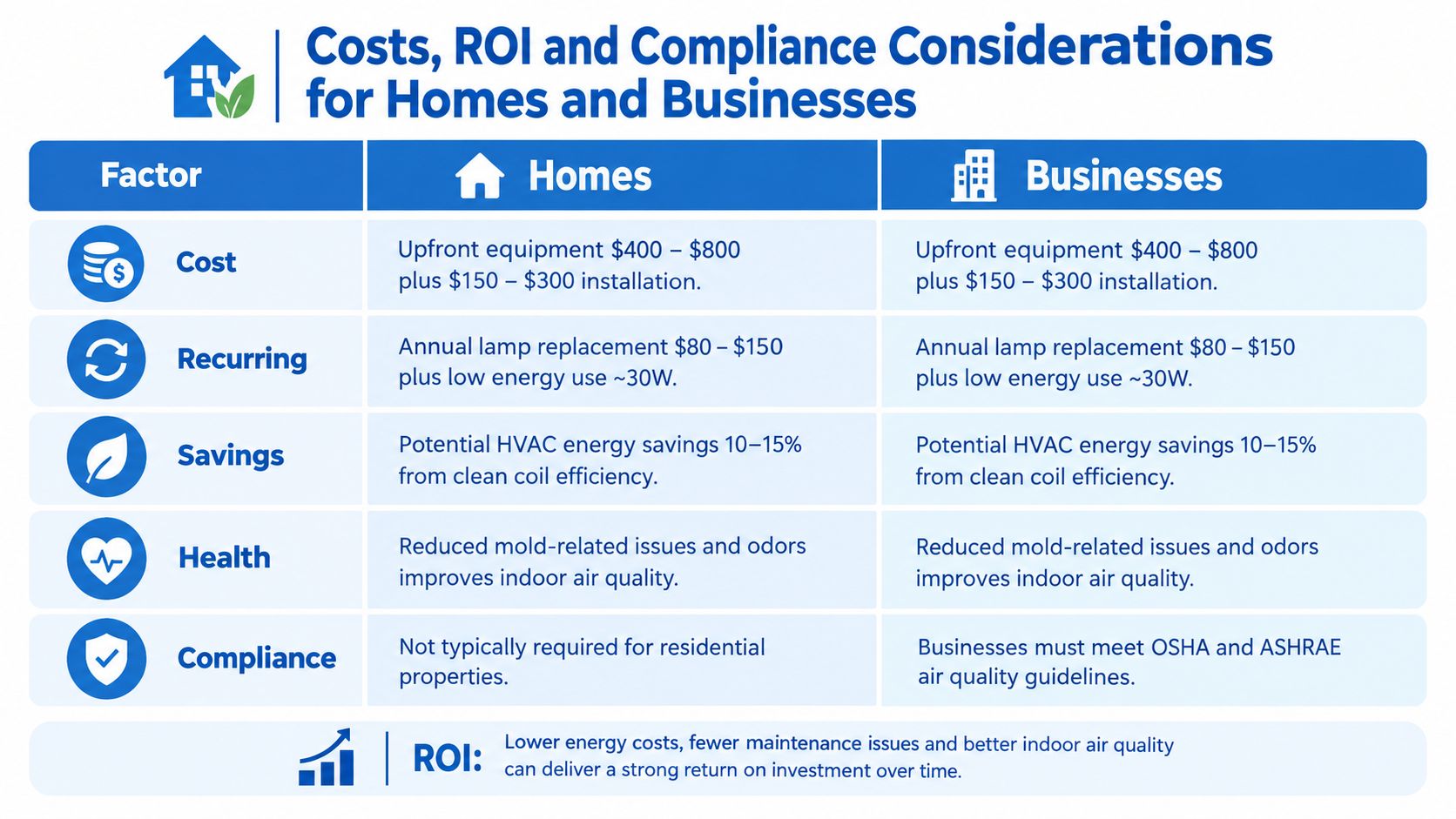
Homes and businesses judge value differently
In a home, the question is usually personal and practical. Does the system help with recurring HVAC odors, coil cleanliness, or peace of mind about the air-handling system? Homeowners tend to care most about whether they'll maintain it and whether it addresses the problem they feel every day.
In a business, the lens shifts. A salon, daycare, gym, clinic, or restaurant may care about occupant perception, maintenance documentation, and consistent operation across longer run hours. The owner also has more reason to think about service protocols and equipment verification rather than just purchase convenience.
Compliance matters more as risk rises
Commercial and institutional buyers should be more cautious than homeowners. Guidance around dose, verification, safety shutoffs, electrical checks, and lamp replacement matters more when a building serves the public or vulnerable occupants.
Mercury-vapor handling and disposal considerations may also matter depending on the lamp technology in use. That isn't a reason to avoid UV. It's a reason to ask better operational questions before buying.
A simple decision matrix helps:
| Buyer type | UV usually makes sense when | Main caution |
|---|---|---|
| Homeowner | Musty HVAC odors, coil hygiene concerns, layered air strategy | Don't expect dust removal |
| Small office | Shared air concerns and recurring system odors | Assign maintenance responsibility |
| Daycare or eldercare | Added hygiene focus in central HVAC | Verify safety and service procedures |
| Restaurant or salon | Odor and HVAC cleanliness concerns | Match system to operating schedule |
The return on investment is often clearest when the system solves a known HVAC-related problem. If the purchase is based on vague hope, disappointment becomes more likely.
Choosing Troubleshooting and Getting Support for Your System
A smart buying decision starts with one question: What am I trying to fix? If the answer is dust, start with filtration and housekeeping. If the answer is coil-related odor, wet-system hygiene, or adding a microbial-control layer inside central HVAC, duct UV belongs on the shortlist.
How to choose without getting lost in jargon
Use this simple filter before you buy:
- Primary complaint: Musty AC smell points more strongly toward coil-area UV than a general “I want cleaner air” goal.
- HVAC layout: A compact system with limited service access may narrow placement choices.
- Willingness to maintain: If no one will track lamp replacement, the system may underperform.
- Expectations: If you want particle capture, pair UV thinking with filtration, not instead of it.
One practical option in this category is the EcoQuest Purifiers HVAC-related lineup, which includes in-system and replacement-part pathways for people looking at integrated air-treatment setups rather than room-only devices.
Common problems after installation
Sometimes the lamp is installed and the homeowner still isn't happy. Usually the complaint falls into one of a few buckets.
- The odor is still there: The source may not be microbial, or the lamp may be aimed at the wrong area.
- The indicator says the unit is on, but results faded: Lamp output may have dropped with age even though the bulb still appears functional.
- Air feels the same as before: That can happen when the buyer expected dust reduction from a technology that doesn't filter dust.
- Reduced confidence after DIY attempts: UV service work needs careful shutdown and handling. Professional help matters here.
When to call a professional
Call an HVAC professional if the system needs relocation, if you suspect light leakage, if moisture problems persist around the coil, or if replacement timing is unclear. Also call if someone installed UV but never discussed exposure time, lamp replacement, or service interlocks. Those are not side issues. They're part of whether the system is doing its job.
The best final test is simple. If an installer can explain where the lamp goes, what problem that placement solves, and how you'll know it keeps working, you're probably having the right conversation.
EcoQuest Purifiers offers HVAC-integrated air treatment products, replacement UV lamps and RCI cells, and support for people trying to match the right equipment to a real indoor air problem. If you're comparing a UV air purifier in duct setup with other whole-home or room-based options, visit EcoQuest Purifiers to review available product categories and replacement parts.