
UV Light Air Purification System How It Works and Is It Safe
You're lying awake because the hallway smells stale again, one child's allergies have flared up, and the filter in the furnace is already doing all it can. That's usually when people start asking whether a UV light air purification system is the missing layer, or just another gadget that sounds scientific and still leaves dust on the shelf.
The short answer is that UV can help, but not in the way many product pages imply. It doesn't sweep dust out of the air, and it doesn't replace a good filter. It works as a disinfection layer, which means the question is whether your home needs help reducing airborne microbes, whether your system is designed for proper exposure, and whether the lamp can maintain its output over time.
Table of Contents
- Introduction to UV Light Air Purification for Healthier Homes
- How UV Light Air Purification Systems Work Inside Your Air
- How Effective UV Systems Are Against Airborne Microbes
- Choosing Between In-Duct and Standalone UV Installations
- Safety Considerations Around Ozone and UV Exposure
- Maintenance Lamp Replacement and Keeping Performance Strong
- How UV Compares to HEPA Carbon and Other Purification Technologies
Introduction to UV Light Air Purification for Healthier Homes
A family notices the same pattern every winter. The house feels closed in, cooking smells linger longer than they should, and the kids' noses seem to react to every bit of dust that gets stirred up. They already have a standard filter, so the next question isn't whether the air is moving. It's whether the air treatment they've got is addressing the part of the problem they care about.
That's where a UV light air purification system enters the conversation. People often hear about UV as if it were a universal fix, but UV light's usefulness is narrower and more targeted at the same time. UV light is meant to inactivate germs, not trap particles, so it fills a different role than a filter or a carbon bed.
This guide is for homeowners, renters, and small business owners who want a plain-language way to decide whether UV belongs in their setup. It also helps if you've already seen strong claims online and aren't sure which ones are tied to real indoor air science and which ones are just marketing.
Upper-room UVGI has been around for a long time, with early demonstrations dating back to the 1930s and later real-world use in hospitals and schools. That history matters because it shows the idea isn't new, but it doesn't mean every modern device performs the same way in a living room, hallway, or duct run. The details of dose, airflow, and installation make all the difference.
Why people start looking at UV
Don't go looking for UV because they love technical products. They start because something in the house feels unresolved. A filter may be catching visible dust, yet odors linger, or a family member keeps getting irritated in a space that seems clean on the surface.
UV can be worth understanding when the goal is to reduce microbial load in the air stream or on HVAC surfaces. It's less useful if the main problem is smoke, debris, or everyday particulate matter. Those are different jobs, and the wrong tool can leave buyers disappointed.
Practical rule: if your biggest complaint is dust or smoke, start with filtration. If your concern is disinfection, UV belongs in the conversation as a supporting layer.
How UV Light Air Purification Systems Work Inside Your Air
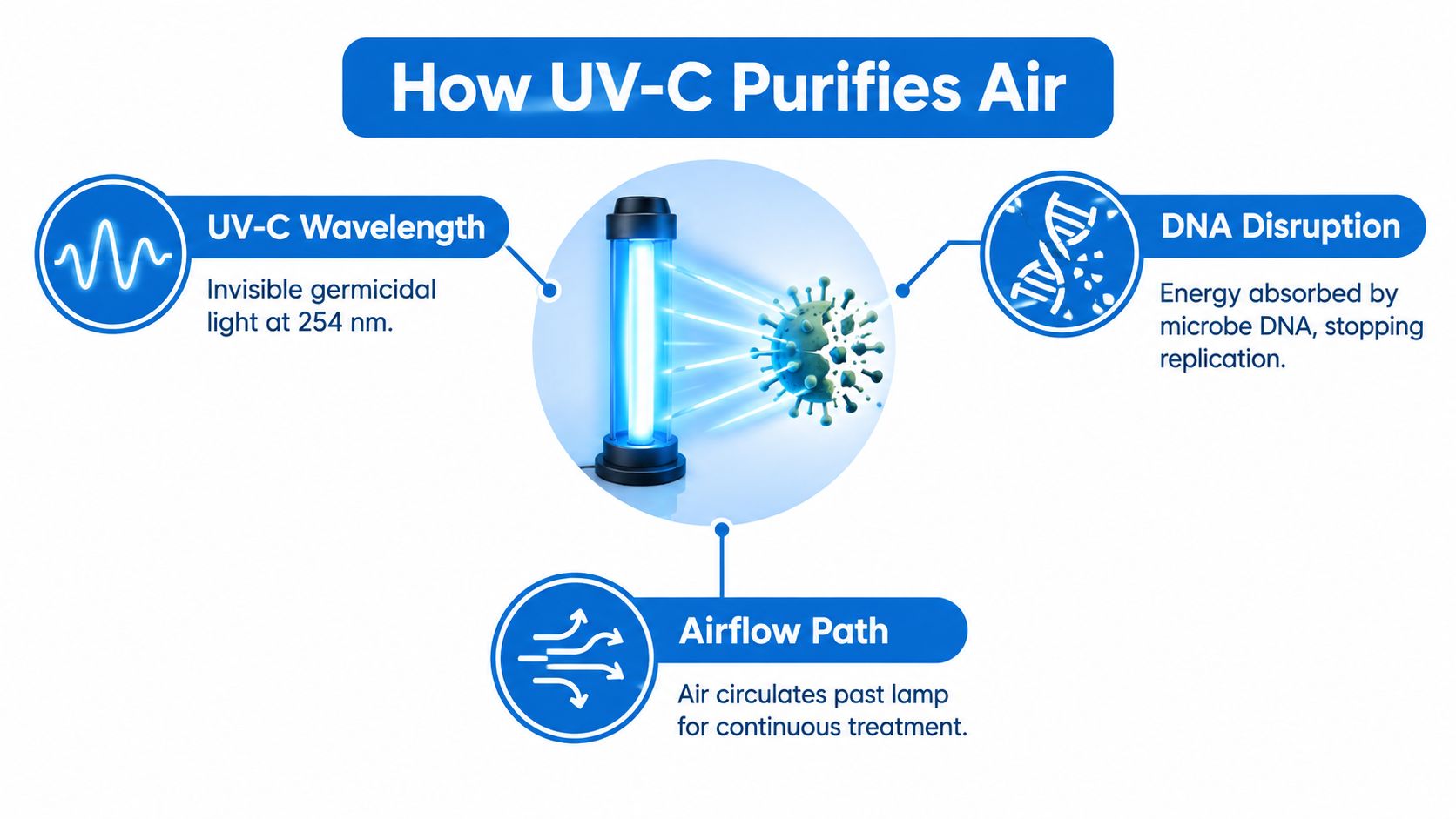
A family can have clean-looking rooms while microbes still move through the air. UV-C adds a disinfection layer by damaging the genetic material of bacteria, viruses, and other microbes. The process resembles sunlight fading a beach towel, except the target is DNA or RNA. Once the damage is sufficient, the microbe loses its ability to replicate normally.
What happens when air passes the lamp
A lamp does not disinfect every molecule that comes near it. Air must pass close enough to the lamp, remain in the treatment zone long enough, and receive enough UV energy. Exposure time, lamp intensity, and airflow speed therefore determine whether the system is actively treating air or producing light.
Upper-room UVGI provides a useful example. A 1936 Duke University hospital operating-room application demonstrated UVGI in occupied medical settings. A later review reported that a 1941 to 1942 Philadelphia school study found lower measles infection in classrooms equipped with UVGI than in control classrooms. These examples support the basic principle, while also showing why room design and air mixing matter.
A well-designed upper-room system typically uses average UV fluence rates of about 30 to 50 μW/cm² in the upper room. Performance can improve when room air circulates through that treated zone. A CDC-linked technical review also describes a practical sizing rule of roughly one 30 W fixture per 200 ft² of floor area. The lesson is straightforward: UV performance depends on geometry, airflow, and dose, not the presence of a lamp alone. CDC-linked technical review on upper-room UVGI design
Enclosed products apply the same principle inside a cabinet or duct. The airflow must move through the exposure zone at a speed that allows the lamp to deliver a meaningful dose. A unit such as Fresh Air Double Plus can combine UV with other media, while duct-integrated systems such as the Air Scrubber Induct 2000 treat air within the moving HVAC stream.
The practical decision is simple: use UV to address microbes, not dust. UV may inactivate organisms that pass through its treatment zone, but it does not capture particles. Dust, smoke, and debris still require filtration or another particle-removal layer.
Key concept: UV is a disinfection layer. Filtration is the particle-capturing layer.
How Effective UV Systems Are Against Airborne Microbes
Effectiveness is where the conversation gets more practical. A UV system isn't judged by whether it has a lamp inside. It's judged by whether the lamp delivers the right dose to the air that passes by it, and whether that dose stays consistent as the system runs.
Why the same technology can perform very differently
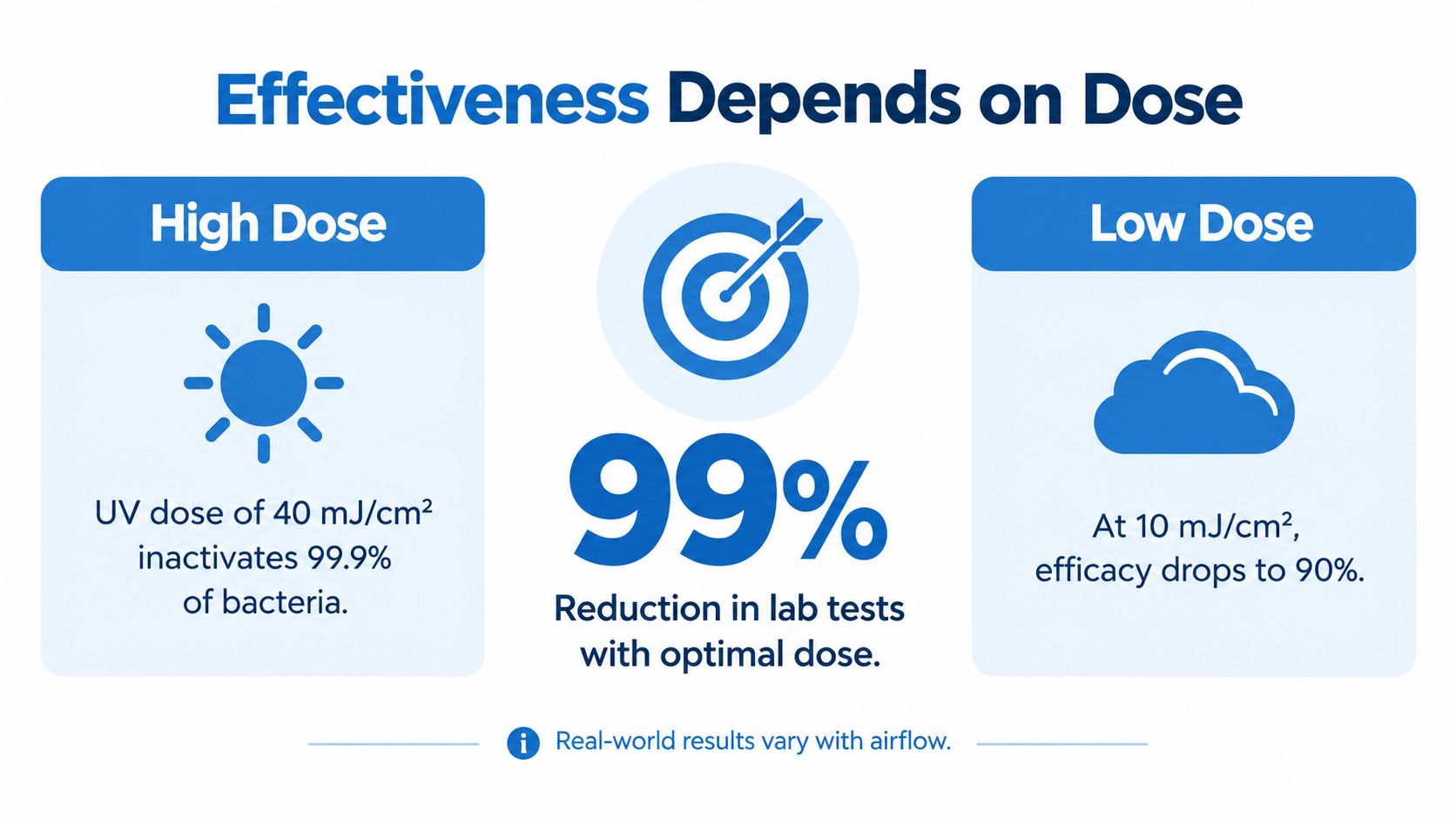
One peer-reviewed device study found a prototype that combined filtration and UV mitigated more than 99% of viable airborne bacteria between inlet and treated air, while UV-only modes ranged from about 79% mitigation at high flow to about 95% at low flow. The same literature also cites a commonly referenced 40 mJ/cm2 UV-C dose at 0.254 microns as being able to inactivate up to 99.99% of many airborne biocontaminants under controlled conditions. Peer-reviewed UV device study and dose discussion
Those numbers don't mean every home unit will do the same thing. They show how much dose and airflow matter. High air speed shortens exposure, and shorter exposure means the lamp has less time to do its job. Low speed can help, but only if the design still moves enough room air through the treatment zone.
For in-duct systems, published reviews report typical 90% inactivation doses of 2000 to 8000 μW·s/cm² for many bacteria and viruses. A systematic review of SARS-CoV-2 and SARS-CoV systems found an overall effective dose range of 2.47 to 423.42 J/m², and estimated that at least 4.64 J/m² for SARS-CoV-2 and 5.84 J/m² for SARS-CoV are needed for 90% inactivation. Review of in-duct UVGI dosing and SARS-CoV-2 estimates
What to ask before you trust a claim
A good provider should be able to explain the lamp placement, the expected airflow path, and how the system delivers enough exposure time. If they can't explain those pieces, the claim is just a slogan. That's especially true in homes where supply ducts, return ducts, and room mixing are all different.
Ask this first: how is the dose verified in real airflow, not just under lab conditions?
The easiest mistake is assuming a higher-watt lamp automatically means better air treatment. It doesn't. The useful question is whether the lamp, the housing, and the air path were designed together.
The video below reinforces that point
Choosing Between In-Duct and Standalone UV Installations
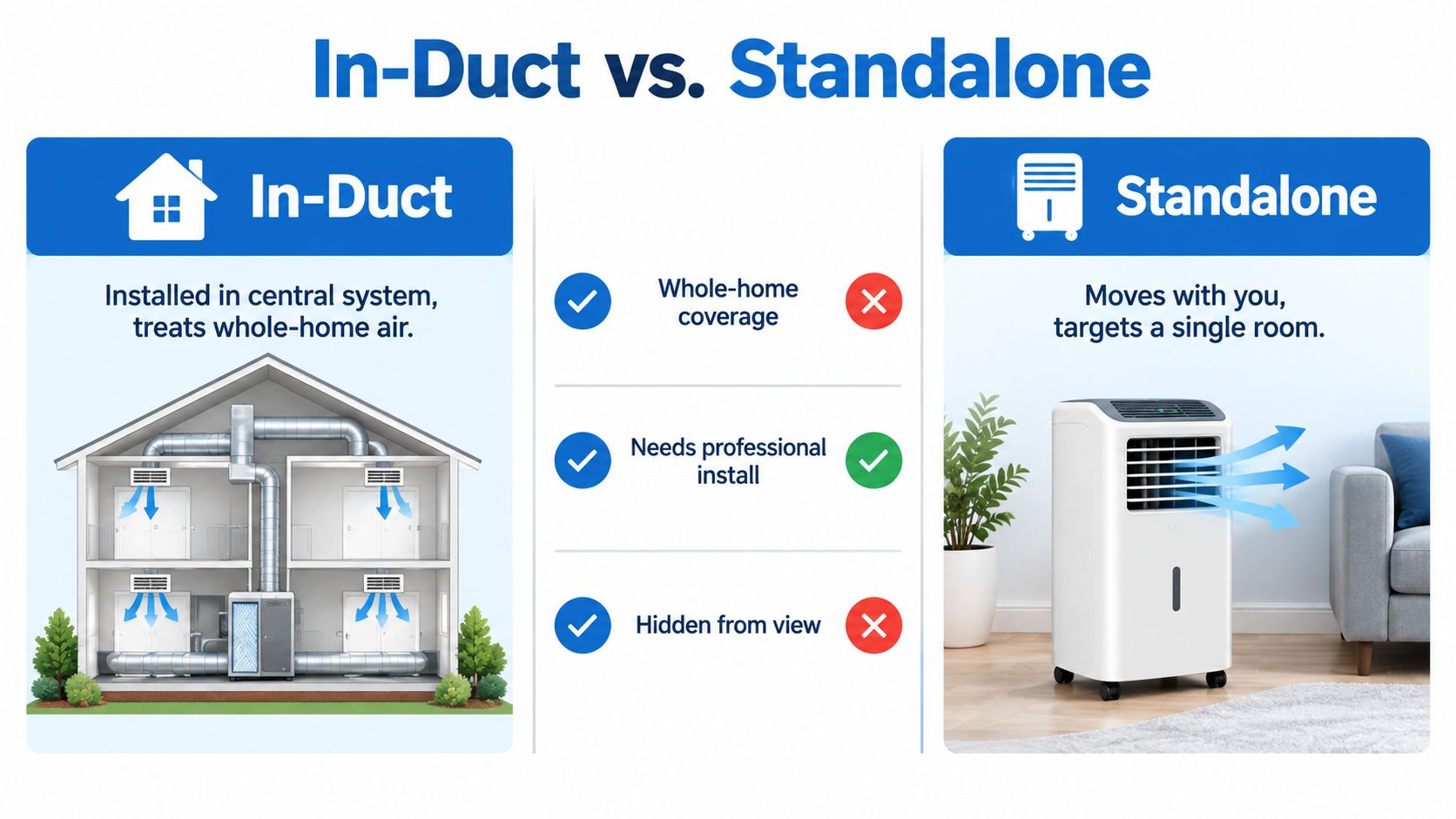
A family room with central HVAC and a ductless rental need different UV solutions. In-duct systems treat air inside the HVAC path as it circulates. Standalone and upper-room units work in one room or an open area, so placement is easier but coverage is narrower.
Match the installation to the air path
A homeowner with central HVAC may choose in-duct UV for broader circulation. The lamp becomes a disinfection layer within the existing air path, rather than a dust filter. It cannot remove settled particles, and it cannot treat rooms that receive little or no conditioned airflow.
A renter or small office without duct access may have a better fit with a standalone or upper-room unit. These systems avoid major HVAC work and focus treatment where people spend time. Their results still depend on room mixing, airflow, lamp output, and the time microbes remain in the treatment zone.
| Feature | In-Duct UV System | Standalone or Upper-Room Unit |
|---|---|---|
| Coverage | Whole-home air path | One room or localized space |
| Install | Usually professional | Often simpler to place |
| Visibility | Hidden inside HVAC | Visible in the room |
| Best for | Central systems and repeated circulation | Flexible rooms and smaller spaces |
| Main limitation | Depends on duct layout and airflow | Does not treat the whole house at once |
If you're already thinking about HVAC airflow, ensure ducts are clean and unobstructed before adding UV, because performance depends on how open the air path stays. A lamp cannot compensate for a restricted or poorly circulating duct run.
A product such as Living Air Classic XL-15 Air Purifier represents a different room-based approach. It is described as a filterless air purifier using ionization and activated oxygen technology for homes, offices, and other indoor environments. That places it closer to a standalone air treatment device than to an in-duct UV add-on.
Decision shortcut: choose in-duct UV when central HVAC repeatedly circulates air through a suitable treatment zone. Choose a standalone or upper-room design when treatment is needed in one room or duct access is unavailable. Before buying, ask how the unit maintains dose as airflow changes and as the lamp ages. A higher lamp rating alone does not prove better disinfection.
Safety Considerations Around Ozone and UV Exposure
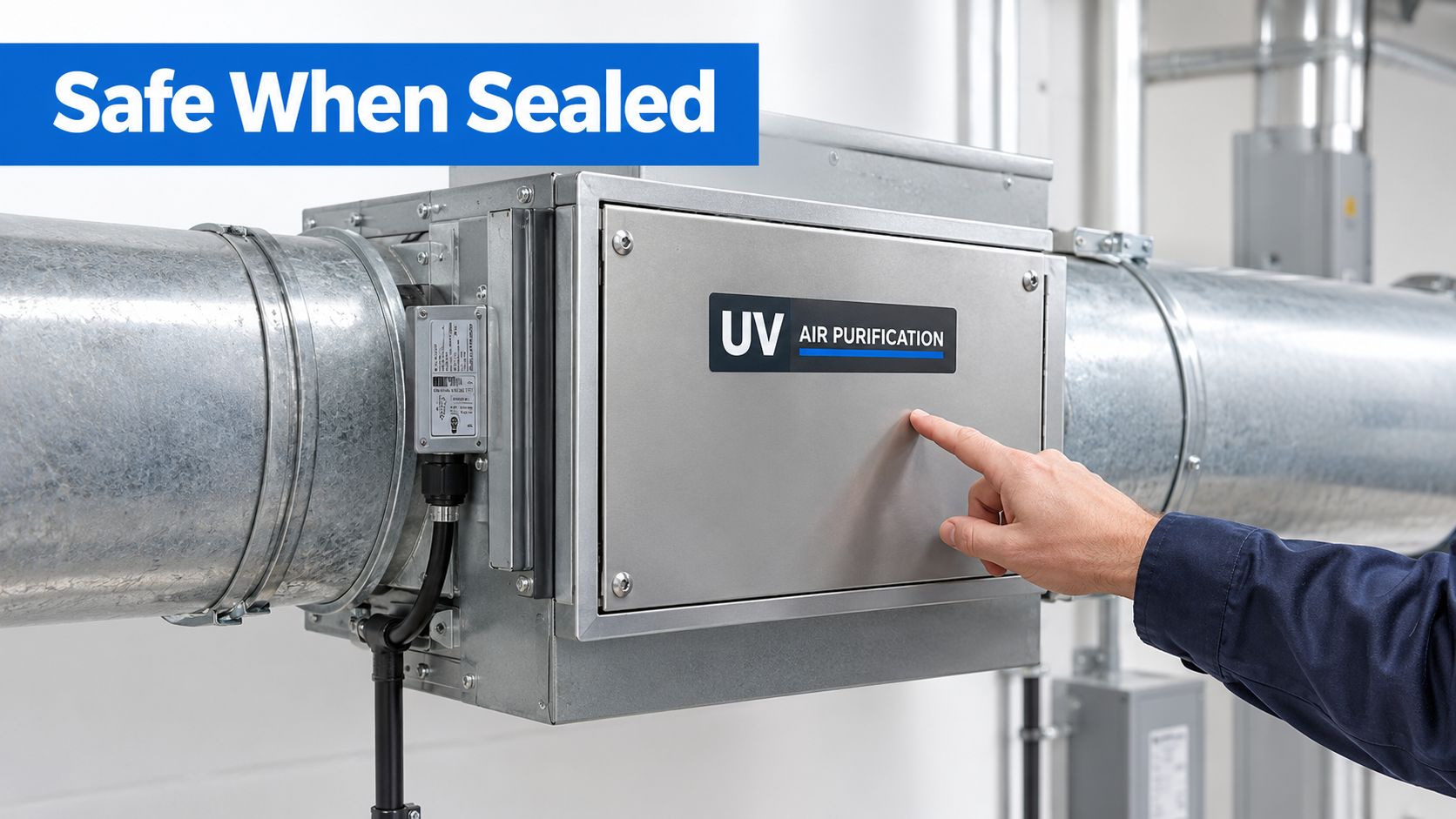
People usually ask two safety questions right away. Will the UV light leak into the room, and will the system make ozone? Those concerns are reasonable, but they're not the same problem, and the answer depends on whether the lamp is enclosed, how the unit is built, and whether the product is used as intended.
Enclosed UV is different from exposed UV
A properly enclosed germicidal UV lamp is designed so occupants aren't exposed to the light during normal use. That's the whole point of putting the lamp inside a cabinet, duct, or upper-room setup instead of leaving it open in the living space. The risk comes when a system is poorly designed, poorly installed, or serviced without care.
Ozone is a separate topic. Some devices use ozone intentionally, while UV systems themselves vary by design and lamp type. The safe move is to verify what the unit produces, not assume every UV product is the same. If a product combines ozone and UV, you should understand that it's addressing a different set of air-quality goals than a simple enclosed disinfecting lamp.
The line between “safe” and “not safe” usually comes down to use conditions, not the existence of UV itself. Occupied spaces need enclosed treatment paths, correct installation, and enough ventilation to avoid unintended exposure. That's why professional setup matters more than flashy spec sheets.
What to verify before buying
- Enclosure design: the lamp should stay isolated from normal room exposure.
- Use case: disinfection is not the same as odor treatment or particle removal.
- Ventilation path: air needs a route through the treated zone, not around it.
- Maintenance access: if a system is hard to service, output often falls off in practice.
- Lamp type: confirm whether the product is UV-only or part of a broader technology package.
The internal chemistry and lamp behavior matter more than the badge on the front. If you're evaluating a device that includes ozone generation, the EcoQuest ozone generators page is a reminder to separate products built for disinfection support from products meant to address strong odor situations.
Safety starts with the housing, not the marketing.
Maintenance Lamp Replacement and Keeping Performance Strong
A UV lamp can still glow and still underperform. That's the trap many buyers miss. UV treatment is about delivered dose, so any drop in lamp output, any buildup on nearby surfaces, or any change in airflow can weaken the result even when the system appears to be running normally.
What changes over time
Independent HVAC guidance notes that UV bulbs commonly last about 1 to 5 years depending on the brand and configuration, and whole-home systems may need periodic replacement to maintain output. Trane's UV light HVAC guidance That means ownership is not a “set it and forget it” purchase. It's more like a water filter, except the thing you're tracking is light output, not clogging alone.
Dust on nearby coils and components also matters because a dirty surface blocks light and can lower effective disinfection. Faster airflow can have the same effect by shortening exposure time. The result is predictable, the lamp may still look active while the actual dose has slipped below what you expected.
The maintenance habit is simple. Replace lamps on schedule, clean the surrounding surfaces during HVAC service, and confirm that the system still matches the airflow conditions it was designed for. If the house has had major duct changes, filter changes, or fan-speed changes, reassessing the setup is smarter than assuming last year's performance still holds.
A practical ownership rhythm
- Check the lamp age when you change seasonal HVAC settings.
- Inspect for dust or coil buildup during routine service.
- Replace worn UV components before output fades far enough to matter.
- Keep records so you know when the last replacement happened.
EcoQuest's RCI cells and UV lamps replacement page fits naturally into that maintenance mindset because it points to the part of the system that wears out. The key lesson is that performance isn't just about installation, it's about keeping the dose strong enough after months of use.
How UV Compares to HEPA Carbon and Other Purification Technologies
A family notices two different problems after moving into a new home: dust settles on furniture, while a musty odor remains after cleaning. A UV system addresses neither problem directly. Its role is microbial inactivation, so the right choice depends on what is affecting the air.
HEPA filters work like a fine mesh, trapping airborne particles such as dust, many allergens, and smoke-related particulate matter. They are the better fit when particle readings, visible dust, or allergy symptoms drive the purchase. UV does not replace that capture step. Carbon or charcoal media target odors and some gases, making them more suitable when smells or chemical vapors persist after reasonable ventilation.
A simple decision matrix helps:
- Choose HEPA when PM2.5, dust, smoke, or allergens are the main complaint.
- Choose carbon when odors or some VOC-related concerns remain.
- Choose UV when microbial inactivation is the goal and air can pass through a well-mixed, adequately dosed treatment zone.
- Combine technologies when the home has more than one problem and each layer has a defined job.
UV performance still depends on the conditions inside that treatment zone. A lamp with reduced output, airflow that moves too quickly, or poor mixing can lower the delivered dose. A unit may therefore include UV while providing limited real-world microbial control. Review lamp age, airflow, and installation design rather than judging the system by its product label alone.
Ionization and photocatalytic or RCI-style technologies add other approaches, but their usefulness depends on the specific design and application. Layered products such as Fresh Air Double Plus combine multiple methods, while a simpler filter-first setup may suit a home focused mainly on particles.
The HVAC path also matters. Duct buildup, leaks, or restricted airflow can undermine any added treatment, so a Greater Vancouver duct cleaning guide may help homeowners identify conditions that should be addressed first.
The practical rule is simple: match the pollutant to the tool, then confirm that the equipment can perform under actual airflow and maintenance conditions. For UV, that means treating it as a targeted microbial-control layer, not a universal purifier. EcoQuest Purifiers offers systems, replacement parts, and options that pair UV with other purification methods.