
Whole House Air Purifier for HVAC System: The 2026 Guide
You've changed the furnace filter, vacuumed the registers, and still find dust on the furniture. Maybe a persistent odor returns every time the blower starts. A contractor then recommends a whole-house air purifier for your HVAC system, but the product brochure focuses on particle ratings and technology names, not whether your blower, filter cabinet, and ductwork can support it.
That distinction matters. A properly selected purifier can improve particle control throughout ducted rooms. A poorly sized unit can restrict airflow, encourage unfiltered bypass, increase equipment strain, or sit unused because maintenance is difficult. The right purchase starts with the HVAC system, not the purifier catalog.
Table of Contents
- What Whole-House Air Purifiers Actually Do
- Core Purification Technologies Explained
- Sizing and Compatibility with Your HVAC
- Installation and Maintenance Considerations
- The Performance Versus Airflow Tradeoff
- How to Choose the Right System for Your Space
What Whole-House Air Purifiers Actually Do
A homeowner with pet odor and visible dust often expects a duct-mounted purifier to solve everything immediately. The device is installed near the air handler, the system runs, and the air should come out clean. In practice, the purifier only treats the air that reaches it, and it can only perform as well as the airflow path allows.
A central system pulls room air through return ducts, sends it through a filter or purification chamber, and pushes the treated air back through supply ducts. Unlike a portable purifier, which serves a defined room, a whole-house unit can treat recirculated air moving through the central HVAC network. That makes it useful for homes where the blower serves multiple rooms, provided the fan runs often enough and the filter housing seals properly.
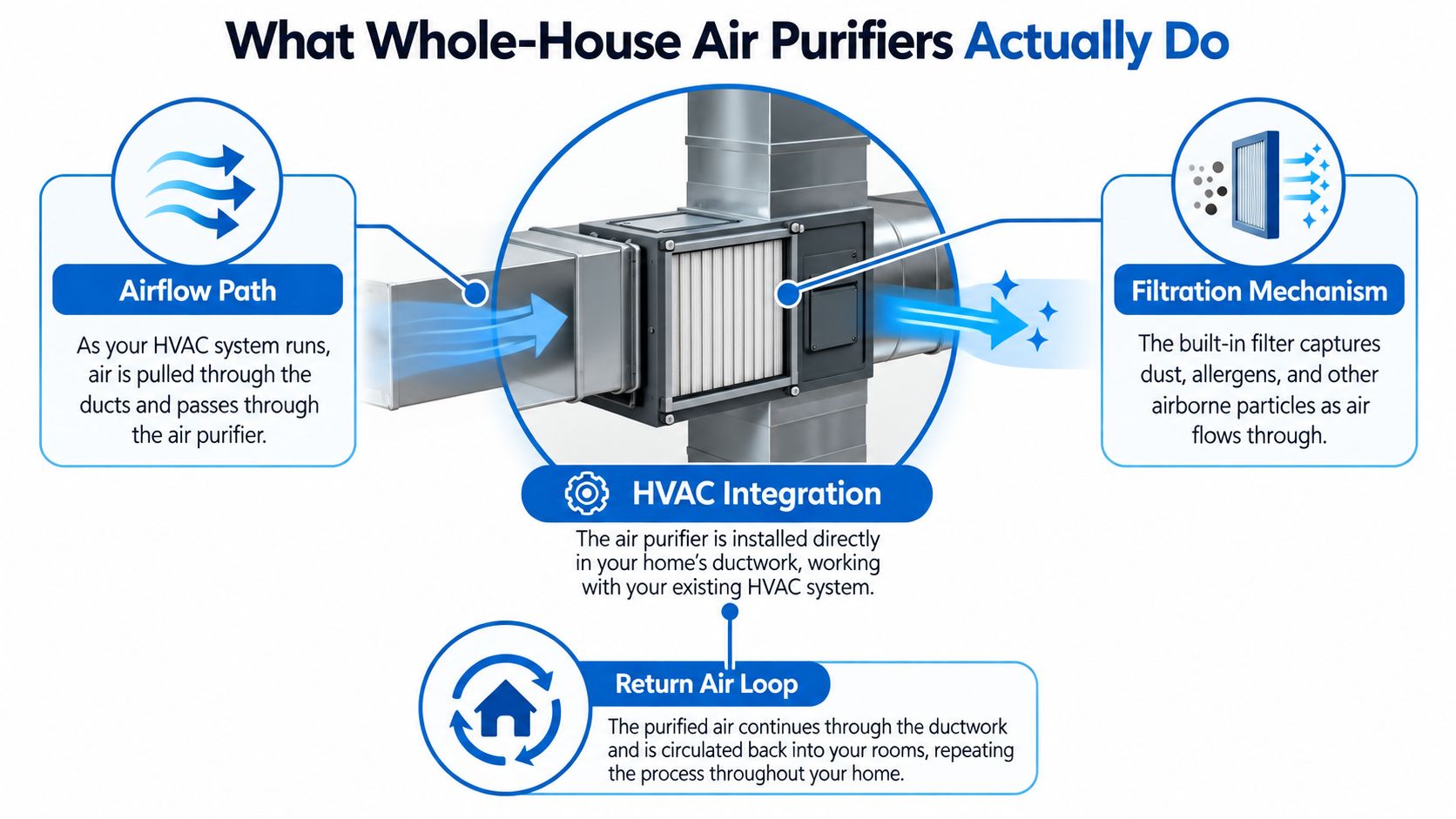
Recirculation is not ventilation
A purifier in the return or supply path doesn't automatically bring fresh outdoor air indoors. It repeatedly cleans some of the air already inside the building. That distinction is important in tightly constructed homes, rooms with stale odors, and spaces affected by combustion or chemical sources.
The U.S. Environmental Protection Agency's indoor-air reference material reports that indoor pollutant concentrations are commonly two to five times higher than outdoor levels and can occasionally exceed outdoor concentrations by more than 100 times. The same material describes typical home air exchange at approximately 0.7 to 1.0 air changes per hour. Those conditions explain why filtration helps, but they don't make filtration a substitute for source control or suitable ventilation.
If cooking produces smoke, fix the range hood and operating habits. If moisture supports mold, address the moisture. If radon is a concern, test and mitigate it with a radon-specific approach. EPA materials have historically identified high radon levels as a significant residential concern, and ordinary HVAC filtration isn't a radon mitigation system.
Practical rule: Treat whole-house purification as one layer of an indoor-air plan, alongside source control, ventilation, filtration, and contaminant-specific mitigation.
Whole-house versus portable cleaning
A portable unit can deliver concentrated cleaning in a bedroom or office and may be the better answer when the central fan rarely runs. A duct-integrated purifier can reach several connected rooms, but it depends on central airflow, balanced returns, and adequate blower runtime.
For broader guidance on reducing indoor pollutants while controlling household energy use, this resource on energy-efficient home air quality offers useful context. The practical takeaway is simple: don't judge a whole-house unit by its label alone. Confirm what air it treats, how often it treats it, and whether contaminants can bypass the treatment chamber.
Core Purification Technologies Explained
Different technologies address different pollutant categories. Mechanical filtration is primarily a particle-control method. UV, photocatalytic oxidation, ionization, and ozone-related systems use other mechanisms, and their claims shouldn't be treated as interchangeable.
Mechanical filtration
A pleated media filter captures particles as air passes through its fibers. More media area usually gives the system more surface for collection, while a sealed cabinet helps prevent air from traveling around the filter. This approach is the clearest choice for dust, pollen, pet dander, and other airborne particles, assuming the filter rating and airflow are appropriate for the equipment.
MERV is the recognized HVAC filter classification. ASHRAE Standard 52.2 introduced MERV in 1999, and the modern framework rates filters from MERV 1 through MERV 16 across particle bands of approximately 0.3 to 1.0 micrometers, 1.0 to 3.0 micrometers, and 3.0 to 10.0 micrometers. These ratings describe particle-size removal performance under standardized testing. They don't tell you whether a filter will fit your rack or overload your blower.
For replacement media and related components, review the filters, screens, and HEPA selection against your unit's dimensions and approved specifications. A filter that doesn't seat tightly can allow untreated air around the media.
UV and photocatalytic systems
UV equipment is intended to expose air or surfaces to ultraviolet energy. Its effectiveness depends on dose, exposure time, lamp condition, airflow, placement, and the target organism. A lamp installed in a fast-moving duct isn't automatically equivalent to a laboratory treatment chamber.
Photocatalytic oxidation, often called PCO, uses light and a catalytic surface to interact with certain compounds. Some products combine PCO with ionization or active oxygen generation. These systems may be selected for odor or gas-related goals, but buyers should request independent evidence for the exact pollutant, operating condition, and maintenance state being claimed.
The ActiveOx RCI PCO Cell with ozone is described in the catalog as an essential part of an air purifier, with replacement indicated when the UV light bulb burns out. That maintenance relationship matters because a technology's intended function can change as lamps age or cells become contaminated.
Ionization and ozone caution
Ionizers charge airborne particles so they can attach to surfaces or be collected by a dedicated surface. They may reduce suspended particles under suitable conditions, but they don't eliminate the need for effective capture, cleaning, or source control. Dust that settles on walls and furniture remains in the building unless someone removes it.
Ozone-producing equipment deserves separate scrutiny. EPA states that ozone has little effect on most indoor contaminants at concentrations that don't exceed public-health standards, while ozone itself can irritate the lungs. ASHRAE's 2024 position document advises against ozone-based air-cleaning devices in occupied spaces and recommends checking electrically powered air-cleaning equipment for ozone emissions under UL 2998 or an equivalent standard.
Ask for evidence covering:
- Particle capture: Look for a recognized efficiency or clean-air metric.
- Microbial claims: Confirm the organism, exposure conditions, and test method.
- Odor treatment: Identify whether the system adsorbs, oxidizes, or merely masks odor.
- By-products: Request ozone and other by-product information, not just removal claims.
- Maintenance: Check lamp, cell, filter, and sensor replacement requirements.
Sizing and Compatibility with Your HVAC
Square footage is a poor starting point for a duct-mounted purifier. The relevant questions are how much air the blower delivers, how much resistance the purifier adds, how large the filter surface is, and whether the cabinet fits the existing return-air path.
Particle capture and active purification also need different evaluation methods. A media filter can be compared through MERV performance, but the final result depends on airflow through the media and the time the system operates. An active device may require separate evidence for particles, microorganisms, odors, or chemical pollutants. One technology's test result can't stand in for another technology's missing data.
Compare the metrics that matter
MERV ratings provide a common language for particle filtration. MERV 13 captures at least 85% of particles in the 1 to 3 micrometer range, while MERV 14 captures at least 90% in that range, according to ASHRAE filtration guidance. The CDC recommends MERV 13, or the highest efficiency the system can accommodate without harmful performance effects.
Clean-air delivery depends on actual delivered airflow. The theoretical filtered-air change rate can be estimated with:
ACH = (Q × 60) / V
Here, Q is delivered airflow in CFM and V is room volume in cubic feet. For example, a 2,000 cubic-foot room receiving 400 CFM through a properly sealed MERV 13 filter has a theoretical filtered-air rate of 12 ACH, based on the calculation described in California's indoor ventilation and filtration guidance. Actual performance can be lower when the fan cycles intermittently, airflow is unbalanced, or air leaks around the filter.
Build a system-specific request
Before asking for a quote, gather the filter dimensions, air-handler model, available cabinet depth, fan settings, measured airflow, and allowable external static pressure. A useful overview of the components in a central system is available in this homeowner's AC system overview, but the final compatibility decision should come from measurements at the equipment.
The Living Air Classic XL-15 Air Purifier is described as a filterless purifier using ionization and activated oxygen technology to help reduce airborne particles, odors, and stale indoor air. That type of product should be evaluated differently from a deep-pleat media cabinet. Ask what pollutant the device is intended to address, whether it emits ozone, and how it interacts with occupied spaces and the HVAC fan.
Installation and Maintenance Considerations
Installation quality determines whether the purifier treats the airstream or merely sits beside it. The preferred location is generally a point where all relevant return air passes through the treatment chamber, with enough straight duct and service clearance for the filter, cell, lamp, and electrical components.
A technician should verify the following before cutting ductwork:
- Identify the airflow direction. Confirm whether the unit belongs in the return or supply path and follow the manufacturer's orientation requirements.
- Measure the opening. Compare the actual filter rack and duct dimensions with the purifier cabinet, not just the nominal filter size.
- Seal the housing. Use suitable gaskets and duct sealing so air can't flow around the media or through unplanned gaps.
- Protect service access. Leave room to remove filters, lamps, cells, and access panels without dismantling the duct.
- Check electrical requirements. Confirm voltage, controls, interlocks, and safe routing before commissioning.
- Record baseline operation. Measure airflow and static pressure before installation, then repeat the measurements afterward.
A narrow one-inch rack may not be suitable for a high-efficiency upgrade. A deeper media cabinet can provide more surface area and may reduce face velocity, but only if the return duct and cabinet can accommodate it. The installer should also inspect the blower compartment and coil. A purifier won't compensate for a damaged blower, blocked coil, disconnected return, or poorly balanced duct system.
Maintenance access is part of performance. Filters load with dust, UV lamps age, cells need replacement, and electronic surfaces can require cleaning. If servicing requires removing a large section of ductwork, maintenance will be delayed, and the unit's real-world performance will decline.
For an in-duct option, review the Living Air Air Scrubber Induct 2000 alongside the equipment layout rather than treating the product name as a sizing recommendation. The installer still needs to verify dimensions, airflow direction, power, access, and the device's intended operating conditions.
The Performance Versus Airflow Tradeoff
The most expensive purifier can't clean air that never passes through it. Every filter and duct-mounted device creates resistance, and higher-efficiency media generally creates more pressure drop. If the blower can't maintain the required airflow, the home may lose comfort while the equipment consumes more energy or experiences additional mechanical stress.
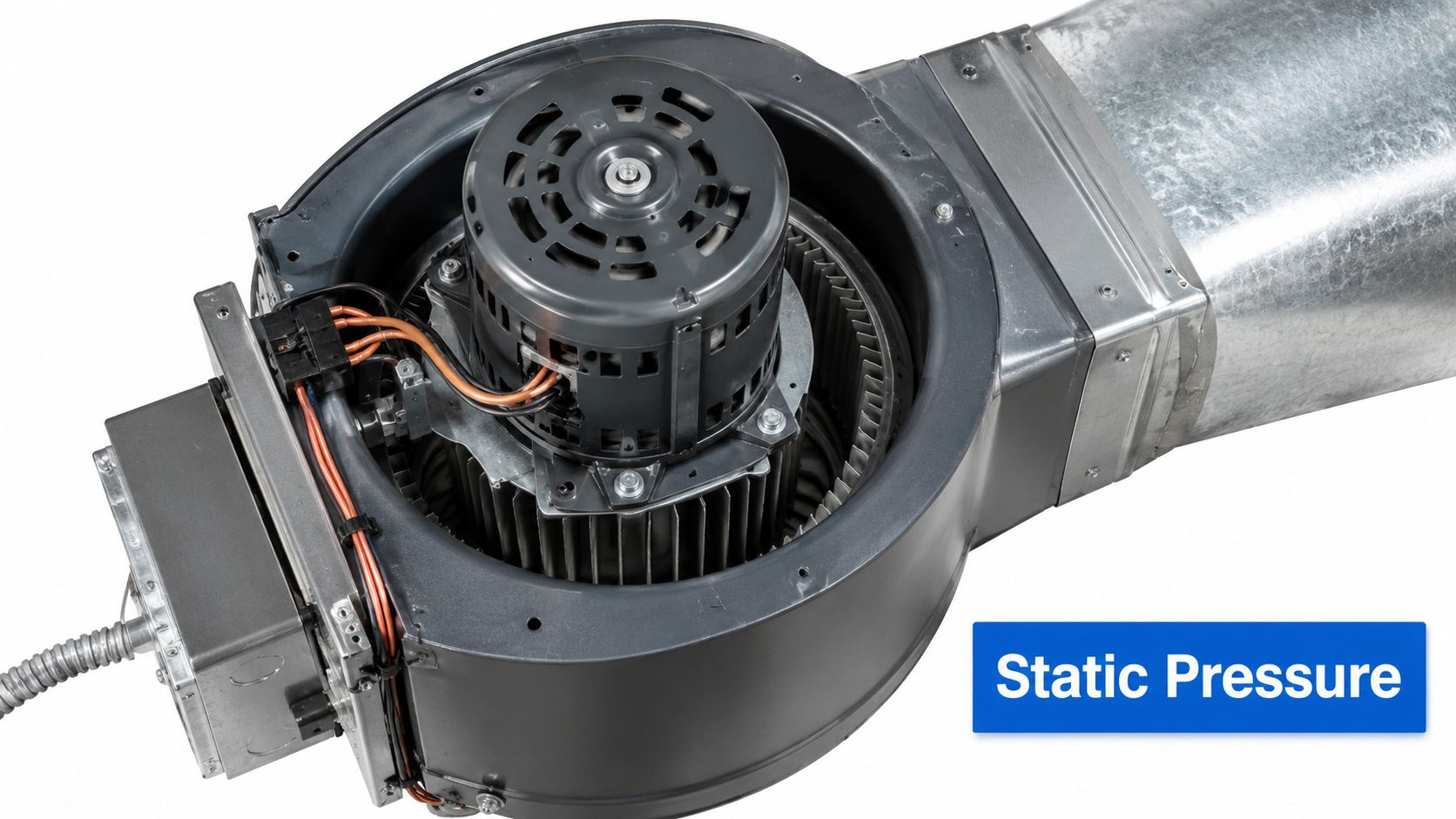
EPA data indicate that MERV 13 filters typically achieve at least 50% removal efficiency for the smallest tested particles, including particles near 0.3 to 1 micrometer, and are more effective against health-relevant PM2.5 than lower-rated filters. The same filtration guidance warns that higher efficiency generally increases pressure drop, so the rating must be matched to the system rather than selected in isolation.
Read the pressure story
External static pressure is the resistance measured across the operating system. A technician should measure it with the blower running and compare the result with the equipment's allowable limit. The key comparison is not just “old filter versus new filter.” It includes the filter, cabinet, coil, dampers, grilles, and ductwork together.
Symptoms of an airflow problem can include weak supply airflow, rooms that don't reach setpoint, unusual blower noise, extended heating or cooling operation, and a filter that loads quickly. These symptoms have multiple possible causes, so they need measurement rather than guesswork.
A tight, correctly sized lower-resistance filter is often more useful than a higher-rated filter with bypass gaps.
A deep or wider filter can reduce face velocity and pressure drop compared with a thin filter of the same MERV rating. EPA also notes that thicker or wider filters generally create less static pressure. That doesn't guarantee compatibility, because cabinet depth, duct dimensions, blower capacity, and installation quality still control the result.
Verify operation after installation
Ask the installer to document filter pressure drop, total external static pressure, airflow, and blower settings. Repeat those checks as the filter loads, because dust accumulation progressively increases resistance. Replace the media according to loading and manufacturer limits, not only a calendar reminder.
A basic indoor air monitor can help you observe changes in particulate conditions, but it isn't a substitute for HVAC measurements. The Living Air air quality monitor can be considered as part of a monitoring plan, while static-pressure testing remains the tool for protecting the blower and verifying airflow.
The CDC's combined-clean-air guidance recommends MERV 13, or the highest efficiency the equipment can accommodate, and describes a target of at least 5 clean-air changes per hour when feasible through ventilation, filtration, and supplemental cleaning. That target should be treated as a system-planning objective, not proof that a particular purifier delivers it in every home.
Use the video below as a visual introduction to HVAC airflow and blower considerations, then have a qualified technician measure your actual installation.
How to Choose the Right System for Your Space
Start with the pollutant, then test the HVAC fit.
For dust, pollen, pet dander, and fine particles, compare sealed mechanical systems using MERV performance, filter area, pressure drop, and delivered airflow. For odors or chemical pollutants, ask for evidence specific to the contaminant. For microbial concerns, review the exposure conditions, maintenance requirements, and any by-products associated with the technology. Don't assume a system designed for odor control provides equivalent particle filtration.
Your buying checklist should include:
- HVAC data: Equipment model, filter dimensions, cabinet depth, airflow, and allowable static pressure.
- Installation details: Sealed fit, correct airflow direction, electrical requirements, and service clearance.
- Operating pattern: Fan runtime, seasonal use, and whether the central system reaches every occupied room.
- Maintenance burden: Filter loading, lamp or cell replacement, cleaning access, and replacement instructions.
- Safety evidence: Ozone emissions, by-products, material effects, noise, and performance decline over time.
- Problem source: Radon, moisture, combustion, and strong chemical sources require measures beyond ordinary filtration.
EPA Indoor airPLUS guidance says higher-MERV filters should be paired with appropriately sized ducts and filter cabinets because excessive pressure drop can increase furnace runtime, motor wear, and energy consumption. That is the decision principle to carry into every quote: choose the highest useful performance your system can support, not the highest rating printed on a box.
EcoQuest Purifiers offers HVAC-integrated air-cleaning products, replacement cells, filters, monitors, and related indoor-air equipment for residential and professional settings. Review the available options at EcoQuest Purifiers, then confirm your blower capacity, static-pressure limits, filter dimensions, and maintenance plan before ordering.